

The rarest treasures in the high desert often hide in plain sight, masquerading under names that don't quite capture their true spirit. You may have asked yourself what makes White Buffalo stone jewelry so unique while admiring the striking stone pulled from the hills of Tonopah, Nevada. This rare stone is defined by its snowy face and deep, ink-like matrix. A matrix is the host rock that threads through the primary stone, creating the dark, web-like patterns seen in genuine pieces.
It's easy to feel overwhelmed by the sea of dyed howlite and magnesite imitations, but knowing what White Buffalo is and where it comes from is the first step toward finding a piece that resonates with your own story. In this guide, we'll explain how to identify a genuine, hand-cut cabochon, a stone shaped and polished into a smooth, rounded top rather than faceted. We'll also show the craftsmanship it takes to set these stones in .925 sterling silver bezels, the metal rim that secures a stone in its setting.
Key Takeaways
- Learn why White Buffalo is not turquoise, as it lacks the copper or iron required for blue and green pigments.
- Discover the specific origin of this stone in the Nevada desert near Tonopah, which remains the primary source for authentic material.
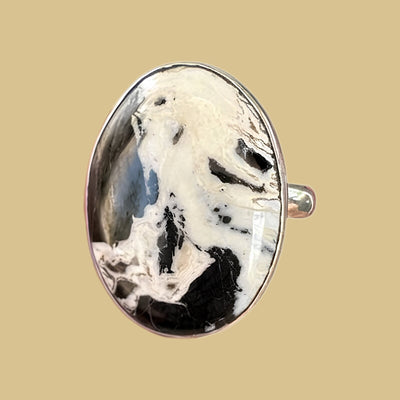
- Understand What Makes White Buffalo Stone Jewelry So Unique? by exploring the contrast between its stark white surface and the dark chert matrix patterns.
- Gain the knowledge needed to distinguish genuine stones from common imitations like dyed howlite or magnesite through careful visual inspection.
- Explore the artisanal process of creating hand-fabricated sterling silver (.925) settings that protect and highlight each one of a kind stone.
Why White Buffalo Is Not Turquoise
White Buffalo is not turquoise. Turquoise relies on copper or iron for its vibrant hues, and White Buffalo has neither, which is why it stays stark white. It turns up in turquoise country, in very limited quantities.
To understand what makes White Buffalo stone jewelry so unique, we have to look at the chemistry beneath the surface. True turquoise is a hydrous phosphate of copper and aluminum. When you look at the chemical formula of turquoise, the presence of copper results in blue tones, while iron introduces the greens we often see in traditional Southwestern style pieces. White Buffalo lacks these metals entirely. Because it grew in the same mineral veins as turquoise but without the coloring agents, it developed a clean, bone-white body that contrasts beautifully against its dark host rock.
Why it is Frequently Called White Turquoise
The term "white turquoise" is a trade name that stuck because White Buffalo turns up in turquoise country and looks like turquoise with the color taken out. The matrix, the host rock that threads through the stone, creates the same dark, web-like patterns you see in good turquoise. But they are different stones, and both look stunning set in White Buffalo Jewelry. The name White Buffalo points to rarity, since a white buffalo is famously rare. Ours comes from our family's claim at the White Buffalo mine near Tonopah, Nevada.
Hardness and How We Cut It
Without copper, nothing in the stone produces blue or green, which leaves the signature white color. White Buffalo has a Mohs hardness ranging from 3.5 to 6, which is quite similar to the turquoise we work with in the studio. This hardness allows us to hand-cut the stone into a smooth cabochon, which is a gemstone that has been shaped and polished rather than faceted. We then secure these stones in a sterling silver (.925) bezel, which is the metal rim that wraps around the edge of the stone to hold it in place. Good material is only found in small, localized pockets.
The Rare Geological Origin in the Nevada Desert
Genuine White Buffalo comes from the White Buffalo mine near Tonopah, Nevada, where our family holds a claim. That small footprint is why authentic material stays scarce and valued by collectors of Southwestern jewelry.
The story of this stone is inseparable from the high desert near Tonopah. Turquoise turns up in pockets all over the world. Good White Buffalo comes from a few thin veins in one small area. Our family holds a claim there, and the White Buffalo we cut ourselves comes from it. That limited supply is a big part of What Makes White Buffalo Stone Jewelry So Unique? When a vein runs out, no more of that exact material comes out of the ground.
Mining Conditions and Scarcity
Extracting high-grade White Buffalo is a labor of patience and physical endurance. The Nevada high desert presents a harsh environment where miners must contend with shifting temperatures and rugged, unforgiving terrain. Mining is often a seasonal endeavor, as the winter snows and summer heat can make the work nearly impossible for months at a time. Because the stone is found in small, localized pockets rather than massive deposits, only a fraction of what is mined is considered jewelry grade. This scarcity means that finding a stone with a clear, white body and a well-defined matrix requires sorting through a vast amount of raw material. We often spend hours looking for the right piece to hand-cut into a cabochon for our studio work.
Documenting Stone Origins
For the intentional collector, knowing where a stone came from matters as much as how it looks. We name the source on the White Buffalo we cut ourselves, so you know it is a genuine Nevada stone and not an imitation. You can learn more on our stone origins page, which covers the journey from the earth to the bench. If you are ready to add a piece to your collection, browse our artisan-made collection of hand-selected stones.
Because good White Buffalo is scarce, each piece we make is a finite piece of desert history. Explore our current selection of White Buffalo stone jewelry to find a hand-cut cabochon that speaks to you.
Identifying the Visual Characteristics of a High Quality Matrix
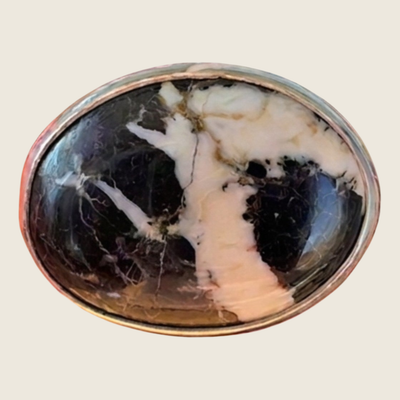
A high quality matrix is defined by a sharp, deliberate contrast between the stark white stone and the dark chert inclusions that thread through the stone. The matrix is the host rock that remains within the primary mineral as it forms, creating the unique patterns that distinguish one piece from the next. When we evaluate What Makes White Buffalo Stone Jewelry So Unique?, we often find the answer in the specific aesthetic of the chert. Chert is a hard, dense sedimentary rock that creates the black or deep chocolate brown patterns characteristic of this material. In the finest specimens, this matrix is not just a random inclusion; it's a balanced composition that frames the white space.
The most sought-after pattern is known as spiderwebbing. Spiderwebbing is a fine, interconnected network of matrix lines that resembles a delicate web woven across the surface of the stone. This pattern is exceptionally rare because it requires the chert to have fractured and healed in a very specific, consistent way during the stone's formation. When evaluating the quality of a matrix, we look for several key markers:
- Color Contrast: A high-grade stone features a crisp, "clean" white without grey or yellow muddy tones.
- Matrix Definition: The chert should have sharp edges where it meets the white stone, indicating a solid, high-quality stone.
- Visual Balance: The pattern should feel intentional, even if it is naturally asymmetrical.
Spiderweb vs Blotchy Matrix Patterns
While every stone has its own narrative, the distribution of the matrix significantly impacts the visual balance of a piece of jewelry. Fine spiderweb patterns are generally considered the gold standard in the lapidary world because of their intricacy and rarity. These delicate lines allow the white stone to shine through while providing a complex visual texture. On the other hand, a blotchy matrix consists of larger, more concentrated areas of chert. While these pieces can be striking and bold, they often lack the rhythmic elegance of a webbed stone. Finding a perfectly symmetrical matrix in a hand-cut stone is nearly impossible, which is why we celebrate the organic asymmetry of these natural creations. Understanding these visual nuances helps collectors appreciate What Makes White Buffalo Stone Jewelry So Unique? beyond its famous name.
The Influence of the Cabochon Cut
The final appearance of the matrix depends heavily on the skill of the lapidary artist and their choice of the cabochon cut. A cabochon is a stone that has been shaped and polished into a smooth, domed surface rather than being cut with flat facets. This traditional Southwestern style is chosen specifically to showcase the natural patterns within the stone without the distraction of light refraction. When we approach a piece of rough material in our studio, we follow a stone-first philosophy. This means the matrix itself dictates where we make our cuts. We look for the "heart" of the stone, aiming to center the most compelling patterns within the hand-fabricated rings or artisan-made pendants we create. By carefully orienting the stone before it is hand-cut, the artist can ensure the final piece highlights the most evocative details of the Nevada desert.
How to Distinguish Genuine White Buffalo from Imitations
Distinguishing genuine White Buffalo from mass-produced imitations requires a keen eye for mineral texture and the depth of the host rock pattern. While the market is often flooded with treated materials, authentic stones possess a specific geological fingerprint that cannot be replicated by industrial dyes or paints.
Part of What Makes White Buffalo Stone Jewelry So Unique? is the organic way the chert matrix settles into the white stone. In a genuine stone, these dark lines are part of the rock's physical structure, showing subtle variations in tone under a jeweler's loupe. A jeweler's loupe is a small, handheld magnification tool used to inspect the fine details of a gemstone. Imitations often rely on surface-level treatments that lack this three-dimensional quality, appearing flat or unnaturally uniform. Understanding What Makes White Buffalo Stone Jewelry So Unique? means looking past the initial color and examining the weight and temperature of the piece in your hand.
Spotting Dyed Howlite and Magnesite
Howlite and magnesite are the most frequent stand-ins for genuine White Buffalo because they are naturally white or grey with dark veins. However, howlite is far more porous and soft, making it an ideal candidate for industrial dyeing processes. When looking at a suspect stone, check the deepest crevices of the matrix for "dye pooling," which appears as unnaturally dark or concentrated spots of color in the cracks. Genuine chert matrix is a separate mineral inclusion, not a liquid pigment. We also recommend evaluating the physical properties of the piece through a simple checklist:
- Temperature: Real stone feels cold to the initial touch and warms slowly in your hand.
- Weight: Genuine White Buffalo has a real density; if a piece feels unnaturally light, it may be a block material. Block material is a synthetic substitute made from crushed stone dust and resin.
- Surface Texture: Authentic stones have a subtle, waxy luster rather than a glass-like or chalky appearance.
At Wildflower, we follow a strict stone-first philosophy and exclude all dyed or treated materials from our workbench.
The Importance of Professional Settings
The quality of the metal work is often the first clue to the authenticity of the stone it holds. Artisan-made pieces featuring genuine White Buffalo are almost exclusively set in sterling silver (.925) or solid 14K gold. If you find a stone set in a mystery metal or a plated backing that feels flimsy, it's a significant red flag. A professional silversmith treats a rare stone with respect, using a hand-fabricated bezel to secure the cabochon. You can find more technical details on identifying high-quality materials in our authenticity guide. We believe the setting should be as honest and enduring as the stone it carries.
The integrity of a stone is only as good as the hands that set it. We invite you to explore our White Buffalo stone jewelry, where every hand-cut cabochon is secured in a custom sterling silver bezel designed to last a lifetime.

The Role of Traditional Southwestern Silversmithing
The final element in What Makes White Buffalo Stone Jewelry So Unique? is the intentional relationship between the stone and its hand-fabricated setting. In our Santa Fe studio, we don't use pre-cast molds or mass-produced components because every hand-cut cabochon possesses its own irregular geometry. Instead, we build each piece from the ground up, starting with a custom bezel. A bezel is the silver band that is carefully shaped to follow the exact perimeter of a specific stone, ensuring a precise and secure fit. By using sterling silver (.925), we provide a durable foundation that holds its value and develops a beautiful patina over time. Patina is the natural darkening or luster that silver acquires through age and wear, adding a layer of history to the piece.
This artisan-made approach honors the narrative of the Nevada desert. When a silversmith works with a rare stone, they aren't just creating a product; they are framing a geological story. The weight of the silver and the precision of the solder joints are markers of quality that you can feel when you hold a piece. This grounded craftsmanship is a core part of What Makes White Buffalo Stone Jewelry So Unique? as it ensures the jewelry is as enduring as the stone itself.
Bezel Settings and Decorative Borders
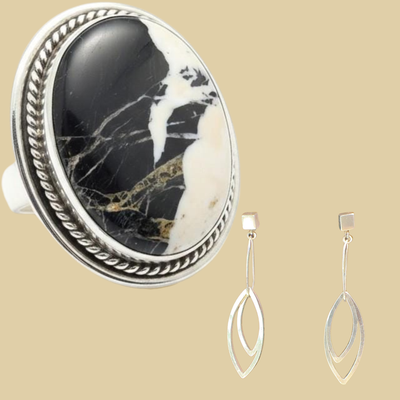
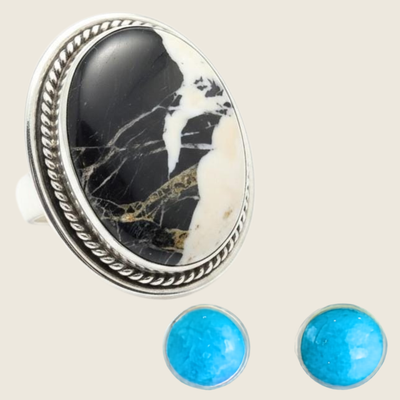
The choice of a bezel style can dramatically change the character of a piece. A plain bezel offers a clean look that lets the stark white stone take center stage. In contrast, a serrated bezel features small, decorative teeth that are pressed down over the edge of the stone for a more traditional texture. We often frame these settings with "rope" or "twist" wire, which is created by intertwining two strands of silver to create a rhythmic border. To make the white stone truly pop, we may use controlled oxidation in the recessed areas of the silver. Oxidation is a chemical process that darkens the metal, creating a high-contrast shadow that highlights the fine details of the stampwork or wire. You can see these techniques in action by exploring our silversmiths page.
Crafting One-of-a-Kind Artisan Pieces
Mass production relies on uniformity, but White Buffalo stone is defined by its beautiful asymmetry. Because no two matrix patterns are identical, a one-of-a-kind approach is the only way to truly respect the material. Supporting small studios and individual artists allows for a level of detail that big-box retailers simply cannot replicate. Each piece we create is a singular expression of a moment in the studio, where the artist listens to what the stone requires. This results in one-of-a-kind artisan pieces that feel intentional and personal. When you wear a piece of handcrafted jewelry, you are carrying the energy of the maker and the quiet history of the Nevada high desert.
Choosing a Piece of Nevada History
Finding a stone that speaks to you starts with understanding where it came from. From the white stone found near Tonopah to its deep black matrix, every detail tells a story of rarity. You've seen that What Makes White Buffalo Stone Jewelry So Unique? comes down to two things: a look nothing else quite matches, and a supply that is small and finite.
We believe in the quiet power of the handmade and the unwavering integrity of genuine materials. Every artisan-made design at Wildflower is finished with a hand-cut cabochon and a custom sterling silver (.925) bezel, always supported by detailed stone origin documentation to protect your investment. This ensures your chosen piece is a vessel for the natural, fleeting beauty of the Southwestern style that will endure for generations. We invite you to find the stone that resonates with your spirit.
Frequently Asked Questions
Is White Buffalo stone actually a type of turquoise?
White Buffalo is not turquoise. It is often sold under the trade name white turquoise, but it lacks the copper that gives turquoise its blue and green color. The name stuck because it comes from the same Nevada mining country and gets cut and set the same way.
Where is the authentic White Buffalo mine located?
White Buffalo comes from the White Buffalo mine near Tonopah, Nevada. Our family holds a claim there. If you see a similar white stone from somewhere else, it is likely a different mineral, such as howlite or magnesite. That tight origin is a big part of what makes White Buffalo stone jewelry so unique.
Why is White Buffalo jewelry so expensive compared to other stones?
The value of these pieces is driven by the extreme scarcity of the raw material and the labor required to process it. Because the mine output is so limited, finding jewelry grade stones is a rare occurrence. High demand for the stark white albino look, combined with the cost of hand-fabricating custom .925 sterling silver settings, reflects the stone's rarity. Each piece requires an artisan to build a custom bezel around the specific shape of the hand-cut cabochon.
How can you tell if White Buffalo jewelry is real or fake?
You can identify genuine stones by looking for a natural, non-repetitive matrix pattern that feels organic rather than printed. Real stones should be set in .925 sterling silver, so always look for that hallmark on the back of the piece. Be wary of stones that look too perfect or show dark dye pooling in the cracks, as these are signs of imitation howlite. Authentic White Buffalo has a subtle waxy luster that synthetic block materials simply cannot replicate.
What is the black pattern in White Buffalo stone called?
The dark patterns seen in the stone are composed of chert, which is a hard sedimentary rock. This material is referred to as the matrix, running through the white stone as it formed. What makes White Buffalo stone jewelry so unique is the high contrast between this dark chert and the white stone. These patterns are entirely natural, ensuring that no two hand-cut cabochons ever look exactly the same in our studio.

Article by
Kimberly Cordova
Kimberly Cordova is the founder and creative director of Wildflower Artisans, a handmade jewelry brand rooted in Santa Fe. Real turquoise, solid sterling silver, and a small line set in solid 14K gold. She built Wildflower around a simple belief: the best jewelry is the kind you actually reach for, not the kind you save for someday.
The collection is built three ways. Some pieces are made in-house, cut by her husband Greg from stones he sources himself, including rough from the family's King's Manassa Mine in Colorado and White Buffalo Mine in Nevada. Some are designed by Kimberly and fabricated by a trusted circle of Santa Fe silversmiths. And some are finished work she curates from artisan makers whose craft meets the same standard, because building a real collection means knowing when to make and when to look.
Turquoise leads, joined by White Buffalo, Wild Horse, Lapis Lazuli, Spiny Oyster, Black Onyx, Opal, and other genuine semi-precious stones. No shortcuts on the stone, the silver, or the story behind either.
Her writing covers everything she has learned along the way: how turquoise forms, how to tell natural from stabilized, what makes one mine different from another, how to read a bezel, and how to shop with confidence in a market that is not always straightforward. It is the kind of plainspoken information she wished someone had laid out for her when she was starting out.
Browse the collection at wildflowerartisans.com. Questions about a stone, a setting, or a specific piece are welcome any time.
0 comments