

A single pair of Zuni petit point cluster earrings represents dozens of hours of patient, manual labor that no machine can ever replicate. It's a common concern for collectors to feel a sense of hesitation when browsing, fearing that a beautiful blue stone might actually be dyed howlite or a piece of molded plastic. You deserve to feel certain that the jewelry you wear is a genuine reflection of Southwestern style and dedicated artistry. At Wildflower Artisans, we believe that understanding the process is the best way to protect your investment and honor the maker's skill.
In this guide, we will walk you through the technical nuances of this lapidary style, from the way a tiny stone is hand-cut into a teardrop shape to the precision required to set it into a sterling silver (.925) bezel. A bezel is the thin metal rim that wraps around a stone to secure it. You'll learn to distinguish between petit point and needle point styles while discovering how to identify a high-quality cluster setting. Wildflower wants you to have the tools to choose a pair of earrings that carries a story of tradition. Matrix patterns are the natural veins of host rock found within a stone. We'll explore these details to ensure your next discovery is authentic.
Key Takeaways
- Learn to distinguish Zuni petit point cluster earrings from needle point styles by observing whether the hand-cut stones are shaped into tiny ovals or thin slivers.
- Identify genuine Southwestern style artistry by looking for a sterling silver (.925) hallmark and checking for a precise stone fit within each hand-soldered bezel.
- Understand the labor involved in artisan-made cluster designs, which are built with a central focal stone and radiating rows of meticulously shaped gems.
- Protect your collection from dyed howlite or plastic imitations by learning to recognize the natural matrix and technical lapidary details found in authentic work.
- Preserve the beauty of your jewelry by avoiding moisture and ultrasonic cleaners, as these can loosen stones or damage the delicate settings of intricate cluster pieces.
Defining the Zuni Petit Point Lapidary Technique
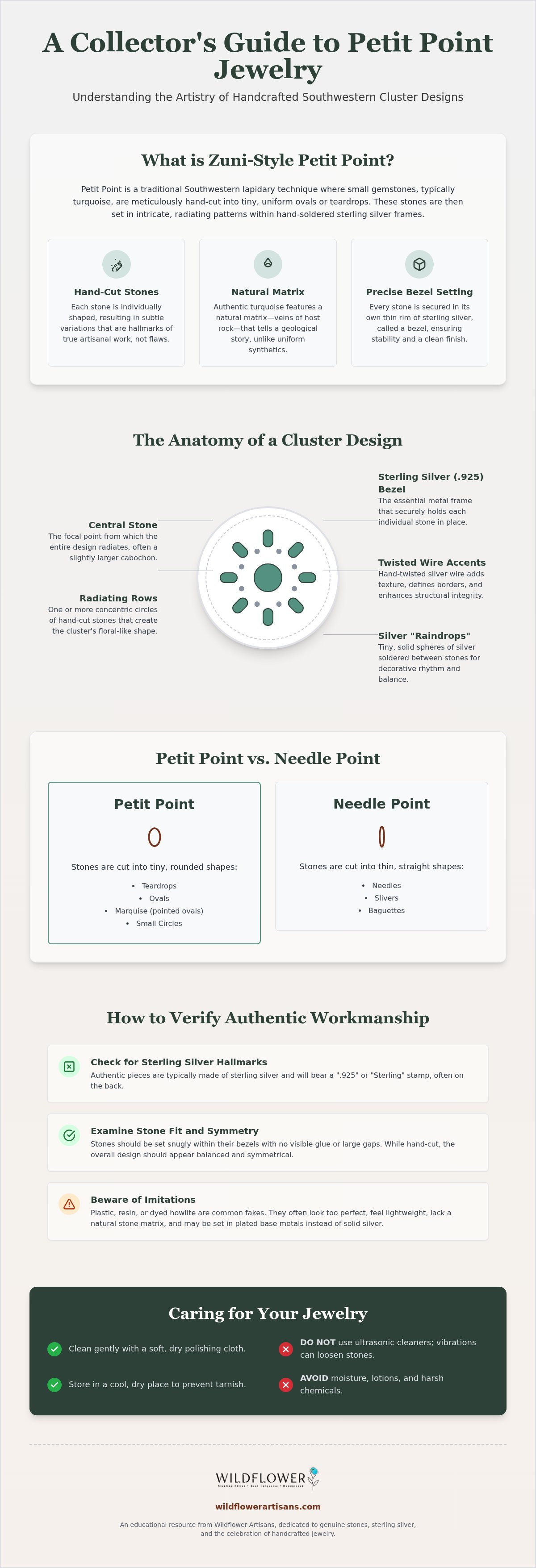
Petit point is a specific Southwestern style of lapidary work where stones are hand-cut into tiny, uniform ovals or teardrops to create intricate patterns. A cabochon is a stone that has been shaped and polished into a smooth, rounded form rather than being faceted like a diamond. Unlike mass-produced jewelry where stones are cast in molds, each stone in this style is individually shaped to fit a specific, hand-soldered silver frame. This technique grew out of the deep artistic roots of the Zuni people, whose history in the American Southwest is defined by a mastery of stonework that predates modern machinery. For generations, these artisans have refined the art of the cluster, turning raw turquoise into delicate, wearable mosaics. Authentic Zuni petit point cluster earrings are a testament to this legacy, requiring a level of patience that few outside the studio can fully grasp.
The Characteristics of Hand-Cut Stones
Hand-cut stones are distinguished by subtle, natural variations in their dimensions that reveal the human touch behind the jewelry. In an artisan-made piece, you might notice that one teardrop is a fraction of a millimeter wider than its neighbor, a hallmark of manual shaping. These variations aren't flaws. They're evidence of a soul at work. We also look for the matrix, which refers to the host rock remains that appear as delicate veins within the turquoise. Factory-produced stones often look suspiciously uniform, lacking the organic narrative found in natural material. These small differences are the fingerprints of authenticity that set Zuni petit point cluster earrings apart from high-street imitations.
Materials Used in Traditional Petit Point
True Southwestern style jewelry is built on a foundation of high-quality materials, specifically sterling silver (.925) and genuine gemstones. Sterling silver is an alloy containing 92.5 percent pure silver, providing the structural integrity needed to hold dozens of tiny bezels in place. A bezel is the thin metal rim that wraps around a stone to secure it. You won't find base metals or plated finishes in a working studio like Wildflower. We prioritize genuine turquoise because it retains the stone's natural character. While stabilized turquoise is a standard industry practice for durability, we strictly avoid the plastic-filled imitations that flood the mass market. Using authentic metals ensures the setting won't peel or irritate the skin over time.
The Anatomy of a Petit Point Cluster Design
Zuni petit point cluster earrings are meticulously constructed with a central stone surrounded by radiating rows of smaller, hand-cut gemstones. Each stone is individually secured within a sterling silver (.925) bezel to create a balanced, floral-like arrangement. This construction method allows for a high density of stones while maintaining a lightweight feel. You can find many examples of this delicate balance when you browse our artisan-made pieces in the studio.
The intricate geometry of these designs is a hallmark of Southwest Indigenous Jewelry traditions. Artisans don't just set stones; they create a silver landscape that protects and highlights the natural material. Beyond the stones themselves, the silverwork provides essential texture. Twisted silver wire often circles the central stone, acting as a visual border that also adds structural strength to the earring. This blend of utility and beauty is what makes the cluster style so enduring for those who value authentic craftsmanship.
Sterling Silver Wirework and Accents
The spaces between the hand-cut stones are rarely left empty. Artisans use "raindrops," which are small, solid spheres of sterling silver, to fill gaps and provide visual rhythm. Each raindrop is made by melting a tiny piece of silver wire until it balls up, then soldering it into place. Twisted wire accents are created by hand-spinning two strands of silver together to form a rope-like pattern. This detail adds a layer of artisanal sophistication that mass-produced jewelry simply cannot replicate with casting machines.
Symmetry and Balance in Artisan Jewelry
Achieving symmetry with organic materials is one of the greatest challenges in creating Zuni petit point cluster earrings. Since no two hand-cut stones are identical, the artist must select and arrange them by eye to ensure the pair looks balanced. Weight is another critical factor. A well-designed cluster earring should feel substantial without pulling on the earlobe. Dangle styles are popular for larger designs because they distribute weight through movement, while post styles offer a more stationary, flush fit against the ear.
The structural integrity of a cluster design relies on the quality of the silverwork and the precision of the stone setting. If you're looking for a piece that showcases this level of detail, explore our collection of turquoise dangle and drop earrings to find a pair that fits your personal style.
Petit Point vs Needle Point Earrings
While both styles showcase exceptional lapidary skill, the primary difference lies in the shape of the hand-cut stones: petit point uses tiny ovals or teardrops, whereas needle point features long, thin slivers. Choosing between them often comes down to the visual texture you prefer. Zuni petit point cluster earrings tend to feel more substantial and floral, while needle point offers a sharp, radiating elegance that feels almost architectural. Both techniques require the artisan to hand-cut each stone on a lapidary wheel, a process that demands immense focus to keep the dimensions consistent across a matching set.
To identify which style you're holding, look closely at the ends of the stones. Petit point stones are rounded or teardrop-shaped, giving the cluster a softer, more organic perimeter. Needle point stones are pointed at both ends, resembling a needle or a sliver of grain. When you are looking for authentic Zuni petit point cluster earrings, the stone shape is your most reliable clue. If you're ever unsure of the terminology we use in the studio, our turquoise glossary provides a deeper look at these technical distinctions.
Identifying Needle Point Precision
Needle point stones are cut into incredibly narrow, needle-like shapes that require a specialized touch to set. Because these stones are so thin, the silversmith must be extremely careful when tightening the sterling silver (.925) bezel around them. A burnishing tool is a smooth metal instrument used to rub and compress the silver rim until it holds the stone firmly. One wrong move with this tool can snap the turquoise sliver in half. This fragility is why needle point is often reserved for more delicate, lightweight designs that emphasize lines over bulk. It's a style that celebrates the absolute limit of how thin a stone can be cut while remaining structural.
The Visual Weight of Petit Point
Petit point stones have a larger surface area than needle point, which allows more of the stone's natural character to shine through. The rounded or teardrop shapes catch the light differently, often creating a more luminous effect in a cluster setting. This extra width makes petit point the preferred choice for larger, more complex cluster patterns where the stones need to fill a specific geometric space. Since the stones are slightly wider, you can often see more of the matrix, or the host rock remains, which adds to the unique narrative of each earring. This visual weight makes them a perfect choice for those who want their jewelry to make a clear, grounded statement of Southwestern style.
How to Verify Authentic Workmanship
Verifying the quality of Zuni petit point cluster earrings involves a close inspection of the stone settings and the silver hallmarks on the reverse side. Authentic artisan-made pieces will show precise hand-cutting and a secure fit within every individual bezel.
Look for the .925 stamp on the back of the earring to confirm the use of sterling silver (.925). This hallmark is the standard for high-quality Southwestern style jewelry and ensures the setting will last for years. You should also examine the stones for a natural matrix, as dyed howlite often has artificial color pooling in its veins. While stabilization is a common, accepted practice to ensure a stone's durability, the color should never look painted or plastic.
Finding a pair that reflects true Southwestern artistry is a journey of appreciation for fine lapidary work. We invite you to explore our selection of authentic turquoise jewelry to see these technical details in person.
At Wildflower, we believe in a stone-first philosophy that prioritizes transparency. This means we are open about the origin of our stones and the methods used to create each piece. Purchasing from a studio with a clear authenticity policy protects you from the flooded market of mass-produced imitations. We want you to feel the same connection to the stone that the artist felt while shaping it.
Inspecting the Bezel and Stone Fit
Each hand-cut cabochon should be seated firmly within its silver frame. Gaps between the stone and the bezel are a sign of poor craftsmanship or a rushed process. The silver should be burnished smooth, with no sharp edges or messy lumps of excess solder visible at the joints. A well-finished piece feels balanced in the hand and smooth against the skin. These small details are the easiest way to tell the difference between a studio piece and a factory alternative.
Understanding Hallmarks and Attribution
Many artisans sign their work with a unique hallmark or initials on the reverse side of the silver. However, some older Southwestern style pieces may be unsigned while still being of exceptional quality. In these instances, we rely on the technical execution of the cluster and the quality of the sterling silver (.925) to determine value. We handle cultural attribution with care, only naming a specific artist when the documentation is clear. This ensures that the legacy of the maker is respected and preserved.
Caring for Intricate Sterling Silver Cluster Settings
Caring for Zuni petit point cluster earrings requires a gentle touch to protect the many small stones and their intricate silver settings. Because these pieces feature dozens of hand-cut cabochons held by delicate bezels, they are more sensitive to environmental factors than a simple silver band. Keeping your jewelry dry and away from harsh substances is the foundation of a long-lasting collection.
Turquoise is a porous stone, meaning it has tiny openings that can absorb liquids and chemicals, which often lead to permanent discoloration over time. You should never use an ultrasonic cleaner on cluster jewelry. These machines use high-frequency sound waves that can vibrate the tiny stones loose from their bezels or cause the turquoise to crack. If a stone falls out of a complex cluster, it can be difficult to find a matching hand-cut replacement that fits the original frame perfectly. For more information on maintaining your collection, we offer a care and repair guide at Wildflower.
Cleaning Methods for Delicate Clusters
Cleaning your cluster jewelry is best done with a dry polishing cloth and a soft-bristled brush to reach tight spaces. This approach removes tarnish and dust without introducing moisture that could damage the setting. Tarnish is a natural layer of corrosion that forms on silver when it reacts with sulfur in the air. A soft-bristled brush, like a clean makeup brush, is perfect for gently whisking away dust from the crevices between the tiny bezels. This prevents buildup without putting pressure on the stones.
For the silver elements, a dedicated polishing cloth is the safest choice. It allows you to target the sterling silver (.925) while avoiding contact with the stones themselves. You should avoid silver dips or liquid cleaners because these chemicals can seep behind the stones and weaken the bond between the stone and the silver base. A cabochon is a stone that has been shaped and polished into a smooth, rounded form, and keeping its surface free of chemical residue ensures it retains its natural luster.
Protecting Your Investment
Storing your earrings in individual pouches and removing them before using personal care products will prevent scratches and chemical damage. Proper habits ensure the stones remain vibrant and the silver stays bright. Personal care items like perfumes, hairsprays, and lotions contain oils and alcohols that can dull the surface of your turquoise. It's a good rule to make your jewelry the last thing you put on in the morning and the first thing you take off at night. This simple routine protects the stones from accidental exposure to chemicals.
Always remove your pieces before swimming or bathing. Chlorine and saltwater are particularly aggressive toward silver and porous stones. For storage, keep each pair in a separate soft pouch to avoid metal-on-stone contact. This prevents the harder silver of one piece from scratching the delicate surface of the stones on another. If you're looking for new additions to your collection that are easy to maintain, our everyday essentials feature styles that are perfect for frequent wear.
Choosing Your Next Piece of Southwestern Artistry
Owning a pair of Zuni petit point cluster earrings is an act of preserving a heritage of manual precision. We have looked at the technical journey of the stone, from the moment it's hand-cut into a delicate cabochon to its final place within a hand-soldered bezel. These details are the markers of a working studio where quality is measured by the snug fit of a stone and the clarity of a sterling silver (.925) hallmark. By learning to distinguish these fine points from mass-produced imitations, you ensure that your collection reflects true artisan craftsmanship.
Wildflower Artisans remains dedicated to transparency, offering only guaranteed genuine stones and settings that stand the test of time. Supporting independent jewelry artisans allows these specialized lapidary traditions to flourish in a world often dominated by the fast and the uniform. We believe that every matrix pattern and silver raindrop tells a story of the high desert and the hands that shaped it. We invite you to find a piece that resonates with your own narrative.
We look forward to helping you find a pair of earrings that you will value for years to come.
Frequently Asked Questions
What is the difference between petit point and needle point?
The primary difference is the shape of the hand-cut stones used in the setting. Petit point stones are shaped into small ovals or teardrops, while needle point features thin, needle-like slivers. Both styles require a high level of technical skill to set into individual sterling silver (.925) bezels. At Wildflower Artisans, we appreciate the distinct visual texture each style brings to a collection. Choosing between them is a matter of personal aesthetic preference.
Is the turquoise in Zuni-style earrings real?
Authentic artisan-made jewelry uses genuine turquoise sourced from reputable mines. Wildflower strictly avoids dyed howlite or plastic imitations that often flood the market. Many Zuni petit point cluster earrings feature stones from storied locations like Kingman or Sleeping Beauty. We recommend looking for natural matrix patterns, which are the veins of host rock within the stone, as a sign of authenticity. Understanding the mine of origin helps you appreciate the stone's unique color.
Why do some cluster earrings cost more than others?
The value of these pieces is driven by the intense labor required to hand-cut dozens of tiny stones. Each cabochon in a pair of Zuni petit point cluster earrings must be shaped by eye and fitted into its own hand-soldered bezel. When you combine this level of time with high-quality materials like sterling silver (.925), the result is a piece of jewelry that carries a much higher value than mass-produced alternatives. It's a direct investment in artisanal skill.
Can I wear my turquoise cluster earrings every day?
You can certainly wear these earrings daily, but they need protection from moisture and chemicals. Because turquoise is a porous stone, it easily absorbs oils from your skin or residues from hairspray and perfume. This absorption can lead to permanent changes in the stone's color over time. We suggest making your jewelry the last item you put on. Always remove your cluster pieces before swimming, bathing, or any activity that causes heavy perspiration.
How do I know if my earrings are made of sterling silver?
Look for a .925 hallmark stamped on the reverse side of the silver setting or on the earring post. This mark confirms the metal is sterling silver, consisting of 92.5 percent pure silver. Authentic Southwestern style jewelry is almost always crafted with sterling silver (.925) or solid 14K gold. Base metals or plated materials lack the durability needed to hold complex cluster settings. A hallmark is a small but vital sign of a piece's quality.
What should I do if a stone falls out of the cluster?
If a stone becomes loose, you should contact a professional jeweler who understands Southwestern style lapidary work. Each stone is hand-cut to fit one specific bezel, so a replacement must be custom-shaped to match the original dimensions. Don't use household glues to fix the stone yourself. These adhesives can damage the stone's surface and make it much harder for a professional to perform a lasting repair. Proper care ensures the setting remains secure.
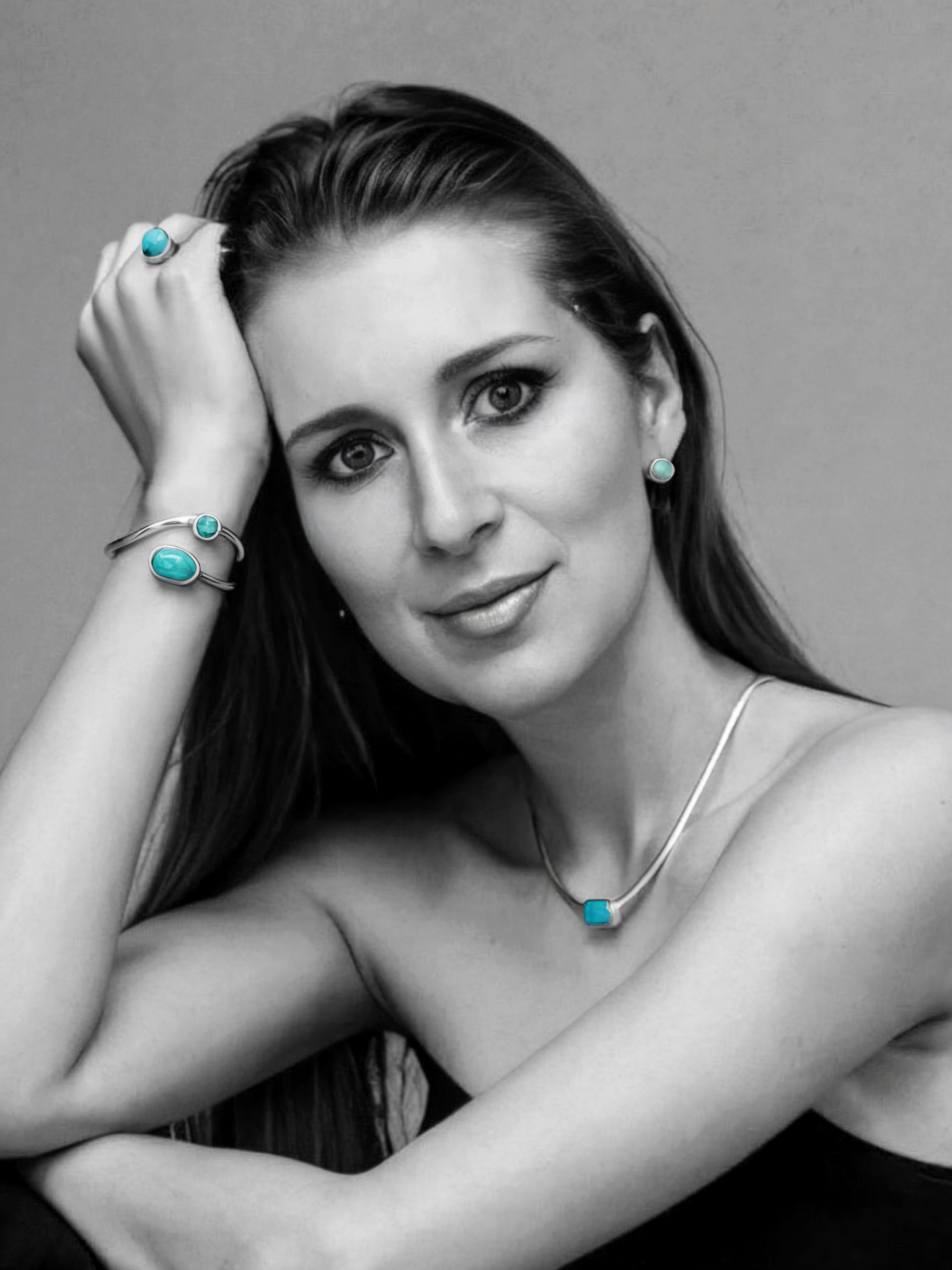
Article by
Kimberly Cordova
Kimberly Cordova is the founder and creative director of Wildflower Artisans, a handmade jewelry brand rooted in Santa Fe. Real turquoise, solid sterling silver, and a small line set in solid 14K gold. She built Wildflower around a simple belief: the best jewelry is the kind you actually reach for, not the kind you save for someday.
The collection is built three ways. Some pieces are made in-house, cut by her husband Greg from stones he sources himself, including rough from the family's King's Manassa Mine in Colorado and White Buffalo Mine in Nevada. Some are designed by Kimberly and fabricated by a trusted circle of Santa Fe silversmiths. And some are finished work she curates from artisan makers whose craft meets the same standard, because building a real collection means knowing when to make and when to look.
Turquoise leads, joined by White Buffalo, Wild Horse, Lapis Lazuli, Spiny Oyster, Black Onyx, Opal, and other genuine semi-precious stones. No shortcuts on the stone, the silver, or the story behind either.
Her writing covers everything she has learned along the way: how turquoise forms, how to tell natural from stabilized, what makes one mine different from another, how to read a bezel, and how to shop with confidence in a market that is not always straightforward. It is the kind of plainspoken information she wished someone had laid out for her when she was starting out.
Browse the collection at wildflowerartisans.com. Questions about a stone, a setting, or a specific piece are welcome any time.
0 comments