

What if the striking black and white stone you've admired in a hand-cut silver cuff isn't actually turquoise at all? Many of us have felt that same pull toward the bold, monochromatic matrix of a White Buffalo cabochon, naturally assuming it's just a rare, colorless cousin to the sky-blue stones we've always cherished. Understanding the White Buffalo Stone vs. Turquoise: Key Differences for Jewelry Makers is essential because, while they share a storied heritage in Southwestern style, they are entirely different minerals born from different geological whispers.
It's frustrating to worry about accidentally damaging a soft stone during a bezel setting or to feel uncertain about whether a piece is genuine or merely dyed howlite. We'll help you navigate these technical waters by exploring the specific mineral compositions and physical hardness that set these stones apart. You'll gain a clear understanding of how to identify, set, and care for both materials, ensuring your work remains as resilient as it is beautiful. This guide looks at the distinct technical requirements of the Tonopah-mined White Buffalo compared to copper-rich turquoise, giving you the confidence to treat each stone with the respect it deserves.
Key Takeaways
- Learn why White Buffalo is geologically distinct from turquoise, as it contains none of the copper that makes turquoise.
- Discover the technical nuances of White Buffalo Stone vs. Turquoise: Key Differences for Jewelry Makers, especially regarding Mohs scale hardness and specific setting techniques.
- Identify the visual markers of authentic materials to help you spot common imitations like dyed howlite or magnesite.
- Master the studio practices for cleaning and maintaining these stones to ensure your handcrafted jewelry remains in pristine condition.
The Mineralogical Divide: No Copper, No Turquoise
White Buffalo stone and traditional turquoise are fundamentally different minerals that happen to share a similar aesthetic history in Southwestern jewelry. While turquoise is a hydrous phosphate of copper and aluminum, White Buffalo contains no copper at all. This lack of copper is the simple reason for its colorless appearance, as the metal is required to produce the vibrant blues we associate with desert gemstones.
In our Santa Fe studio, we often hear people ask for "white turquoise," but this term is actually a mineralogical misnomer. For a stone to be classified as turquoise, it must contain copper or iron, the very elements that provide the signature blue and green hues we love. Without those minerals, the stone simply isn't turquoise. White Buffalo is a distinct geological discovery that offers a different kind of beauty, one rooted in a monochromatic palette rather than the vibrant sky-tones of the desert. Understanding White Buffalo Stone vs. Turquoise: Key Differences for Jewelry Makers begins with this chemical distinction, as it dictates everything from the stone's color to how it behaves under a jeweler's saw.
Why Chemical Composition Matters for Makers
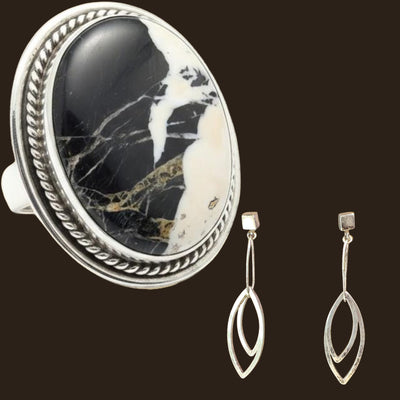
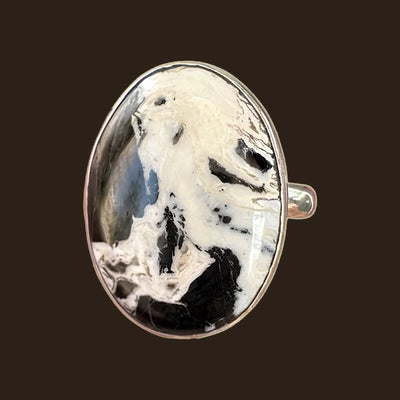
The absence of copper in White Buffalo results in its stark, porcelain-white body, but it is the presence of black chert that creates its famous webbing. The matrix is the host rock or mother stone that remains visible within a finished gemstone. In traditional turquoise, this matrix might be golden-brown limonite or dark iron-rich spiderwebs, but in White Buffalo, the chert provides a sharp, high-contrast black that feels both modern and grounded. Artisans typically cut these stones into a cabochon, which is a gemstone that has been shaped and polished into a smooth, rounded form rather than being cut with facets. Because it is a different stone, it has a different structure than turquoise, which affects its porosity and how it accepts a polish.
Identifying the Tonopah Source
Authentic White Buffalo is found exclusively in one location: the White Buffalo mine near Tonopah, Nevada, where our family holds a claim. This single-source origin is a significant part of why these stones are so highly valued by collectors and artisans alike. Recognizing the source of your material is a vital part of mastering White Buffalo Stone vs. Turquoise: Key Differences for Jewelry Makers, as the mine dictates the stone's physical properties. When we work with these materials, we are handling a very specific piece of Nevada's high desert. While you might find other white stones on the market, such as Wild Horse magnesite or dyed howlite, only the material from this specific Tonopah vein is true White Buffalo. For those interested in the history of these landscapes, our page on about our mines offers a deeper look at where these treasures are unearthed. You can also explore our current selection of White Buffalo Jewelry to see how this rare material looks when set in sterling silver (.925). A fingerprint of the earth that can't be replicated by mass-produced imitations.
Durability and the Mohs Scale: Handling Stones in the Studio
Turquoise generally ranks between 5 and 6 on the Mohs scale of mineral hardness, while White Buffalo stone is notably softer, typically falling between 3.5 and 5. This gap in physical resilience is one of the most critical White Buffalo Stone vs. Turquoise: Key Differences for Jewelry Makers, as it dictates how much pressure a stone can withstand during the setting process and how easily it might scratch during daily wear.
When you're working at the bench, you'll notice that turquoise feels denser and more resistant under a file or saw. White Buffalo, because it is a different stone, can feel more delicate on the wheel. Hardness isn't just a number on a chart; it's a measure of how a stone resists the friction of life. Both of these materials are porous, meaning they have tiny microscopic openings that can absorb skin oils, soaps, or even the chemicals in silver polish. If a stone absorbs these substances, its color can shift over time, which is why we always emphasize careful handling in our studio. You can see how we balance these delicate materials by browsing our shop all jewelry collection, where each piece is designed with the stone's specific needs in mind.
The Role of Stabilization in Jewelry Making
Stabilization is the process of infusing a natural stone with a clear, pressurized resin to improve its structural integrity and lock in its color. Many White Buffalo cabochons require this treatment because the raw material can be prone to crumbling or "checking" when they hit the high speed of a lapidary wheel. This isn't about hiding flaws, but rather about ensuring the stone is hardy enough to be worn. In our work, we believe in being plainspoken about these processes. A stabilized stone is still a genuine stone, but it has been given a bit of extra help to survive the journey from the mine to a finished bezel.
Impact Resistance for Daily Wear
Because White Buffalo is softer than most turquoise, it requires a more intentional approach to jewelry design. While a high-grade turquoise ring can often handle the occasional bump against a desk, a White Buffalo ring is more susceptible to bruising or cracking if struck directly. We often suggest that softer stones are best suited for earrings or pendants, where they face less physical impact. If we do set a softer stone in a ring or cuff, we often use a thicker bezel of sterling silver (.925) to act as a protective wall around the edge of the cabochon. This craftsmanship ensures that the beauty of the stone is preserved for years to come.
Our curated selection of turquoise jewelry showcases stones from legendary mines, each chosen for its unique matrix and reliable hardness. We take pride in pairing these natural wonders with artisan-made settings that respect the geological story of every piece.
Visual Storytelling: Matrix Patterns and Color Contrast
White Buffalo is characterized by its high-contrast, black-and-white monochromatic palette, while turquoise offers a spectrum of blues and greens often interrupted by golden-brown or dark spiderweb matrix patterns. These visual markers define the visual weight and storytelling potential of a finished piece, allowing an artisan to choose between the vibrant saturation of a sky stone or the architectural grounding of a white mineral.
Traditional turquoise matrix varies significantly depending on the minerals present during its formation. You'll often see golden-brown limonite or dark, iron-rich spiderwebs that create a storied, organic feel. These patterns are what give turquoise its personality, making every hand-cut stone a unique map of the earth. In contrast, White Buffalo offers a sharp, modern aesthetic. The black chert matrix against a porcelain-white background provides a bold focal point that feels intentional and grounded. In our studio, we often use these white stones to create pieces that feel clean and structural, especially when designing sterling silver rings that need to stand out on the hand.
Designing with the Matrix in Mind
When you're looking at a White Buffalo cabochon, the matrix generally falls into two categories: 'blotch' or 'spiderweb.' A blotch matrix features larger, irregular islands of black chert, while a spiderweb matrix consists of fine, delicate lines that crisscross the stone's surface. Orienting the stone within a bezel is a meditative part of the process. We rotate each cabochon to find the most balanced composition before the silver is ever pushed. Using sterling silver (.925) is a deliberate choice here; the cool, bright metal enhances the crisp contrast of the black and white without competing for attention. This thoughtful approach to composition is one of the White Buffalo Stone vs. Turquoise: Key Differences for Jewelry Makers that separates a simple setting from a piece of wearable art.
Southwestern Style and Modern Trends
White Buffalo has transitioned from a rare lapidary curiosity to a staple in high-end artisan-made jewelry. It's no longer just an alternative to turquoise; it's a partner. We're seeing a beautiful visual synergy when pairing White Buffalo with traditional blue stones in handcrafted cuffs or statement necklaces. This combination highlights the natural, asymmetrical beauty of both materials. It honors the sky stone tradition while embracing a contemporary, monochromatic palette that appeals to a wide range of styles. By focusing on the visual narrative of the stone, we ensure that every piece tells a story of the high desert landscape from which it was pulled.
Sourcing Authenticity: The Rarity of White Buffalo
Authentic White Buffalo is significantly rarer than many varieties of commercially available turquoise. Because it is sourced from a single location in Nevada, the supply is naturally limited, which inevitably invites a market flooded with imitations. Identifying White Buffalo Stone vs. Turquoise: Key Differences for Jewelry Makers requires a sharp eye for these mimics, as the value of your piece depends entirely on the integrity of the material. We've seen many collectors feel discouraged by the prevalence of treated stones or outright fakes, which is why we focus so heavily on education within our studio.
Spotting the Imitations: Howlite vs. White Buffalo
Dyed howlite and magnesite are the most common stones used to deceive buyers. Howlite is naturally white but features a gray, blurred matrix that lacks the definition found in genuine materials. When we look at a hand-cut White Buffalo cabochon, the matrix is a crisp, obsidian-black chert that creates a high-contrast boundary against the white stone. The luster of the stone is another giveaway. White Buffalo takes a vitreous, glass-like shine when polished, reflecting light with a clarity that softer minerals like howlite can't achieve. You might also encounter Wild Horse stone, which is a mix of magnesite and hematite. While Wild Horse is a beautiful, artisan-made choice in its own right, its matrix is typically brownish or reddish, lacking the monochromatic purity of true White Buffalo.
The Value of Mine-Specific Jewelry
Provenance is the soul of Southwestern style jewelry. Knowing that a stone came from a specific location like the Royston, Kingman, or White Buffalo mines adds a layer of narrative that mass-produced pieces lack. Mine closures are a constant reality in the lapidary world; when a specific vein is exhausted, the stones already in circulation become finite treasures. This scarcity is a major factor in the long-term value of your collection. At Wildflower, we prioritize a stone-first philosophy, ensuring every piece is vetted by a professional who understands these geological nuances. We believe in the beauty of the genuine, even when it's asymmetrical or rare. Every stone has a story, and we're here to help you read it correctly.
Finding genuine materials is the first step in creating a piece that lasts for generations. Our White Buffalo Jewelry collection features only authentic stones from the Nevada source, each hand-cut to highlight its natural black and white contrast.
Studio Practices: Setting and Maintenance for Longevity
Setting and maintaining these materials requires a gentle touch and a deep respect for their porous nature. While turquoise is slightly more resilient, both stones demand a studio approach that prioritizes structural integrity over speed. Understanding White Buffalo Stone vs. Turquoise: Key Differences for Jewelry Makers is most vital at the workbench, where the wrong tool or too much pressure can compromise a rare cabochon.
In our studio, we always reach for fine silver (.999) bezel wire when working with softer materials like White Buffalo. Fine silver is softer than sterling silver (.925), which means it requires less force to push against the stone. This reduces the risk of the stone chipping or cracking under the pressure of a setting tool. We also strictly avoid using ultrasonic cleaners or steam machines. The high frequency vibrations and intense heat can shatter the delicate crystalline structure or cause stabilized resins to cloud. Instead, we recommend a simple, soft cloth and, if absolutely necessary, a tiny drop of pH neutral soap. Storing your pieces away from direct sunlight and extreme temperature shifts is equally important to prevent the stone from becoming brittle over time.
Bezel Setting Tips for Softer Stones
To secure a stone without causing stress fractures, we use a burnishing technique. Burnishing is the process of using a smooth, polished steel or stone tool to rub and compress the bezel wall over the edge of the cabochon. This gentle, repetitive motion is far safer than using a hammer and punch. If a stone is cut thin, we might place a small shim or backing underneath it. A shim is a thin layer of material used to elevate the stone so its top curve sits perfectly flush with the bezel edge. For pieces intended for daily wear, we often choose a heavy gauge bezel. This thicker wall of silver acts as a protective buffer, shielding the edges of a softer stone from the inevitable bumps of a busy life. This technical foresight is a hallmark of artisan made jewelry.
Long-Term Care for the Collector
For those who wear these treasures, care is less about rules and more about a ritual of respect. We advise our clients to apply lotions, perfumes, and hairsprays before putting on their jewelry. Because these stones are porous, they can absorb chemicals that lead to permanent discoloration over time. There is a beautiful tradition in the Southwest of "waking up" a stone through wear. The idea is that the stone thrives when it is part of your journey, but this must be balanced with its delicate nature. Treating your jewelry with this level of intention ensures that the fleeting beauty of the natural world remains vibrant for years to come. You can find more detailed guidance on our care and repair page to keep your collection in pristine condition.
Honoring the Geological Story of Your Collection
Building a jewelry collection is an act of storytelling through the natural world. By distinguishing between the phosphate-rich blues of traditional turquoise and the monochromatic white of White Buffalo, you protect the longevity of your most cherished pieces. Mastering the nuances of White Buffalo Stone vs. Turquoise: Key Differences for Jewelry Makers ensures you can navigate the market with a discerning eye, focusing on the rare Tonopah source rather than common imitations like dyed howlite. It's about more than just aesthetics; it's about respecting the physical resilience and origin of every stone you wear.
At Wildflower, we remain in awe of these materials. Our studio works exclusively with hand-cut stones from verified American mines, setting them in sterling silver (.925) or solid 14K gold. We guarantee authentic, untreated materials because we believe the earth's natural variations are more beautiful than any factory-made imitation. Whether you're drawn to the vibrant sky stone tradition or the architectural contrast of a black and white matrix, your choice reflects a deep appreciation for the landscape.
Carry these stories with you. Every stone is a fleeting moment of beauty, captured in metal and meant to be worn through the seasons of your life. We invite you to find a piece that resonates with your own narrative.
Frequently Asked Questions
Is White Buffalo Stone a type of turquoise?
White Buffalo is geologically distinct from turquoise because it contains no copper. It is frequently called white turquoise because it was discovered in a turquoise mine and shares a similar black chert matrix. While they are often found near each other in nature, they are entirely different minerals with unique chemical signatures.
Where is authentic White Buffalo Stone mined?
Genuine White Buffalo comes from the White Buffalo mine near Tonopah, Nevada, where our family holds a claim. If you encounter a stone from a different location labeled with this name, it is likely a different mineral such as magnesite or howlite. Knowing the specific source is a cornerstone of understanding White Buffalo Stone vs. Turquoise: Key Differences for Jewelry Makers, as it ensures you are working with the real material.
Does White Buffalo Stone require stabilization?
Many specimens undergo stabilization to enhance their physical hardness and prevent the porous surface from absorbing skin oils. This process is a standard industry practice that makes the stone durable enough for daily wear in rings or cuffs. Without this treatment, the delicate stone could crumble during the cutting process or discolor over time when exposed to the elements.
How can I tell the difference between White Buffalo and dyed howlite?
You can identify authentic White Buffalo by its sharp, obsidian black matrix and the vitreous luster it achieves when polished. Howlite typically has a more porous appearance and a web like gray matrix that can look printed or artificial rather than organic. When evaluating White Buffalo Stone vs. Turquoise: Key Differences for Jewelry Makers, the crisp, high contrast webbing of the genuine Nevada stone is a primary indicator of its value.

Article by
Kimberly Cordova
Kimberly Cordova is the founder and creative director of Wildflower Artisans, a handmade jewelry brand rooted in Santa Fe. Real turquoise, solid sterling silver, and a small line set in solid 14K gold. She built Wildflower around a simple belief: the best jewelry is the kind you actually reach for, not the kind you save for someday.
The collection is built three ways. Some pieces are made in-house, cut by her husband Greg from stones he sources himself, including rough from the family's King's Manassa Mine in Colorado and White Buffalo Mine in Nevada. Some are designed by Kimberly and fabricated by a trusted circle of Santa Fe silversmiths. And some are finished work she curates from artisan makers whose craft meets the same standard, because building a real collection means knowing when to make and when to look.
Turquoise leads, joined by White Buffalo, Wild Horse, Lapis Lazuli, Spiny Oyster, Black Onyx, Opal, and other genuine semi-precious stones. No shortcuts on the stone, the silver, or the story behind either.
Her writing covers everything she has learned along the way: how turquoise forms, how to tell natural from stabilized, what makes one mine different from another, how to read a bezel, and how to shop with confidence in a market that is not always straightforward. It is the kind of plainspoken information she wished someone had laid out for her when she was starting out.
Browse the collection at wildflowerartisans.com. Questions about a stone, a setting, or a specific piece are welcome any time.


0 comments