

That striking white cabochon laced with rich chocolate veining is often mislabeled as white turquoise, leaving jewelry lovers rightfully confused. When you hold a piece of handcrafted jewelry, you want the quiet certainty of real stone, not synthetic resin or dyed howlite masquerading as a Southwestern treasure. If you have ever asked what is Wild Horse magnesite, the answer is grounded in honest lapidary work and mineralogy rather than marketplace fiction.
At Wildflower Artisans, our studio celebrates this material for its own distinct character. Geologically, it is a natural union of creamy white magnesite and reddish-brown hematite, cut from private stockpiles of an Arizona mine that ceased commercial production in the late 1990s. In this guide, you will discover the precise differences between magnesite and turquoise, learn how to recognize genuine stones by their warm matrix, and feel confident choosing authentic sterling silver jewelry designed for a lifetime of wear.
Key Takeaways
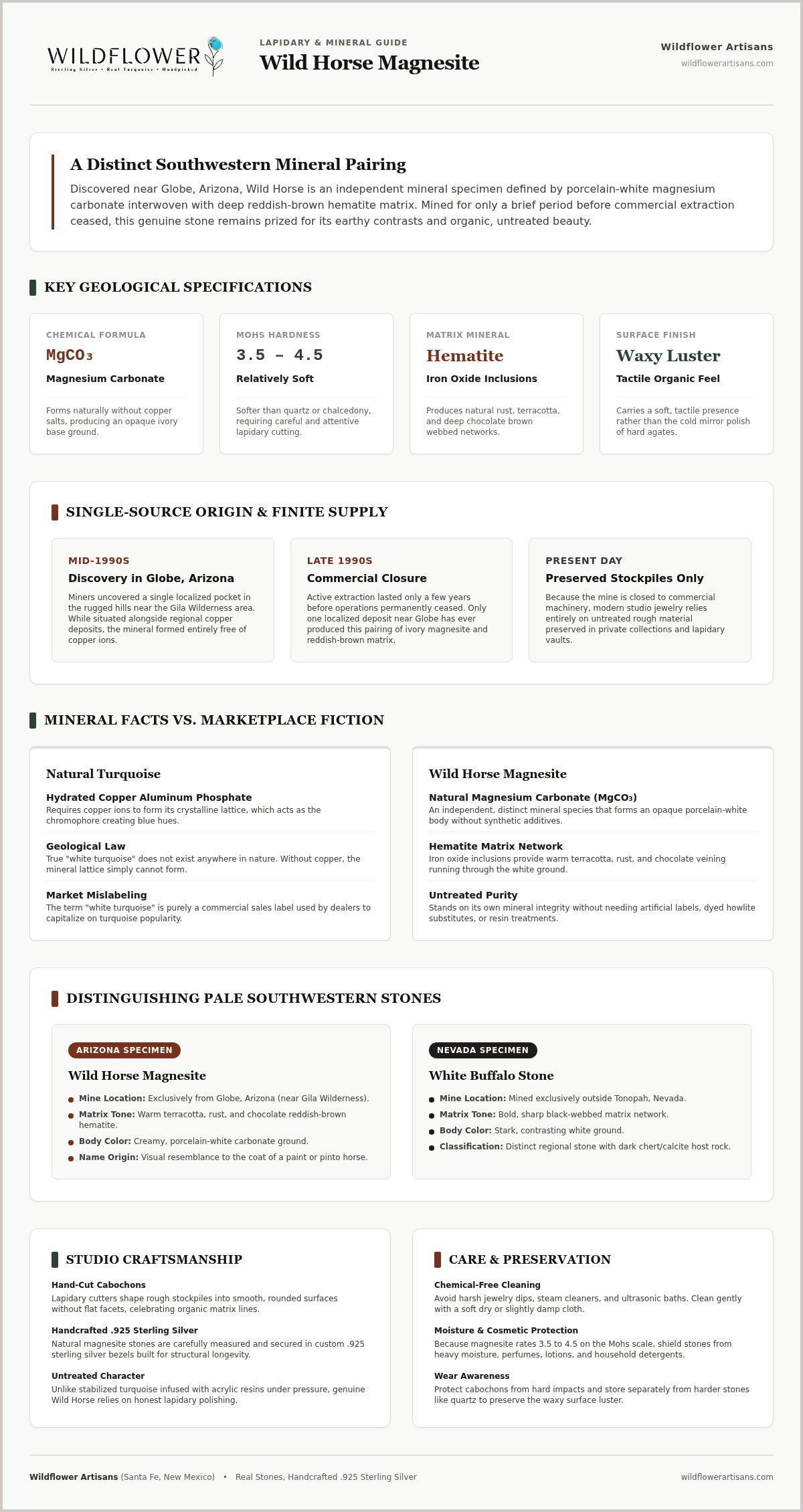
- Understand exactly what is Wild Horse magnesite, exploring how natural magnesium carbonate forms with reddish-brown hematite matrix rather than copper-rich turquoise.
- Distinguish genuine Arizona magnesite from dyed howlite, composite resin, and black-webbed White Buffalo stone.
- Discover how lapidary cutters shape rough stockpiles into hand-cut cabochons that celebrate organic chocolate veining.
- Spot the visual hallmarks of authentic studio jewelry set in handcrafted .925 sterling silver bezels.
- Learn simple, chemical-free care practices to protect untreated magnesite stones from daily wear and moisture damage.
What Is Wild Horse Magnesite? Definition and Mineral Properties
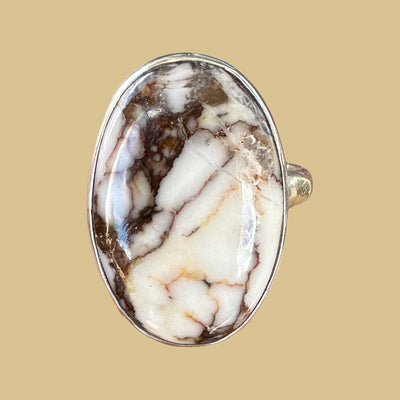
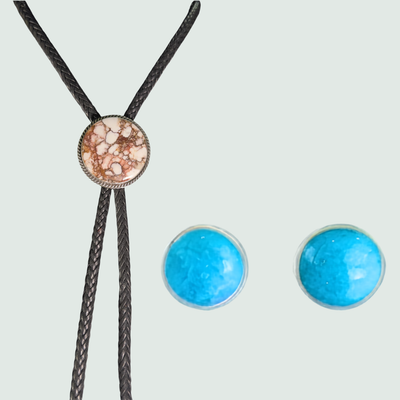
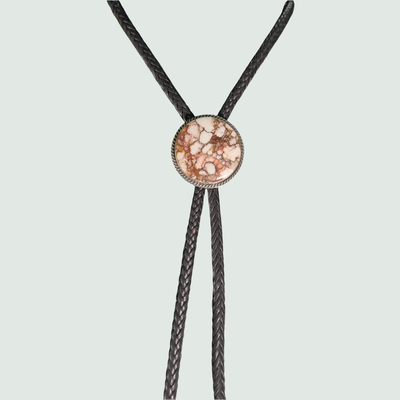
Wild Horse magnesite is a natural mineral specimen composed of magnesium carbonate that features an opaque porcelain-white body accented by a deep reddish-brown hematite matrix. This distinctive Southwestern stone earned its trade name from its visual similarity to the mottled coat of a paint or pinto horse. Unlike glassy silicates, raw magnesite carries a soft, tactile presence that lapidary cutters prize for its warm, organic contrasts.
When buyers first ask what is Wild Horse magnesite, confusion often stems from the marketplace tendency to group every pale Southwestern stone under a turquoise umbrella. In truth, it is an independent mineral deposit discovered only in southern Arizona, admired for the interplay between pale ivory fields and earthy iron veining. You can explore the geological lineage of this unique material in our guide to Wild Horse stone origins.
The Geology and Chemical Composition of Magnesite
From a mineralogical perspective, magnesite forms as magnesium carbonate with the standard chemical formula MgCO3. It registers between 3.5 and 4.5 on the Mohs hardness scale, making it relatively soft compared to chalcedony or quartz. A cabochon is a gemstone that has been shaped and polished into a smooth, rounded surface rather than cut with flat facets. Matrix refers to the host rock or foreign mineral network visible inside a polished cabochon. In Wild Horse, natural iron oxide inclusions, primarily hematite, create the warm chocolate and rust-colored webbing tracing across the white carbonate ground.
Discovery and Mining History Near Globe, Arizona
Miners uncovered the primary Wild Horse deposit during the mid-1990s in the rugged hills near Globe, Arizona, tucked near the Gila Wilderness area. While the pocket formed alongside regional copper deposits, the mineral remained chemically distinct, entirely free of the copper salts that yield blue and green hues. Active commercial extraction lasted only a few years before operations ceased in the late 1990s.
- Single-source origin: Only one localized deposit near Globe has ever produced this exact pairing of pure ivory magnesite and reddish-brown matrix.
- Closed production: Because active mining ended decades ago, modern jewelry relies entirely on rough material preserved in private collections and lapidary stockpiles.
- Distinctive hand feel: Hand-cut pieces possess a subtle, waxy luster rather than the cold, mirror polish of hard agates.
Understanding what is Wild Horse magnesite means appreciating a finite regional treasure. Each cut stone tells the story of a specific desert pocket that opened, yielded its patterns, and closed to commercial machinery forever.
Wild Horse Magnesite vs. White Turquoise: Clearing the Confusion
Geologically speaking, true white turquoise does not exist anywhere in nature. The term is purely a commercial trade misnomer used by dealers to capitalize on the widespread popularity of turquoise. While mineral collectors recognize the distinct beauty of Arizona magnesite, casual shoppers asking what is Wild Horse magnesite often run into deceptive listings claiming the stone is an ultra-rare white variety of turquoise. Natural turquoise is a hydrated phosphate of copper and aluminum; without copper, the mineral lattice simply cannot form.
To identify magnesite accurately, lapidary workers look at chemical composition and physical properties rather than retail labels. Stabilized turquoise refers to low-grade turquoise infused with clear acrylic resin under pressure to harden the stone and lock in its color. Untreated Wild Horse, by contrast, relies on natural mineral density and artisan handling to maintain its organic structure. Magnesite does not need artificial titles to establish its worth; it stands on its own as a genuine, collectible Southwestern mineral.
Why Turquoise Cannot Be Naturally White
Copper serves as the primary chromophore, or coloring agent, that produces turquoise's signature sky blues, while trace amounts of iron introduce rich greens. If a pale mineral forms without copper ions, it belongs to an entirely different mineral family such as calcite, howlite, chert, or magnesite. When unethical sellers label white stones as turquoise, they misrepresent mineral science and mislead collectors who want natural provenance.
Wild Horse Magnesite Compared to White Buffalo Stone
Southwestern jewelry enthusiasts frequently encounter two pale favorites: Arizona Wild Horse and Nevada White Buffalo. While both stones feature bold, contrasting patterns set into sterling silver, their origins and aesthetics are completely distinct:
- Geographic origin: Wild Horse comes exclusively from Globe, Arizona, whereas White Buffalo is mined outside Tonopah, Nevada.
- Matrix color: Wild Horse shows warm terracotta and chocolate brown hematite, while White Buffalo carries stark black chert veining.
- Lapidary presence: White Buffalo offers a sharp, modern contrast, whereas the warm earthy webbing of Wild Horse brings a softer, antique depth to silverwork.
You can read our detailed guide to stone origins and natural properties to see how regional geology shapes every mine cut. If you appreciate the interplay of distinct natural minerals paired with thoughtful benchwork, explore our handcrafted designs across the complete jewelry collection.
Understanding the difference between copper-bearing minerals and carbonate stones gives you total buying confidence. That honesty is why our bench never uses confusing commercial trade names. It is why every piece in our Wild Horse magnesite jewelry collection is shaped from genuine Arizona rough and set by hand in .925 sterling silver.
Visual Characteristics: Matrix Patterns and Cabochon Shapes
Every natural Wild Horse cabochon carries a completely unique organic pattern, defined by the dialogue between pale carbonate mineral and deep iron veining. When collectors investigate what is Wild Horse magnesite from a bench perspective, they discover a stone that resists factory calibration. Lapidary cutters do not force these rough blocks into rigid, mass-market templates. Instead, the wheel follows the stone's inner topography, carving contours that balance creamy porcelain fields with rich chocolate webbing.
While standard mining texts categorize magnesite as a functional industrial magnesium ore, studio lapidaries view this Arizona discovery purely as gem-grade art. Fresh off the polishing arbor, genuine Wild Horse reveals a soft, waxy luster. That delicate glow sets it apart from glassy agates and creates an immediate warmth when paired with the bright, cool surfaces of .925 sterling silver.
The Role of Hematite in Chocolate Matrix Webbing
The earthy drama of Wild Horse comes entirely from hematite mineralization that seeped into structural fractures millions of years ago. These iron oxides express themselves in warm mahogany, terracotta, and deep chocolate brown patterns:
- Spiderweb webbing: Fine, delicate thread lines that fracture across pure white fields, creating high-contrast visual tension.
- Mottled patches: Broad, painterly washes of rust and cocoa that soften the negative space like the coat of an Appaloosa horse.
- Calico distributions: Clustered pockets of intense color sitting alongside wide, serene expanses of untreated porcelain white.
A single fist-sized rough stone can produce dramatically different cabochons. One cut might yield a tight, high-contrast spiderweb, while the adjacent slice offers open, cloud-like creaminess.
How Lapidary Artists Cut and Shape Wild Horse Cabochons
Shaping this material requires patient hands and fine-grit diamond wheels. Because magnesite is a softer mineral, excessive heat or aggressive grinding can shatter fragile boundary lines between the white carbonate and the hematite host. Cutters water-cool the wheels continuously, coaxing out gentle, domed profiles that invite the fingertips.
In Southwestern jewelry studios, artists favor freeform shapes over strict commercial ovals. Tracing the organic flow of the veining preserves rough weight and honors the stone's natural geometry. Crucially, the cutter sands the reverse side completely flat. A true flat back allows the finished cabochon to rest flush against a silver backplate, giving silversmiths the stable foundation needed to roll a clean sterling silver bezel tightly around its perimeter.
How to Identify Authentic Wild Horse Magnesite Jewelry
Natural Wild Horse magnesite feels cool, dense, and substantial when placed against your skin, warming slowly to your body heat. Genuine stones show sharp, organic transitions between the porcelain-white field and the reddish-brown hematite matrix. Imitations, by contrast, feel lightweight and exhibit fuzzy, bleeding contact lines. Discerning buyers asking what is Wild Horse magnesite need tangible evaluation points to navigate an online market flooded with synthetic blocks, cast plastics, and dyed mineral substitutes.
Because the Arizona mine closed decades ago, untreated rough material is scarce. That scarcity encourages counterfeiters to produce artificial lookalikes using cheap factory methods. Knowing how to inspect the matrix margins, test surface temperature, and evaluate silversmithing details ensures you invest in genuine earth-born minerals rather than factory novelty items.
Spotting Common Imitations: Dyed Howlite and Block Plastics
Dyed howlite remains the most pervasive substitute in mass-market jewelry. While natural howlite is a white borate mineral with dark gray or black webbing, manufacturers dye the matrix brown to mimic Arizona hematite. A gentle wipe with an acetone-dampened cotton swab on an inconspicuous edge quickly pulls away artificial topical stains.
- Plastic block composites: Made from ground mineral dust bound in polyester resin. These feel noticeably warm to the touch, weigh very little, and often exhibit repeating, stamped matrix patterns.
- Fuzzy matrix borders: In dyed howlite, the dye bleeds into the white pores, blurring the borders. Genuine hematite maintains crisp, sharp edges against white magnesite.
- Surface luster: Synthetic blocks display an unnatural, glassy plastic shine, while authentic magnesite retains a soft, porcelain luster.
Evaluating Silver Craftsmanship and Artisan Settings
The metalwork surrounding a stone tells an equally revealing story. Authentic studio pieces are set in solid .925 sterling silver, where artisans build custom bezels tailored specifically to each cabochon's organic perimeter. A bezel is a protective collar of precious metal that wraps around the edge of a gemstone to hold it securely in place. Commercial factories rarely invest the time required to hand-form heavy silver around irregular, freeform cabochons.
Look for sturdy backplates and hand-rolled bezels that cradle the stone without industrial adhesives. You can review our studio commitment to authentic handmade jewelry to understand how our Santa Fe makers verify natural provenance before a single strip of silver is sawed or soldered.
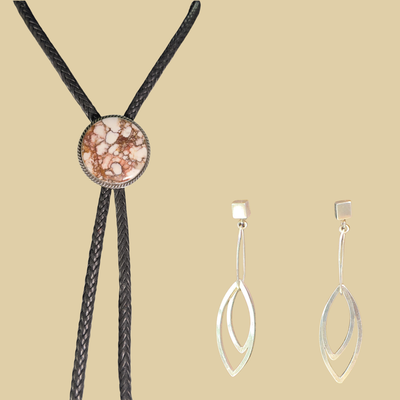
That careful setting work is the difference between a mass-market reproduction and a heirloom piece. It is why our artisan ring collection features individually cut stones secured inside hand-burnished bezels, giving each natural matrix pattern the protection it deserves.
How to Care for Wild Horse Magnesite Jewelry
Magnesite is a moderately porous, relatively soft mineral registering between 3.5 and 4.5 on the Mohs scale, meaning it requires mindful handling and chemical-free care to protect its natural finish. Unlike harder silicate stones, untreated magnesium carbonate readily absorbs foreign liquids, household solvents, and cosmetic oils. Anyone seeking to understand what is Wild Horse magnesite must recognize that preserving its raw, untreated porcelain luster depends entirely on gentle daily habits rather than aggressive cleaning routines.
Ultrasonic cleaning machines and chemical silver dips should never touch this stone. Ultrasonic vibrations can quickly shatter delicate hematite boundary lines, while harsh liquid tarnish removers seep into microscopic pores, permanently discoloring the ivory field. Instead, clean surrounding silverwork by hand using a treated silver polishing cloth, carefully polishing around the bezel rim without rubbing abrasive compounds directly across the stone's face.
Daily Wear Guidelines and Moisture Protection
A simple rule of thumb for genuine Southwestern stones is to make your jewelry the very last thing you put on in the morning and the first thing you take off at night. Airborne chemicals, salon sprays, and skin lotions contain petroleum distillates and alcohols that can dull the soft polish over time:
- Cosmetic barrier: Allow perfumes, hairsprays, and body lotions to dry completely on your skin before fastening pendants or rings.
- Water exposure: Remove rings and bracelets before washing hands, washing dishes, swimming in chlorinated pools, or soaking in hot tubs.
- Physical activity: Take off your jewelry prior to gardening, gym workouts, or heavy manual chores to avoid impact scratches against hard tools.
Safe Cleaning and Storage Practices for Handcrafted Pieces
Routine cleaning takes only a moment. After a day of wear, wipe the face of the cabochon with a clean, dry, lint-free microfiber cloth to lift away natural skin oils and dust. If the stone requires a deeper refresh, lightly dampen the cloth with lukewarm water, gently wipe the surface, and immediately dry the setting thoroughly with a soft cotton towel.
Because quartz, jasper, and turquoise are harder than magnesite, loose drawer storage can lead to accidental surface scratches. Store each piece flat in its own fabric pouch or inside a fabric-lined jewelry box compartment away from high humidity and prolonged direct sunlight. Practicing deliberate care keeps these rare Arizona stones as crisp and luminous as the day our Santa Fe silversmiths finished burnishing the silver.
Embracing the Natural Character of Southwestern Stones
Learning what is Wild Horse magnesite transforms how you view Southwestern stonecraft. Rather than chasing confusing labels like white turquoise, you can celebrate this material for what it truly is: a finite Arizona treasure combining rich magnesium carbonate with natural hematite veining. Each piece carries a finite history mined during the 1990s, offering an earthy contrast that factory composites can never replicate.
At Wildflower Artisans, our Santa Fe studio remains devoted to honest stonecraft and complete geological transparency. Greg Cordova cuts genuine rough stones with an eye for natural balance, while our silversmiths hand-fabricate custom bezels using solid .925 sterling silver to protect these softer gems. When you choose jewelry grounded in lapidary knowledge, you bring home a wearable piece of the American high desert built to endure for generations.
Wear your stones with confidence, knowing that natural variations and warm, hand-cut matrices are the true hallmarks of authentic Southwestern art.
Frequently Asked Questions
Is Wild Horse magnesite the same as real turquoise?
No, Wild Horse magnesite is an entirely different mineral species from genuine turquoise. Natural turquoise is a hydrated phosphate mineral composed of copper and aluminum, which creates its blue and green coloration. Wild Horse contains zero copper, consisting instead of magnesium carbonate banded with iron-rich hematite. Sellers who call it turquoise are simply using a misleading trade moniker rather than accurate mineral science.
Where is Wild Horse magnesite mined?
Authentic Wild Horse magnesite comes from a single localized mineral claim discovered near Globe, Arizona, bordering the Gila Wilderness area. Commercial excavation began and ended during the mid-to-late 1990s, meaning the mine is no longer actively producing rough stone. Today, independent lapidary studios cut cabochons exclusively from finite, preserved rough stockpiles held in private mineral collections.
Why is it sometimes called Wild Horse turquoise?
Vendors frequently mislabel the stone as Wild Horse turquoise to make it sound familiar and attractive to Southwestern jewelry shoppers. Because turquoise commands high market value, trade nicknames are often attached to pale regional stones found near copper mines. Understanding what is Wild Horse magnesite helps buyers see through marketplace misnomers and value the stone for its own natural porcelain character.
Can you wear Wild Horse magnesite jewelry every day?
Yes, you can wear Wild Horse magnesite jewelry regularly if you practice mindful daily habits. Because the mineral is relatively soft and naturally porous, protect it from direct exposure to water, cosmetics, household cleaners, and rigorous manual work. Choosing sturdy, hand-fabricated sterling silver bezel settings provides essential edge protection against accidental drops or side impacts during daily wear.
How hard is Wild Horse magnesite on the Mohs scale?
Wild Horse magnesite rates between 3.5 and 4.5 on the Mohs mineral hardness scale. This makes it softer than turquoise, which rates between 5.0 and 6.0, and significantly softer than quartz or chalcedony. Lapidary cutters must use steady, water-cooled diamond wheels to shape the stone without crumbling the natural contact lines along the hematite matrix.
What is the difference between Wild Horse and White Buffalo stone?
The visual and geographical differences between the two stones are distinct. White Buffalo is mined in Tonopah, Nevada, and displays an ivory body accented by jet-black chert matrix webbing. Wild Horse originates in Globe, Arizona, and features warm terracotta, rust, and chocolate brown hematite webbing. Both stones are distinct non-turquoise minerals that create striking contrasts when set into polished silver.
How do I know if my Wild Horse stone is genuine?
Genuine Wild Horse magnesite feels cool and substantial against the skin, featuring sharp, organic margins where the white carbonate meets the reddish-brown hematite. Plastic imitations feel light, warm quickly, and display repeating surface patterns. Dyed howlite shows blurry, bleeding matrix edges. An authentic stone holds a soft porcelain luster rather than a synthetic, mirror-bright plastic sheen.
Article by
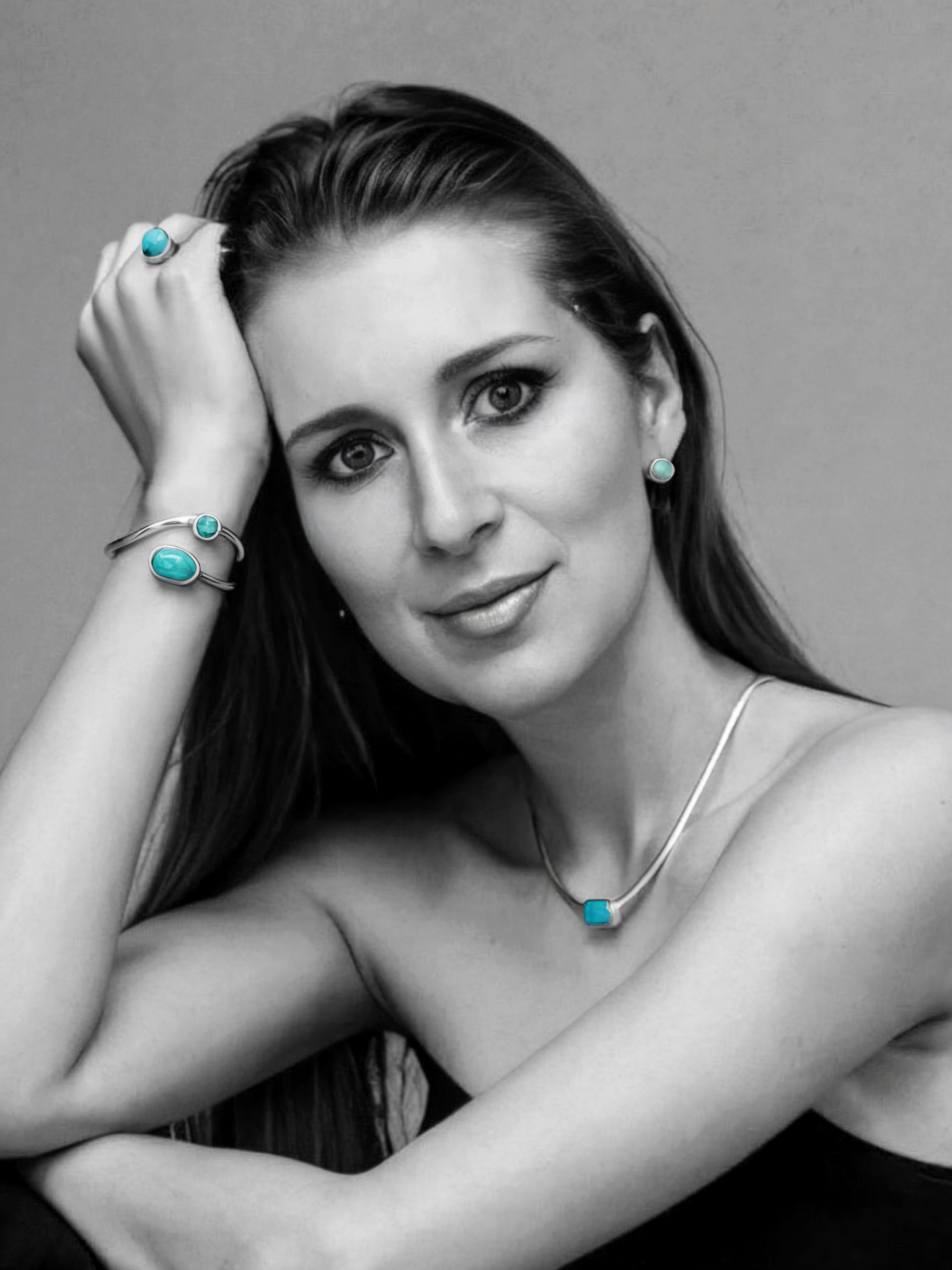
Kimberly Cordova
Kimberly Cordova is the founder and creative director of Wildflower Artisans, a handmade jewelry brand rooted in Santa Fe. Real turquoise, solid sterling silver, and a small line set in solid 14K gold. She built Wildflower around a simple belief: the best jewelry is the kind you actually reach for, not the kind you save for someday.
The collection is built three ways. Some pieces are made in-house, cut by her husband Greg from stones he sources himself, including rough from the family's King's Manassa Mine in Colorado and White Buffalo Mine in Nevada. Some are designed by Kimberly and fabricated by a trusted circle of Santa Fe silversmiths. And some are finished work she curates from artisan makers whose craft meets the same standard, because building a real collection means knowing when to make and when to look.
Turquoise leads, joined by White Buffalo, Wild Horse, Lapis Lazuli, Spiny Oyster, Black Onyx, Opal, and other genuine semi-precious stones. No shortcuts on the stone, the silver, or the story behind either.
Her writing covers everything she has learned along the way: how turquoise forms, how to tell natural from stabilized, what makes one mine different from another, how to read a bezel, and how to shop with confidence in a market that is not always straightforward. It is the kind of plainspoken information she wished someone had laid out for her when she was starting out.
Browse the collection at wildflowerartisans.com. Questions about a stone, a setting, or a specific piece are welcome any time.
0 comments