

The dark, intricate lines crossing a blue cabochon aren't just patterns; they are the physical map of the host rock where the gemstone lived for millions of years. This host rock, known as the matrix, becomes a spiderweb when it forms thin, interconnecting veins that surround small islands of turquoise. Understanding what is spiderweb matrix in turquoise helps you see the stone as a geological narrative rather than just a piece of jewelry.
It's frustrating to search for a genuine piece only to encounter dyed howlite or stabilized plastic. You want a stone that reflects the true character of a specific mine, whether it's the deep blues of Kingman or the varied greens of Royston. This guide will show you the exact mineral conditions required for these patterns to form and the specific markers used to verify authenticity. We'll explore the factors that determine value in high-grade stones and give you the tools to evaluate turquoise with the confidence of a seasoned collector.
Key Takeaways
- Identify the unique geological process where thin veins of host rock lace through the stone to create rare, natural patterns.
- Learn why the tightness of the webbing and the contrast of the host rock determine the market value of high-grade cabochons.
- Understand what is spiderweb matrix in turquoise to better differentiate between organic mineral growth and laboratory-made block turquoise.
- Discover how specific mines like Kingman or Royston produce distinct matrix colors, ranging from dark brown limonite to golden quartz.
- Master the best practices for caring for these stones, including the use of protective bezels in .925 sterling silver or solid 14K gold settings.
Defining Spiderweb Matrix in Natural Turquoise
Spiderweb matrix is a rare pattern of thin, interconnected veins of host rock that lace through a turquoise stone to create a network resembling a web. This intricate structure occurs naturally when turquoise grows within the small fractures of a surrounding mineral, preserving the original stone's skeletal framework.
In our Santa Fe studio, seeing a high-grade spiderweb cabochon on the workbench is a special occasion. Matrix is the non-turquoise host rock or 'mother stone' that remains visible in a finished cabochon. While most stones feature large, random patches of host material, a true spiderweb is a geological miracle. It requires turquoise minerals to seep into tiny, hairline fractures of a harder mineral over millions of years. The visual contrast of a dark limonite web against a vibrant sky-blue surface is a hallmark of authentic turquoise jewelry. Collectors prize these patterns for their rarity and the complex story they tell about the earth's history. Knowing what is spiderweb matrix in turquoise helps you appreciate why these stones are the centerpieces of many one-of-a-kind artisan pieces.
Host Rock vs. Mother Stone
Host rock is the original stone in which turquoise minerals formed over millions of years. It serves as the foundation or cradle for the gemstone. In a spiderweb pattern, the turquoise fills the cracks of this host rock rather than replacing it entirely. This creates the "mother stone" effect, where the host material acts as a fine, dark outline for the turquoise cells. Unlike a "calico" matrix, which has large, blotchy sections, the spiderweb mother stone provides a delicate, structural frame. Harder minerals like iron-rich limonite often produce these sharp, distinct lines that remain crisp even after the stone is hand-cut and polished.
Visual Characteristics of Fine Webbing
The color and structure of the webbing reveal the stone's unique identity. You'll often find deep black or chocolate brown lines in stones from the Bisbee mine, while other mines might produce golden or reddish hues. A high-quality spiderweb is defined by its "cells," which are the individual islands of turquoise surrounded by the matrix. We look for symmetry and a consistent cell size across the face of the cabochon. When you examine a natural stone, you'll notice the depth of the veins. They aren't just on the surface; they are part of the stone's internal architecture. This structural depth is a key part of what is spiderweb matrix in turquoise and serves as a primary marker of a genuine, untreated stone.
The Geological Formation of Spiderweb Patterns
The geological formation of spiderweb matrix occurs when mineral-rich groundwater seeps into the pre-existing fractures of a harder host rock. This creates the intricate network of lines that collectors look for when asking what is spiderweb matrix in turquoise. Over millions of years, the turquoise minerals solidify within these gaps while the original host stone remains as a delicate, structural web. Limonite is an iron-rich ore that often forms the dark brown or black matrix found in Southwestern turquoise. This iron-rich material is hard enough to resist being replaced by the turquoise, allowing the fine lines to persist.
This process requires specific environmental conditions involving pressure and mineral-rich groundwater. Copper-rich water must interact with phosphorus and aluminum in a high-pressure environment to form the stone. If the host rock is relatively soft, the turquoise might replace it entirely, resulting in a "pure" stone with no matrix. However, when the host rock is a hard mineral like quartz or chert, the turquoise is forced into tiny, narrow veins. This type of spiderwebbing is almost always a sign of nugget formation rather than seam formation. While seam turquoise grows in flat layers within rock fissures, nuggets form in pockets where the host rock provides a complex, 360-degree mold for the mineral deposits.
Crevice Filling and Mineralization
The mineralization process is incredibly slow and depends on the movement of water through the earth. As the mineral-heavy water evaporates, the copper and aluminum phosphates harden into the solid gemstone we recognize. Understanding what is spiderweb matrix in turquoise requires looking at the chemistry of the earth's crust. The thin veins of the mother stone are preserved only if the host rock maintains its structural integrity throughout this hardening cycle. If you enjoy seeing these natural patterns in person, you might appreciate exploring our authentic turquoise jewelry collection to see how different mines produce varying matrix densities.
The Role of Lapidary Work
Revealing a spiderweb pattern is a matter of precision and careful orientation. A lapidary must study the raw stone to decide how to orient the cut to highlight the most symmetrical parts of the web. A cabochon is a gemstone that has been shaped and polished into a smooth, rounded top rather than faceted. Cutting a cabochon with fine webbing requires a steady hand to avoid breaking the stone along the delicate matrix lines. We often look to the work of expert lapidaries like Greg Cordova, whose experience with mine-specific materials ensures the stone's natural beauty is preserved during the shaping process.
Our studio specializes in setting these unique, hand-cut stones into durable mounts that stand the test of time. You can find exceptional examples of these patterns in our handmade turquoise rings, where each piece is designed to showcase the natural complexity of the matrix.
Evaluating Rarity and Value in Spiderweb Turquoise
Grading the quality of a spiderweb pattern depends on the density of the matrix lines and the visual contrast they create against the turquoise. A tight web with very small, well-defined cells is significantly rarer and more valuable than a stone with thick, irregular matrix. Tightness is a technical term used by lapidaries to describe the size of the turquoise cells between the matrix lines. In high-grade specimens, these cells are small and uniform, creating a delicate appearance that looks almost like fine lace across the surface of the cabochon.
The visual impact of the stone is heavily influenced by the contrast between the mother stone and the gemstone itself. Collectors often look for a sharp distinction, such as a deep black limonite web set against the bright blue of Kingman turquoise. When the matrix is dark and the lines are fine, the pattern pops, making the stone a centerpiece for one-of-a-kind artisan pieces. If the lines are too thick or the contrast is low, the stone is usually classified as standard rather than spiderweb grade. For instance, Royston turquoise can feature a range of greens and blues, often paired with a golden or reddish-brown matrix. The way these colors interact within a tight web determines the final grade and desirability of the hand-cut stone.
Rarity is the ultimate driver of value in these stones. In any given mine, only a tiny fraction of the material pulled from the earth will display a true spiderweb pattern. Most turquoise is either clear or features random, disconnected matrix. Because it's so difficult to find stones where the fractures were perfectly spaced for millions of years, these patterns command a premium. Understanding what is spiderweb matrix in turquoise from a collector's perspective means recognizing that you're looking at a geological anomaly. We prioritize these rare finds in our handmade turquoise rings because they offer a level of detail that mass-produced stones simply cannot replicate.
Beyond the surface pattern, we evaluate the structural integrity of the webbing. In a genuine cabochon, the matrix is a three-dimensional skeleton that runs through the entire stone. This means the pattern you see on the top is a true reflection of the stone's internal soul. When we select stones for our small-batch collections, we look for this depth, ensuring that every piece of jewelry we create is as authentic as the earth it came from. This attention to detail is why high-grade spiderweb remains the gold standard for Southwestern style jewelry.
Evaluating Rarity and Value in Spiderweb Turquoise
Grading the quality of a spiderweb pattern depends on the density of the lines and the visual contrast between the matrix and the turquoise. A tight web with very small, well-defined cells is significantly rarer and more valuable than a stone with thick, blotchy matrix. This rarity is a result of the small percentages of a mine's total output that actually display these patterns. Collectors often seek out high-blue stones with a dark, contrasting matrix because the pattern is more legible and visually striking. Understanding what is spiderweb matrix in turquoise means recognizing that you're looking at the finest fraction of what a mine produces.
Tightness of the Web
Tightness is a technical term used to describe the density and proximity of the matrix lines that form the cells of the turquoise. A tight web is a pattern where the matrix lines are very close together, creating tiny turquoise windows. Larger cells are generally considered less desirable in high-grade stones because they lack the intricate, lace-like appearance of a fine web. We look for consistency across the entire cabochon; the pattern should remain uniform from edge to edge without any areas where the matrix becomes thick or disappears. This level of detail is only found in the highest grades of natural stone.
Mine-Specific Spiderweb Patterns
Identifying the origin of a stone often comes down to the color and texture of its matrix. You can explore the differences in our stone origins guide. Nevada mines, such as the Number 8 and Royston, are legendary for their unique spiderweb signatures. The Number 8 mine is famous for its black and golden-brown webbing, while Royston often features a deep brown matrix that laces through green and blue gradients. The term black spiderweb refers to a specific look where the matrix is composed of dark limonite or manganese, providing a sharp contrast against a clear blue stone. This color acts as a fingerprint, helping us identify where a stone was pulled from the earth.
We feature these diverse patterns in our collection of authentic turquoise jewelry, focusing on stones from the Royston and Kingman mines. Every piece is hand-cut in our studio to ensure the natural matrix is preserved and protected by a secure silver or gold setting.
Natural Spiderweb vs. Imitation and Treated Stones
Authentic spiderweb matrix is a structural network of host rock that permeates the entire stone, while imitations are typically surface-level patterns created with dyes or resins. Identifying what is spiderweb matrix in turquoise requires looking for the organic depth and slight irregularities that occur only in nature. Because these patterns are so rare, the market is frequently filled with materials that mimic the look of high-grade stones without the geological history.
The most common imitation you'll encounter is block turquoise. Block turquoise is a laboratory-made material consisting of plastic resins and dyes pressed together to mimic natural stone. Another common fake is "reconstituted" turquoise, which is made by taking the dust and small fragments left over from cutting and gluing them together with heavy resins. In these cases, the web is often just a dark dye injected into the mixture to create a high-contrast look. These patterns lack the three-dimensional quality of a natural stone. When you look at a genuine cabochon, the matrix isn't just a drawing on the surface; it's a mineral skeleton that exists throughout the stone's body.
Detection Methods for Collectors
Using a jeweler's loupe is the most reliable way to inspect the relationship between the matrix and the turquoise. Under magnification, a natural spiderweb will show slight variations in the width and depth of the veins. Artificial patterns often look too perfect or symmetrical, lacking the random, wandering nature of organic growth. You can also try the fingernail test. In many natural stones, the matrix is slightly softer or harder than the turquoise. This means you can often feel a subtle texture or a tiny "catch" as your nail crosses a vein. If the stone feels perfectly glassy and smooth despite having a heavy web, it may be a sign of a resin-based imitation.
The Importance of Untreated Stones
At Wildflower, we prioritize stones that haven't been altered by artificial means to ensure you receive a piece with lasting character. You can read more about our commitment to stone integrity on our authenticity page. It's helpful to distinguish between stabilization and color enhancement. Stabilization involves using pressurized resin to make a soft stone hard enough to cut; this is common and often necessary for wearability. Color enhancement, however, uses dyes to make a low-grade stone look like a high-blue specimen. A genuine, natural spiderweb stone is a better long-term investment because its beauty is inherent. These untreated stones represent the true essence of what is spiderweb matrix in turquoise, and they retain their value among serious collectors for decades.
We believe that the slight imperfections in a natural stone are what make it beautiful. You can see this philosophy in our collection of authentic turquoise jewelry, where every stone is selected for its unique, organic matrix. Each piece is hand-cut in our studio to celebrate the stone's natural narrative.

Caring for and Styling Spiderweb Turquoise Jewelry
Caring for spiderweb turquoise involves protecting the stone from oils and chemicals that could penetrate the more porous veins of the matrix. These stones are most effectively displayed in high-quality sterling silver or gold settings that protect the edges of the cabochon. Because the matrix lines are often composed of iron-rich limonite or other minerals, they can react differently to moisture and chemicals than the turquoise itself. Understanding what is spiderweb matrix in turquoise also means understanding its physical vulnerabilities as a natural, earth-born material.
When you wear a piece with heavy webbing, you're carrying a fragment of geological history that took millions of years to form. This beauty is enduring but requires a gentle touch. We always suggest that jewelry should be the last thing you put on in the morning and the first thing you take off at night. This simple habit prevents the stone from coming into contact with hairspray, perfume, or skin lotions. These substances can seep into the fine fractures of the matrix, potentially darkening the lines or dulling the luster of the turquoise cells over time. For more specific guidance on maintaining the life of your pieces, visit our care and repair page.
A bezel is a thin band of metal that wraps around the edge of a stone to hold it securely in place. We prioritize this setting style in our studio because it offers the best protection for the stone's perimeter. In a spiderweb cabochon, the edges can be slightly more fragile where the matrix meets the stone's border. A hand-cut bezel in .925 sterling silver or solid 14K gold provides a protective buffer against daily wear. This is especially important for turquoise rings, which encounter more frequent impacts than necklaces or earrings.
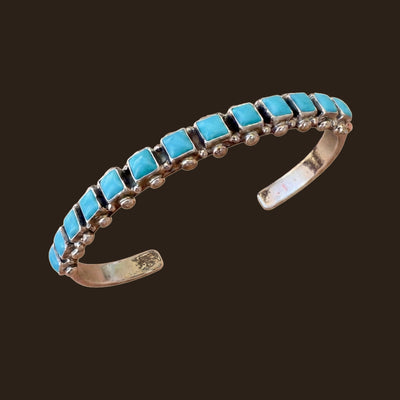
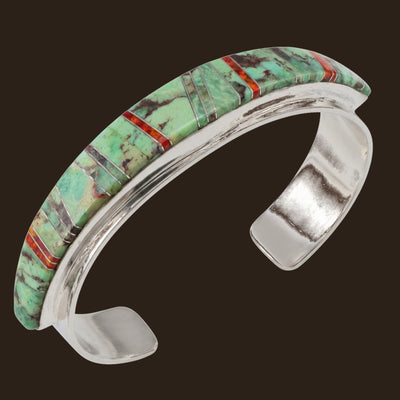
Styling these stones is an exercise in balance. The intricate, lace-like pattern of a tight web is a visual feast, so we often pair them with minimalist silverwork to avoid competition. A wide turquoise cuff bracelet allows the pattern to be seen in its full glory across a larger surface. The contrast of the dark matrix against the bright metal creates a sophisticated look that works as well with a casual linen shirt as it does with evening attire. If you're ready to add a rare pattern to your collection, explore our artist-made sterling and turquoise jewelry to find a piece that resonates with your personal style.
Caring for and Styling Spiderweb Turquoise Jewelry
Caring for spiderweb turquoise requires protecting the stone from oils and chemicals that can penetrate the more porous veins of the matrix. Because these stones are natural works of art, they are most effectively displayed in high-quality .925 sterling silver or solid 14K gold settings that protect the edges of the cabochon. Understanding what is spiderweb matrix in turquoise involves recognizing that the matrix lines are often composed of minerals like limonite, which can be more absorbent than the turquoise itself. This physical trait makes the stone sensitive to environmental factors like perfumes and lotions.
We recommend styling these intricate stones as standalone statement pieces to avoid visual clutter. The complex, lace-like pattern of a high-grade spiderweb provides enough visual interest that adding other busy accessories can feel overwhelming. A single turquoise cuff bracelet or a large pendant necklace allows the natural narrative of the stone to take center stage. Knowing what is spiderweb matrix in turquoise helps you choose minimalist settings that won't distract from the pattern's organic beauty. Avoid using ultrasonic cleaners or harsh chemical soaps on any matrix-heavy stones. These tools can vibrate the stone too intensely or strip away natural oils, potentially damaging the delicate bond between the turquoise and its mother stone.
Protective Settings and Silversmithing
A bezel is a thin band of metal that wraps around the edge of a stone to hold it securely in place. In our studio, we prefer solid bezels over prongs for spiderweb specimens because they provide a continuous wall of protection for the stone's perimeter. This is a key part of our work at Wildflower, where our skilled silversmiths hand-cut every mount to fit the specific contours of the stone. Cool-toned .925 sterling silver is a classic choice for blue spiderweb turquoise, while we reserve solid 14K gold for the rarest specimens to elevate their natural warmth and value.
Daily Wear and Maintenance
Maintaining the luster of your jewelry is a simple process that focuses on prevention. We follow the rule that your turquoise should be the last thing you put on in the morning and the first thing you take off at night. This keeps the stone away from hairsprays and skin products that can discolor the matrix over time. For regular cleaning, use only a soft, damp cloth to gently wipe the surface of the cabochon. You can find more detailed instructions on our care and repair page. When you aren't wearing your pieces, store them in a dry, cool place to prevent the matrix from absorbing excess environmental moisture. If you're looking for a new addition to your collection, explore our artist-made sterling and turquoise jewelry to find a stone that speaks to you.
Start Your Collection with Confidence
Owning a piece of spiderweb turquoise is like holding a million-year-old narrative of the earth in the palm of your hand. You now have the tools to identify the geological rarity of these patterns and the markers of authenticity that separate natural stone from imitation block materials. We believe that the most beautiful jewelry comes from a deep respect for the medium; the host rock is a partner in the stone's design rather than a flaw. Each stone in our studio is hand-selected for its unique matrix and natural beauty. Understanding what is spiderweb matrix in turquoise allows you to evaluate high-grade cabochons with the discerning eye of a seasoned collector. Our small-batch production process uses only .925 sterling silver and solid 14K gold to protect these rare treasures for generations to come.
Explore our curated collection of handcrafted turquoise jewelry and find a piece that speaks to you. We invite you to discover a stone that resonates with your personal story. You can also find a selection of our Southwestern style pieces on Etsy as a plain alternative. We look forward to helping you find an authentic piece that you will cherish for a lifetime.
Frequently Asked Questions
Is spiderweb turquoise more expensive than clear turquoise?
Spiderweb turquoise is generally more expensive than clear turquoise because of its extreme rarity and high collector demand. Only a tiny percentage of the turquoise pulled from any given mine will feature the intricate, interconnected veins required for this specific pattern. Because these stones are so difficult to find, they command a higher price in the market than stones with a solid, uniform color.
Does all turquoise have a matrix?
Not all turquoise has a matrix, as many stones form in solid, uniform colors without any host rock inclusions. While clear stones are prized for their purity, others are valued specifically for the character their mother stone provides. Learning what is spiderweb matrix in turquoise helps you appreciate the unique geological narrative that host rock adds to a hand-cut cabochon.
Can you fake a spiderweb pattern?
It is possible to fake a spiderweb pattern using dyed resins, block turquoise, or by painting artificial lines onto the surface of a stone. Genuine matrix is an internal structural element that permeates the entire gemstone rather than sitting on the surface. Under magnification, authentic webbing shows depth and slight organic irregularities that distinguish it from the too-perfect symmetry of laboratory-made imitations.
What mines produce the best spiderweb turquoise?
The Number 8, Kingman, and Royston mines are among the most famous sources for high-grade spiderweb turquoise in the American Southwest. Each of these locations produces a distinct signature, such as the golden-brown web of the Number 8 or the dark limonite lines often found in Kingman stones. These mine-specific markers help collectors identify the origin and the geological history of a specific piece.
Is black matrix better than brown matrix?
Neither black nor brown matrix is objectively better, as the value is usually determined by the tightness and consistency of the web rather than its specific color. Black matrix provides a high-contrast look that many find striking against bright blue turquoise. Brown or golden matrix offers a warmer, more earthy aesthetic that often complements the green-toned stones found in Nevada mines.
How do I clean spiderweb turquoise jewelry?
You should clean your jewelry using only a soft, slightly damp cloth to avoid damaging the stone or its setting. Never use ultrasonic cleaners or harsh soaps because the matrix veins are often more porous than the turquoise itself. These porous areas can absorb chemicals, oils, or perfumes, which may darken the matrix or dull the stone's natural luster over time.

Article by
Kimberly Cordova
Kimberly Cordova is the founder and creative director of Wildflower Artisans, a handmade jewelry brand rooted in Santa Fe. Real turquoise, solid sterling silver, and a small line set in solid 14K gold. She built Wildflower around a simple belief: the best jewelry is the kind you actually reach for, not the kind you save for someday.
The collection is built three ways. Some pieces are made in-house, cut by her husband Greg from stones he sources himself, including rough from the family's King's Manassa Mine in Colorado and White Buffalo Mine in Nevada. Some are designed by Kimberly and fabricated by a trusted circle of Santa Fe silversmiths. And some are finished work she curates from artisan makers whose craft meets the same standard, because building a real collection means knowing when to make and when to look.
Turquoise leads, joined by White Buffalo, Wild Horse, Lapis Lazuli, Spiny Oyster, Black Onyx, Opal, and other genuine semi-precious stones. No shortcuts on the stone, the silver, or the story behind either.
Her writing covers everything she has learned along the way: how turquoise forms, how to tell natural from stabilized, what makes one mine different from another, how to read a bezel, and how to shop with confidence in a market that is not always straightforward. It is the kind of plainspoken information she wished someone had laid out for her when she was starting out.
Browse the collection at wildflowerartisans.com. Questions about a stone, a setting, or a specific piece are welcome any time.

0 comments