

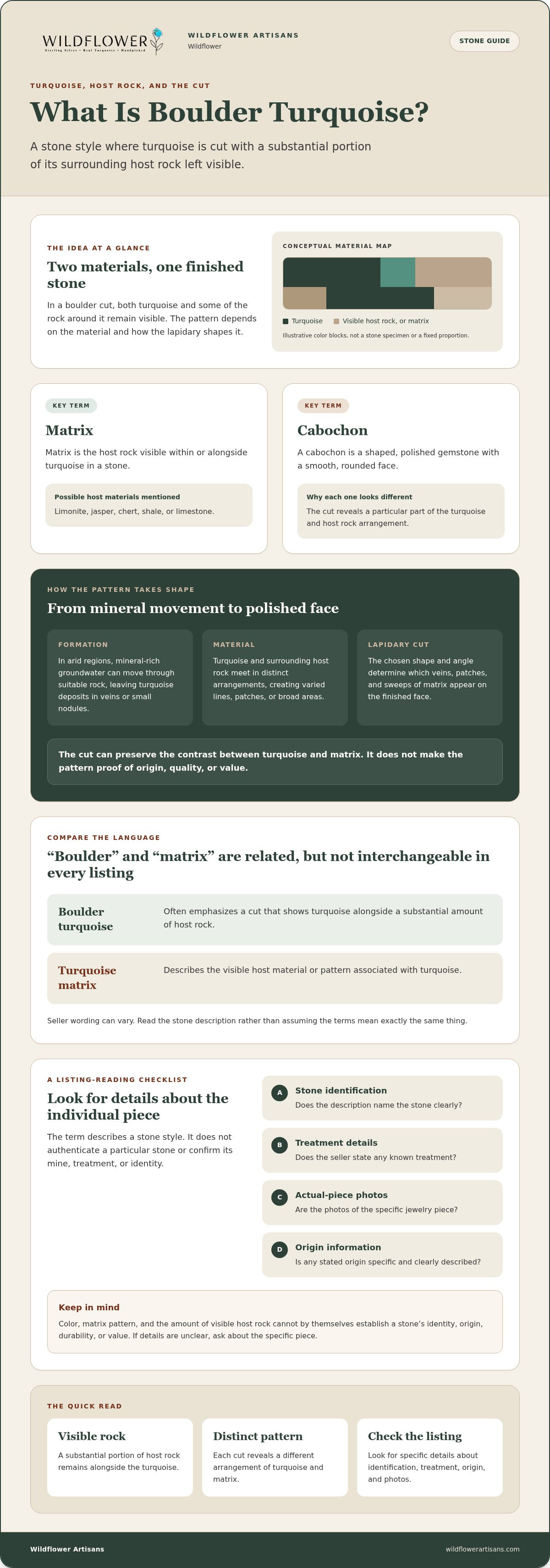
What if the brown around a turquoise vein is part of the stone’s appeal, not an imperfection to hide? If you’re asking “what is boulder turquoise,” the term generally describes turquoise cut with a substantial amount of its host rock left visible alongside it.
That surrounding rock is called matrix. Its color and pattern can make each cabochon look like a small landscape. Knowing what the term describes helps when a jewelry listing uses “boulder turquoise” loosely or a striking pattern leaves you unsure what you’re seeing. Below, we explain how turquoise and matrix appear together, how a boulder cut differs from a stone with fine spiderweb lines, and what to check in a listing, including any stated origin or treatment. A vivid surface may catch your eye, but clear details about the individual stone help you understand what you’re choosing.
Key Takeaways
- Learn what is boulder turquoise and why visible host rock is part of its distinctive look.
- See how a lapidary’s cut can preserve the contrast between turquoise and matrix in a cabochon.
- Understand why sellers may use “boulder turquoise” and “turquoise matrix” differently.
- Use a simple checklist to assess stone descriptions, treatment details, and photos of the actual jewelry piece.
- Explore genuine turquoise jewelry and check individual listings for details about each stone.
What Is Boulder Turquoise? A Clear Definition of the Stone
Boulder turquoise is turquoise cut with a substantial portion of its host rock, or matrix, left visible in the finished stone. The turquoise may appear as veins or ribbons running through the surrounding rock, so both materials remain visible in the cabochon.
In a jewelry listing, “boulder turquoise” generally describes the stone’s appearance and how it has been cut. It does not name a specific color or quality grade. Its earthy lines and contrasting areas can make each piece distinctive, but the pattern alone cannot establish the stone’s identity, treatment, origin, or value.
What does boulder mean in boulder turquoise?
In plain language, “boulder” points to turquoise presented with a noticeable amount of the surrounding rock, rather than a cut that shows mostly turquoise. Matrix is the host rock visible within or alongside turquoise in a stone. Depending on the material, that rock may include limonite, jasper, chert, shale, or limestone.
Turquoise forms when mineral-rich groundwater moves through suitable rock in arid regions, leaving deposits in veins or small nodules. During lapidary work, a cutter can shape the material to preserve some of the host rock beside the turquoise. The matrix may appear as a broad field, a branching line, or a narrow ribbon. These patterns describe what you see, not a quality grade. Appearance alone does not prove a stone’s durability, value, or identity.
Is boulder turquoise still real turquoise?
Yes, boulder turquoise can be genuine turquoise. However, the words “boulder turquoise” in a listing do not authenticate a particular piece. The label describes a style of stone, but does not by itself confirm the mine, treatment, or even whether the material has been accurately identified.
Look for a description that names the stone and states any known treatment. If those details are unclear, ask the seller what is known about the specific piece rather than relying on its color or matrix pattern as proof. A helpful turquoise buying guide can also help you compare listing details and prepare focused questions.
How Turquoise and Host Rock Create Boulder Turquoise’s Pattern
Boulder turquoise’s pattern comes from turquoise occurring within surrounding host rock, combined with the lapidary’s decision about how to shape the material. In arid regions, mineral-rich groundwater can move through rock containing copper and aluminum, allowing turquoise to form in veins or small nodules. A cut can preserve some of the surrounding rock, leaving both materials visible in the finished stone.
What is matrix in a turquoise stone?
Matrix is the visible host material associated with turquoise. It may appear as lines, patches, or web-like markings beside or across the turquoise. In a boulder cut, a lapidary may retain a larger area of host rock, making its relationship to the turquoise especially clear.
There is no single pattern that defines the stone. One piece may show a broad field of host rock with a narrow turquoise vein, while another may have more turquoise crossed by irregular markings. Color and proportion vary from stone to stone. Neither a particular pattern nor the amount of matrix proves a stone’s origin or quality.
Why do boulder turquoise cabochons look different from one another?
A cabochon is a shaped, polished gemstone with a smooth, rounded face. As a lapidary studies the material, the chosen cut determines which areas of turquoise and matrix appear on that face. A different angle or outline can bring forward a vein, a patch, or a wider sweep of host rock.
Each boulder turquoise pattern differs because the turquoise and host rock meet in a distinct arrangement, and each cut reveals a different part of it. Two stones can share a boulder appearance yet have very different balance, color, and movement. Their patterns may be visually distinctive, but they cannot identify a mine by themselves.
The contrast between turquoise and matrix gives each stone its own visual character. Wildflower Artisans offers artist-made jewelry featuring genuine turquoise and sterling silver. Browse the turquoise collection and check each listing for details about the individual stone.
Boulder Turquoise vs. Turquoise Matrix: What the Names Tell You
“Boulder turquoise” and “turquoise matrix” overlap in seller language, but they are not universally identical terms. “Boulder” often emphasizes a cut that shows turquoise alongside a substantial amount of host rock. “Matrix” describes the visible host material or pattern. Treat either label as a description to clarify, not as a standardized guarantee.
| Term | What it generally describes | What to check |
|---|---|---|
| Boulder turquoise | A stone cut to show turquoise with a noticeable portion of host rock. | Review the actual piece and ask how the seller identifies its material. |
| Turquoise matrix | Visible host material or markings associated with turquoise. | Check whether the listing describes lines, patches, or a larger area of host rock. |
Does boulder turquoise mean the same thing as turquoise matrix?
Not always. Matrix names the visible host material or its pattern, while “boulder” often highlights how much host rock remains visible beside the turquoise. A seller may describe matrix without calling the piece boulder turquoise, or use the terms with some overlap. Compare the wording with clear views of the individual stone rather than assuming every listing follows the same naming convention.
The distinction is between what the stone visibly shows and the seller’s chosen description. If the amount or placement of host rock matters to you, ask the seller to explain how the term applies to that specific piece.
Does the word boulder tell you a turquoise stone’s value or origin?
No. “Boulder” alone does not establish a stone’s grade, mine, treatment, or value. A broad field of matrix or fine web-like markings may describe its appearance, but the label cannot confirm where the material came from or how it was treated. Look for item-specific details instead of drawing conclusions from the name or pattern.
For more stone and jewelry terminology, explore our turquoise glossary. You can also browse handmade jewelry and review each listing for information about its individual stone.
How to Read a Boulder Turquoise Jewelry Listing with Confidence
A useful listing identifies the stone, shares any known treatment details, and shows clear views of the actual jewelry piece. These details help you separate information about the stone from seller terminology or assumptions based on its color and pattern.
Use this checklist as you review a listing:
- Stone identification: Does the description clearly name the material as turquoise, rather than relying only on a style label?
- Treatment: Does the seller disclose any known treatment, or answer your question about what is known for this specific stone?
- Actual-piece photos: Are there clear views from more than one angle, and does the seller confirm that the photos show the piece being sold?
- Origin claims: Is a mine or location stated as a documented detail, rather than inferred from the stone’s appearance?
This checklist can help you ask useful questions, but it cannot prove authenticity on its own. If a detail matters to your decision, ask the seller to clarify it before purchasing.
What should a listing say about a boulder turquoise stone?
Look for a direct material description and any known treatment information. A listing might use “boulder” to describe the visible balance of turquoise and host rock, but that word alone does not explain the stone’s identity, treatment, or origin. Ask whether the photos show the exact piece, especially if its pattern is a major part of what appeals to you.
Can you identify boulder turquoise from a photograph?
A photograph can show visible color and matrix, but it cannot establish every material fact about a stone. Lighting, camera settings, and image editing may change how turquoise hues or host-rock markings appear. Compare several views with the written description, and ask the seller about anything that remains unclear.
If you’re weighing details beyond appearance, Wildflower’s turquoise buying guide offers broader questions to consider while shopping. Use it alongside item-specific descriptions, not as a substitute for them.
Every cut preserves a different balance of turquoise and matrix, so a clear listing helps you understand the stone in front of you. Wildflower’s collection features genuine turquoise jewelry in artist-made designs. Check individual listings for the stone details provided.
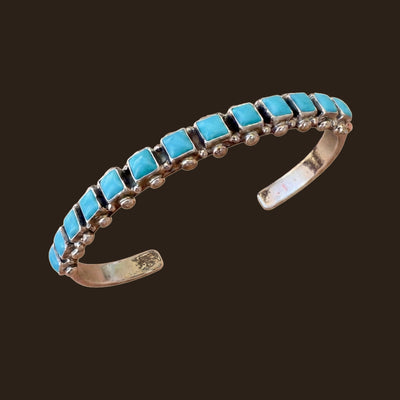
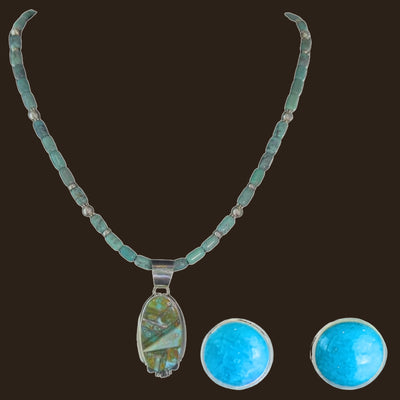
Explore Genuine Turquoise Jewelry with Stone Details Clearly Stated
Wildflower offers artist-made jewelry featuring genuine stones and sterling silver. When considering a particular piece, check its individual listing for the stone’s identification and any known treatment details. Do not assume that a collection-wide description answers questions about a specific stone.
That distinction matters because “boulder” describes a visible relationship between turquoise and host rock, while a listing should describe the stone in the piece. Clear details help you understand what you’re considering, whether you’re choosing for yourself or selecting a gift. The word “turquoise” alone may not answer questions about treatment or origin.
What makes a stone-specific jewelry description useful?
A stone-specific description connects the material you see to the actual piece being offered. Look for a direct identification and any disclosed treatment information. Consider origin details only when the seller can confirm them. If something important is missing, ask rather than filling in the gap based on color, matrix pattern, or a broad collection label.
Wildflower shares information about its approach to genuine stones on its turquoise authenticity page. Use that information as context, then read the description for the individual piece you’re considering. A general statement about a retailer or collection should not be treated as proof of a particular stone’s origin or treatment.
How can readers continue learning about turquoise?
The central idea behind what is boulder turquoise is turquoise presented with visible host rock. Sellers may use related terms in different ways, so compare the wording with the item’s description and ask for clarification when needed.
For more context as you compare stones, Wildflower’s turquoise glossary can help with terminology, while its turquoise buying guide offers broader questions to consider. Use those resources alongside the listing, not in place of its stone-specific details.
Choosing turquoise jewelry is easier when the description makes the materials clear. Take time to review each listing, consider the details that matter to you, and choose a piece whose materials and description you understand.
Choose Turquoise with a Clearer Eye
Now you can answer what is boulder turquoise: it describes turquoise shown with visible host rock, with the matrix pattern shaped by the material and the lapidary’s cut. Sellers may use “boulder” and “matrix” differently, so look beyond the label. Check the description for the specific stone, ask about known treatment, and remember that a photograph can show a pattern without confirming every detail.
Wildflower offers artist-made jewelry featuring genuine stones and sterling silver. For more about its approach to authenticity, read Wildflower’s authenticity information, then review the details on each individual listing.
Take your time finding a piece whose materials and details feel right. Each stone has its own character, and a thoughtful choice can make its natural pattern part of your story.
Frequently Asked Questions
What is boulder turquoise?
Boulder turquoise is turquoise cut with a noticeable portion of its surrounding host rock left visible in the finished stone. The host rock, called matrix, may appear as lines, patches, or broader areas beside the turquoise. “Boulder” describes the stone’s appearance and cut, not a quality grade or confirmed origin. Sellers may use the term differently, so check the description of the specific piece.
Is boulder turquoise real turquoise?
Yes, boulder turquoise can be genuine turquoise presented with visible host rock. However, the label alone does not verify a particular stone’s identity or treatment. Look for an explicit stone description and any known treatment information, and ask the seller for clarification if those details are missing. Do not assume that every piece described as boulder turquoise is untreated or comes from a particular mine.
What is the difference between boulder turquoise and turquoise matrix?
The terms overlap, but they are not always used identically. “Matrix” refers to the visible host material or its pattern in a turquoise stone, while “boulder turquoise” often emphasizes a cut that preserves a substantial amount of host rock alongside the turquoise. A listing may mention matrix without using “boulder.” Since seller terminology can vary, use the photos and item-specific description to understand what’s being offered.
Can you tell if boulder turquoise is genuine from a picture?
No. A photograph can show visible color and matrix, but it cannot confirm that a stone is genuine turquoise or establish its treatment or origin. Lighting, camera settings, and image editing may also affect how the colors and markings appear. Compare multiple views with the written description, ask whether the images show the exact piece, and contact the seller if any important material details remain unclear.
Article by
Kimberly Cordova
Kimberly Cordova is the founder and creative director of Wildflower Artisans, a handmade jewelry brand rooted in Santa Fe. Real turquoise, solid sterling silver, and a small line set in solid 14K gold. She built Wildflower around a simple belief: the best jewelry is the kind you actually reach for, not the kind you save for someday.
The collection is built three ways. Some pieces are made in-house, cut by her husband Greg from stones he sources himself, including rough from the family's King's Manassa Mine in Colorado and White Buffalo Mine in Nevada. Some are designed by Kimberly and fabricated by a trusted circle of Santa Fe silversmiths. And some are finished work she curates from artisan makers whose craft meets the same standard, because building a real collection means knowing when to make and when to look.
Turquoise leads, joined by White Buffalo, Wild Horse, Lapis Lazuli, Spiny Oyster, Black Onyx, Opal, and other genuine semi-precious stones. No shortcuts on the stone, the silver, or the story behind either.
Her writing covers everything she has learned along the way: how turquoise forms, how to tell natural from stabilized, what makes one mine different from another, how to read a bezel, and how to shop with confidence in a market that is not always straightforward. It is the kind of plainspoken information she wished someone had laid out for her when she was starting out.
Browse the collection at wildflowerartisans.com. Questions about a stone, a setting, or a specific piece are welcome any time.
0 comments