

A single squash blossom necklace is less of a piece of jewelry and more of a map that traces a path through Moorish Spain, colonial Mexico, and the rich cultural tapestry of the continent. It's a design that feels deeply rooted in the earth, its origins as fluid as the molten silver used to create it. You’ve likely felt the weight of a heavy silver crescent or traced the smooth surface of a vibrant turquoise cabochon, sensing a deeper narrative held within the metal. To truly appreciate these pieces, it helps to understand the story behind the squash blossom design and how it evolved from a Spanish horse bridle ornament into a hallmark of a distinctive and cherished style.
At Wildflower Artisans, we believe that understanding the history behind a piece makes it a vessel for emotion rather than just an accessory. We'll guide you through the cross-cultural history and technical silversmithing artistry that define this recognized silhouette. You'll learn to identify the difference between authentic artisan work and factory imitations. This knowledge is vital in a market where the prevalence of counterfeit jewelry is a serious concern, with millions of dollars' worth sold each year. We're going to look closely at the meaning of the Naja, the precision of a hand-set bezel, and the nuances of sterling silver (.925) construction. It's a journey into the heart of the working studio at Wildflower. Every hand-cut stone tells a story of patience and skill.
Key Takeaways
- Trace the history of the Naja pendant from its origins as a protective Spanish bridle ornament to its place as a focal point in Southwestern style.
- Learn the story behind the squash blossom design and how the introduction of smelting and casting techniques in the 1800s transformed the region's jewelry.
- Clarify the botanical confusion by discovering why these silver beads resemble the pomegranate fruit more than the vegetable they are named after.
- Master the technical details of quality silversmithing, including how a well-crafted bezel should smoothly conform to a hand-cut cabochon.
- Gain the practical knowledge needed to verify the authenticity of sterling silver (.925) and genuine stones like Kingman or Royston turquoise.
Understanding the Squash Blossom Design and the Naja Pendant
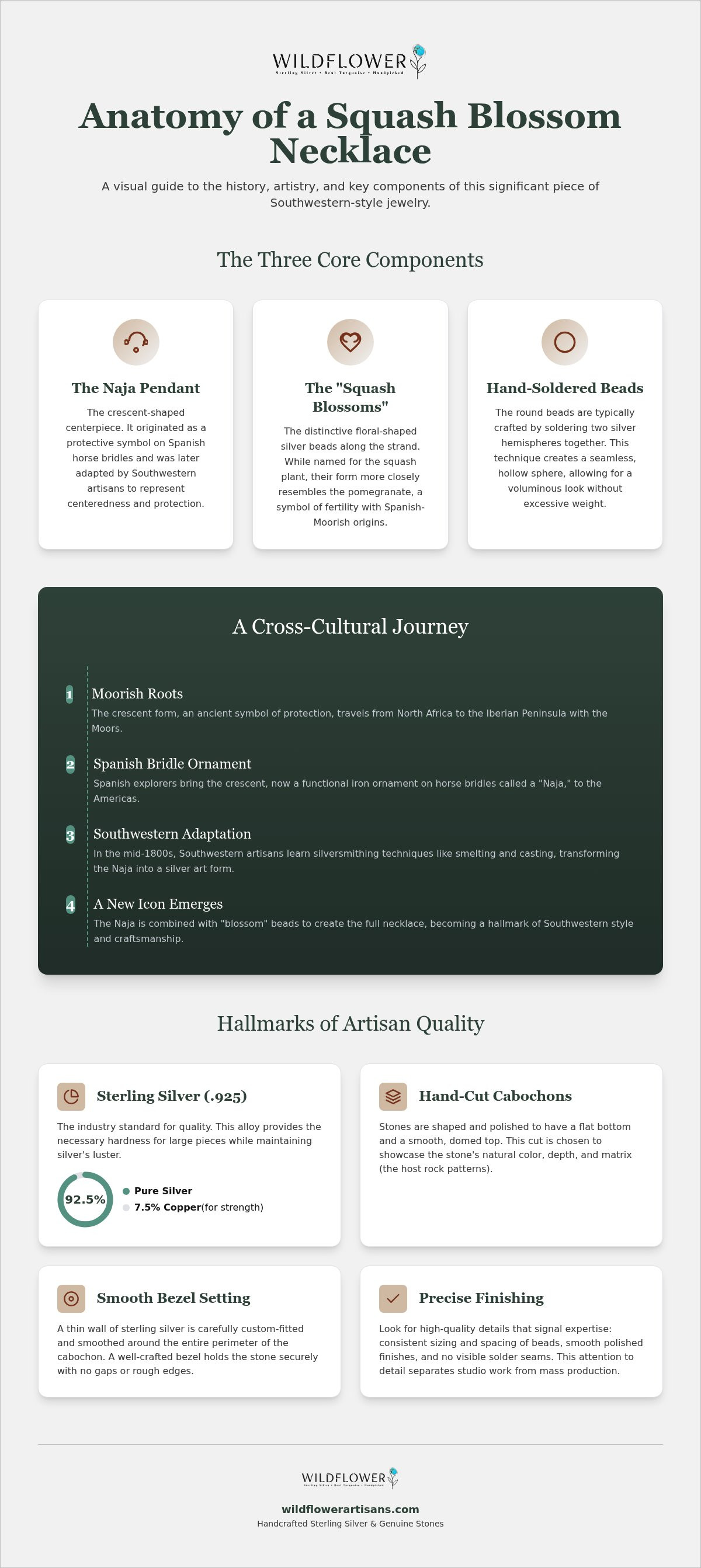
The squash blossom design is a structural harmony of a central crescent pendant called a Naja and a rhythmic sequence of silver beads and floral blossoms. This composition balances heavy silver elements with delicate spacing to create a piece that drapes gracefully against the body.
When you hold a finished piece, you can feel the intentionality in the weight. The story behind the squash blossom design is as much about the physical balance of the metal as it is about the history it carries. Artisans often use sterling silver (.925) to ensure the structural integrity of these large-scale pieces. This specific alloy, which contains 92.5 percent pure silver and 7.5 percent copper for strength, provides the necessary hardness to prevent the heavy Naja from warping over time while maintaining the luster of the precious metal. The arrangement isn't accidental. Each bead and blossom is placed to provide spacing and movement, ensuring the necklace doesn't sit stiffly but instead moves with the wearer. You can see this artistry in our collection of necklace pendants where balance is a primary focus.
The Symbolic Significance of the Naja
The Naja is a crescent-shaped ornament that serves as the focal point of the necklace. This term refers to the traditional protective symbol originally found on Spanish horse bridles. Its history is a winding one, moving through the Moorish culture of North Africa before crossing the Atlantic with Spanish explorers. While it’s often mistaken for a religious icon, it’s actually a representation of a protective boundary. In the broader context of Native American jewelry, the Naja was adapted from these iron bridle ornaments into refined silver pieces. Local creators recognized the beauty of the curve and began casting it in silver to represent a sense of centeredness and protection. It’s a beautiful example of cultural exchange where a functional object was transformed into a work of art that resonates through the centuries.
Anatomy of the Traditional Silver Bead
The beads used in these necklaces are often more complex than they appear at a glance. Most are hand-soldered, a process where two silver hemispheres are fused together using heat and a filler metal to create a seamless hollow sphere. This technique is vital for the story behind the squash blossom design because it allows for a grand, voluminous aesthetic without making the necklace too heavy to wear comfortably. These beads are interspersed with the floral blossoms to provide necessary spacing. This allows the necklace to drape naturally over the collarbone rather than bunching. When you're looking at a high-quality artisan piece, you'll notice consistent bead sizing and a smooth, polished finish that shows no visible seams. It’s this attention to technical detail that separates a studio-made piece from a mass-produced imitation.
The Influence of Spanish and Moorish Traditions on Southwestern Jewelry
The story behind the squash blossom design is a narrative of cultural fusion, where Spanish colonial influences met the technical curiosity of Southwestern creators. This blend of traditions transformed silver from a functional material into a medium for high-art personal adornment.
While silverwork is now synonymous with the high desert, these techniques arrived relatively late, appearing in the mid-19th century. Local artisans didn't just copy the work they saw; they mastered the difficult arts of smelting and casting with remarkable speed. Casting is the process of pouring molten metal into a mold to create a specific shape. Early makers often used melted silver coins, such as pesos, to provide their raw material. This practice established a lasting preference for high-purity metal, a detail that remains central to the story behind the squash blossom design today. It's why we still prioritize sterling silver (.925), which consists of 92.5 percent pure silver, to maintain that tradition of quality and luster.
Moorish Roots and the Crescent Form
The crescent shape of the Naja has a lineage that stretches back to the Moors of North Africa. During their centuries-long occupation of the Iberian Peninsula, they introduced the crescent moon symbol into Spanish art and metalwork. Spanish silversmiths eventually incorporated this design into horse trappings, particularly as a protective ornament on the browband of a bridle. When these designs traveled across the Atlantic, Southwestern artisans adopted the form. It wasn't a religious conversion but an aesthetic appreciation of the curve and the technical challenge of casting such a bold shape in silver. They saw the beauty in the asymmetrical and the organic, much like the stones we select for our work today.
Spanish Colonial Trade and Silverwork
Trade routes between Mexico and the northern territories acted as a pipeline for both ideas and tools. As artisans acquired better equipment, they refined their casting methods to create more intricate textures and details. One of the most distinct imports was the pomegranate motif, a symbol deeply tied to Spanish heraldry and representing fertility and abundance. This fruit, common in the Mediterranean, was stylized into the silver petals we recognize today. The significance of this design is so profound that it's recognized as the Official State Necklace of New Mexico. This designation honors the transition of silver from functional horse gear to a form of jewelry that captures the soul of the region. If you're looking for a piece that carries this weight of history, you might start by exploring our full jewelry collection.
Product Bridge: Handcrafted Necklace Pendants
The evolution of the Naja continues in our modern studio work, where we celebrate the crescent form through clean lines and intentional stone placement. Our collection features handcrafted necklace pendants that honor these historical silhouettes while using genuine stones like Kingman or Royston turquoise. These pieces serve as a quiet bridge between ancient protective symbols and your own contemporary personal style.
Why the Squash Blossom Design Resembles a Pomegranate
While the beads are called squash blossoms, the design actually mimics the flowering end of a pomegranate fruit. This specific shape, featuring a rounded base and spreading petals, was a common decorative element in Spanish silverwork long before it reached the Southwest.
The story behind the squash blossom design is one of botanical adaptation and cultural familiarity. Spanish silversmiths brought the pomegranate motif from the Mediterranean, where the fruit was a symbol of abundance and fertility. Local artisans, however, saw the silver petals through the lens of their own harvests. The result is a design that carries the history of two worlds in its silver curves. It's a testament to how we find meaning in the things we grow and the things we create.
The Visual Connection to the Pomegranate
If you examine the silver petals on a traditional bead, you'll notice they flare outward from a central point just like the calyx of a pomegranate. A calyx is the protective outer layer of a flower bud that remains at the top of the fruit after it ripens. Spanish explorers carried dried pomegranates and seeds, and the visual memory of this fruit influenced the silver patterns they commissioned from local makers. The pomegranate was often used as a symbol on Spanish capes and buttons, which were frequently traded with artisans. These small silver details were the seeds of what would become the most recognized silhouette in the region. It’s a study in how a single shape can travel across oceans and take on new life.
The Adoption of the Squash Blossom Name
The linguistic shift from pomegranate to squash blossom occurred because squash was a staple of local agriculture and culture. To an artisan who spent their days tending to the earth, the silver petals looked remarkably like the blossoms in their own gardens. The visual similarity between the two blossoms is striking, both featuring a soft, trumpet-like flare. The term was likely popularized by early traders who needed a descriptive name for the jewelry to help bridge the gap between artisan creators and national buyers. This helped position turquoise jewelry as a product of the Southwestern landscape. Today, the name represents a specific genre of style rather than a literal botanical study. It’s a reminder that authenticity is often found in the way we interpret the world around us. The misnomer has become a standard that honors the relationship between the maker and the land.
Technical Artistry in Hand-Cut Turquoise and Sterling Silver Settings
Technical excellence in this design is defined by the quality of the stone settings and the precision of the silver work. The story behind the squash blossom design is written in the fine lines of the metal and the character of the stones selected for each piece.
Every structural element in these pieces serves a specific purpose. A bezel is a thin band of silver that wraps around the edge of a stone to hold it securely in place. High-quality bezels are smooth and conform perfectly to the stone shape without gaps or jagged edges. Most Southwestern style jewelry features stones cut as a cabochon. A cabochon is a stone that has been shaped and polished into a smooth, rounded form rather than faceted. This cut highlights the natural matrix of the turquoise. The matrix refers to the host rock remains found within a turquoise stone. These patterns of brown, black, or gold are unique to each individual mine and serve as a fingerprint of the stone's origin.
Selecting Genuine Stones and Mine Origins
Authentic pieces often feature stones from specific mines such as Kingman, Royston, or Sleeping Beauty. Each mine produces a distinct color profile and matrix pattern. For instance, Royston is known for its deep greens and browns, while Sleeping Beauty is prized for its clear sky-blue hue. White Buffalo jewelry offers a striking alternative to traditional blue stones. White Buffalo is a high-contrast stone with black chert matrix found in Nevada. It's technically a magnesite and alunite mixture, but its visual impact is undeniable. Refer to our turquoise glossary to understand the technical terms used by lapidary experts when describing stone quality.
The Role of the Silversmith in Design Balance
A master silversmith must calculate the weight of the silver to ensure the necklace is comfortable for the wearer. Sterling silver (.925) provides the necessary durability for these intricate designs. It's an alloy of 92.5 percent pure silver and 7.5 percent copper, giving the piece the strength to hold heavy stones without bending. The spacing of the blossoms is critical for a flattering drape. If the blossoms are too close, the necklace will feel stiff and unnatural against the skin. Hand-stamped details on the Naja or the petals add a layer of texture that mass-produced pieces cannot replicate. This stamping is done using steel tools and a hammer, a process that requires a steady hand and years of practice.
The relationship between the silver setting and the stone is the heart of our studio philosophy. We focus on finding the perfect stone first and building the silver around its natural character. Our selection of authentic turquoise jewelry showcases hand-cut cabochons from reputable mines. These pieces are built to last using traditional silversmithing methods.
How to Select a Handcrafted Squash Blossom Necklace for Your Collection
Selecting a handcrafted necklace requires an eye for technical detail and an appreciation for the artisan’s individual style. This process involves evaluating the physical weight, the hallmark of the silversmith, and the integrity of the stone settings to ensure the piece is a genuine work of art.
When you're ready to add one of these pieces to your life, you're not just buying jewelry; you're becoming a steward of the story behind the squash blossom design. It’s a weight you should feel, literally and figuratively. A quality sterling silver (.925) necklace should feel substantial but not burdensome, resting with a certain gravity that speaks to the density of the metal. If a piece feels surprisingly light, it might be hollow or made of a lesser alloy. Most Southwestern style jewelry is built to last for generations, and that longevity starts with the thickness of the silver used in the beads and the Naja.
Look for the hallmark of the artisan on the reverse side of the silver. A hallmark is a small stamp that identifies the creator and the metal purity, acting as a signature of the working studio. This little mark is your assurance that the piece was made with the technical excellence we’ve discussed throughout this guide. You should also verify the authenticity of the stones. Genuine turquoise has a depth and character that dyed howlite or plastic can never replicate. Look for a natural matrix and the subtle variations in color that occur when a stone is hand-cut from a specific mine. You can learn more about our commitment to genuine materials on our authenticity page. Avoid mystery metals that lack a clear purity stamp.
Evaluating the Symmetry and Drape
Lay the necklace flat on a table to check its alignment. The Naja should sit perfectly centered, and the blossoms should be mirrored on each side like the leaves on a stem. Pick the necklace up and hold it against your neck to feel how it settles. The beads should roll smoothly without catching or kinking. This fluidity is the result of careful stringing and consistent bead sizing. The length of the necklace should complement your wardrobe and frame. Common lengths range from 20 to 30 inches, depending on the number of blossoms and the scale of the Naja. A shorter 20-inch piece might feature fewer blossoms and sit higher on the collarbone, while a 30-inch version offers a more dramatic, traditional drape.
Investing in Artisan-Made Quality
Artisan-made jewelry is an investment in a specific creative vision and a connection to the story behind the squash blossom design. These pieces are often one-of-a-kind, reflecting the personality of the silversmith in every hand-stamped detail. High-quality jewelry uses solid sterling silver rather than plated metals. Plating eventually wears away, but solid .925 silver can be polished and repaired over decades of wear, becoming a family heirloom. Choosing a piece with a documented mine origin, like Royston or Kingman, adds to the narrative value of your collection. It connects the silver to the earth in a way that mass-produced fashion can't achieve. You're choosing a piece that will grow more beautiful as it patinas with age, telling its own story alongside yours.
Honoring the Legacy of Southwestern Silverwork
The story behind the squash blossom design is a living record of how disparate cultures can weave together to create something entirely new and deeply meaningful. From the protective crescent of the Naja to the delicate flare of silver petals, these pieces carry a weight that goes beyond their physical sterling silver (.925) construction. You now understand that while the name honors the essential squash crop, the silhouette itself captures a Mediterranean pomegranate motif brought to the high desert centuries ago. This technical and cultural fusion is what makes each handcrafted piece a vessel for history and emotion.
When you choose a piece from our working studio, you're investing in small-batch artisan craftsmanship and the preservation of these narratives. We prioritize a stone-first philosophy, using hand-cut cabochons from reputable mines like Kingman and Royston. Each setting is carefully constructed with a smooth bezel to ensure your jewelry remains a reliable companion through the years. We invite you to explore the work that continues this tradition of technical excellence and authentic expression.
We're here to help you find a piece that resonates with your own story. Every hand-cut stone and polished silver bead is a celebration of the natural world and the skilled hands that shape it.
Frequently Asked Questions
Is the squash blossom design a religious symbol?
No, the squash blossom is not a religious icon but rather a symbol of protection and cultural fusion. While the Naja crescent was once used to ward off the evil eye in Moorish tradition, its adoption in the Southwest was largely based on aesthetic appreciation. It represents a protective boundary and a deep connection to the earth. Today, it stands as a hallmark of Southwestern style rather than a specific spiritual instrument.
What is the meaning behind the Naja pendant?
The Naja is a crescent-shaped pendant that serves as the focal point of the necklace, originating from Spanish horse bridle ornaments. Its name comes from the Navajo word for crescent. Historically, it was believed to offer protection. In the story behind the squash blossom design, the Naja acts as a visual anchor, balancing the rhythmic flow of the silver beads and floral blossoms that drape around the neck.
Can you wear a squash blossom necklace with casual clothing?
Yes, you can absolutely wear a squash blossom necklace with casual clothing like a simple white linen shirt or a denim jacket. These pieces are intended to be lived in, not just reserved for formal occasions. The weight of the silver and the vibrant matrix of the hand-cut stones provide a grounded, artisanal contrast to everyday fabrics. It’s a way to carry a piece of the high desert with you wherever you go.
How can you tell if a squash blossom necklace is real sterling silver?
You can verify the metal by looking for a small stamp, or hallmark, that says .925 or the artist’s unique signature. This indicates the piece is made of sterling silver (.925), which is 92.5 percent pure silver mixed with copper for durability. Real silver also has a specific weight and a cool touch that plated base metals cannot mimic. Over time, genuine silver will develop a natural patina rather than chipping or revealing a different colored metal underneath.
Why are some squash blossom necklaces so much heavier than others?
The weight of a necklace depends on whether the silver beads are hollow or solid and the thickness of the Naja casting. High-quality artisan pieces often use a heavier gauge of sterling silver (.925) to ensure the piece doesn't warp over time. The density of the stones also plays a role; a large cabochon with a thick bezel setting will naturally add more gravity to the design than smaller, thinner stones.
What is the difference between turquoise and White Buffalo stones in these designs?
Turquoise is a copper and aluminum phosphate known for its blue and green hues, while White Buffalo is a white magnesite and alunite stone with a black chert matrix. Turquoise colors vary based on the specific mine, such as the sky blue of Sleeping Beauty or the deep greens of Royston. White Buffalo provides a high-contrast, monochrome look. Both stones are hand-cut into cabochons to highlight their unique patterns and natural beauty in Southwestern jewelry.
Article by
Kimberly Cordova
Kimberly Cordova is the founder and creative director of Wildflower Artisans, a handmade jewelry brand rooted in Santa Fe. Real turquoise, solid sterling silver, and a small line set in solid 14K gold. She built Wildflower around a simple belief: the best jewelry is the kind you actually reach for, not the kind you save for someday.
The collection is built three ways. Some pieces are made in-house, cut by her husband Greg from stones he sources himself, including rough from the family's King's Manassa Mine in Colorado and White Buffalo Mine in Nevada. Some are designed by Kimberly and fabricated by a trusted circle of Santa Fe silversmiths. And some are finished work she curates from artisan makers whose craft meets the same standard, because building a real collection means knowing when to make and when to look.
Turquoise leads, joined by White Buffalo, Wild Horse, Lapis Lazuli, Spiny Oyster, Black Onyx, Opal, and other genuine semi-precious stones. No shortcuts on the stone, the silver, or the story behind either.
Her writing covers everything she has learned along the way: how turquoise forms, how to tell natural from stabilized, what makes one mine different from another, how to read a bezel, and how to shop with confidence in a market that is not always straightforward. It is the kind of plainspoken information she wished someone had laid out for her when she was starting out.
Browse the collection at wildflowerartisans.com. Questions about a stone, a setting, or a specific piece are welcome any time.
0 comments