

A heavy gauge silver cuff sits on our studio workbench at Wildflower Artisans, its surface reflecting the cool morning light while the dust from a hand-cut cabochon still clings to the jeweler's saw. A cabochon is a stone that has been shaped and polished into a smooth, rounded surface rather than faceted. Finding quality men's turquoise jewelry shouldn't feel like a guessing game between genuine earth-mined stones and dyed plastic imitations. You likely want a piece that carries the weight of .925 sterling silver and the story of a specific mine, rather than something mass-produced in a factory.
We've put together this technical guide to help you navigate the standards of lapidary work and silversmithing at Wildflower. You'll learn how to identify high-quality stone origins, understand the importance of heavy-gauge construction, and select durable designs that withstand daily wear. This exploration covers everything from the matrix of the stone to the precision of the bezel setting. The matrix refers to the host rock that remains visible within the cut turquoise stone, providing evidence of its natural origin. A bezel is a thin strip of metal that is wrapped around the stone to hold it securely in place.
Key Takeaways
- Distinguish authentic men's turquoise jewelry from imitations by verifying the use of .925 sterling silver and documented mine-specific stones.
- Evaluate stone quality through color saturation, hardness, and the character of the natural matrix.
- Examine technical details like hand-cut bezels and clean solder points to ensure long-term durability for daily wear.
- Apply specific measuring techniques for wide-band rings and heavy silver cuffs to guarantee a comfortable and secure fit.
- Understand the structural and ethical value of small-batch artisan production compared to mass-market jewelry.
What defines high-quality men's turquoise jewelry?
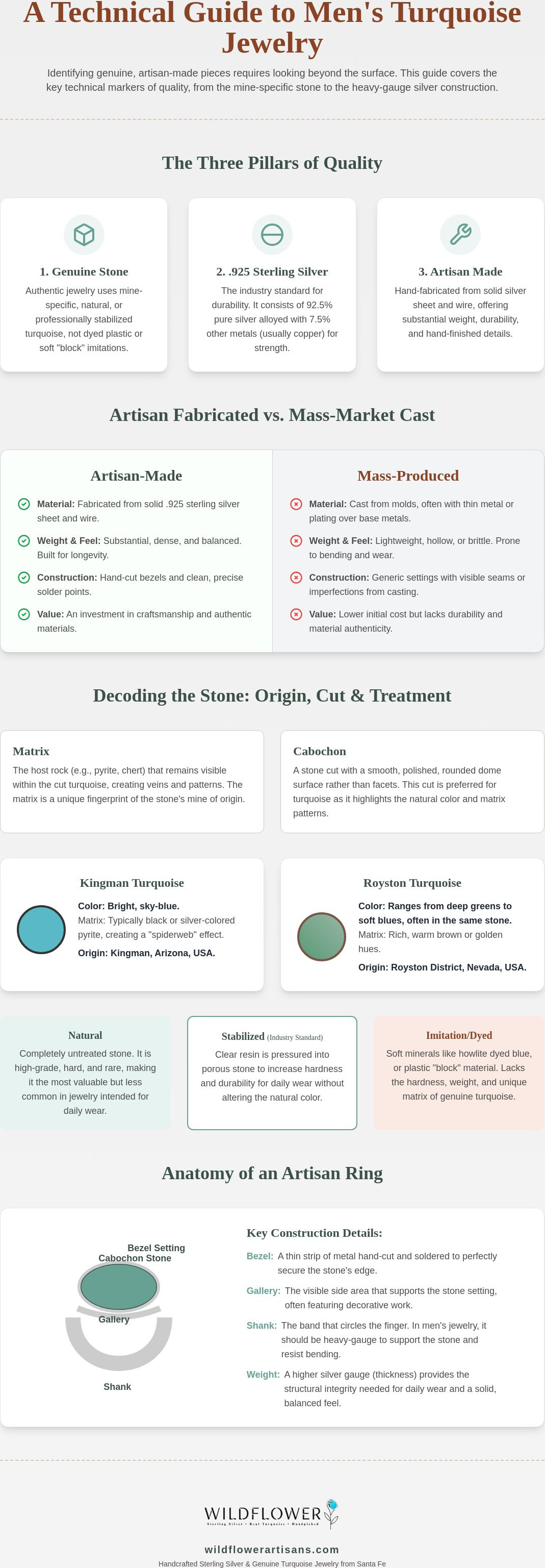
High-quality men's turquoise jewelry is defined by the use of genuine, mine-specific stones set in heavy-gauge .925 sterling silver using artisan construction techniques. This standard ensures that each piece offers both structural longevity and documented material authenticity.
When we evaluate a piece in the Wildflower studio, we look first at the marriage of stone and metal. Authentic men's turquoise jewelry consists of genuine untreated or stabilized stones rather than dyed plastic or soft "block" imitations. We use .925 sterling silver for our settings to ensure the jewelry lasts for decades. .925 sterling silver is a metal alloy containing 92.5 percent pure silver and 7.5 percent other metals, typically copper, to increase the hardness of the material. Pure silver is too soft for daily wear, so this alloy provides the strength needed for a ring or cuff to hold its shape over years of use.
We distinguish between small-batch artisan pieces and mass-produced cast jewelry by looking at the density and finish of the metal. Cast jewelry is made by pouring molten metal into a mold, which often results in thinner, lighter components that can feel hollow or brittle. Artisan-made jewelry is often fabricated from solid silver sheet and wire. This method allows for a more substantial weight and a level of hand-finished detail that mass production cannot replicate. You won't find the same structural integrity in factory-made items that use thin silver to cut costs.
The role of metal weight in durability
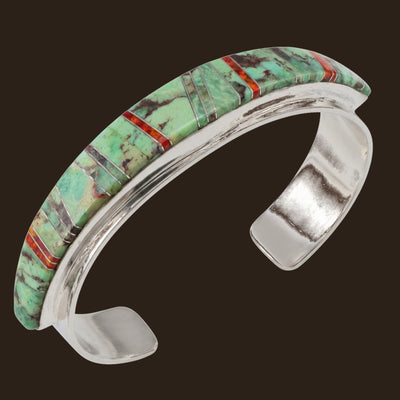
Men's jewelry requires a higher silver gauge than standard fashion pieces because it's often subjected to more physical stress. We prefer thick silver bands for rings and cuffs because they provide the structural integrity needed for daily wear. The weight of the silver impacts the tactile feel of the jewelry; it should feel solid and balanced on the wrist or finger. Lightweight alternatives often use thin metal that bends easily or thin plating that eventually wears away to reveal a base metal underneath. Investing in a piece with a high metal weight ensures the jewelry won't warp or thin out after years of contact with tools, steering wheels, or work surfaces.
Anatomy of a masculine jewelry design
A well-constructed ring is composed of several technical parts that must work in harmony. The shank is the part of the ring that circles the finger, and it must be wide enough to support the weight of the stone. The gallery is the visible side area of the ring that supports the stone setting and often features decorative stamps or saw work. In masculine designs, proportions are key. We balance the size of the hand-cut cabochon with a metal frame that is wide enough to protect the stone's edges. You can see these principles in our men's collection, where we prioritize heavy-gauge silver and secure bezel settings for every piece.
Understanding turquoise varieties and mine-specific origins
Genuine turquoise is evaluated based on its hardness, color saturation, and the presence of a natural matrix. These technical traits help us identify the origin of the stone and ensure it's suitable for the heavy wear typical of men's turquoise jewelry.
When we select stones at Wildflower, we look closely at the matrix, which is the host rock material that appears as veins or patterns within the turquoise stone. This matrix provides a visual fingerprint of the mine where the stone was formed. Most of our pieces feature a cabochon, which is a stone that has been shaped and polished into a smooth dome rather than faceted. This cut is preferred for rings and bolos because it highlights the natural patterns without the sharp edges of a faceted gem.
Comparing stones from the Kingman and Royston mines reveals the diversity of the American Southwest. Kingman turquoise often displays a bright, sky-blue color with a black or silver-colored matrix. In contrast, stones from the Royston mine in Nevada are prized for their versatility, showing colors that range from deep emerald greens to soft blues, often within the same stone. Royston matrix is usually a rich brown or golden hue that creates a striking contrast against the polished silver of a heavy ring or cuff.
Natural vs stabilized turquoise stones
Selecting the right stone for men's turquoise jewelry involves understanding how different mines produce varying levels of hardness and color stability. Stabilization is a technical process where clear resin is pressured into porous stone to harden it for jewelry use. We use stabilized stones for many of our designs because they offer the durability required for daily use without changing the stone's natural pigment. We strictly avoid dyed howlite or plastic imitations, which are often sold as "block turquoise" in mass-market retail. These materials lack the weight and character of genuine minerals. You can learn more about these distinctions in our turquoise buying guide.
Rare stones and unique matrix patterns
Some collectors prefer the earthy character of King's Manassa turquoise, which is known for its distinct green hues and golden-brown matrix. If you prefer a monochrome look, White Buffalo and Wild Horse stones provide a sharp contrast of white and black or brown patterns. While these aren't technically turquoise, they're cut as cabochons and set in the same artisan style. Every matrix pattern is unique, meaning no two pieces of jewelry will ever look exactly the same. This individuality is a core part of the appeal for those who value handcrafted artisan jewelry that tells a specific story of the earth.
We invite you to explore our current selection of men's turquoise and silver jewelry to see these unique matrix patterns in person. Each piece in our studio is chosen for its specific stone character and structural weight.
Evaluating silversmithing and technical construction
Technical quality in silverwork is found in the precision of the bezel and the cleanliness of the solder points. A bezel is a thin silver rim that is folded over the edge of a stone to secure it. When we examine men's turquoise jewelry at the studio, we look for a seamless fit where the metal meets the stone. Durable men's turquoise jewelry requires this level of technical focus to ensure the piece can handle the rigors of daily activity. Solder points are the locations where metal pieces are joined using heat; these should be smooth and free of pits or excess material. If these technical details are overlooked, the piece may lose its stone or develop structural cracks over time.
The role of a lapidary is essential in this process because they cut stones specifically for custom silver settings. In mass production, stones are often cut to standard sizes to fit pre-made molds. In contrast, an artisan lapidary hand-cuts each cabochon to highlight its specific matrix and color. The silversmith then builds a custom frame around that exact stone. This collaboration ensures that the proportions of the metal work perfectly with the weight and height of the turquoise. We focus on these small batch designs to maintain a high level of technical control over every component. You can learn more about the makers behind these pieces on our silversmiths page.
The precision of a hand-set bezel
A silversmith ensures a tight fit around the unique shape of a cabochon by carefully filing and shaping the bezel wire before soldering it to the base plate. A gap-free bezel is a sign of professional craftsmanship. It prevents moisture and debris from getting trapped behind the stone, which can lead to damage or discoloration. Some designs use smooth bezels for a minimalist look, while others use serrated bezels with a fine toothed edge. Regardless of the style, the metal must be thick enough to provide a secure grip without thinning out during the polishing phase.
Hand-stamping and silver textures
Hand-stamping is the process of using steel tools to impress designs into metal. This technique requires a heavy gauge of silver to prevent the metal from warping under the force of the hammer. High-quality silver textures show a depth and consistency that machine-pressed patterns cannot match. Machine-made patterns often look shallow and lack the crisp edges found in artisan work. Documented Southwestern style silverwork often utilizes these traditional methods to add visual weight and narrative to the design. We prioritize these techniques in our cuffs and bangles to ensure every stamped line is intentional and durable.
Selecting the right fit and style for daily wear
Finding the correct size is essential for the comfort and safety of heavy silver jewelry. If a ring is too tight, it can become uncomfortable during temperature changes when your hands naturally swell. If a cuff is too loose, it risks catching on objects or sliding off during activity. Men's turquoise jewelry often features substantial metal weights that require a precise fit to feel balanced on the hand or wrist. We've found that wide bands, which are common in masculine designs, often require a half-size larger than thin rings. This occurs because a wider surface area displaces more skin, making the fit feel tighter than a standard narrow band.
For sterling silver cuffs, the gap is the open space between the two ends of the metal. A gap that is too large can allow the cuff to rotate or slide off, while one that is too small makes it difficult to slide over the narrowest part of the wrist. Generally, a gap of one inch is the standard for most men's wrists. It's best to measure your wrist at the bone to ensure the metal length and the gap work together for a secure fit that doesn't pinch.
Measuring for rings and cuffs at home
You don't need professional tools to get an accurate measurement for your jewelry. Follow these steps to ensure your piece fits correctly from the start:
- Use a flexible measuring tape or a piece of string to find the circumference of the finger or the wrist in inches or millimeters.
- Account for the knuckle size when selecting a ring diameter. The band must be able to slide over the joint with slight resistance but without causing pain.
- Subtract the cuff gap from your total wrist measurement to determine the required metal length. For example, if your wrist measures 7.5 inches and you prefer a 1-inch gap, you should look for a cuff with a 6.5-inch inner circumference.
Caring for stones and silver
Turquoise is a porous mineral that can be sensitive to environmental factors, even when stabilized. You shouldn't expose your jewelry to household chemicals, hand sanitizers, or prolonged water submersion. These substances can seep into the stone or react with the silver, potentially altering the color of the matrix over time. To maintain the shine of .925 sterling silver, use a dry polishing cloth specifically designed for jewelry. Avoid liquid chemical dips, as they can remove the intentional oxidation that highlights the stamped patterns and the character of the stone. For more detailed maintenance guidance, visit our care and repair page.
Ready to find a piece that fits your lifestyle? Browse our full selection of authentic artisan jewelry to find the right style for your daily wear.
The value of small-batch artisan jewelry
Small-batch production allows for individual attention to stone setting and metal finishing. This focused approach is the only way to ensure that men's turquoise jewelry maintains its structural integrity over decades of use. In a working studio, we handle every component with a focus on longevity, which is fundamentally different from the mass-market model where speed is prioritized over quality. Independent studios offer a transparent alternative to the opaque supply chains of large retailers. When we sit at the bench, we aren't thinking about volume; we're thinking about the person who will wear the piece while working and living. Solid .925 sterling silver is a permanent material that can be repaired and polished indefinitely. In contrast, plated jewelry is essentially disposable, as the base metal eventually reacts with the skin or the air once the thin surface layer fails. Our commitment to authenticity means we never use mystery metals or undisclosed treatments.
Authenticity as a long-term investment
Genuine turquoise from specific mines retains value for collectors because many of these historic sites are no longer active. When you invest in a piece from a specific mine, you're securing a portion of a finite natural resource that cannot be replaced. Transparency in the lapidary process allows us to trace a stone from the rough material to the finished cabochon. In our studio, we value the natural stone asymmetries that occur in the earth. These variations in the matrix and color saturation are the signatures of a natural origin. A hand-cut stone tells a story of the earth that a factory-molded imitation never could.
Avoiding mystery metals and imitations
Base metals and thin plating carry a high risk of skin irritation and structural failure in mass-produced jewelry. These materials often contain nickel or lead, which can cause reactions for those with sensitive skin. Mass-produced cast rings are particularly prone to failure because the casting process can leave hidden air bubbles in the metal. These weak points often lead to cracked shanks or loose settings that are difficult to repair. Identifying quality artisan work requires looking past the initial shine to the technical construction underneath. By choosing small-batch jewelry, you ensure that every solder point was inspected by a human eye and every stone was set by a skilled hand.
Investing in a legacy of artisan craftsmanship
Choosing artisan men's turquoise jewelry ensures you receive a piece made with genuine mine-specific stones and heavy-gauge .925 sterling silver designed for lifelong durability. This technical standard prioritizes structural integrity and material authenticity over the disposable nature of mass-produced alternatives. We focus on small-batch studio construction at Wildflower to maintain precision in every bezel and depth in every hand-stamped texture. Understanding these details helps you move past imitation materials to find a piece that carries a genuine story of the earth. You're finding a design that resonates with your personal style and appreciation for honest, durable materials. Explore our collection of handcrafted men's turquoise jewelry to find your next heirloom.
Frequently Asked Questions
How can I tell if men's turquoise jewelry is real?
You can identify genuine men's turquoise jewelry by checking the stone's temperature and looking for a .925 hallmark on the silver. Genuine turquoise feels cool to the touch because it is a mineral, whereas plastic imitations warm up quickly against your skin. A hallmark is a small stamp on the metal that indicates its purity. You should also examine the matrix for natural variations that lack the repetitive patterns found in dyed howlite or block turquoise.
What is the difference between natural and stabilized turquoise?
Natural turquoise is untreated stone that remains in its original state after being mined, while stabilized turquoise has been treated with a clear resin to increase its hardness. Stabilization is a technical process that prevents porous stones from absorbing oils or breaking during the silversmithing process. Both varieties are considered genuine stones in artisan jewelry and are suitable for different design needs. Stabilized stones are often preferred for rings that face more physical stress.
Does sterling silver jewelry tarnish over time?
Sterling silver naturally develops a dark layer of tarnish when the metal reacts with sulfur in the atmosphere. This oxidation is a normal characteristic of .925 sterling silver and does not indicate a lack of quality or purity. You can restore the original luster of your jewelry by using a soft polishing cloth to gently rub away the surface discoloration. Regular wear can actually help prevent heavy tarnish buildup by causing constant friction against your skin.
How do I measure my wrist for a turquoise cuff?
To find your size for a turquoise cuff, use a flexible measuring tape to find the circumference of your wrist just above the bone. Once you have this measurement, subtract the gap size of the cuff from your total wrist circumference. The gap is the open space between the two ends of the cuff that allows it to slide onto the wrist. This calculation ensures the band wraps securely around your wrist without the risk of falling off or pinching the skin.
What does the matrix in a turquoise stone mean?
The matrix is the host rock material that appears as dark or light veins within the turquoise stone. These patterns are natural indicators of the specific mine where the stone was formed, such as the golden-brown matrix often found in Royston turquoise. Each matrix is unique, ensuring that every piece of men's turquoise jewelry has its own distinct visual character. Collectors often value a specific matrix pattern as much as the color of the stone itself.
Can I wear a turquoise ring every day?
You can wear a turquoise ring every day as long as you protect the stone from household chemicals, perfumes, and physical trauma. Because turquoise is a porous mineral, it can absorb substances that might alter its color or damage the surface over time. Removing your jewelry before heavy manual labor or using cleaning agents will help maintain the stone's original finish for years. Periodic cleaning with a damp cloth is usually enough to keep the setting and stone in good condition.
Article by
Kimberly Cordova
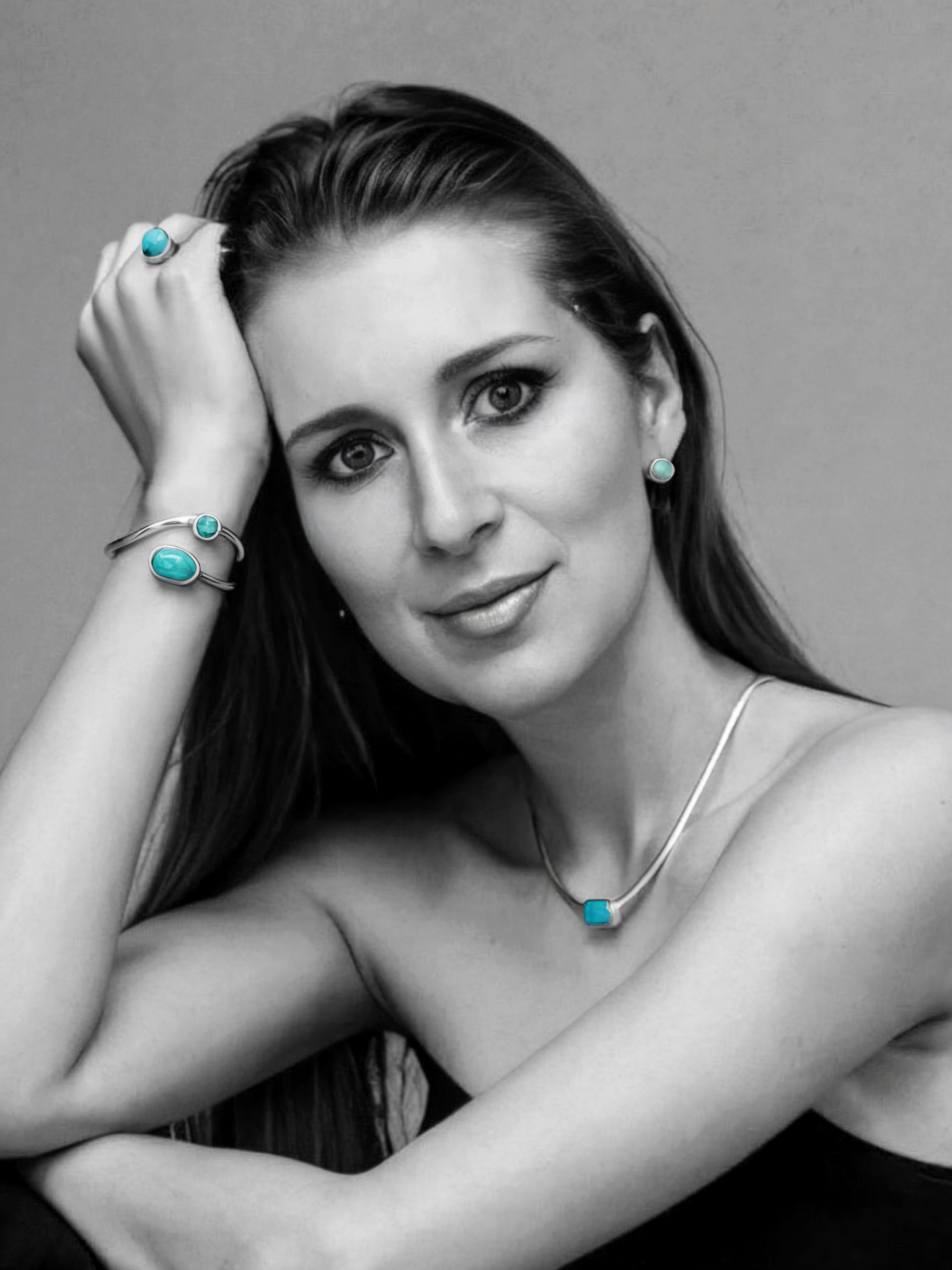
Kimberly Cordova is the founder and creative director of Wildflower Artisans, a handmade jewelry brand rooted in Santa Fe. Real turquoise, solid sterling silver, and a small line set in solid 14K gold. She built Wildflower around a simple belief: the best jewelry is the kind you actually reach for, not the kind you save for someday.
The collection is built three ways. Some pieces are made in-house, cut by her husband Greg from stones he sources himself, including rough from the family's King's Manassa Mine in Colorado and White Buffalo Mine in Nevada. Some are designed by Kimberly and fabricated by a trusted circle of Santa Fe silversmiths. And some are finished work she curates from artisan makers whose craft meets the same standard, because building a real collection means knowing when to make and when to look.
Turquoise leads, joined by White Buffalo, Wild Horse, Lapis Lazuli, Spiny Oyster, Black Onyx, Opal, and other genuine semi-precious stones. No shortcuts on the stone, the silver, or the story behind either.
Her writing covers everything she has learned along the way: how turquoise forms, how to tell natural from stabilized, what makes one mine different from another, how to read a bezel, and how to shop with confidence in a market that is not always straightforward. It is the kind of plainspoken information she wished someone had laid out for her when she was starting out.
Browse the collection at wildflowerartisans.com. Questions about a stone, a setting, or a specific piece are welcome any time.

0 comments