

A heavy, hand-wrought men's sterling silver cuff bracelet should feel like a second skin, carrying the weight of the high desert and the quiet intent of the maker, yet the search for such a piece often ends in the disappointment of a hollow, mass-produced imitation that lacks the soul of a working studio. We at Wildflower Artisans understand the hesitation that comes with buying jewelry online, particularly the fear of receiving a piece that's merely silver-plated or features a stone with a questionable history, because we believe you deserve an heirloom that matches your own durability and grit. This guide serves as a grounded conversation about quality, helping you navigate the technical differences between .925 sterling silver and lesser alloys. We'll walk through how to identify artisan details like a hand-soldered bezel or a carefully sourced cabochon, giving you the knowledge to choose a cuff from Wildflower that will age with grace alongside you.
Key Takeaways
- Identify the hallmarks of artisan quality by evaluating the weight of heavy gauge .925 sterling silver and the precision of hand-forged details.
- Choose between intricate hand-stamped Southwestern style patterns and minimalist bands to find a men's sterling silver cuff bracelet that reflects your personal story.
- Learn to appreciate the stone-first philosophy, where the unique character of a hand-cut cabochon dictates the final design of the piece.
- Follow simple steps to measure your wrist and adjust the gap for a secure fit that remains comfortable throughout the rhythms of your day.
- Understand how to maintain the intentional oxidation and natural patina of your silver to ensure its beauty deepens over time.
Evaluating the craftsmanship and weight of .925 sterling silver
High-quality silver jewelry relies on the purity of the alloy and the substantial weight of the metal to ensure a lifetime of wear. Evaluating a men's sterling silver cuff bracelet begins with understanding the .925 standard and the physical presence of heavy-gauge silver on the wrist.
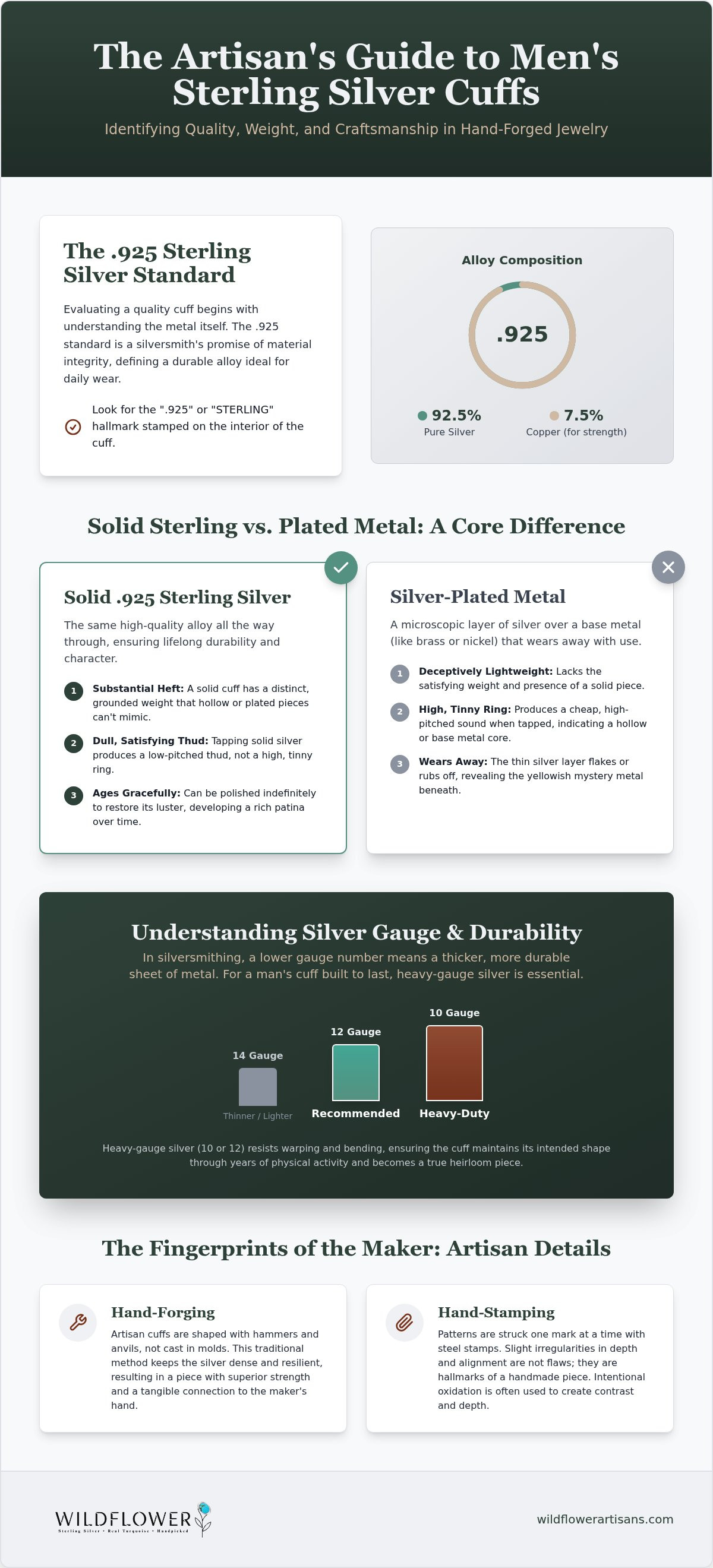
The .925 sterling silver standard defines an alloy consisting of 92.5 percent pure silver and 7.5 percent copper. Pure silver is naturally too soft for a daily-wear cuff, so the copper provides the necessary strength to hold its shape against the bumps and movements of a busy life. When you turn the bracelet over in your hands, look for the .925 hallmark stamped on the interior. This small mark is a silversmith's promise of material integrity. At Wildflower Artisans, we prioritize this authenticity in every piece we create, ensuring the metal is never a mystery.
A solid silver cuff has a distinct, grounded heft that hollow or plated alternatives cannot mimic. When you tap a solid bracelet, it produces a dull, satisfying thud rather than a tinny ring. This weight isn't just about luxury; it's about how the metal responds to the heat of your skin and the movement of your arm. A heavier piece feels permanent and intentional, grounding the wearer in the present moment.
The difference between solid silver and plated metals
Plated jewelry involves electrocuting a microscopic layer of silver onto a base metal like brass or nickel. Over months of wear, this thin skin inevitably wears away, revealing the yellowish mystery metal beneath. A solid sterling silver piece is different. Because it's the same metal all the way through, it can be polished or buffed indefinitely to restore its original luster. It lives with you, changing and brightening as you do, without ever losing its fundamental character.
Understanding silver gauge and durability
The thickness of the metal is measured by its gauge. In the silversmithing world, a lower gauge number indicates a thicker piece of silver. For a durable men's sterling silver cuff bracelet, we often look for 10 or 12 gauge silver. This heavy-gauge metal resists warping and maintains the intentional curve of the cuff, even during physical activity. Choosing a thicker gauge ensures the bracelet won't snap or thin out at the stress points where the metal flexes, making it a true heirloom piece.
Choosing between stamped Southwestern styles and minimalist bands
Selecting a men's sterling silver cuff bracelet often comes down to the narrative you want to wear on your wrist. Some prefer the rich, textured history of Southwestern style jewelry, while others lean toward the quiet strength of a minimalist band. Both styles rely on the artist's ability to manipulate heavy metal into a comfortable, wearable form. In our studio, we practice hand-forging, a process where the silver is shaped using traditional hammers and anvils rather than being cast in a mold. This method ensures the metal remains dense and resilient. When evaluating the craftsmanship and weight of these pieces, you can feel the physical difference that manual labor makes.
The art of hand-stamping silver
Silversmiths use hardened steel stamps to strike patterns directly into the metal, creating a rhythmic texture across the surface. These motifs, often inspired by the natural world, are applied one strike at a time. Because each mark is delivered by hand, you will find slight irregularities in the depth and alignment of the stamps. These aren't flaws; they are the fingerprints of the maker. To make these patterns pop, we use intentional oxidation to darken the recessed areas, providing a sharp contrast against the bright, polished silver. This technique gives the piece a sense of age and character that machine-made items simply cannot replicate.
Minimalist cuffs and smooth finishes
For those who value a clean, modern aesthetic, a minimalist band allows the quality of the silver to speak for itself. These cuffs work seamlessly in professional environments or as a subtle addition to casual attire. The beauty here lies in the finish. A high-polish finish reflects light with mirror-like clarity, while a brushed or satin finish offers a muted, understated glow that hides daily scratches well. A smooth finish emphasizes the natural, cool color of the silver, creating a piece that feels both contemporary and grounded. If you're ready to find a piece that resonates with your personal style, you can explore our full range of handcrafted silver jewelry to see these techniques in person.
Occasionally, an artist might integrate rugged leather accents into a cuff design to provide a weathered texture. This pairing of organic hide with cool metal creates a tactile, earthy contrast that softens the overall aesthetic. Whether you choose a heavily stamped piece or a simple band, the focus remains on the integrity of the material and the skill of the hand that shaped it.
Our studio's dedication to traditional methods is most evident in our curated selection of wristwear. You can browse our men's sterling silver cuffs to find both heavily textured stamped pieces and sleek, unadorned bands.
Integrating genuine stones and hand-cut cabochons
Integrating genuine stones into a cuff requires a stone-first approach where the silver bezel is hand-fitted to the unique shape of a hand-cut cabochon. This method ensures that the natural character of the stone remains the focal point of the jewelry.
At Wildflower, we follow a stone-first philosophy where the organic character of a gem dictates the entire structure of the piece. Instead of forcing a stone into a pre-made mold, the silversmith builds the men's sterling silver cuff bracelet around the specific dimensions of the stone. We primarily use cabochons, which are stones that have been shaped and polished to a smooth, rounded surface rather than being faceted like a diamond. To hold this stone securely, we use a bezel, which is a thin rim of sterling silver that is carefully folded over the edge of the stone. This traditional setting method ensures the stone stays in place during daily movement while protecting its edges from impact.
Choosing untreated, genuine stones is essential for ensuring the piece maintains its value and beauty over decades. Many mass-market options use stabilized or dyed materials that can lose their color or luster over time. We prefer stones that retain their natural hardness and hue. This allows the wearer to connect with the raw beauty of the earth in a way that synthetic materials cannot match.
Identifying genuine turquoise and its matrix
Genuine turquoise is rarely a single, uniform color. It often features a matrix, which is the host rock material that appears as intricate veins of brown, black, or gold throughout the stone. This matrix tells the story of the stone's origin. For instance, stones from the Royston mine often show a beautiful transition from forest green to light blue, while Kingman turquoise is known for its brilliant sky-blue tones. When you're searching for a men's sterling silver cuff bracelet, be wary of pieces that look too perfect or uniform. Plastic imitations or dyed howlite lack the depth and cool temperature of real stone.
The appeal of White Buffalo and Wild Horse stones
For those who prefer a more monochromatic or earthy palette, White Buffalo stone jewelry offers a striking alternative to blue. Found in the Dry Hills mine in Nevada, White Buffalo is a white stone characterized by its sharp, black chert matrix. It isn't technically turquoise, but it's often cut and set using the same traditional Southwestern style techniques. Similarly, Wild Horse is a magnesite stone known for its creamy white base and bold, reddish-brown matrix patterns. These stones provide a rugged, sophisticated look that pairs exceptionally well with the heavy gauge silver of a handcrafted cuff.
Measuring your wrist for a secure cuff fit
A properly fitted men's sterling silver cuff bracelet should rest securely just behind the wrist bone without rotating freely or sliding down toward the palm. Ensuring a correct fit is essential for daily comfort and prevents the metal from catching on clothing or surroundings.
The gap is the opening between the two ends of the silver, and it's the most misunderstood part of a cuff's anatomy. This space allows you to slip the bracelet on and off, but it also dictates how the piece balances on your arm. Most artisan cuffs feature a gap of approximately one inch. If this opening is too wide, the cuff will feel unstable and risk falling off. If it's too narrow, you'll struggle to put it on without causing unnecessary stress to the metal. A cuff that sits just behind the wrist bone allows for a full range of motion while remaining stationary.
A step-by-step guide to finding your size
Finding your size is a straightforward process that requires only a piece of string or a flexible measuring tape. Wrap the tape around the narrowest part of your wrist, just behind the bone, and note the circumference. If you are using a string, mark where the ends meet and measure that length against a flat ruler. This number represents your wrist size. When you browse our work, compare this to the total interior circumference of the cuff, which includes the gap measurement. You want a size that matches your wrist as closely as possible to ensure the bracelet remains stationary throughout your day.
How to properly adjust and wear a silver cuff
To put on your cuff, slide it onto the thinnest part of your side-wrist through the gap. Once the silver is on your arm, rotate the bracelet so the design faces up. If the cuff feels a bit loose, you can gently squeeze the ends together to achieve a more secure fit. You should only need to do this once. Avoid the habit of pulling the ends apart to take it off or squeezing it every time you put it on. This frequent bending leads to metal fatigue, a condition where the silver becomes brittle and eventually develops microscopic cracks. By making one careful adjustment, you protect the artist's work and ensure the piece lasts a lifetime.
Our studio's commitment to durability extends to how we help you wear and care for your jewelry. You can find our latest artist-made designs in the men's turquoise and silver jewelry collection, where each piece is built for daily wear.
Preserving the finish and patina of your silver jewelry
Silver naturally deepens in color over time as it reacts with the environment, a process that adds a storied character to your men's sterling silver cuff bracelet. This evolution is a sign of authenticity, separating solid .925 silver from plated metals that simply flake or peel. Patina is the thin layer of oxidation that forms on the surface of silver, turning the bright metal into a canvas of greys and blacks that highlight the maker's marks.
To slow this oxidation process, we suggest storing your jewelry in a dry, cool place away from direct sunlight. A simple cloth pouch or a lined jewelry box works well to protect the metal from the moisture in the air. This careful storage preserves the delicate balance between the bright silver and the dark, intentional oxidation applied by the maker. When you treat the piece with this level of intention, it ceases to be a mere accessory and becomes a vessel for memory. Avoiding exposure to harsh household chemicals and chlorine will also prevent the silver from developing a brittle, unwanted tarnish.
Cleaning techniques for silver and stones
Maintaining the luster of your jewelry requires a gentle touch and the avoidance of harsh chemicals that can strip away the artist's intentional finish. We recommend using a soft, non-abrasive polishing cloth to remove surface tarnish from the silver. Avoid chemical dips or ultrasonic cleaners at all costs. These methods are far too aggressive for the organic nature of our work. They can strip away the dark oxidation in the stamped patterns and permanently damage the structure of a hand-cut cabochon. Stones like turquoise are porous and can absorb chemicals, leading to permanent discoloration or structural weakness. If a stone needs cleaning, a damp cloth with a trace of mild soap is all that's required. For more detailed guidance, you can visit our care and repair page.
The role of patina in Southwestern style
The aged appearance of silver is a hallmark of Southwestern style jewelry, where the contrast between dark oxidation and bright metal creates visual depth. Patina refers to the natural darkening of the silver's surface over time. Many collectors of artisan work prefer this aged look over a high-shine finish because it tells the story of the piece's history. When you polish your men's sterling silver cuff bracelet, focus on the high points of the design. Leaving the dark oxidation in the recessed areas of the hand-stamping emphasizes the artist's skill and the three-dimensional quality of the metal. This selective polishing creates a rhythmic play of light and shadow that machine-made jewelry cannot mimic. It's a way to honor the labor of the silversmith while letting the piece evolve alongside your own rhythms.
Choosing a legacy piece for your collection
Finding a piece that resonates with your personal narrative begins with a focus on material integrity and the quiet weight of artisan skill. A high-quality men's sterling silver cuff bracelet is more than a simple accessory; it's a testament to the stone-first philosophy and the hand-forged techniques practiced in our Santa Fe studio. By prioritizing heavy-gauge .925 sterling silver and genuine, untreated stones, you ensure that your investment remains as durable as the stories it will eventually carry. We've explored how a hand-fitted bezel and a properly measured gap create a fit that feels like a natural extension of your own skin.
As you move forward, remember that the natural patina and subtle darkening of the silver are not flaws but markers of a life well-lived. Choosing jewelry made with intention means embracing the slight irregularities of hand-stamped patterns and the unique matrix of a natural cabochon. We invite you to find a piece that speaks to your own sense of authenticity and grounded style.
We look forward to helping you find an heirloom that will grow more beautiful with every season of wear.
Frequently Asked Questions
How can I tell if a cuff is real sterling silver?
Real sterling silver is identified by the .925 hallmark usually stamped on the interior surface. You can also verify authenticity through weight and temperature; solid silver feels heavy for its size and stays cool to the touch. A simple magnet test is another reliable method because silver is non-magnetic. If a magnet sticks to the bracelet, it's likely a base metal like steel or iron that has been plated with a thin layer of silver.
What is the difference between a cuff and a bangle?
A cuff features a C-shaped design with an open gap, whereas a bangle is a closed, continuous loop. Because of this opening, you can slide a cuff onto your wrist from the side rather than pushing it over your hand. This design allows for a more tailored fit that doesn't slide around. The men's sterling silver cuff bracelet is often favored for its rugged aesthetic and its ability to stay comfortably in place during movement.
Can I adjust the size of a silver cuff myself?
You can make a one-time adjustment to your silver cuff for a secure fit, but you must avoid repeated bending. To tighten the piece, cradle it in your palm and apply gentle, even pressure to the ends. If you need to widen the gap, pull the sides apart slowly. Frequent resizing causes the metal to develop microscopic stress fractures. Over time, this metal fatigue can lead to the silver cracking or snapping at the center.
What does the .925 stamp on a bracelet mean?
The .925 stamp indicates that the metal meets the international standard for sterling silver, containing 92.5 percent pure silver. The remaining 7.5 percent is typically copper, which provides the structural strength necessary for daily wear. Without this added alloy, a men's sterling silver cuff bracelet would be too soft to hold its shape or protect a set stone. This hallmark serves as a silversmith's certification of the material's purity and long-term value.
How do I clean a silver cuff with turquoise stones?
Use a dry polishing cloth to brighten the silver surfaces while keeping all liquids away from the turquoise. Turquoise is a porous stone that easily absorbs chemicals, perfumes, and even mild soaps, which can cause the color to shift or the stone to degrade. If the stone requires cleaning, use only a soft, slightly damp cloth. Avoid ultrasonic cleaners or harsh dips, as these can destroy the bezel's integrity and strip away the intentional oxidation.
Why are some silver cuffs heavier than others?
Weight variations are caused by the gauge of the silver, with lower gauge numbers representing thicker and heavier metal. Artist-made cuffs often use 10 or 12 gauge silver to ensure the piece resists warping and feels substantial on the wrist. In contrast, mass-market jewelry frequently utilizes thinner, higher-gauge sheets to reduce production costs. A heavier cuff is a hallmark of quality silversmithing, offering the durability required for a piece intended to be passed down.
Article by
Kimberly Cordova
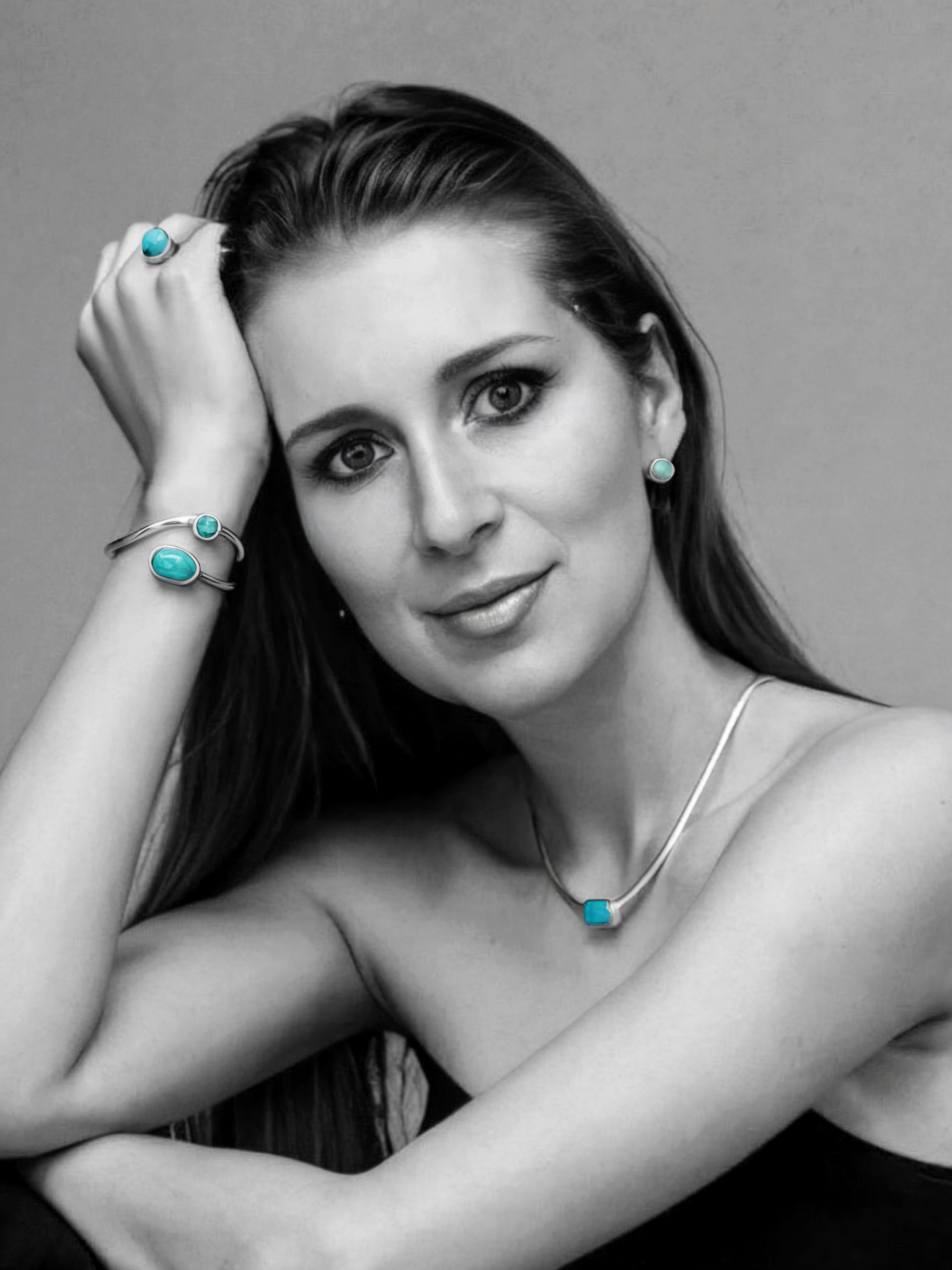
Kimberly Cordova is the founder and creative director of Wildflower Artisans, a handmade jewelry brand rooted in Santa Fe. Real turquoise, solid sterling silver, and a small line set in solid 14K gold. She built Wildflower around a simple belief: the best jewelry is the kind you actually reach for, not the kind you save for someday.
The collection is built three ways. Some pieces are made in-house, cut by her husband Greg from stones he sources himself, including rough from the family's King's Manassa Mine in Colorado and White Buffalo Mine in Nevada. Some are designed by Kimberly and fabricated by a trusted circle of Santa Fe silversmiths. And some are finished work she curates from artisan makers whose craft meets the same standard, because building a real collection means knowing when to make and when to look.
Turquoise leads, joined by White Buffalo, Wild Horse, Lapis Lazuli, Spiny Oyster, Black Onyx, Opal, and other genuine semi-precious stones. No shortcuts on the stone, the silver, or the story behind either.
Her writing covers everything she has learned along the way: how turquoise forms, how to tell natural from stabilized, what makes one mine different from another, how to read a bezel, and how to shop with confidence in a market that is not always straightforward. It is the kind of plainspoken information she wished someone had laid out for her when she was starting out.
Browse the collection at wildflowerartisans.com. Questions about a stone, a setting, or a specific piece are welcome any time.
0 comments