

A piece of genuine malachite isn't just a green stone, it's a topographical map of a lost world etched in concentric layers of forest and moss that seem to shift and breathe under the light. Many collectors feel a pull toward these deep, swirling greens but hesitate to buy malachite jewelry because the market is often flooded with plastic imitations and brittle, mass-produced settings that fail to honor the stone's organic nature.
At Wildflower Artisans, we'll show you how to distinguish a natural, hand-cut cabochon from a synthetic one and explain why the technical precision of a .925 sterling silver bezel is vital for protecting this delicate mineral's soft structure. We'll walk through the specific ways our studio identifies quality stones and the careful methods required to set them so you can feel confident in choosing a piece that captures the true, unrepeatable beauty of the earth.
Key Takeaways
- Learn to identify genuine malachite by its cool weight and irregular, organic banding that never repeats in a predictable or symmetrical pattern.
- Understand the technical necessity of a .925 sterling silver bezel setting to protect this soft stone from everyday wear and tear.
- Discover the specific cleaning techniques required to preserve the polish of your malachite jewelry without using damaging chemicals or ultrasonic heat.
- Gain a studio perspective on how the scale of a hand-cut cabochon determines the visual rhythm and style of a finished artisan piece.
- Explore the mineral origins of these copper-rich stones and why their natural growth results in unique, eye-like patterns.
Understanding Malachite and Its Distinctive Banding
Malachite is a copper carbonate hydroxide mineral distinguished by its rich green hues and rhythmic, concentric banding. This stone forms in unique clusters known as botryoidal masses, which create the signature "eye" patterns and stripes found in fine malachite jewelry. These grape-like formations are what give the stone its depth; when a lapidary artist slices through the mineral, they reveal the hidden layers of growth that have accumulated over millennia.
Artisans and collectors value the stone for its varied matrix, which can range from a pale, almost milky mint to a deep, velvety forest green. When we polish these stones into a smooth cabochon, which is a stone that has been shaped and polished rather than faceted, a high-quality specimen will reveal a silky luster. This chatoyancy, or cat-eye effect, allows the light to dance across the bands as you move. It's a natural phenomenon that mass-produced, imitation stones simply cannot replicate.
The Geological Formation of Green Banding
The striking green layering in malachite is the result of copper deposits oxidizing over thousands of years within the earth. As mineral-rich water interacts with copper ores, it creates thin, rhythmic layers of growth. If the mineral grows in a confined space, it often forms concentric rings that look like bullseyes or "eyes." In more open veins, the growth produces straight, parallel banding patterns. Every stone is entirely unique. No two growth cycles are identical, making each piece of artisan-made jewelry a one-of-a-kind map of geological history. We often find that the most compelling stones are the ones where these two patterns intersect, creating a complex visual story of the earth's movement.
Identifying Quality in Raw and Polished Stones
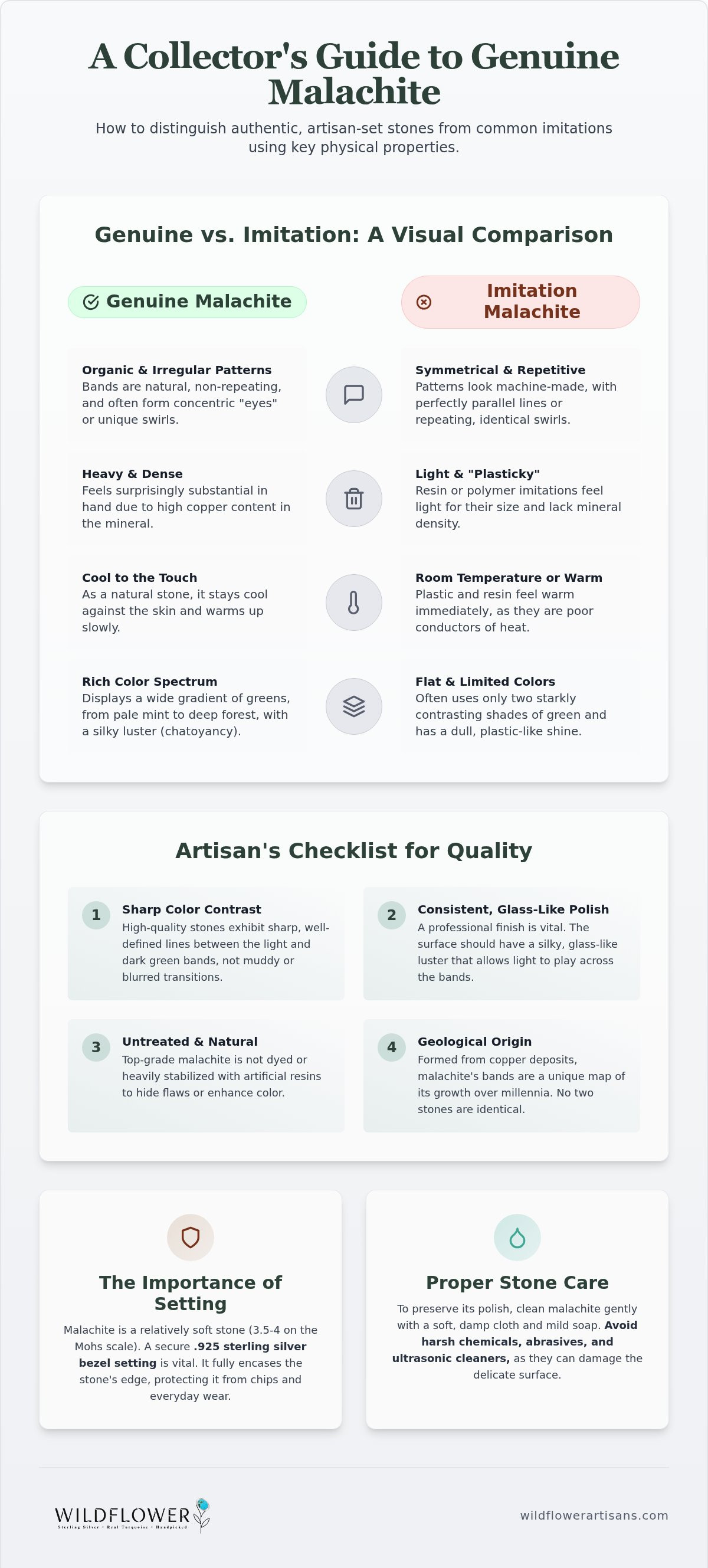
High-quality malachite is characterized by sharp color contrast and a dense, heavy feel due to its mineral composition. When you're evaluating a stone in the studio, look for sharp definitions between the light and dark green bands. If the colors bleed together or look muddy, the stone may be lower grade or poorly cut. A consistent, glass-like polish is also vital. Without a professional finish, the stone won't show its true depth or that characteristic silky sheen that defines the mineral's beauty.
Weight is another key indicator of authenticity that we always check. Because malachite has a high copper content, natural stones feel surprisingly heavy and dense in the hand. If a piece feels light or warm to the touch like plastic, it's likely a synthetic imitation rather than a genuine mineral. Genuine stones will also feel cold to the skin initially, slowly warming as they absorb your body heat.
- High Contrast: Look for sharp lines between different shades of green.
- Silky Luster: Watch for a subtle sheen that moves with the light.
- Density: Feel for a noticeable weight caused by copper minerals.
- Natural Variation: Expect irregular patterns that avoid perfect symmetry.
Identifying Genuine Malachite in Artisan Designs
Authentic malachite is distinguished by its substantial weight and a surface that remains cold to the touch until it absorbs your body heat. Unlike mass-produced imitations, genuine malachite jewelry features a complex spectrum of green shades and irregular banding that reflects its natural growth.
In the studio, we often see pieces that look like malachite at a distance but reveal themselves as imitations upon closer inspection. Real stone has a physical presence that's hard to fake. Because of its high copper content, a hand-cut cabochon feels dense and substantial in your palm. If you pick up a piece and it feels surprisingly light or "plasticky," it's likely a resin or polymer clay substitute. Another tell-tale sign is the color palette. Nature doesn't work in just two shades. True malachite displays a rich gradient from pale seafoam to deep, midnight green. Imitations often rely on stark, high-contrast stripes of just two colors, which lacks the subtle shimmer or chatoyancy found in natural mineral specimens. Chatoyancy is a luminous, silk-like shimmer that appears to move across the surface of a stone as it catches the light.
Common Imitations and How to Spot Them
Factory-made imitations typically use resin or polymer clay to mimic the stone's appearance, resulting in stripes that look mechanically perfect. You can quickly spot these fakes by looking for repetitive patterns or using the temperature test. Natural stone is a poor conductor of heat, so it stays cool against your skin much longer than plastic. If the piece feels warm immediately, it's likely a synthetic material. Look closely at the stripes; if they are perfectly parallel and uniform across the entire surface, you're likely looking at a man-made product rather than a stone formed in the earth.
The Importance of Untreated Stones
Untreated malachite refers to stones that haven't been dyed or heavily stabilized with artificial resins to hide flaws or enhance color. Untreated stones are those that retain their natural chemical composition without the addition of dyes or excessive artificial stabilizers. At Wildflower, we prioritize stones that retain their raw beauty. We avoid mystery metals and treated stones because they don't hold up to the standards of a working studio. Choosing pieces from a studio that understands these nuances is the best way to find authentic artisan-made jewelry that lasts. It's about respecting the stone's history and ensuring the piece ages gracefully alongside you.
Our malachite jewelry collection is built on this foundation of authenticity, featuring hand-selected stones that showcase the mineral's natural, unmanipulated beauty. We ensure every cabochon is properly identified so you can wear your piece with absolute confidence.
The Art of Setting Malachite in Sterling Silver
Setting malachite requires a gentle hand and an eye for structural integrity because the stone is relatively soft. On the Mohs scale, which measures a mineral's resistance to scratching, malachite ranks between 3.5 and 4. This makes it significantly softer than turquoise or quartz. To ensure your malachite jewelry stands the test of time, we almost exclusively use a bezel setting. A bezel is a thin strip of .925 sterling silver that we hand-form around the perimeter of the stone and then fold over the edge to lock it in place. Unlike prong settings that leave the stone's edges exposed, a bezel provides a protective silver wall that guards against chips and everyday impact. In our studio, we don't use pre-cast settings for these stones. Because every hand-cut cabochon has a unique height and curve, we must tailor the silver housing to the specific stone to ensure a flush, secure fit.
Southwestern Style and Silversmithing Techniques
In our Santa Fe studio, we often lean into traditional Southwestern style elements to complement the stone's natural geometry. We might use a saw-tooth bezel, where the top edge of the silver strip is cut into tiny points, or add a frame of twisted wire to create texture. These details aren't just decorative; they add physical mass to the setting, making the piece more durable. We also use oxidation, a process where we intentionally darken the silver in recessed areas, to create a deep patina. This contrast makes the vibrant green banding of the malachite pop against the silver. Every piece is finished with a meticulous hand-polish to achieve a mirror finish on the silver, reflecting the high standards of a working artisan studio.
Choosing Between Rings and Pendants
Because malachite is a softer mineral, we often suggest starting your collection with malachite pendants. Pendants rest against the chest and face far less physical impact than jewelry worn on the hands. However, if you're drawn to malachite rings, look for a low-profile setting. A low-profile design keeps the stone close to the finger, reducing the chance of it catching on clothing or knocking against hard surfaces. We also ensure every piece has a solid .925 sterling silver backing. This solid foundation provides essential stability for the hand-cut cabochon, preventing the stone from cracking if the silver frame is flexed. A well-constructed setting is the difference between a piece that lasts a season and one that becomes a staple in your collection. This structural focus ensures the organic beauty of the stone is preserved for years of wear.
Caring for Your Malachite and Sterling Silver Pieces
Proper care for malachite involves protecting its soft surface from scratches and avoiding all harsh chemicals that could damage the stone's natural polish. Because this mineral is sensitive to heat and acid, owners should rely on gentle, dry cleaning methods to maintain its vibrant green banding.
Keeping your malachite jewelry vibrant requires a bit of mindfulness because the stone is quite reactive to its environment. It's a copper-based mineral, so it doesn't take much to dull that deep forest green luster we love. The Mohs scale is a system used to measure the scratch resistance of various minerals. Since malachite sits at a low 3.5 to 4, it's easily marred by everyday surfaces. Even the dust in your home often contains tiny particles of quartz, which is hard enough to leave microscopic scratches on a malachite cabochon over time. We recommend skipping the ultrasonic cleaners and chemical dips entirely. The vibrations and heat of an ultrasonic machine can cause internal fractures in the stone to expand, potentially splitting it. Instead, use a soft, dry microfiber cloth to gently wipe away skin oils and dust.
- Separate Storage: Keep your pieces in individual soft pouches to prevent harder stones like quartz or turquoise from scratching the surface.
- Chemical Awareness: Apply perfumes, hairsprays, and lotions before putting on your jewelry to avoid etching the stone's polish.
- Dry Cleaning Only: Stick to a soft, dry cloth; never use steam cleaners or harsh jewelry dips.
Daily Wear and Protection
Take your rings off before you start gardening or reach for the cleaning supplies. Household chemicals, especially anything acidic like lemon juice or vinegar, will eat into the stone's surface and kill the polish instantly. Once that glossy finish is etched, it usually requires a professional lapidary to re-polish the stone. Moisture is another factor to consider. While a quick splash of water won't hurt, letting a ring sit in damp conditions can eventually alter the luster of the mineral. We suggest a quick "wiggle test" every few months. Gently press the edge of the cabochon with a wooden toothpick. If you feel any movement, bring it back to a professional studio to have the bezel tightened before the stone becomes loose.
Maintaining the Sterling Silver Shine
For the silver work, stick to a dedicated polishing cloth specifically made for .925 sterling silver. These cloths are infused with a gentle compound that removes tarnish without needing liquids or abrasive pastes. Never use liquid silver "dips" on malachite. The chemicals in those dips are designed to strip oxidation, but they are far too aggressive for a copper carbonate mineral and will permanently damage the stone. Interestingly, the best way to keep the silver bright is simply to wear it. The natural friction of your skin and clothing acts as a very fine polish, keeping tarnish from settling into the metal. Regular wear also ensures you're keeping an eye on the setting's integrity.
We take pride in crafting settings that provide a safe harbor for these expressive, banded stones. If you're looking for a piece that balances this delicate nature with rugged silver work, explore our handcrafted malachite jewelry.
Read our detailed guide on professional jewelry care and repair
Selecting Your Next Malachite Statement Piece
Choosing the right piece of malachite jewelry involves evaluating the scale of the banding against the size of the setting and ensuring the artisan-made silverwork provides a secure, gap-free housing for the stone. When you look at a hand-cut cabochon, the rhythm of the lines should match the scale of the piece. For instance, tiny "eye" patterns can get lost in a large pendant, while bold, wide stripes might feel overwhelmed in a small stud earring. It's about finding a visual balance that resonates with your personal style. Some collectors prefer the high-energy movement of tight, concentric circles, while others find peace in the broad, sweeping curves of forest green bands.
As you examine a potential addition to your collection, pay close attention to the technical finish. The .925 sterling silver bezel should be rolled tightly against the stone's edge with no visible gaps. In a working studio, we spend significant time ensuring the silver follows every organic curve of the stone. If you see light between the silver and the mineral, the stone isn't properly supported. Artisan-made jewelry offers a physical connection to the maker's process that mass-produced items lack. You aren't just buying a green stone; you're acquiring a piece where a silversmith carefully considered the orientation of every stripe before making the first cut.
Matching Malachite with Other Stones
Malachite acts as a natural anchor in a multi-stone collection, especially when paired with other vibrant Southwestern staples. The deep greens provide a grounded contrast to the fiery oranges of spiny oyster jewelry or the royal blues of lapis lazuli. Because malachite is visually "busy" with its intricate banding, it often looks best when paired with simple silver bands or minimalist settings. This allows the stone's natural geometry to remain the focal point. We often create Santa Fe sets that balance these textures, using the steady green of malachite to tie together more erratic matrix patterns in turquoise or oyster shell.
The Value of One-of-a-Kind Jewelry
Every malachite stone is a unique piece of earth history, meaning no two pieces will ever be identical. For serious collectors, the value lies in this inherent rarity and the ability to trace a stone's origins through its distinct patterns. We celebrate the natural asymmetry of these minerals rather than trying to force them into a factory-perfect mold. A stone that is slightly off-center or has an unusual swirl often tells a more compelling story than one with uniform lines. When you choose one-of-a-kind artisan pieces, you're honoring the unrepeatable growth cycles of the earth. These pieces aren't just accessories; they're wearable narratives that reflect a deep respect for the organic world and the skilled hands that shaped them.
Bringing Home a Piece of Southwestern History
Authenticity in your collection begins with understanding the physical weight and cool touch of a genuine mineral. By choosing hand-cut stones secured in a protective .925 sterling silver bezel, you ensure that the delicate geometry of the earth remains safe for years of wear. These pieces are more than simple adornments; they're vessels for emotion and celebrations of natural, fleeting beauty that have been shaped by skilled hands in our Santa Fe studio. We focus on the fine details, from the matrix of the stone to the mirror polish on the metal, to ensure every piece is a celebration of the organic world.
When you select malachite jewelry, you're choosing a stone with a specific narrative etched into its green layers. We prioritize guaranteed genuine stones and traditional artisan-made techniques to honor that story. Every cabochon we set reflects a commitment to quality over mass production, offering a grounded sophistication that connects you to the rhythms of the seasons. Choosing a piece with documented origins and intentional silverwork means you're investing in a legacy of Southwestern style that values the artist's eye as much as the raw material.
We invite you to find a piece that speaks to your own journey and celebrates the asymmetrical wonder of the natural world. It's our hope that these stones bring a sense of quiet tranquility and connection to your everyday life.
Frequently Asked Questions
Is malachite jewelry safe for everyday wear?
Malachite can be worn daily if you take specific precautions to protect its soft surface from impact and scratches. It ranks between 3.5 and 4 on the Mohs scale, which is a system used to measure the scratch resistance of various minerals. Because of this softness, malachite jewelry is best suited for pendants or earrings that don't face constant contact. If you choose a ring, ensure it has a protective bezel setting and remove it before physical activity.
How can I tell if my malachite is real or plastic?
Genuine malachite is heavy and cold to the touch because of its high copper content. Real stones feature irregular, organic banding in a spectrum of green shades that never repeat perfectly or look symmetrical. Plastic imitations feel lightweight and warm. They often have repetitive, high-contrast black and green stripes that look printed or molded rather than grown in the earth over thousands of years.
Can malachite get wet?
You should keep your malachite jewelry as dry as possible to preserve its natural polish and luster. While a quick splash of water won't cause immediate harm, prolonged exposure or submerging the stone can dull its finish and damage its structural integrity over time. If your piece does get wet, dry it immediately with a soft, clean cloth to prevent mineral buildup or etching on the stone's surface.
Why is malachite often set in sterling silver?
Sterling silver provides a durable, protective frame that beautifully complements the stone's deep green hues. The cool tone of .925 sterling silver creates a striking visual contrast with the vibrant banding of the mineral. Silversmiths prefer this metal because it's malleable enough to be hand-formed into secure bezel settings, which are essential for shielding the edges of this relatively soft stone from chips and wear.
Does malachite change color over time?
Natural malachite is chemically stable and won't fade or change color even when exposed to sunlight. However, the surface polish can become dull or matte if it's frequently exposed to skin oils, perfumes, or household acids. Regular gentle wiping with a soft, dry cloth is usually all it takes to maintain that deep green luster and keep the stone looking as vibrant as the day it was cut in our studio.
Article by
Kimberly Cordova
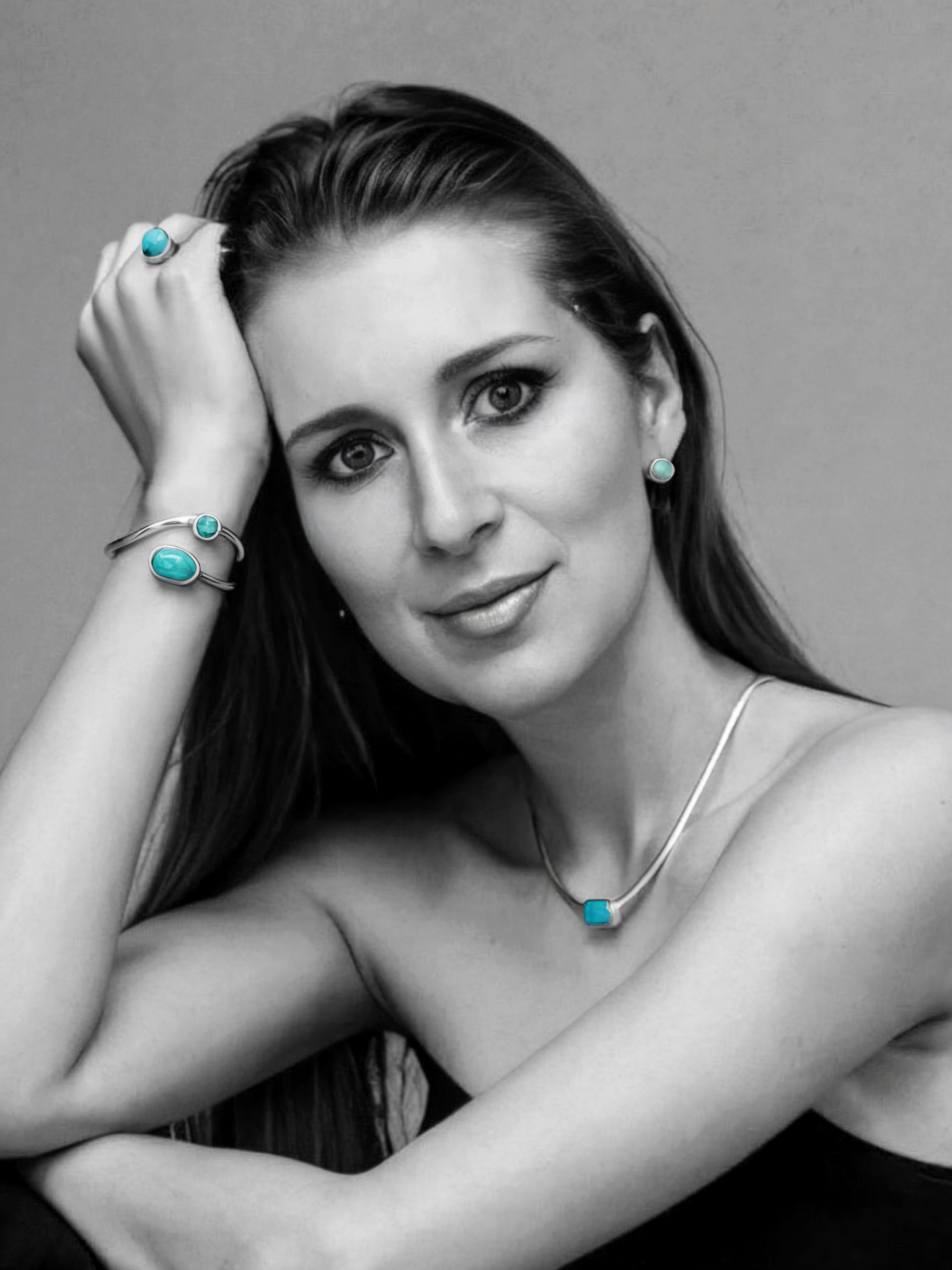
Kimberly Cordova is the founder and creative director of Wildflower Artisans, a handmade jewelry brand rooted in Santa Fe. Real turquoise, solid sterling silver, and a small line set in solid 14K gold. She built Wildflower around a simple belief: the best jewelry is the kind you actually reach for, not the kind you save for someday.
The collection is built three ways. Some pieces are made in-house, cut by her husband Greg from stones he sources himself, including rough from the family's King's Manassa Mine in Colorado and White Buffalo Mine in Nevada. Some are designed by Kimberly and fabricated by a trusted circle of Santa Fe silversmiths. And some are finished work she curates from artisan makers whose craft meets the same standard, because building a real collection means knowing when to make and when to look.
Turquoise leads, joined by White Buffalo, Wild Horse, Lapis Lazuli, Spiny Oyster, Black Onyx, Opal, and other genuine semi-precious stones. No shortcuts on the stone, the silver, or the story behind either.
Her writing covers everything she has learned along the way: how turquoise forms, how to tell natural from stabilized, what makes one mine different from another, how to read a bezel, and how to shop with confidence in a market that is not always straightforward. It is the kind of plainspoken information she wished someone had laid out for her when she was starting out.
Browse the collection at wildflowerartisans.com. Questions about a stone, a setting, or a specific piece are welcome any time.
0 comments