

Every genuine larimar stone in existence originates from a single volcanic mountain in the Dominican Republic. This singular source creates a unique narrative for the gem, especially when comparing larimar vs turquoise, which formed in arid pockets across the American West and beyond. You likely value these stones for their ability to hold a moment of organic beauty in a hand-cut cabochon. It's understandable to feel uncertain about which to choose when faced with different price points and the quiet worry of encountering mass-produced imitations.
We've put together this comparison to provide a grounded look at the technical traits of both minerals. You'll gain a clear understanding of their geological origins, their relative durability for daily wear, and the visual hallmarks that define high-grade specimens. The right choice often depends on your lifestyle. This guide explores the rarity of the Caribbean pectolite following the 2022 mine closure and how the varied matrix of turquoise offers a different kind of artisanal character for your jewelry collection.
Key Takeaways
- Understand the geological differences between these stones, including how volcanic activity creates larimar while arid weathering produces turquoise.
- Discover how rarity impacts value, especially when weighing larimar vs turquoise in light of the recent closure of the world's only larimar mine.
- Learn to distinguish between the soft, oceanic marbling of Caribbean stones and the bold matrix patterns common in Southwestern style turquoise.
- Compare the durability and Mohs hardness of each mineral to ensure your artisan-made jewelry stands up to your daily habits.
- Gain the technical knowledge needed to verify authenticity and avoid mass-produced or imitation materials in your collection.
What are the main differences between larimar and turquoise?
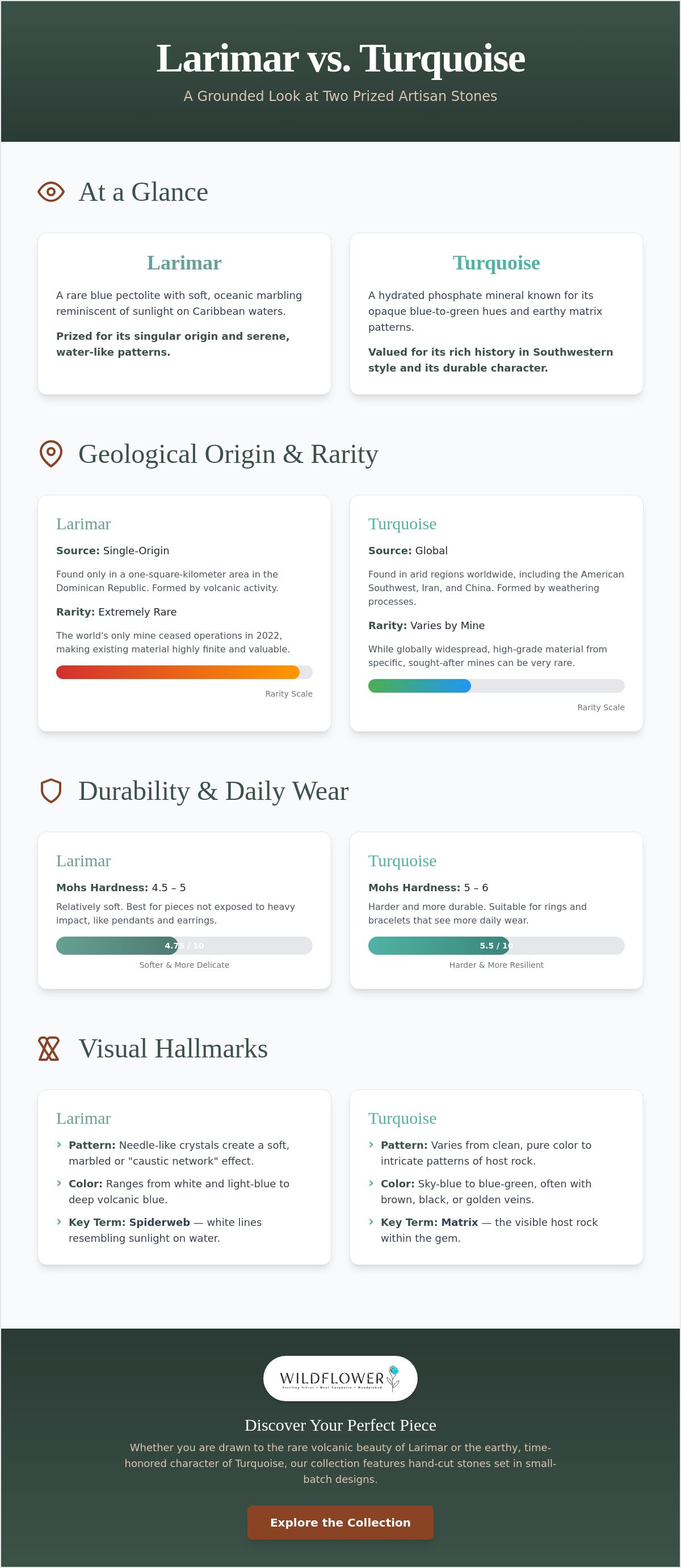
Larimar is a rare blue variety of pectolite formed by volcanic activity in the Dominican Republic, while turquoise is a hydrated copper and aluminum phosphate found in arid regions worldwide. These stones differ significantly in their chemical composition, hardness, and the geological environments where they formed over millions of years.
At Wildflower Artisans, we often see collectors drawn to the cool, calming shades of blue that both these minerals offer. While they might look similar at a passing glance, the story of larimar vs turquoise is one of fire and water. One stone comes from the volcanic heights of a single Caribbean mountain, while the other is born from the quiet, arid stretches of the desert. Understanding these differences helps you appreciate the journey each stone took before it reached our studio. Choosing between them is often a matter of deciding which natural narrative speaks most clearly to you.
To better understand the physical and visual differences between these two stones, watch this helpful comparison:
Defining the mineral composition
Larimar is a pectolite, a silicate mineral that usually appears in muted greys or whites, but the presence of copper in one specific spot on earth turns it that famous blue. It formed within basaltic lavas where hot fluids filled cavities in the rock. This was a rare volcanic event that occurred in only one location. In contrast, Turquoise geological properties reveal it as a secondary mineral. It forms when rainwater seeps through copper-bearing rocks in dry climates, picking up minerals as it travels. In our studio, we typically set these stones as a cabochon. A cabochon is a stone that has been shaped and polished into a smooth, rounded top rather than faceted. This cut allows the internal patterns of the mineral to remain the focus of the piece.
Visual characteristics at a glance
The patterns you see in these stones tell their life stories. Larimar has a needle-like crystal structure that grows in radiating clusters. This creates a spiderweb of white lines that look like sunlight dancing on the bottom of a shallow pool. A spiderweb pattern refers to fine, interconnected lines of matrix or contrasting color that lace across the surface of a stone. Turquoise often features a matrix, which is the host rock that remains visible in the finished gem. This host rock might be brown limonite, black chert, or even golden pyrite. Whether it is the dark, earthy veins of Royston turquoise or the clean blues of Kingman, the matrix adds a sense of place. Hand-cut stones from small batch studios ensure these patterns are balanced within the bezel, celebrating the natural asymmetry of the earth. We find that these variations make each piece a vessel for emotion rather than just an accessory.
Comparing the geological origins and rarity of these stones
Larimar is a single-source gemstone found only in the Bahoruco mountain range of the Dominican Republic. This geological exclusivity makes it significantly rarer than turquoise, which occurs in arid pockets across the globe. When we weigh the value of larimar vs turquoise, we are looking at the difference between a stone that exists in one tiny square kilometer of earth and one that has defined jewelry traditions from the American Southwest to the mountains of Iran. This extreme rarity is a primary reason why collectors are so protective of their pieces.
The story of these minerals is written in the earth itself. One was born from the heat of volcanic activity in the Caribbean, while the other formed through the slow percolation of water in the desert. This contrast in formation not only dictates where they are found but also how difficult they are to source for small batch jewelry studios. While turquoise has been mined for thousands of years, larimar is a newcomer to the world of fine art and jewelry, adding a layer of modern intrigue to its narrative.
The Caribbean origin of larimar
Larimar was only officially discovered in 1974. Its history is brief but impactful. Because it is found in just one volcanic deposit, the supply is finite and increasingly fragile. The recent closure of the Filipinas Mine in May 2022 due to safety concerns has only heightened this scarcity. No new material is being officially pulled from the earth at this time. This single-source nature means that every cabochon is a limited piece of history. For those curious about the specifics of this blue pectolite, our stone origins for larimar page offers a deeper look at its discovery and the unique volcanic conditions required for its formation.
The diverse mines of the American Southwest
Turquoise rarity is a different conversation. While the mineral itself is found in many countries, the value of a specific piece often comes down to the mine it was pulled from. In the American Southwest, mines like Royston or Kingman are famous for their distinct color profiles. These colors are dictated by the minerals in the surrounding soil. Copper creates the vivid blues we love, while iron introduces earthy greens. According to the GIA Turquoise Guide, these chemical impurities are what give each mine its unique fingerprint. You can explore our about our mines page to see how we source these specific materials for our collections.
Rare varieties and collector value
Collectors often seek out specific, limited varieties that are no longer being actively mined. High-grade specimens from the now-closed Sleeping Beauty mine or rare finds from the King's Manassa and White Buffalo mines represent the pinnacle of rarity in the turquoise world. White Buffalo is a striking white stone with black matrix that is often found alongside turquoise deposits. Because these mines produce such small quantities of gem-grade material, they are highly sought after for one-of-a-kind artisan pieces. If you are looking for a piece that captures this sense of place and history, you can browse our latest artisan-made creations in the studio. Each stone is selected for its character and authenticity, ensuring your collection remains as unique as the landscape it came from.
How do the color profiles and matrix patterns differ?
When we look at the visual character of larimar vs turquoise, we are comparing the fluid translucency of water against the solid, opaque weight of the earth. Larimar is prized for its range of light blue to deep volcanic blue, which is often marbled with white streaks that look like sunlight dancing on the Caribbean Sea. Turquoise offers a much broader spectrum of color. It can range from the bright robin's egg blue of a clear sky to the deep forest greens found in iron-rich soil. These differences are not just aesthetic. They are the visible results of the chemical impurities and mineral structures that formed each stone.
One of the most striking distinctions is how the patterns are held within the gem. In larimar, the patterns are internal to the crystal structure itself. In turquoise, the patterns are often external inclusions of the host rock, known as matrix. Matrix is the remnant of the surrounding stone that remains embedded in the turquoise after it is cut. While turquoise is almost always opaque, high-grade larimar can have a slight milkiness or translucency that allows light to move through the stone in a way that turquoise simply cannot.
Understanding the larimar pattern
High-grade larimar is often graded by its "volcanic" or "water" pattern. These white lines are not cracks or flaws. They are actually different concentrations of the mineral pectolite. When the stone is hand-cut into a cabochon, a skilled lapidary artist will orient the stone to highlight these radiating clusters. The most valuable specimens feature a saturated, dark blue contrasted against sharp, crisp white spiderwebbing. Because the stone is slightly translucent, a sterling silver bezel setting acts as a mirror. It reflects light back through the pectolite crystals to enhance that oceanic glow. This internal light is a hallmark of the stone that no imitation can truly replicate.
The role of matrix in turquoise
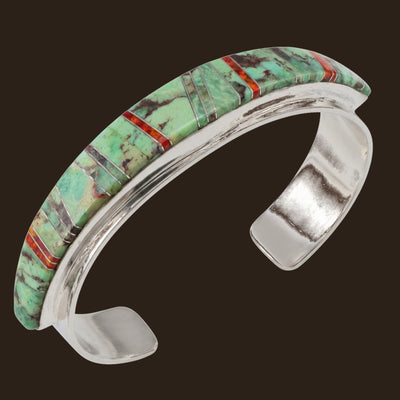
For many collectors, the matrix is what gives a piece of turquoise its soul. This host rock can appear as a delicate spiderweb of fine lines, a splotchy "chunky" pattern, or a single bold vein running through the blue. The color of the matrix tells you about the mine's chemistry. For example, King's Manassa turquoise is famous for its characteristic golden-brown matrix, which contrasts beautifully with its blue-green hues. Other mines might produce a deep black chert matrix or a reddish iron-oxide pattern. Unlike the internal patterns of larimar, turquoise matrix is a physical part of the stone's history. It is a literal piece of the mountain where the stone was born. These earthy inclusions are why turquoise is so central to Southwestern style jewelry, as they ground the vivid blues in a natural, organic context.
Durability and care for artisan-made jewelry
Turquoise generally ranks between 5 and 6 on the Mohs scale, while larimar is slightly softer, typically falling between 4.5 and 5. Both stones require intentional care during daily wear because they are relatively soft compared to common gemstones like quartz or sapphire. This technical difference is a key consideration when weighing larimar vs turquoise for your collection. While turquoise offers a bit more resilience, both minerals are precious vessels for emotion that deserve a gentle hand to remain beautiful for years to come.
The Mohs scale and stone hardness
The Mohs scale is a measure of a mineral's resistance to scratching. It is a simple 1 to 10 ranking where a diamond is a 10 and talc is a 1. To give you a grounded comparison, a common copper penny has a hardness of about 3, while a glass window pane is roughly a 5.5. Because larimar often sits just below the hardness of glass, it can be marked by everyday metal objects or even harsh household dust. Turquoise is slightly more durable, yet it still sits far below the hardness of common quartz. At Wildflower, we protect these delicate cabochons by using traditional hand-set techniques. A sterling silver bezel provides a necessary shield for the stone. This silver wall surrounds the base of the gem, ensuring the edges don't chip during your daily movements.
Daily care routines
Maintaining the vibrancy of your jewelry is a quiet act of appreciation for the natural world. Natural turquoise is porous. It has tiny, invisible openings that can absorb skin oils, soaps, or chemicals from your favorite perfume. Over time, these additions can chemically react with the copper in the stone, causing a bright blue to shift toward a soft, mossy green. Larimar faces a different challenge from the environment. It is photosensitive, meaning that long-term exposure to direct, intense sunlight can eventually cause the deepest blues to lose their saturation. We treat these stones with the respect they deserve as small batch artisan materials.
- Avoid the frantic energy of ultrasonic cleaners, as the high-frequency vibrations can cause internal fractures in softer stones.
- Remove your jewelry before applying lotions, hairspray, or perfume to prevent chemical absorption.
- Clean your stones with a soft, damp cloth rather than immersing them in water or using harsh soaps.
Taking these small, intentional steps ensures that your jewelry remains a celebration of natural beauty for decades. For long-term guidance on keeping your collection in gallery condition, please refer to our jewelry care and repair guide. When you choose a piece from our studio, you are choosing a companion for your journey. You can browse our shop for everyday essentials and find a handcrafted piece that balances this delicate beauty with the strength of sterling silver.
Selecting the right piece for your collection
Choosing between larimar vs turquoise depends on whether you prefer the fluid, oceanic patterns of the Caribbean or the earthy, varied matrix of the American Southwest. Both stones offer unique artisanal value, but they require different considerations regarding rarity, mine origin, and color saturation.
In our studio, we see these stones as more than just materials. They are a celebration of fleeting beauty. Whether you are drawn to the cool, oceanic marbling of a Dominican pectolite or the grounded, historic weight of a Southwestern phosphate, the key is finding a piece that feels intentional. Both minerals pair exceptionally well with sterling silver. The bright, reflective quality of the metal acts as a quiet frame for these natural masterpieces. Its cool luster doesn't compete with the blues and greens of the stones but instead highlights the subtle variations in the matrix or the delicate marbling of the pectolite crystals. At Wildflower, we find that this combination creates a harmonious balance between the organic gem and the artisanal setting.
Evaluating quality in larimar
When you are looking for a high-quality larimar cabochon, color saturation and contrast are your primary guides. The most sought-after stones feature a deep, saturated blue often referred to as volcanic blue. You should look for sharp, crisp white lines that create a distinct spiderwebbing effect against the blue background. We recommend avoiding stones that appear overly translucent, washed out, or grayish, as these lack the vibrant character that makes the stone famous. Greg Cordova’s lapidary work focuses on these specific features, ensuring that each hand-cut stone captures the most evocative patterns possible. A well-cut stone will have a smooth, symmetrical dome that allows light to move through the internal crystal structure without interruption, creating that recognizable Caribbean glow.
Evaluating quality in turquoise
For turquoise, authenticity is the most important factor in your selection. We prioritize natural stones that haven't been treated with dyes or plastic resins, as these maintain their character over time. You can identify quality by looking for clean, precise lapidary work and a secure fit within the setting. In artisan-made rings, the stone should be held tightly by a smooth bezel with no visible gaps. The mine origin also plays a significant role in long-term value. Collectors often find that a stone's narrative is just as important as its appearance. Knowing that your turquoise came from a small batch out of the Royston mine or that your larimar was sourced before the recent mine constraints adds a layer of depth to the piece. Whether you prefer a clear, matrix-free blue or a complex web of host rock, the stone should feel like a deliberate choice rather than a generic substitute.
Finding the right stone for your story
Whether you feel a pull toward the volcanic blues of the Caribbean or the desert-born greens of the Southwest, your choice in larimar vs turquoise is a reflection of your own journey. You've seen that while larimar offers a rare, single-source narrative with its fluid patterns, turquoise provides a diverse history rooted in specific mines like Royston or Kingman. Both minerals require thoughtful care and a protective sterling silver setting to preserve their natural beauty. At Wildflower, we prioritize authenticity in every piece, using only guaranteed genuine stones with confirmed mine origins. Every cabochon is hand-cut by expert lapidary Greg Cordova to highlight its unique character, then set into small batch artisan-made jewelry. Discover our latest collection of handcrafted larimar and turquoise jewelry to find a piece that speaks to your personal style. For those who prefer the added comfort of established buyer protections, you can also browse our curated selection at wildflowersantafe.etsy.com.
Frequently Asked Questions
Is larimar more expensive than turquoise?
Larimar is generally more expensive on a per-carat basis because it comes from only one location on earth. Since the 2022 closure of the Filipinas Mine, prices have risen significantly due to the finite supply. While high-grade turquoise from a closed mine like Sleeping Beauty can command high prices, entry-level larimar typically carries a higher price tag than common turquoise varieties.
Can you wear larimar and turquoise jewelry together?
You can certainly pair these stones together in your collection. Their shared oceanic and sky-blue palettes create a beautiful, cohesive look that celebrates natural variety. Many collectors enjoy the contrast between the fluid marbling of larimar and the earthy matrix of Southwestern style turquoise. Mixing these textures adds a layer of artisanal depth to any outfit.
How can I tell if my larimar or turquoise is real?
Real stones will always show unique, asymmetrical patterns that mass-produced fakes cannot replicate. Genuine larimar features distinct radiating crystal structures and varying shades of blue, while natural turquoise often has a visible matrix or slight color shifts. If a stone looks perfectly uniform or feels like plastic against your teeth, it's likely an imitation.
Does turquoise change color over time?
Natural turquoise is a porous mineral that can absorb oils, perfumes, and lotions from your skin. Over many years, these substances can react with the copper in the stone, leading to a subtle shift from blue toward green. This change is a natural part of the stone's life story. You can slow this process by applying your beauty products before putting on your jewelry.
What is the rarest color of larimar?
The most sought-after and rarest color is a deep, saturated shade known as volcanic blue. This high-grade material features intense color contrasted by sharp white spiderweb patterns. Most larimar found today is a lighter, translucent blue. Finding a hand-cut cabochon with that specific, dark saturation is becoming increasingly difficult as existing stockpiles diminish.
Is larimar a type of turquoise?
Larimar is not a type of turquoise, even though they share similar blue hues. Larimar is a rare blue variety of the mineral pectolite, which is a silicate. Turquoise is a hydrated phosphate of copper and aluminum. When comparing larimar vs turquoise, they are entirely different minerals with distinct chemical structures and geological histories.
Where is the best place to buy authentic larimar jewelry?
The best place to buy is from a small batch studio that provides clear information about stone origins. Because of the recent increase in glass and quartz imitations, you should look for artisans who understand the technical differences in the stones. Avoid retailers that use vague marketing fluff and instead choose creators who prioritize the natural character of each hand-cut piece.
Can I wear my turquoise ring every day?
You can wear a turquoise ring daily if it's set in a protective sterling silver bezel. This setting style wraps the metal around the edges of the cabochon to prevent chipping. Since turquoise is a 5 to 6 on the Mohs scale, it's durable enough for regular wear, but you should still remove it before gardening, swimming, or using household cleaners.
Article by
Kimberly Cordova
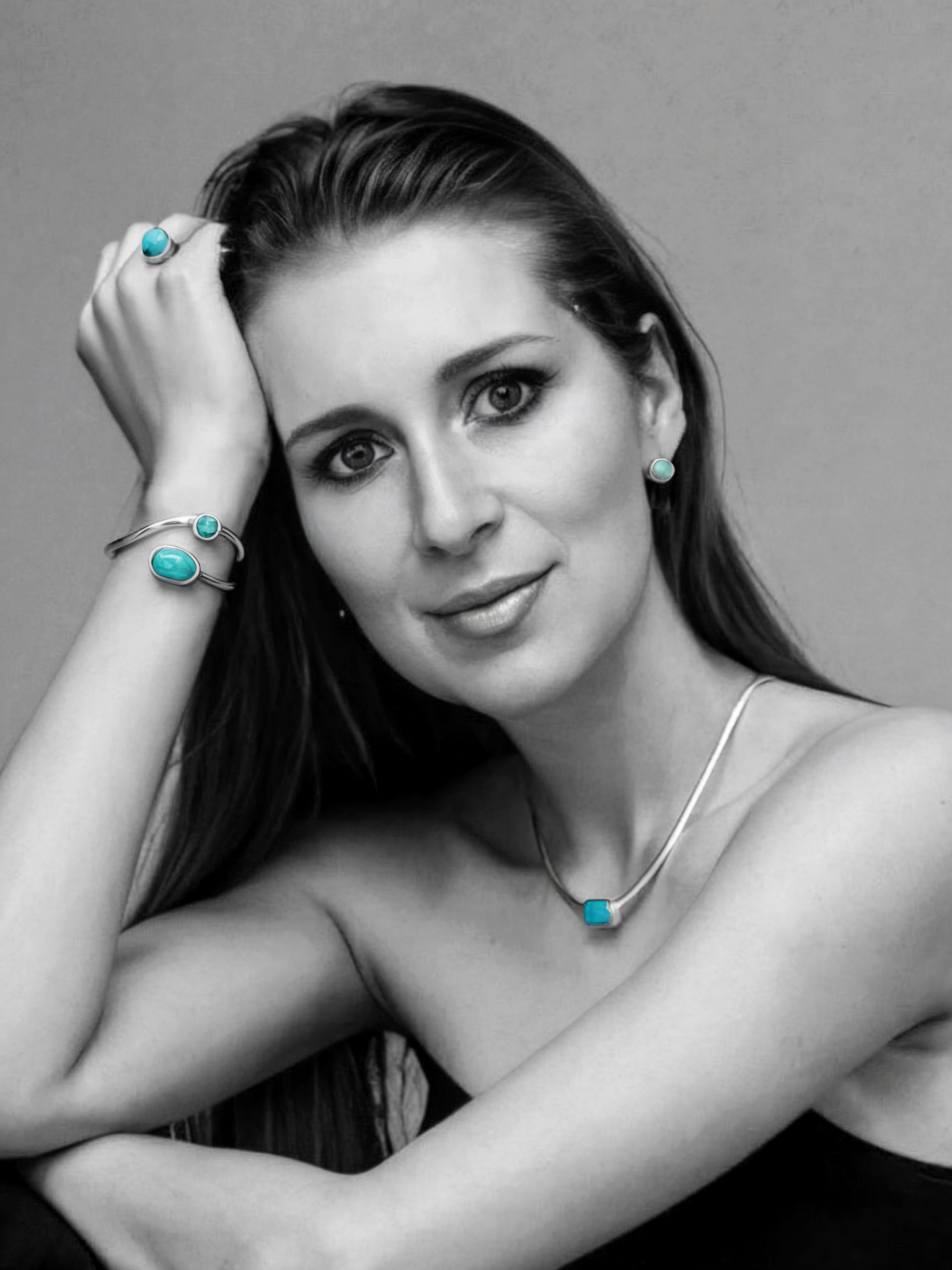
Kimberly Cordova is the founder and creative director of Wildflower Artisans, a handmade jewelry brand rooted in Santa Fe. Real turquoise, solid sterling silver, and a small line set in solid 14K gold. She built Wildflower around a simple belief: the best jewelry is the kind you actually reach for, not the kind you save for someday.
The collection is built three ways. Some pieces are made in-house, cut by her husband Greg from stones he sources himself, including rough from the family's King's Manassa Mine in Colorado and White Buffalo Mine in Nevada. Some are designed by Kimberly and fabricated by a trusted circle of Santa Fe silversmiths. And some are finished work she curates from artisan makers whose craft meets the same standard, because building a real collection means knowing when to make and when to look.
Turquoise leads, joined by White Buffalo, Wild Horse, Lapis Lazuli, Spiny Oyster, Black Onyx, Opal, and other genuine semi-precious stones. No shortcuts on the stone, the silver, or the story behind either.
Her writing covers everything she has learned along the way: how turquoise forms, how to tell natural from stabilized, what makes one mine different from another, how to read a bezel, and how to shop with confidence in a market that is not always straightforward. It is the kind of plainspoken information she wished someone had laid out for her when she was starting out.
Browse the collection at wildflowerartisans.com. Questions about a stone, a setting, or a specific piece are welcome any time.

0 comments