

The most perfect-looking vintage concho belt in the room is often the one you should trust the least. Learning how to authenticate a vintage concho belt is less about finding a flawless surface and more about developing a quiet intimacy with the silversmith's hand and the geological narrative of the earth. At Wildflower Artisans, we understand the hesitation you feel when browsing a crowded market, where the fear of overpaying for dyed howlite or plastic stones can overshadow the joy of discovery. It's a common concern for collectors who value the soul of a piece over the convenience of a mass-produced imitation.
You deserve to feel certain that the weight you carry is genuine sterling silver (.925) rather than a clever base metal. Wildflower is here to help you identify specific silversmithing markers and stone characteristics used to distinguish genuine artisan-made belts from factory replicas. We'll examine the intricate details of a hand-cut cabochon, the nuances of a natural stone matrix, and the historical hardware markers that define different construction phases. By the time we finish our conversation, you'll have the confidence to spot a hand-soldered bezel and appreciate the deliberate, beautiful imperfections that make Southwestern style jewelry a vessel for emotion and history.
Key Takeaways
- Identify the historical markers of First Phase construction, such as the hand-cut diamond slots used before artisans began soldering silver loops.
- Master how to authenticate a vintage concho belt by performing a simple tarnish test to verify the presence of genuine sterling silver (.925).
- Recognize the depth of a genuine stone by examining the matrix and natural color variations within the hand-cut cabochon.
- Inspect the reverse side of the conchos for copper or brass slides, which are more reliable indicators of age than modern screw-on backings.
- Learn to prioritize pieces with verifiable mine origins, such as King's Manassa or White Buffalo, to ensure your collection holds lasting value.
Understanding the Evolution of Concho Belt Construction
Authenticating a vintage piece begins with recognizing the historical progression of Southwestern design styles. Each era possesses specific markers that reveal how the artisan worked the metal and shaped the silver. Understanding this Evolution of Concho Belts is the first step in knowing how to authenticate a vintage concho belt.
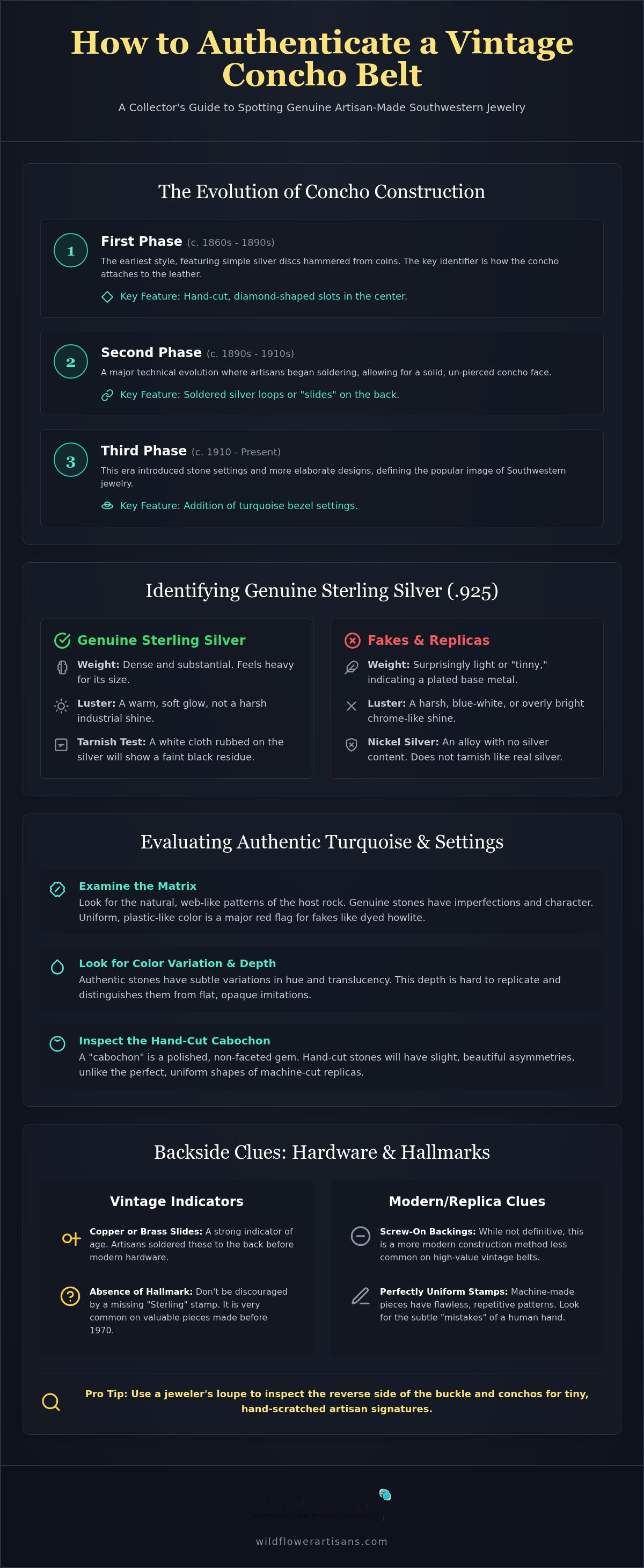
The earliest belts, known as First Phase (roughly 1860s to 1890s), feature simple silver discs. These conchos were secured to the leather through hand-cut, diamond-shaped slots in the center. In the Second Phase (1890s to 1910s), artisans began soldering silver loops or "slides" to the back, allowing the concho itself to remain solid. This period also introduced the silver tongue and buckle. The Third Phase (starting around 1910) brought the vibrant addition of turquoise settings and increasingly complex stamp work. Each phase represents a shift in both tool availability and aesthetic preference, providing a roadmap for any collector.
Early Slot Styles and Hand Stamping
Look closely at the center of the conchos. If you see diamond-shaped openings where the leather passes through, you're likely holding a very early piece. These were often hammered out of silver coins, giving them a distinct density and weight. Examine the stamp work around the edges. Genuine hand-tooling rarely shows the mathematical precision of a machine. You'll find slight variations in depth and uneven spacing where the artisan's punch met the metal. These small "mistakes" are actually signatures of authenticity that tell the story of a working studio.
The Introduction of Repousse Techniques
Repousse is a technique where the silversmith hammers the metal from the back to create a raised, three-dimensional design on the front. It's a hallmark of skilled craftsmanship that adds texture and life to the silver. To verify this, always turn the concho over. You should see a corresponding indentation that mirrors the pattern on the face. Handmade repousse has a softer, more organic flow compared to modern cast pieces. Cast metal often feels rigid or has sharp, uniform edges that lack the gentle soul of hammered sterling silver (.925). Sterling silver (.925) is a high-quality alloy consisting of 92.5% pure silver and 7.5% copper for strength. When you're learning how to authenticate a vintage concho belt, the back of the piece is often more honest than the front.
Identifying Genuine Sterling Silver and Artisan Metalwork
Sterling silver (.925) is the foundational material for authentic Southwestern concho belts, though its presence isn't always announced by a hallmark. Identifying the metal involves a combination of sensory tests and a basic understanding of silver's physical properties. Knowing how to authenticate a vintage concho belt starts with feeling the weight of the piece. Sterling silver is a dense, heavy metal that feels substantial in the palm. If a belt feels surprisingly light or "tinny," it's often a sign of a silver-plated base metal or a hollow cast.
Observe the luster of the metal under a natural light source. Genuine silver possesses a warm, soft glow that resembles moonlight, whereas chrome or stainless steel often has a harsh, blue-white tint. You can also perform a simple tarnish test by rubbing a small, inconspicuous area with a clean white cloth. If the cloth comes away with a faint black residue, it's a positive sign of silver oxidation. With the market price of silver reaching approximately $71.31 per troy ounce in August 2026, the material value of a heavy-gauge concho belt is significant, making these physical checks more important than ever.
The Reality of Hallmarks and Maker Marks
Many of the most valuable vintage belts made before 1970 lack official stamps, making visual and tactile inspection essential. While modern collectors look for "Sterling" or ".925" marks, don't assume a piece is fake just because it's unmarked. Early artisans often focused on the hand-cut details of the silver rather than branding. Look for artisan-specific signatures that might be hand-scratched or lightly stamped on the reverse of the buckle or the end concho. These marks are often tiny and weathered, requiring a loupe to see clearly, but they offer a direct connection to the working studio where the piece was born.
Spotting Nickel Silver and Mystery Metals
Distinguishing genuine silver from alloys like nickel silver requires an eye for luster and a nose for the distinct scent of base metals. Nickel silver, frequently called German silver, contains no actual silver at all; it's an alloy of nickel, copper, and zinc. If you warm a concho between your hands, nickel silver often gives off a faint, brassy, or metallic smell that sterling silver (.925) does not. Check the high-friction areas, such as the edges of the conchos or the buckle's tongue, for plating wear. If you see a yellowish metal peeking through the silver surface, the piece is plated. While a magnet can rule out iron-based cores, many fakes are made of non-magnetic zinc or pewter, so the scent and luster tests remain your most reliable tools.
Building a collection of genuine pieces requires a discerning eye for these material truths. You can find a curated selection of verified, artist-made sterling silver jewelry at Wildflower that honors these traditional standards of craftsmanship.
Evaluating Authentic Turquoise and Stone Settings
The stone is the quiet heart of the piece, telling a geological story that spans centuries. Genuine turquoise will always show subtle variations in color and matrix, reflecting the unique mineral composition of the earth where it formed. Matrix refers to the host rock remains found within the turquoise, appearing as brown, black, or metallic veins. When you're learning how to authenticate a vintage concho belt, the stone's character is your most honest guide. You should avoid stones that look perfectly uniform or have a plastic sheen, as these often indicate dyed howlite or mass-produced block turquoise. Authentic stones feel cool to the touch and carry a density that plastic cannot replicate. For a deeper look at these variations, our turquoise buying guide offers more detail on what to look for in a high-quality stone.
Hand-Cut Bezels vs. Machine Settings
A bezel is a thin strip of silver (.925) wrapped around the stone and soldered to the base to hold it in place. In authentic artisan-made belts, you'll often find a visible seam where the ends of the silver strip meet. Look for slight irregularities in how the metal conforms to the hand-cut cabochon. A cabochon is a gemstone that has been shaped and polished into a smooth, rounded surface rather than faceted. Check for sawtooth bezels, which were common in mid-century Southwestern style. In genuine vintage pieces, the teeth are hand-filed, meaning they may vary slightly in height or width, unlike the sterile perfection of modern machine-stamped settings. These small variations show the hand of the silversmith, who likely hand-crimped the metal around the stone using basic studio tools.
Identifying Genuine Matrix and Pyrite
The texture of the stone provides another layer of proof for any collector. Genuine matrix should be slightly recessed or flush with the stone's surface, never painted on or sitting like a thin layer of film. If you look closely, you might find pyrite inclusions, which are tiny metallic flecks that shimmer like gold. These are particularly common in turquoise from mines like Kingman or Morenci. Observe the depth of the stone under a loupe or natural sunlight. Genuine turquoise has a subtle, translucent quality that allows light to penetrate the surface, whereas plastic imitations feel flat and opaque. This depth is a key marker in how to authenticate a vintage concho belt and separate the artisan's work from a factory imitation. At Wildflower, we prioritize these natural narratives, ensuring every piece reflects the true geological history of the Southwest.
Examining the Backing and Hardware for Age Indicators
The reverse side of a concho belt often tells a more honest story of its origin than the front. While the face of the silver might be polished to hide its age, the hardware underneath remains a quiet witness to the artisan's process. Learning how to authenticate a vintage concho belt requires you to look past the stone and silver surface to the functional elements that hold the piece together. Authentic vintage conchos are typically secured to the leather using copper or brass slides rather than being screwed in with modern industrial fasteners. Inspect the buckle attachment for hand-soldered joins, which show a slight, organic thickening of the metal, rather than the flat, sterile appearance of modern industrial adhesives.
The Role of Copper Belt Slides
Look at the back of the concho for a vertical bar, known as a slide, made of copper or brass. These slides were hand-cut and then hand-soldered to the silver disc. You should observe the points where the slide meets the silver. In a genuine piece, these joins will show subtle signs of the torch's heat and the flow of the solder. Observe the patina on the copper. It should be dark and consistent with the age of the silver, reflecting decades of slow oxidation rather than a forced, chemical aging process. If the metal on the back looks too bright or the attachment is a modern Chicago screw, the piece is likely a contemporary reproduction.
Leather Quality and Wear Patterns
The leather itself acts as a historical record of the belt's journey. Examine the edges of the leather for hand-burnishing or raw, suede-like finishes that feel soft and pliable to the touch. Genuine vintage leather will have developed a natural darkening, or patina, in the areas where it has rubbed against clothing or skin. Check the holes for stretching. A belt that has been worn for forty years will show oval-shaped distortion in the holes used most often. Smell the leather. Authentic vintage leather has a faint, earthy scent that speaks of natural tanning processes, whereas new, cheap leather often smells of harsh chemicals or synthetic dyes. These sensory details are essential markers in how to authenticate a vintage concho belt and ensure your collection represents true Southwestern craftsmanship.
After examining the hardware and leather of your vintage finds, you might feel inspired to add a new piece to your daily rotation. We invite you to explore our curated selection of Southwestern style turquoise jewelry that honors these same traditional construction methods.
Building an Authentic Collection with Confidence
Authenticating vintage jewelry is a skill developed through touch, observation, and a focus on material truth. This process requires a slow, intentional approach to identifying the weight and temperature of the materials used in Southwestern style pieces. When you're learning how to authenticate a vintage concho belt, your fingers are often as important as your eyes. Genuine sterling silver (.925) and natural stones have a specific density and a characteristic cold feel against the skin that plastic and base metals simply cannot mimic. You'll begin to notice the difference between vintage style pieces, which are modern creations purposefully distressed to look aged, and true vintage belts that show period-correct construction markers such as hand-cut slots or copper slides.
Prioritize pieces that come with clear, documented stone origins to ensure your collection holds its value. Whether you're looking for the deep greens of Royston or the clear sky-blue of Sleeping Beauty turquoise, knowing the mine provides a layer of provenance that stabilizes the value of your investment. Provenance is the documented history of an object's origin and ownership. At Wildflower Artisans, we believe that jewelry authenticity is found in these geological details and the honest work of the silversmith's studio.
Working with Reputable Studios
Seek out sellers who are willing to show you every angle of a piece through high-quality imagery. A trustworthy studio will provide detailed macro photography of the back of the conchos and the stone matrix, allowing you to inspect the bezel joins and the host rock for yourself. Always ask for specific information regarding the mine the turquoise was sourced from. If a listing uses vague terms like tribal or Indian-style without naming a specific artisan or technique, it's often a sign that the seller lacks deep knowledge of the craft. Professional collectors value transparency and the story of the stone, as seen in our guide to stone origins.
Caring for Your Vintage Investment
Once you've mastered how to authenticate a vintage concho belt and brought a piece home, proper care ensures it remains a vessel for emotion for years to come. Clean your silver with a soft, dry cloth rather than harsh chemical dips. These chemicals can seep into the pores of the turquoise, causing permanent discoloration or damaging the stone's structure. Store your belt in a cool, dry place to prevent the leather from becoming brittle or cracking over time. Above all, learn to appreciate the history written in the metal. View each small scratch or bit of deep tarnish as part of the piece's unique narrative and character, celebrating the beauty of a handmade object that has survived the decades.
Honoring the Hand of the Artisan
Mastering how to authenticate a vintage concho belt is a journey that connects your senses to the geological history of the Southwest. By looking past the surface to examine copper slides, feeling the substantial weight of sterling silver (.925), and identifying the unique matrix of a hand-cut cabochon, you protect the integrity of your collection. These details are the quiet signatures of a working studio, separating a vessel of history from a mass-produced imitation. At Wildflower Artisans, we bring our Santa Fe-based expertise to every piece we curate, ensuring that the story of the stone is never lost.
Wildflower invites you to explore our studio's latest creations, where every stone is guaranteed genuine and every bezel is hand-crimped with care. Whether you are searching for a specific mine origin or a one-of-a-kind statement piece, you can move forward with the confidence that your jewelry reflects true material truth. We are here to help you find a piece that resonates with your own narrative.
Your eye for detail is what keeps these traditional artisan techniques alive. We look forward to helping you grow a collection that you can wear with pride and peace of mind.
Frequently Asked Questions
Can a concho belt be authentic if it does not have a hallmark?
Yes, a concho belt can be entirely authentic without a hallmark, as many early artisans did not mark their work. Hallmarking only became a common studio practice in the latter half of the 20th century. When learning how to authenticate a vintage concho belt, you should prioritize construction markers like hand-stamping and copper slides over the presence of a stamp. These physical signatures offer a more reliable narrative of the piece's origin than a modern mark.
How can I tell if the turquoise in my belt is real or dyed?
Identifying genuine turquoise involves looking for a natural matrix, which is the host rock remains found within the stone. In authentic pieces, these veins are part of the stone's physical structure rather than being painted on the surface like the ink-like lines found in dyed howlite. You can also perform a temperature test. Genuine turquoise stays cool to the touch much longer than plastic or resin imitations, which quickly warm to your body's heat.
What are the copper loops on the back of the conchos for?
These copper loops are known as belt slides, and they serve the functional purpose of allowing the leather strap to pass through the concho. In vintage pieces, particularly those from the early to mid-20th century, these slides were almost always hand-cut from copper or brass. They were then hand-soldered directly to the silver disc. Seeing these specific metal choices and soldering points is a key step in how to authenticate a vintage concho belt.
Is 'nickel silver' the same as sterling silver?
Nickel silver is not the same as sterling silver (.925) and contains no actual silver content at all. It is a base metal alloy combining copper, nickel, and zinc, often resulting in a yellowish or grey tone. Sterling silver is a precious metal consisting of 92.5% pure silver. It is softer and warmer to the eye than nickel silver, which is much harder and lacks the soft, moonlight luster found in genuine artisan-made jewelry.
Why is the leather on vintage belts often so thin?
The thin profile of vintage leather is often a result of its original design and decades of natural wear. Early concho belts were intended to be worn through the narrow loops of trousers or over a dress, requiring a more slender strap. Artisans typically hand-cut these straps from hides. Over time, the leather has naturally thinned and softened, creating a pliable texture that modern, factory-made belts often fail to replicate with their thicker, stiffer hides.
What does 'repousse' mean in concho belt design?
Repousse is a specialized silversmithing technique where the metal is hammered from the reverse side to create a raised, three-dimensional design on the front. This method is a hallmark of high-quality, handmade craftsmanship. It was particularly popular during the Second and Third Phase construction eras. When you turn a concho over and see the corresponding indentation of the pattern, you're observing the soul of the artisan's work rather than a sterile, machine-cast replica.

Article by
Kimberly Cordova
Kimberly Cordova is the founder and creative director of Wildflower Artisans, a handmade jewelry brand rooted in Santa Fe. Real turquoise, solid sterling silver, and a small line set in solid 14K gold. She built Wildflower around a simple belief: the best jewelry is the kind you actually reach for, not the kind you save for someday.
The collection is built three ways. Some pieces are made in-house, cut by her husband Greg from stones he sources himself, including rough from the family's King's Manassa Mine in Colorado and White Buffalo Mine in Nevada. Some are designed by Kimberly and fabricated by a trusted circle of Santa Fe silversmiths. And some are finished work she curates from artisan makers whose craft meets the same standard, because building a real collection means knowing when to make and when to look.
Turquoise leads, joined by White Buffalo, Wild Horse, Lapis Lazuli, Spiny Oyster, Black Onyx, Opal, and other genuine semi-precious stones. No shortcuts on the stone, the silver, or the story behind either.
Her writing covers everything she has learned along the way: how turquoise forms, how to tell natural from stabilized, what makes one mine different from another, how to read a bezel, and how to shop with confidence in a market that is not always straightforward. It is the kind of plainspoken information she wished someone had laid out for her when she was starting out.
Browse the collection at wildflowerartisans.com. Questions about a stone, a setting, or a specific piece are welcome any time.
0 comments