

What if the bargain price of a factory-made ring actually costs you more in the long run through broken settings and skin irritation? It's a common heart-break to find a beautiful piece of Southwestern style jewelry only to discover it's actually dyed howlite or a mystery metal that leaves a green mark on your skin. We know how it feels to want something authentic that reflects a connection to the earth, only to be met with the hollow weight of a mass-produced imitation.
Understanding the technical differences in handmade vs mass produced jewelry is the best way to ensure your next investment features genuine materials and lasting durability. This guide will teach you how to look past the marketing hype to find the truth in the craftsmanship. We'll show you how to identify a hand-cut cabochon, the importance of a sturdy sterling silver .925 bezel, and the unique matrix patterns that signify a stone came from a real mine rather than a plastic mold. By the end, you'll have the confidence to choose pieces that carry a real narrative and the structural integrity to last for years.
Key Takeaways
- Learn the technical distinctions between bench-made artisan work and factory-stamped production to ensure your investment features genuine craftsmanship.
- Discover how to identify untreated stones like White Buffalo and King's Manassa turquoise while avoiding common imitations like dyed howlite.
- Recognize structural markers like hand-burnished bezels that ensure your jewelry won't break or turn your skin green.
- Gain the confidence to differentiate between handmade vs mass produced jewelry by examining the stone's natural matrix and the artist's finishing techniques.
- Understand why choosing small-batch Southwestern style jewelry made from sterling silver .925 supports working studios and preserves traditional silversmithing methods.
Defining Handmade vs Mass Produced Jewelry
Handmade jewelry involves a bench-made process where an artisan controls every step from raw metal to the finished piece, whereas mass produced jewelry relies on high-volume casting and stamping machines to create identical units. This distinction is the foundation of quality, as studio work prioritizes the unique characteristics of each stone over factory uniformity.
The primary difference in handmade vs mass produced jewelry lies in the human element of the studio. While a factory sees a production quota, an artisan sees a narrative. Studio pieces are typically made in small batches or as one-of-a-kind items, allowing the maker to respond to the specific needs of the materials. This stone-first philosophy means the metal is designed to serve the stone, rather than forcing a gem into a pre-made, generic setting that might not offer the best fit or security.
The Bench-Made Process vs Machine Casting
In a working studio, we start with raw materials like sterling silver .925 sheets and wire. An artisan hand-cuts the metal and fabricates a bezel to fit the exact dimensions of a specific cabochon. A bezel is a thin metal band that holds a gemstone in place. A cabochon is a gemstone that has been shaped and polished into a smooth, rounded form rather than faceted. This tailored approach ensures the stone is held tightly and safely. Most factory-made pieces use liquid metal casting where silver is poured into pre-made molds. These cast settings are often thin and brittle because the metal is porous. Hand-forging involves heating and hammering the metal, which actually strengthens the silver's internal structure and makes it more durable for daily wear. You can feel the difference in the weight and balance of a hand-fabricated piece.
Why Uniformity is Not Always a Sign of Quality
Many people are conditioned to think that perfect symmetry is the mark of high quality, but in jewelry, it often signals a machine-made origin. Machines are programmed to ignore the natural variations in genuine stones. This often results in a sterile look that lacks the soulful nature of Art jewelry. When you examine a piece of one-of-a-kind artisan jewelry, you might notice a natural matrix. The matrix is the web-like pattern of host rock found within a stone. Mass production often uses block turquoise that has no matrix or a repetitive, printed pattern. Slight tool marks or a subtle asymmetry are hallmarks of a piece that was touched by a person rather than a robot. These details tell the story of the silversmiths who spent hours refining a single setting. Choosing handmade vs mass produced jewelry means choosing a piece that honors the organic beauty of the earth rather than the cold precision of a factory line. Small batch work ensures that your jewelry isn't just another unit in a seasonal inventory, but a lasting piece of wearable art.
Materials and the Lapidary Detail
Artisan studios prioritize the raw integrity of the earth by using genuine, untreated stones and high-grade metals such as sterling silver .925 and solid 14K gold. Unlike factory production that often hides flaws behind chemical dyes and thin plating, handcrafted work celebrates the natural narrative and structural strength of the materials. At Wildflower Artisans, our focus remains on the stone-first philosophy, where the metal is tailored to the gem rather than the other way around.
When comparing handmade vs mass produced jewelry, the most significant technical difference is found in the lapidary work. Lapidary is the art of cutting and polishing stones. In a factory setting, stones are often treated as interchangeable parts. In our working studio, the stone is the protagonist. Wildflower (referred to as Wildflower Artisans in its first mention) selects materials based on their origin and physical properties, ensuring that every piece of authentic turquoise jewelry starts with a stone that hasn't been chemically altered to mimic a higher grade.
The Importance of a Hand-Cut Cabochon
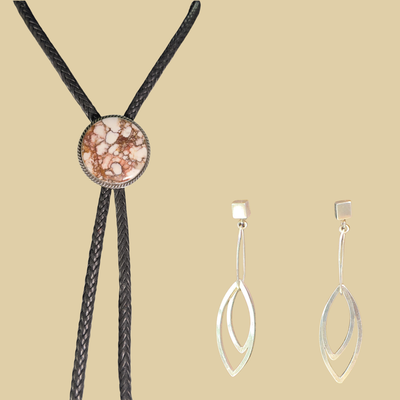
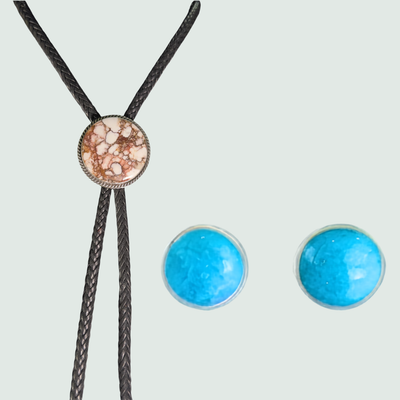
A cabochon is a stone that has been shaped and polished into a smooth, rounded dome rather than being cut with facets. An artist looks at a raw piece of White Buffalo stone or King's Manassa turquoise and identifies the matrix. The matrix is the intricate, web-like pattern of host rock that remains within the stone. Hand-cutting allows the maker to preserve the most beautiful parts of this pattern. Mass production frequently relies on plastic-based block turquoise or dyed howlite, which are soft materials that lack the cooling weight and mineral depth of the real thing. These imitations often have a repetitive, printed pattern that fails to capture the organic movement found in nature. By hand-cutting each stone, the artisan ensures the setting is built around the stone's unique geometry rather than forcing the stone into a pre-made mold.
Integrity of Sterling Silver .925 and Solid 14K Gold
The metal used in your jewelry dictates how long the piece will last and how it will react with your skin. We use only sterling silver .925 and solid 14K gold because they are hypoallergenic and durable. Many mass-produced items are made from mystery metals or base metals like brass that are plated in a thin layer of silver. This plating eventually wears away, exposing the reactive metal underneath which can turn your skin green. A solid sterling silver cuff has a distinct tactile weight and a warmth that hollow, machine-stamped versions cannot replicate. Choosing solid materials means your jewelry can be cleaned, polished, and even repaired for decades to come. You can explore our full range of handcrafted Southwestern style jewelry to see these quality materials in practice.
If you are looking for pieces that highlight these rare, mine-specific stones, our authentic turquoise jewelry collection features hand-selected cabochons from legendary locations like Royston and Sleeping Beauty. Each setting is fabricated by hand to honor the specific matrix and character of the individual stone.
Comparing Durability and Long-Term Value
Mass-produced jewelry is typically built for speed and seasonal trends, whereas artisan-made pieces utilize heavier gauges of metal and structural reinforcements designed for lifelong wear. This fundamental difference in construction determines whether a piece will become a cherished heirloom or a broken item in a jewelry box. When you evaluate handmade vs mass produced jewelry, the longevity of the piece is often found in the thickness of the silver and the security of the stone setting.
In a working studio, we use a thicker gauge of sterling silver .925 for the bezel and the shank. The shank is the circular band that wraps around your finger. A heavier shank prevents turquoise rings from becoming misshapen or thinning out after years of friction against the skin. Most factory-made rings use the thinnest possible metal to save on material costs, resulting in a piece that can easily bend or snap. Because handmade pieces are fabricated from solid metal rather than cast from porous molds, they maintain their structural integrity through daily activities.
Why Factory Jewelry Often Fails
Many factory pieces are made from "pot metal," which is a term for low-grade, brittle alloys often found in cheaper imports. These pieces are liquid-cast in thousands of units, a process that can leave the metal porous and prone to cracking under stress. Factories frequently use glue to set stones rather than a hand-burnished bezel. They don't offer the same security as a metal setting, which leads to lost gems as the adhesive degrades over time. This creates a cycle of "disposable" jewelry that eventually ends up in a landfill because the materials are not worth the cost of a fix. Unlike these mass-market items, handmade sterling silver jewelry can be professionally resized or mended. Because we use solid sterling silver .925, a jeweler can safely apply heat to the metal for care and repair without the risk of the piece melting or bubbling.
The Investment Value of Authentic Stones
Authentic Southwestern style jewelry holds its value because it represents a finite resource from the earth. As famous mines like Sleeping Beauty or Number 8 close, the stones harvested from them become increasingly rare and sought after by collectors. A one-of-a-kind piece featuring a high-grade Royston turquoise cabochon is more than a fashion choice; it is a documented asset. These pieces possess a lasting quality that allows them to be passed down through generations. While mass-market items lose nearly all value once they leave the store, documented artisan work often appreciates as the stones become harder to source. Investing in authentic turquoise jewelry ensures that you are wearing a piece of history that remains as sturdy and beautiful as the day it was finished.
How to Identify Handcrafted Southwestern Style Jewelry
Identifying the technical markers of quality in handmade vs mass produced jewelry involves examining the structural integrity of the metalwork and the organic variations within the stones. By looking for specific signs of the artist's hand, you can ensure your investment features genuine materials rather than factory imitations.
The first thing you should notice is the heft. Genuine sterling silver .925 and natural stone have a distinct, cooling weight that plastic and base metal cannot replicate. When you hold a piece of handcrafted jewelry, it should feel substantial and balanced. Next, look for the hallmarks. A hallmark is a stamp on the back or interior of a piece that indicates the metal purity, such as .925 for sterling silver. You should also look for a maker's mark. A maker's mark is a unique stamp that identifies the individual artist or studio responsible for the work. While mass-produced items might have a metal stamp, they rarely feature the personal signature of a working artist.
Spotting the Artist's Hand
To find the soul of a piece, you have to look closely at the finishing details. Examine the interior of a ring or the underside of a pendant for subtle tool marks. These tiny indentations are signs of a person working at a bench with pliers and files. You should also look at the patina. Patina is a surface layer that develops on silver through oxidation, often used by artists to add depth and contrast to a design. In a studio, we apply this by hand and then buff it away to highlight the textures. Factories often use a uniform chemical spray that looks flat and lacks the character of a hand-rubbed finish. Finally, observe the shape of the stone. Hand-cut cabochons are rarely perfect, machine-precise circles; their slight asymmetry is a beautiful mark of authenticity.
Identifying Genuine Turquoise vs Imitations
Genuine stone has a specific thermal conductivity that makes it feel cold to the touch. If you press a stone against your skin and it warms up instantly, it's likely plastic or resin. You should also check the matrix for signs of dye residue. The matrix is the host rock webbing within the stone. If you see dark, inky spots concentrated in the cracks, the stone may be dyed howlite. A stone that looks "too perfect" or has a repetitive pattern is often a red flag in lower-priced jewelry. Real turquoise from mines like Kingman or Sleeping Beauty will have unique, non-repeating variations that no machine can perfectly mimic.
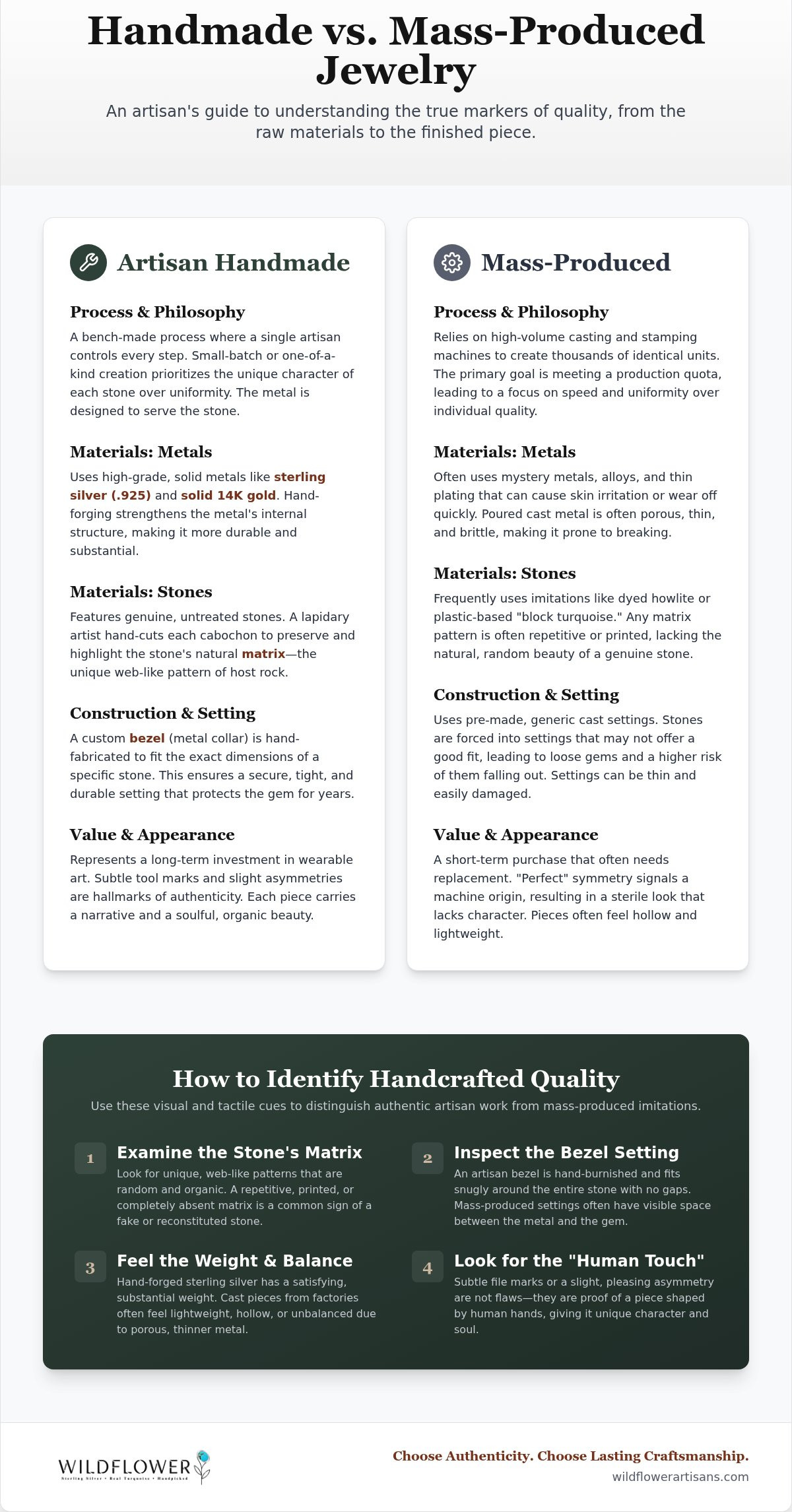
Our collection of one-of-a-kind artisan pieces features the distinct maker's marks and hand-burnished bezels that define quality Southwestern style. These pieces showcase the organic asymmetry of hand-cut stones and the structural weight of solid sterling silver .925.
Choosing Quality Over Mass Production
Choosing quality in handmade vs mass produced jewelry means investing in pieces that preserve traditional silversmithing techniques while offering superior durability and material transparency. A single high-quality piece often outlasts a dozen mass-produced items, providing a connection to the earth that factory casting cannot replicate.
Supporting an artisan studio ensures that the craft of hand-fabricating bezels and hand-cutting cabochons continues. When you choose studio work, you aren't just buying an accessory; you're supporting a narrative that begins at the mine and ends in your collection. Unlike mass production, where materials are anonymous and often sourced through complex industrial chains, artisan jewelry offers peace of mind. You know exactly what is against your skin because we only use sterling silver .925 and solid 14K gold. This transparency eliminates the risk of skin irritation caused by the mystery metals found in cheaper imports. Every piece of handcrafted jewelry carries the intent of the maker, resulting in a finished product that feels intentional rather than accidental.
Building a Curated Collection
A curated collection is built intentionally by selecting versatile pieces that feature genuine stones and structural integrity. We often suggest starting with everyday essentials such as sterling silver studs or a simple ring featuring a hand-cut stone. These foundational pieces allow you to experience the tactile difference of solid metal and genuine matrix patterns before moving into more complex designs. As you grow your collection, we encourage you to ask questions about stone origins and silver grades. Understanding whether a stone is from the Royston or Kingman mine adds a layer of personal connection to your jewelry that mass-produced items lack. A collection built on quality reflects a personal journey and a respect for the natural world.
The Role of the Modern Studio
The modern studio serves as a bridge between the natural world and the wearer, prioritizing stone integrity and transparent sourcing. At Wildflower, our "stone-first" philosophy dictates that the design must honor the unique geometry of the cabochon. We don't use the standard factory approach of forcing stones into pre-made, generic settings. Instead, we fabricate each bezel to fit the specific stone we've selected, ensuring a secure and lasting fit. This transparency in our process ensures you receive authentic turquoise jewelry that is free from dyes or plastic fillers. Choosing artisanal quality is a commitment to authenticity over perfection. It's about finding beauty in the organic and knowing that your jewelry has been handled with care from the moment the stone was cut to the final hand-burnished finish.
Investing in Lasting Artistry
Choosing between handmade vs mass produced jewelry is an intentional step toward building a collection that honors both the earth and the artisan. You now have the technical tools to identify the hand-burnished bezels and unique matrix patterns that signify a genuine investment. By focusing on solid sterling silver .925 and stones from documented American mines, you ensure your jewelry remains a durable part of your story rather than a disposable trend. These pieces carry a weight and a narrative that factory-cast items simply cannot replicate.
We remain committed to a stone-first philosophy, strictly excluding all dyed howlite and mystery metals from our studio work. Every piece we offer is a celebration of natural beauty, designed with the structural integrity to be passed down through your family. Authentic Southwestern style jewelry isn't just an accessory; it's a connection to the landscape and the skilled hands that shaped the metal to fit the stone.
We hope you feel empowered to choose pieces that reflect your personal values and your appreciation for fine studio work. Wear your jewelry with the confidence that it was made to last as long as the stones themselves.
Frequently Asked Questions
Why does handmade jewelry cost more than factory made pieces?
Handmade jewelry costs more because it requires individual artisan labor and solid precious metals rather than automated machine casting. Every bezel, which is the metal band holding a stone, is hand-fitted to a unique cabochon. This labor-intensive process ensures structural integrity that mass production can't match. You're paying for a maker's expertise and the use of solid sterling silver .925 rather than thin, hollowed-out metal molds designed for speed.
How can I tell if my turquoise jewelry is authentic or dyed howlite?
You can identify authentic turquoise by its cooling temperature and its unique, non-repeating matrix, which is the host rock webbing found within the stone. If you notice dark dye concentrated in the cracks or if the stone warms up instantly like plastic, it's likely a treated imitation. We strictly exclude dyed howlite or block turquoise because these materials lack mineral depth. Real turquoise has a natural weight that imitations can't replicate.
Is sterling silver .925 better than silver plated jewelry?
Sterling silver .925 is superior to silver plated jewelry because it is a solid precious metal that won't wear away or irritate your skin. Silver plated jewelry consists of a thin layer of silver over mystery metals, which are undisclosed base metal alloys. This plating eventually chips or rubs off, exposing the reactive metal underneath. Solid sterling silver is hypoallergenic and can be cleaned, polished, or repaired for a lifetime of daily wear.
Can mass produced jewelry contain genuine turquoise stones?
Mass produced jewelry can contain genuine stones, but they are often lower-grade stabilized pieces or composite chips designed to fit standard machine molds. In the debate of handmade vs mass produced jewelry, the quality of the stone is usually the first compromise in a factory. Studio work prioritizes mine-specific stones with a distinct matrix, whereas factories focus on uniformity. This often results in factory pieces using treated stones to maintain a consistent look.
What does 'hand-cut' mean in relation to gemstones?
The term hand-cut refers to the lapidary process where an artisan shapes and polishes a stone by hand rather than using a computerized grinding machine. This allows the maker to preserve the most beautiful parts of the cabochon, which is a stone polished into a smooth dome. This method honors the stone's natural narrative. A hand-cut stone will often have a subtle asymmetry that is a beautiful mark of its artisanal origin.
Is handmade jewelry more durable for daily wear?
Handmade jewelry is generally more durable for daily wear because the metal is work-hardened, or strengthened through hammering, during the forging process. A hand-fabricated bezel wraps tightly around the stone, providing a mechanical hold that glue-set factory pieces lack. This compression makes the metal less brittle than the porous cast metal found in mass production. Choosing handmade vs mass produced jewelry ensures your pieces have the structural strength to survive daily life.
Article by
Kimberly Cordova
Kimberly Cordova is the founder and creative director of Wildflower Artisans, a handmade jewelry brand rooted in Santa Fe. Real turquoise, solid sterling silver, and a small line set in solid 14K gold. She built Wildflower around a simple belief: the best jewelry is the kind you actually reach for, not the kind you save for someday.
The collection is built three ways. Some pieces are made in-house, cut by her husband Greg from stones he sources himself, including rough from the family's King's Manassa Mine in Colorado and White Buffalo Mine in Nevada. Some are designed by Kimberly and fabricated by a trusted circle of Santa Fe silversmiths. And some are finished work she curates from artisan makers whose craft meets the same standard, because building a real collection means knowing when to make and when to look.
Turquoise leads, joined by White Buffalo, Wild Horse, Lapis Lazuli, Spiny Oyster, Black Onyx, Opal, and other genuine semi-precious stones. No shortcuts on the stone, the silver, or the story behind either.
Her writing covers everything she has learned along the way: how turquoise forms, how to tell natural from stabilized, what makes one mine different from another, how to read a bezel, and how to shop with confidence in a market that is not always straightforward. It is the kind of plainspoken information she wished someone had laid out for her when she was starting out.
Browse the collection at wildflowerartisans.com. Questions about a stone, a setting, or a specific piece are welcome any time.
0 comments