

What if the most vivid reds and purples in your collection were actually biological maps of the ocean's depth? When you consider Spiny Oyster Shell Jewelry: Color is the defining trait that captures the imagination, yet it's often the source of the most questions. It's natural to feel a bit of hesitation when you see such saturated, organic brilliance. You want to be sure that the vibrant orange or deep violet held within a sterling silver bezel is a true gift from the sea, not a product of dyes or mystery treatments.
We understand that desire for authenticity because we work with these materials every day in our Santa Fe studio. In this guide, you'll discover the natural origins of red, orange, and purple spiny oyster shells and how these vibrant hues are preserved in our artisan-made jewelry. We'll walk you through the biological reasons for these color variations, explain how rarity affects the value of a hand-cut cabochon, and give you the knowledge needed to care for these organic gemstones. By the end, you'll feel confident identifying high-quality shells and choosing pieces that celebrate the raw, fleeting beauty of the Pacific.
Key Takeaways
- Learn how the mollusk's habitat and diet naturally produce the striking reds, oranges, and purples found in Southwestern style jewelry.
- Identify why Spiny Oyster Shell Jewelry: Color varies by species, including the rare Spondylus princeps found in deeper waters.
- Understand the meticulous lapidary process of creating a hand-cut cabochon that preserves the shell's organic visual depth.
- Discover how to spot authentic artisan-made pieces set in durable sterling silver (.925) rather than mass-produced imitations.
- Master the essential care techniques needed to protect organic shells from chemicals and environmental damage to maintain their vibrant polish.
The Biological Origins of Spiny Oyster Shell Colors
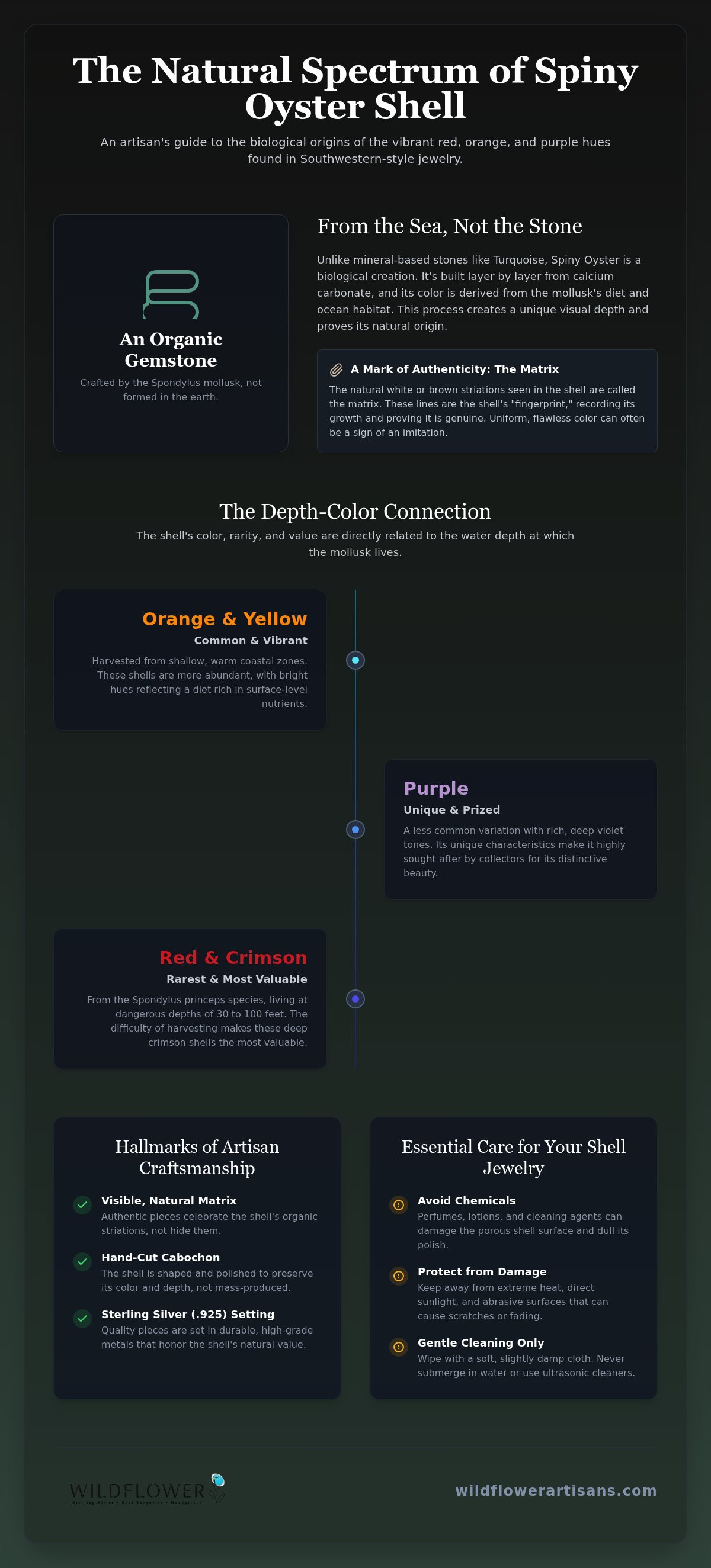
Spiny oyster jewelry is crafted from the shells of the Spondylus genus, a bivalve mollusk whose vibrant colors are naturally produced by its diet and the depth of its coastal habitat. These shells serve as organic gemstones, prized for centuries in Southwestern style jewelry for their unique calcium carbonate structure and striking visual depth.
When you hold a piece of spiny oyster jewelry, you're holding a piece of natural history. Unlike turquoise, which is a mineral formed by complex chemical reactions in the earth, spiny oyster is a biological creation. It's built by the mollusk over time, layer by layer, as it filters nutrients from warm coastal waters. This organic origin means that the shell is composed primarily of calcium carbonate rather than the copper and aluminum phosphates found in minerals. Because it grows in the sea, the shell absorbs pigments from its surroundings, creating a palette that mirrors the vivid sunsets of the Pacific coast.
In our studio, we often talk about the "stone-first" philosophy. This means we let the natural character of the shell dictate the final design. For Spiny Oyster Shell Jewelry: Color is the primary guide for our artisans. We look for pieces where the natural hues are most concentrated, ensuring that the finished cabochon (a stone that has been shaped and polished rather than faceted) retains the raw beauty of the Spondylus shell. It's a delicate balance of science and art that starts deep beneath the ocean's surface.
Environmental Factors Influencing Shell Pigment
The saturation and hue of a spiny oyster shell depend heavily on the water temperature and specific mineral content of the mollusk's environment. These natural conditions contribute to the intensity of the pigment, with warmer waters often yielding more vivid oranges and reds.
One of the most defining characteristics of a genuine shell is the matrix, which refers to the natural white or brown striations found within the calcium carbonate structure. These lines aren't imperfections. Instead, they're markers of authenticity and natural growth patterns. Just as you might see unique veining in a piece of turquoise jewelry, the matrix in spiny oyster tells the story of the mollusk's life. These variations are essential for identifying genuine artisan-made pieces. If a shell looks too uniform or lacks these organic transitions, it's often a sign of a dyed or imitation material. We prefer to celebrate these asymmetrical details, as they prove the shell's journey from the sea to the jeweler's bench.
Red Spiny Oyster Shell Rarity and Visual Depth
Red spiny oyster is considered the most valuable color variation because the mollusks live at significant depths, making them difficult and dangerous to harvest. These deep crimson hues are found in the Spondylus princeps species, which thrives far below the shallow coastal zones where orange varieties are more common.
When we look at Spiny Oyster Shell Jewelry: Color intensity is often a direct reflection of the shell's biological journey. High-quality red shells range from a warm brick red to a saturated, deep crimson that almost glows. Because these shells grow in more stable, deeper environments, they often feature less matrix than their orange counterparts. This leads to a more solid, uniform color profile that lapidaries prize for creating bold, singular focal points in Southwestern style pieces.
The rarity of the red shell isn't just about the pigment. It's about the risk involved in procurement. Divers must go to depths of 30 to 100 feet to find Spondylus princeps. This difficulty, combined with the shell's natural beauty, places it at the top of the rarity hierarchy. Understanding the rarity of Spiny Oyster Shell Jewelry: Color helps collectors appreciate the value of these deep-sea finds. It's a striking contrast to the more abundant orange shells found in tidal areas, which are much easier to collect. When we find a high-grade red shell in the studio, we treat it with immense respect during the cutting process.
Our studio carefully selects these deep crimson pieces to ensure every setting honors the shell's natural origin. You can view our current selection of handcrafted spiny oyster jewelry to find these rare red varieties set in sterling silver (.925).
Identifying Genuine Red Shell Pigment
You can distinguish natural red shell from dyed imitations by examining the grain for organic transitions and small white striations rather than a flat, monochromatic surface.
Because the red portion of the shell is relatively thin compared to the whole structure, artisans must be incredibly precise during the hand-cut process. Red shells are often shaped into thick cabochons to showcase their solid color profile without exposing the white backing of the shell. This depth gives the piece a weight and presence that is hard to replicate with synthetic materials. A well-cut red stone will have a lustrous, almost waxy finish that feels substantial to the touch.
In our studio, we find that pairing these deep red tones with sterling silver (.925) creates a high-contrast look that highlights the shell's warmth. The cool luster of the silver acts as a perfect frame for the fiery crimson center. If you are looking for a piece that balances this natural intensity with artisanal detail, you might explore our latest handcrafted jewelry additions to see how we set these rare shells. We focus on clean, secure bezels that allow the natural pigment to be the star of the piece.
Vibrant Orange and Yellow Tones in Artisan Shell Jewelry
Orange is the most prevalent hue found in spiny oyster jewelry, offering a warm spectrum that ranges from soft, pale peach to a saturated, vivid tangerine. These warm tones are the hallmark of the Spondylus limbatus species, which is found in the shallower, sun-drenched waters of the Sea of Cortez and along the Pacific coast.
While red shells are prized for their rarity, orange shells are beloved for their incredible versatility and the way they capture the light. In our Santa Fe studio, we often see shells that mimic the shifting colors of a high-desert sunset. The pigment isn't always uniform. It often flows in waves across the surface of the shell, creating a sense of depth that you won't find in dyed imitations. When evaluating Spiny Oyster Shell Jewelry: Color intensity is a key factor, but the character of the orange is what truly makes a piece stand out.
Our collection of handcrafted spiny oyster jewelry celebrates these warm tones through carefully selected shells set in sterling silver (.925). We look for pieces that have a natural glow, ensuring that the finished jewelry feels alive and connected to its coastal origins.
Occasionally, we encounter yellow spiny oyster, which is a rare sub-variant of the orange shell. These stones can appear as a bright, cheerful lemon or a deep, golden honey hue. Because yellow is much less common than orange, it's a favorite for collectors looking for a unique addition to their Southwestern style collection. These yellow tones often occur near the hinge of the shell, where the calcium carbonate structure is densest and the pigment concentration shifts.
The Aesthetic of the Shell Matrix
In the world of lapidary work, the matrix refers to the natural patterns of white, cream, or light brown host shell material that remains visible after the stone has been polished. This matrix is one of the most reliable ways to verify that your jewelry is genuine, as it follows the organic growth lines of the mollusk.
We don't view these white striations as flaws. Instead, we use the matrix to create one-of-a-kind patterns in our rings and pendants. A hand-cut cabochon that features a mix of vivid tangerine and creamy white has a rhythmic, painterly quality. It tells the story of the shell's growth over several years. Some of our most striking pieces feature a natural transition from orange to yellow within a single stone. When we find these bi-color sections, we carefully orient the shell during the cutting process to highlight the gradient. This ensures that the Spiny Oyster Shell Jewelry: Color remains the focal point while celebrating the asymmetrical beauty of the natural world.
Purple Spiny Oyster Shell Variations and Unique Characteristics
Purple spiny oyster shells are highly sought after for their regal hues and are harvested from the Spondylus calcifer species. This specific mollusk produces a spectrum of violet that sets it apart from its red and orange relatives found in the Pacific coastal waters.
When you look at Spiny Oyster Shell Jewelry: Color variations are often limited by the physical structure of the shell itself. The purple pigment is typically found only on the outer "lip" of the shell, which is the very edge where the mollusk grows. This biological limitation means that large, solid purple pieces are incredibly difficult to cut. Most of the shell body is a creamy white, so finding a section with enough purple depth to create a cabochon is a genuine win for any lapidary artist. It’s a game of millimeters at the grinding wheel.
The color range is surprisingly broad, moving from a light, airy lavender to a deep, royal plum that looks almost black in certain lights. You'll often see striking white bands or "water lines" that follow the curved growth of the shell. These bands aren't just visual details; they're a biological record of the mollusk's life in the sea. They show periods of growth and rest, creating a rhythmic pattern that collectors of Southwestern style jewelry prize for its organic honesty. We find that these "water lines" add a layer of narrative to every piece we create, proving the shell was never treated or dyed.
The Value of Solid Purple Cabochons
Solid purple stones without white striations are considered premium in the jewelry market because they require an exceptionally thick pigmented lip to harvest. Finding a piece of Spondylus calcifer with a solid color profile is rare, as most shells naturally transition into the white matrix very quickly as you move toward the center.
In our studio, the selection process is slow and intentional. We examine each raw shell to see which parts offer the most saturated violet before we ever touch a saw. These deep purple hues are often featured in our artisan-made rings where the metalwork protects the delicate shell edges. Because shell is an organic material, it’s softer than minerals like turquoise, so a secure bezel is essential for longevity. When we find that perfect piece of solid plum, we often set it in sterling silver (.925) to let the cool metal contrast with the warmth of the royal purple. It’s a combination that feels both grounded and sophisticated, honoring the Spiny Oyster Shell Jewelry: Color that only the deep sea can produce.
Technical Craftsmanship and the Preservation of Shell Color
Preserving the natural color of spiny oyster requires precise lapidary work, starting with the hand-cut process. Unlike many commercial operations that use mass-produced blanks, a working studio focuses on the specific geometry of each individual shell to ensure the most vibrant pigment is showcased.
When we work at the bench, we shape the shell into a cabochon. A cabochon is a stone that has been shaped and polished into a smooth, domed surface rather than faceted with sharp angles. For Spiny Oyster Shell Jewelry: Color is often concentrated in a very thin layer on the shell's surface. If an artisan isn't careful during the hand-cut stage, they can easily grind right through the red or purple pigment, leaving only the white calcium carbonate beneath. This is why you'll often see our pieces featuring slightly asymmetrical shapes; we follow the color where it lives in the shell rather than forcing it into a perfect circle.
To keep these organic stones secure, we almost always utilize a bezel setting. In this style of metalwork, a thin rim of sterling silver (.925) or solid 14K gold is folded over the edges of the stone. This creates a protective wall that guards the shell against the bumps and scrapes of daily wear. Because spiny oyster is an organic material, its edges can be more brittle than a hard mineral like agate. The bezel ensures the stone stays put for decades. We avoid the use of clear coatings, plastic resins, or stabilizers that many mass-marketers use. While these coatings might make a shell look shiny initially, they eventually yellow and peel, obscuring the natural visual depth of the shell.
Polishing and Finishing Organic Shells
Bringing out the natural luster of the Spondylus shell involves a slow progression of polishing grits. We start with a coarse diamond wheel to remove the rough, calcified exterior and the characteristic spines that give the oyster its name. As the vibrant orange or deep violet begins to emerge, we move to finer and finer sandpaper, often ending with a polishing compound that gives the shell a glass-like finish.
The artisan must constantly balance the removal of the rough exterior with the preservation of the pigmented layer. It's a meditative process that requires a light touch and a keen eye. A smooth, high-polish finish isn't just about aesthetics. It serves a practical purpose by sealing the surface of the shell. This prevents the organic material from absorbing skin oils, perfumes, or dirt that could dull the color over time. When a shell is polished correctly, its natural glow comes from the structure of the calcium carbonate itself, not from a topical spray or wax. This ensures that the Spiny Oyster Shell Jewelry: Color you fall in love with today remains just as vivid years down the road.
Caring for the Vibrant Colors of Your Sterling Silver Shell Pieces
Proper care is essential to ensure that the organic colors of spiny oyster shell jewelry remain vibrant for decades, as these natural pigments are susceptible to environmental damage. Because the shell is a biological material rather than a mineral, it requires a different approach than cleaning your traditional gemstones.
When you wear your favorite Southwestern style pieces, it's easy to forget that the shell is porous. It breathes. This means it can absorb what you put on your skin. We always tell our clients in the studio to make jewelry the last thing they put on in the morning and the first thing they take off at night. You should avoid exposing your pieces to harsh chemicals, perfumes, or hairsprays. The alcohol and synthetic oils in these products can seep into the calcium carbonate, eventually dulling the natural polish and altering the Spiny Oyster Shell Jewelry: Color over time. If you wouldn't put it on a delicate piece of silk, don't let it touch your shell.
Cleaning your jewelry doesn't require specialized equipment. In fact, you should stay far away from ultrasonic cleaners. These machines use high-frequency sound waves that can vibrate the organic layers of the shell, leading to micro-fractures or loosening the stone from its bezel. Instead, simply use a soft, damp cloth to wipe away any surface oils after a day of wear. If the piece needs a deeper clean, a tiny drop of mild, additive-free soap in lukewarm water is plenty. Just be sure to dry it immediately with a soft towel.
Storage is another factor that many collectors overlook. While the Sea of Cortez is sun-drenched, your jewelry box shouldn't be. You should store your shell pieces in a cool, dry place away from direct sunlight. Long-term exposure to UV rays can cause the organic pigments to fade, especially the lighter lavender and orange tones. Keeping them in a lined box also prevents the silver from tarnishing as quickly, which saves you time at the polishing bench.
Maintaining the Sterling Silver (.925) Setting
We recommend using a dedicated polishing cloth for the silver parts of your jewelry while being careful to avoid the shell itself. Most polishing cloths are treated with mild abrasives or chemicals that are perfect for sterling silver (.925) but can scratch the softer surface of a hand-cut cabochon.
If you're unsure about the best way to handle a specific piece, you can refer to the Wildflower Artisans care and repair guide for more detailed instructions. There is a practical reason for keeping your silver bright beyond simple aesthetics. When the metalwork is clean and reflective, it actually enhances the perceived saturation of the shell's color. The high contrast between the cool luster of the silver and the warm, organic center makes the Spiny Oyster Shell Jewelry: Color appear deeper and more vivid. It’s a simple trick of light that honors the artisanal work put into every piece.
Embrace the Natural Spectrum of the Spondylus Shell
Understanding the biological story behind each hue allows you to appreciate the true rarity of these organic gems. Whether you are drawn to the deep crimson of the Spondylus princeps or the regal plum of the purple varieties, the natural matrix and growth lines serve as a signature of authenticity. When selecting Spiny Oyster Shell Jewelry: Color should always be viewed as a gift from the ocean's depths, preserved through careful lapidary work and intentional design.
At Wildflower, we remain dedicated to the Southwestern style tradition, ensuring every piece is handcrafted with genuine shell and guaranteed sterling silver (.925). Our artisans select hand-cut stones for their superior color saturation, creating settings that honor the shell's natural origin. We don't use dyes or clear resins, focusing instead on the raw beauty of the materials found in our studio.
Explore our collection of authentic spiny oyster shell jewelry
We hope this guide helps you find a piece that resonates with your appreciation for the natural world. There is a quiet joy in wearing a stone that still carries the rhythm of the tides within its polished surface.
Frequently Asked Questions
Does spiny oyster shell jewelry fade over time?
Spiny oyster jewelry can fade if it is left in direct sunlight for extended periods or exposed to harsh household chemicals. Since the color is organic, ultraviolet rays can slowly break down the natural pigments held within the calcium carbonate. You can prevent this by storing your pieces in a dark, dry jewelry box when they aren't being worn. Avoiding contact with perfumes and hairsprays also helps keep the saturation looking fresh for decades.
Is the color in spiny oyster shell jewelry natural or dyed?
High-quality artisan jewelry features natural colors that come directly from the Spondylus mollusk's diet and ocean environment. While some mass-produced items use dyed howlite or plastic, Spiny Oyster Shell Jewelry: Color is naturally occurring and verified by its unique matrix. These white or cream striations are organic growth patterns that dyes cannot accurately replicate. We always suggest looking for these natural transitions to ensure your piece is genuine.
What is the rarest color of spiny oyster shell?
Deep red and solid purple are the rarest colors because they are the most difficult to harvest and cut into jewelry. Red shells are found at significant ocean depths, often requiring divers to descend 30 to 100 feet. Purple is rare because the pigment only appears on the very outer lip of the shell. This makes it difficult to find a section thick enough to shape into a solid-colored cabochon without exposing the white host material.
How can I tell if my spiny oyster jewelry is authentic?
You can identify authentic shell by looking for natural growth lines and the presence of a white or brown matrix. Fake shells often look too uniform or have a flat, painted appearance that lacks visual depth. Genuine spiny oyster has a distinct weight and a waxy luster that develops a soft glow when polished. If a stone feels unusually light or lacks any internal variations, it is likely a synthetic imitation or a dyed substitute.
Can spiny oyster shell jewelry get wet?
Your shell jewelry can handle an occasional splash of water, but you shouldn't submerge it in a pool, hot tub, or the ocean. The calcium carbonate structure is porous and can absorb chemicals like chlorine or salts, which may damage the surface polish. If your piece does get wet, simply wipe it dry with a soft cloth immediately. Keeping the stone dry helps preserve the hand-cut finish and protects the integrity of the sterling silver setting.

Article by
Kimberly Cordova
Kimberly Cordova is the founder and creative director of Wildflower Artisans, a handmade jewelry brand rooted in Santa Fe. Real turquoise, solid sterling silver, and a small line set in solid 14K gold. She built Wildflower around a simple belief: the best jewelry is the kind you actually reach for, not the kind you save for someday.
The collection is built three ways. Some pieces are made in-house, cut by her husband Greg from stones he sources himself, including rough from the family's King's Manassa Mine in Colorado and White Buffalo Mine in Nevada. Some are designed by Kimberly and fabricated by a trusted circle of Santa Fe silversmiths. And some are finished work she curates from artisan makers whose craft meets the same standard, because building a real collection means knowing when to make and when to look.
Turquoise leads, joined by White Buffalo, Wild Horse, Lapis Lazuli, Spiny Oyster, Black Onyx, Opal, and other genuine semi-precious stones. No shortcuts on the stone, the silver, or the story behind either.
Her writing covers everything she has learned along the way: how turquoise forms, how to tell natural from stabilized, what makes one mine different from another, how to read a bezel, and how to shop with confidence in a market that is not always straightforward. It is the kind of plainspoken information she wished someone had laid out for her when she was starting out.
Browse the collection at wildflowerartisans.com. Questions about a stone, a setting, or a specific piece are welcome any time.
0 comments