

What if the clearest clue to your jewelry style isn’t a trend or a label, but the pieces you reach for again and again? You may love a bold turquoise ring, delicate silver earrings, and a simple gold pendant, yet still wonder how they fit together. That mix can be a beginning, not a contradiction.
Finding your personal jewelry style starts with noticing what already feels natural to wear. The colors, materials, shapes, and scale you choose for ordinary days can reveal more than a mood board or a style category ever could. And when you understand those patterns, it’s easier to choose a meaningful piece with confidence, rather than bring home something lovely that stays tucked away.
In this guide, we’ll look at your repeat-wear favorites alongside the clothes you live in, then consider how stone color, metal, shape, and proportion affect the way jewelry feels on you. You don’t need to settle on one label or make every piece match. Just look closely at what you love wearing, and let those small, familiar choices point the way.
Key Takeaways
- Start with a quiet audit of the jewelry you wear often and the pieces that stay untouched to spot useful patterns.
- Use material, color, shape, and scale as a practical preference map; sterling silver is .925, while gold pieces are solid 14K.
- Compare individual design details instead of trying to fit yourself into one broad style label.
- Test your observations by rotating pieces through real outfits and routines before choosing a new one.
- Finding your personal jewelry style can help you choose a first piece that brings together your preferences, comfort, and personal meaning.
Finding Your Personal Jewelry Style Starts With What You Already Wear
Personal style becomes clearer when you notice what you choose repeatedly. Before buying anything new, look at the pieces you reach for during an ordinary week, the ones reserved for particular occasions, and the purchases that rarely leave their boxes. Those patterns offer a more useful starting point than a broad label.
Personal jewelry style is the pattern of colors, materials, shapes, and proportions you return to, not a fixed category you have to fit. You might wear silver most days and still love a warm stone or a sculptural gold piece now and then. Preferences can overlap and change; the point is to notice what feels comfortable and genuinely yours.
What does your jewelry drawer already tell you?
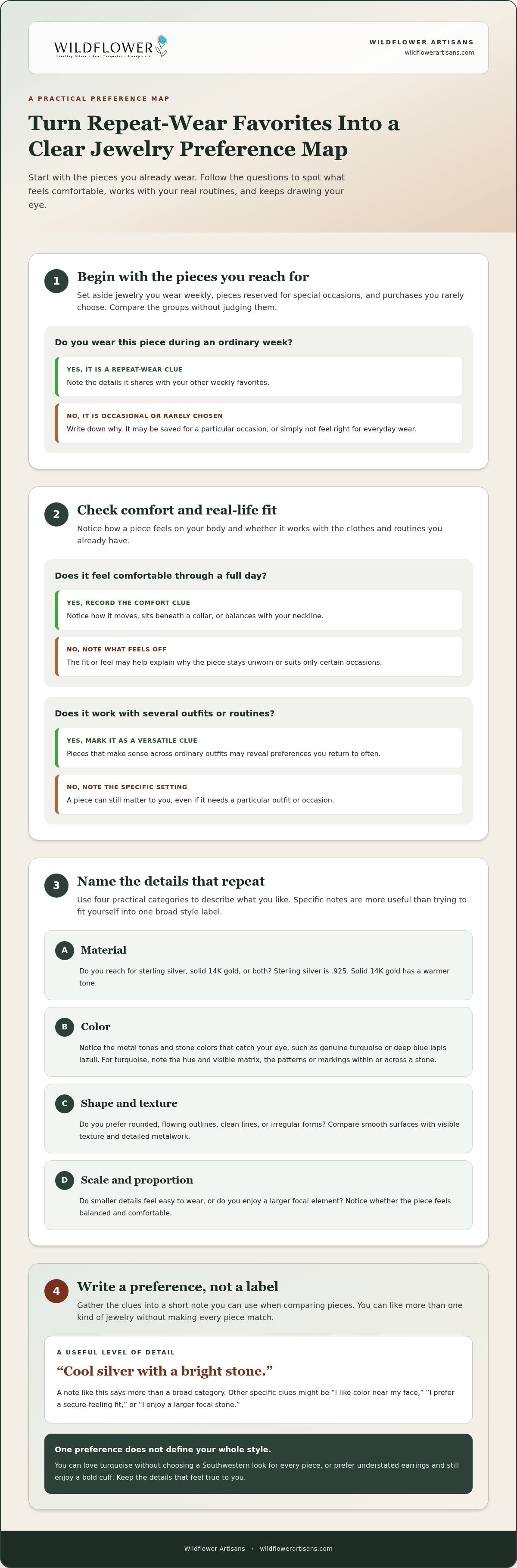
Set aside the jewelry you wear weekly, then compare it with pieces you save for special occasions or rarely choose. Notice repeated details: slender hoops or rounded studs, smooth metal or textured surfaces, small stones or larger cabochons, cool tones or vivid color. Also note how each piece feels on your body. Does it move comfortably, sit neatly beneath a collar, or feel balanced with your usual neckline?
Make a quick inventory without judging it. A few notes can reveal patterns that aren’t obvious when everything is mixed together:
- Color: Which metal tones and stone colors appear most often?
- Material: Do you favor sterling silver, stones, or a mix?
- Silhouette and scale: Are your favorites rounded, angular, delicate, or substantial?
- Wear: What feels comfortable through a full day?
Next to each favorite, write down why it earns its place. The reason may be practical, like a secure-feeling fit, or personal, like a gift tied to someone you love. Texture, memory, and visual balance count just as much as color.
Which pieces feel like you, rather than merely fashionable?
A trend can catch your eye without becoming part of your everyday life. Think about whether a piece still appeals when you set aside how current it looks. The jewelry that feels most like you often works with several outfits or routines, rather than requiring a special occasion to make sense.
Try a simple test: imagine wearing each piece with clothes you already own, then notice whether you feel at ease or self-conscious. One preference doesn’t define your whole style. Loving turquoise doesn’t require every piece to be Southwestern, and choosing understated earrings doesn’t mean you can’t enjoy a bold cuff. Keep observations specific: “I like color near my face” is more useful than assigning yourself a single style type.
If you want to compare different forms and stone colors while reflecting on what catches your eye, browsing handcrafted jewelry in a range of designs can offer useful visual reference. Let the details guide your notes, not a label you feel you have to claim.
A Simple Method for Naming Your Personal Jewelry Preferences
A four-part preference map makes your jewelry choices easier to describe: note material, color, shape, and scale. Together, these details give you practical language for what you like without squeezing your taste into a single style label.
Use a page in a notebook or a note on your phone, and write one or two observations under each heading. You’re not making rules for future purchases. You’re gathering clues that can help you recognize what feels at home on you.
- Material: Do you reach for sterling silver, solid 14K gold, or both? Sterling silver is .925; solid 14K gold offers a distinct material choice with a warmer tone.
- Color: Which metal tones and stone colors draw your eye? Consider genuine turquoise, deep blue lapis lazuli, or another color you repeatedly notice.
- Shape: Do you prefer rounded, flowing outlines, clean lines, or more irregular forms?
- Scale: Do smaller details feel easy to wear, or do you enjoy a larger focal element?
Keep your notes specific. “Cool silver with a bright stone” gives you more to work with than “Southwestern” or “minimalist.” You can appreciate both a compact silver ring and a larger pendant, while still noticing that color or material ties them together.
How do materials and stone colors shape your preferences?
Metal changes the overall feeling of a design. Sterling silver has a cool gleam, while solid 14K gold brings warmth; neither choice dictates a whole style. With stones, look beyond the broad color family and notice the particular hue, contrast, or pattern that holds your attention. Matrix means the patterns or markings visible within or across a stone. In turquoise, that variation can make two pieces with similar blue-green color feel quite different.
Stabilized turquoise is turquoise treated to improve its durability or appearance. The term describes treatment, not a preference you have to hold. Instead, note what you respond to in a finished piece: its color, the visible matrix, or how the stone sits within its setting. A cabochon is a polished gemstone shaped with a rounded, unfaceted top.
What shapes, textures, and proportions do you reach for?
Look closely at the contrast between a smooth outline and detailed metalwork, or between a polished surface and more visible texture. Ask whether you enjoy a quiet detail that catches the light up close or a larger focal stone that reads clearly across a room. Then consider proportion: a piece can feel substantial without being uncomfortable, or delicate while still having a strong shape.
Your notes can help you compare how one preference appears across different kinds of jewelry. The Wildflower Artisans shop-all jewelry collection includes rings, earrings, cuffs, pendants, and one-of-a-kind designs. Notice how a favorite stone color or shape feels in each form as you explore.
Compare Jewelry Details to Discover What Feels Most Like You
Comparing individual design details reveals more than choosing a broad style label. Two pieces can both feel simple or Southwestern, yet differ in color, outline, scale, surface, and how practical they feel in your day. Looking at one detail at a time helps you understand what draws you in without deciding that one choice is better than another.
Try comparing two pieces side by side, or picture each with an outfit you already wear. Use this table to describe what you notice, then add your own words in the final column.
| Detail | One possibility | Another possibility | Ask yourself |
|---|---|---|---|
| Color | A dominant stone color | A quieter, metal-forward design | Do I want color to lead, or prefer the metal’s gleam? |
| Silhouette | Round or softly organic | Elongated or angular | Which outline feels familiar beside my clothing? |
| Scale | Small and close to the body | Larger and more noticeable | Which proportion feels comfortable and balanced? |
| Surface detail | One clear focal feature | Layered texture or several details | Do I prefer a quiet surface or more to look at? |
| Everyday practicality | Light, simple, and easy to pair | More movement or a stronger presence | Would I choose it often, and does it suit my routine? |
How can you compare color and silhouette?
Imagine a pendant with a vivid stone as the main point of color beside a silver design where the metal shape takes the lead. Neither is more versatile by default. Then look at the outline: round forms may echo curved necklines, while elongated or angular shapes can pick up a crisp collar or a straight seam. Organic contours offer another kind of movement. Notice which shapes repeat in the clothes you feel most yourself wearing.
How do scale and detail affect everyday wear?
A small stud sits close to the ear, while a hoop or drop earring creates a more noticeable outline and may move as you do. A single focal detail gives the eye one place to rest; layered texture brings several details into view. Think beyond occasion labels. Comfort, movement, and how often you’d choose a piece are just as useful as how it looks in a mirror.
One detail you consistently prefer can be a steady guide to a more confident jewelry choice. If earrings are an easy way to compare shape and scale, you can explore handcrafted earrings in different silhouettes while keeping your observations in mind.
Try Your Jewelry Style in Real Life Before Choosing a New Piece
A short wear-and-reflection exercise tests your preferences against real outfits and routines. Instead of reviewing what you’ve worn in the past, deliberately rotate a few different pieces and notice which ones feel natural as your day unfolds.
Choose a small group of jewelry you already own, with some contrast between them. You might include a colorful pendant, a simple pair of studs, and a ring with a more noticeable shape. Wear one piece at a time with familiar clothes, not a special outfit chosen to make it work. The aim is to see how each piece fits into the day you actually have.
How can you test a preference with jewelry you own?
Give each piece a fair try on different days and in ordinary settings. Notice whether you forget you’re wearing it because it feels comfortable, or keep adjusting it as you move. Pay attention to whether its color and shape feel like a welcome detail with your clothes, and whether you reach for it naturally again. A preference that holds across changing outfits may be more useful than one that appears only in a particular moment.
Keep a brief note after wearing each piece. A useful journal prompt is: What was I wearing? Which piece did I choose? How did it feel after a few hours? What felt personally right, if anything? Write down the first honest answer. “The pendant sat comfortably under my cardigan” or “I liked the color, but wanted less movement” gives you practical information for a future choice.
What should you notice before choosing something new?
After trying the pieces, look for details that recur in your notes. Turn those observations into a short list, such as “silver, rounded shape, small scale” or “colored stone, smooth surface, secure fit.” A bezel is a metal rim that holds a gemstone around its edge. Noting whether you like this kind of setting can help you describe construction as well as appearance.
A lasting preference often shows up in more than one outfit or day, while a temporary attraction may be tied to a particular color, event, or passing mood. Both are worth noticing. You don’t have to dismiss a fresh impulse, just pause before treating it as a reliable guide for a piece you hope to wear often. That small distinction can make finding your personal jewelry style feel less like guessing and more like learning from experience.
The Everyday Essentials collection brings together jewelry intended for regular wear, offering a useful way to consider how your preferences translate into familiar pieces. Compare its designs with the details your notes reveal, and notice which ones you can imagine choosing repeatedly.
Choose a First Piece That Reflects Your Personal Jewelry Style
Choose one piece that brings together several preferences you’ve already observed, rather than trying to find a piece that represents every side of you. A thoughtful first choice might echo a color you love, feel comfortable through an ordinary day, and carry a personal meaning that makes you glad to wear it.
Before browsing, circle two or three details that appeared more than once in your notes. They might be a particular metal, a favorite stone color, a rounded shape, or a scale that feels easy to wear. Use those details to make a flexible shortlist, not a set of rules. Your tastes can be varied, and they can shift as your life and wardrobe change.
How do you turn your preference notes into a useful shortlist?
Start with the details that matter most in real life. If comfort showed up repeatedly, prioritize a form you can imagine wearing for a full day. If a certain stone color keeps drawing you in, let it narrow your search while staying open to different shapes and settings. Then ask what personal meaning, if any, you’d like the piece to hold. Meaning can come from a memory or milestone, but a simple, pleasing design is reason enough.
Consider each possible piece through the same small set of questions:
- Does it reflect a preference I’ve noticed more than once?
- Does the material, stone, and shape feel right together?
- Can I picture wearing it with clothes and routines I already have?
- Do I feel a personal connection, or am I responding mostly to a passing trend?
You don’t need every answer to be an immediate yes. The questions are there to help you slow down and see a piece clearly, not to make choosing feel like an exam.
How can you choose without needing a fixed style label?
Describe the piece in concrete terms: a silver pendant with a vivid stone, a small gold stud, or a ring with an organic outline. Those details tell you more than a trend category, and they leave room for different kinds of jewelry to feel like you. A style quiz or label can be a prompt, but it can’t replace your own sense of comfort, meaning, and likely wear.
Handcrafted designs can offer small variations in stone color, shape, and surface detail, so a piece may have an individuality that a broad category doesn’t capture. Wildflower Artisans offers one-of-a-kind artisan pieces for those drawn to distinct details; explore the one-of-a-kind jewelry collection at your own pace. There’s no need to complete a matching set. One well-chosen ring, pendant, or pair of earrings can be enough to mark what you’ve learned.
Let your shortlist guide you, then give yourself room to respond to the piece in front of you. Browse the full Wildflower Artisans jewelry collection to explore handcrafted designs and find one that feels meaningful, wearable, and your own.
Let Your Next Jewelry Choice Feel Like You
Finding your personal jewelry style isn’t about arriving at a final label. It’s about making room for the details that keep drawing you in, while staying open to the pieces that surprise you. Let your notes be a compass, not a set of rules. Your preferences can grow alongside your life.
At Wildflower Artisans, handcrafted jewelry featuring genuine stones and sterling silver sits alongside solid 14K gold pieces, with individual designs offering different details to discover. As you browse, notice which pieces make you pause and imagine wearing them. There’s no need to complete a set or choose the piece that fits a trend. Choose at your own pace, guided by what feels meaningful and wearable to you.
Your style is allowed to be a little unexpected. Follow the details that feel like yours, and let the next piece become part of your story.
Frequently Asked Questions
How do I find my personal jewelry style if I like many different looks?
Give yourself room to enjoy different looks, then notice which ones suit different parts of your life. You might prefer a quiet piece for work and a more expressive design for a family gathering. Finding your personal jewelry style doesn’t require choosing between them. Think of your taste as a collection of preferences with more than one mood, and let each piece earn its place in the way you actually live.
Can I mix different jewelry styles and still have a cohesive look?
Yes, pieces with different styles can feel cohesive when they share a connecting detail. A similar metal tone, a repeated stone color, or balanced proportions can bring varied shapes together. You can also let one piece take the lead and keep the others quieter, so the overall look feels intentional rather than crowded. Try the combination with an outfit you wear often, then adjust based on how it feels.
Is handmade jewelry a good choice for expressing personal style?
Handmade jewelry can suit personal style when you’re drawn to details that feel considered rather than uniform. Small differences in stone pattern, shape, or finish can give a piece its own character, while the form and material still reflect your preferences. Look for a design detail that holds your attention, whether it’s an unusual outline or the way a stone’s markings meet the silver. Choose what feels meaningful to you.
How can I choose jewelry as a gift when I do not know someone's style?
Start with what you’ve seen them wear: earrings, rings, or necklaces, and whether they favor subtle or noticeable pieces. If you’re unsure about fit or metal, a gift card lets them choose a design themselves. For a ready-to-give idea, Wildflower’s jewelry gift guide can help you explore options with the recipient’s habits and preferences in mind.
Article by
Kimberly Cordova
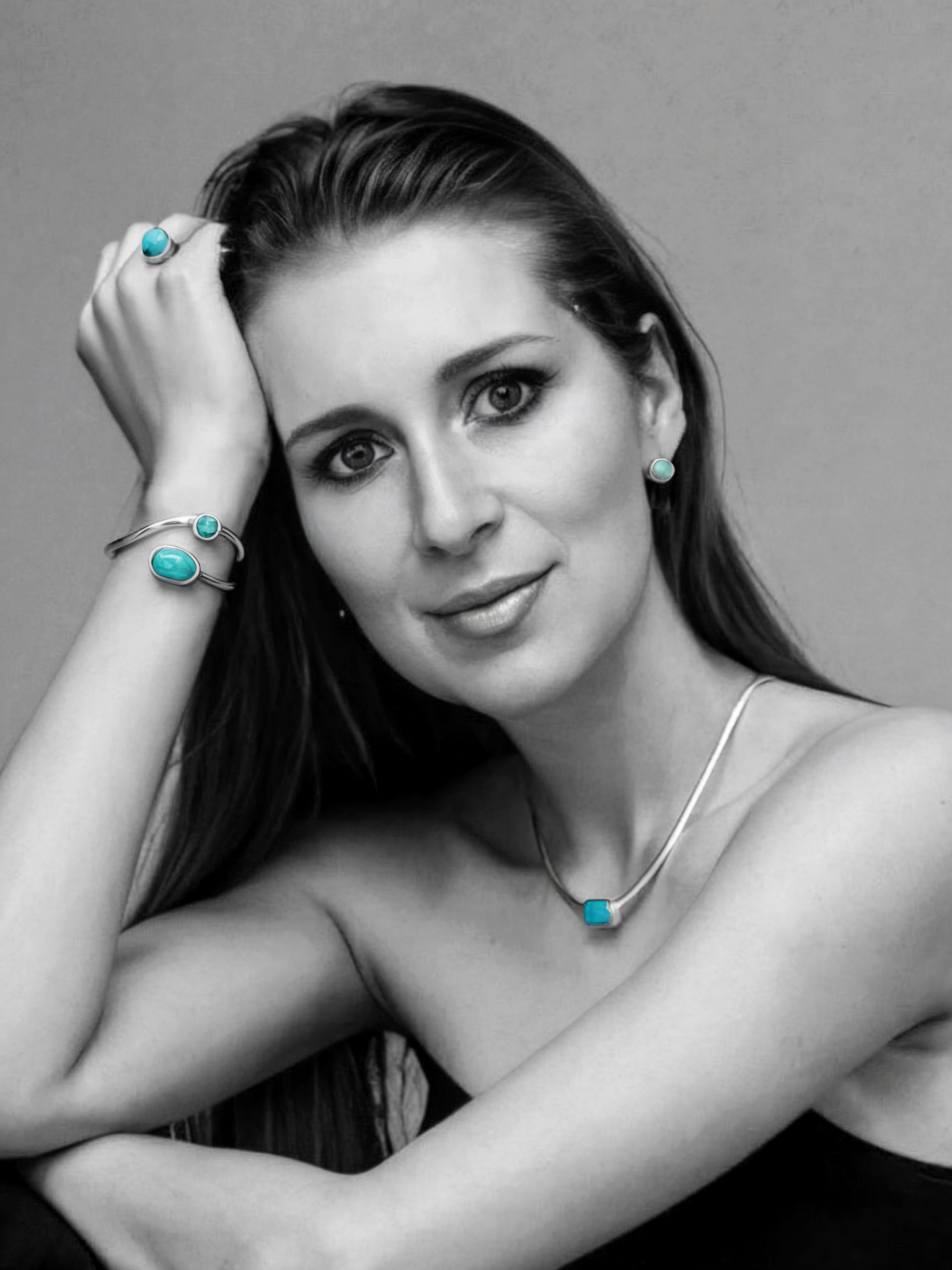
Kimberly Cordova is the founder and creative director of Wildflower Artisans, a handmade jewelry brand rooted in Santa Fe. Real turquoise, solid sterling silver, and a small line set in solid 14K gold. She built Wildflower around a simple belief: the best jewelry is the kind you actually reach for, not the kind you save for someday.
The collection is built three ways. Some pieces are made in-house, cut by her husband Greg from stones he sources himself, including rough from the family's King's Manassa Mine in Colorado and White Buffalo Mine in Nevada. Some are designed by Kimberly and fabricated by a trusted circle of Santa Fe silversmiths. And some are finished work she curates from artisan makers whose craft meets the same standard, because building a real collection means knowing when to make and when to look.
Turquoise leads, joined by White Buffalo, Wild Horse, Lapis Lazuli, Spiny Oyster, Black Onyx, Opal, and other genuine semi-precious stones. No shortcuts on the stone, the silver, or the story behind either.
Her writing covers everything she has learned along the way: how turquoise forms, how to tell natural from stabilized, what makes one mine different from another, how to read a bezel, and how to shop with confidence in a market that is not always straightforward. It is the kind of plainspoken information she wished someone had laid out for her when she was starting out.
Browse the collection at wildflowerartisans.com. Questions about a stone, a setting, or a specific piece are welcome any time.

0 comments