

A single piece of kingman turquoise can hold the entire gradient of an Arizona sky, from the pale whisper of dawn to the deep, electric blue of a summer afternoon. It's a stone that tells a story through its intricate matrix of host rock, often punctuated by flecks of golden pyrite or dark, rambling veins. Many collectors worry about accidentally purchasing dyed howlite or mass-produced block turquoise that lacks the soul of a genuine, hand-cut cabochon. We believe that a piece of jewelry should be as authentic as the landscape that inspired it.
You shouldn't have to guess whether the stone in your sterling silver bezel is genuine or why it's often labeled as stabilized. This guide will walk you through the history of the Kingman mine, which remains the last commercially producing turquoise mine in the United States. We'll help you distinguish between various color profiles and treatments so you can find an artisan-made piece from Wildflower Artisans that resonates with your personal style. You'll learn how to identify quality matrix patterns and understand the technical differences between natural and stabilized stones to help you choose the right piece for your Wildflower collection. This knowledge ensures you can confidently invest in authentic Southwestern style.
Key Takeaways
- Trace the heritage of the Mineral Park district in Arizona, where stones have been harvested for over a thousand years.
- Learn to identify the wide color spectrum of kingman turquoise, ranging from soft sky blue to deep forest green with unique matrix patterns.
- Understand the technical difference between natural stones and stabilized varieties that use clear resin for enhanced durability and color.
- Discover how to select the right scale and color story for your collection, whether you prefer dainty studs or bold statement cuffs.
- See how intentional silverwork and expert lapidary techniques bring out the best in these artisan-made Southwestern pieces.
What makes Kingman turquoise unique among American stones?
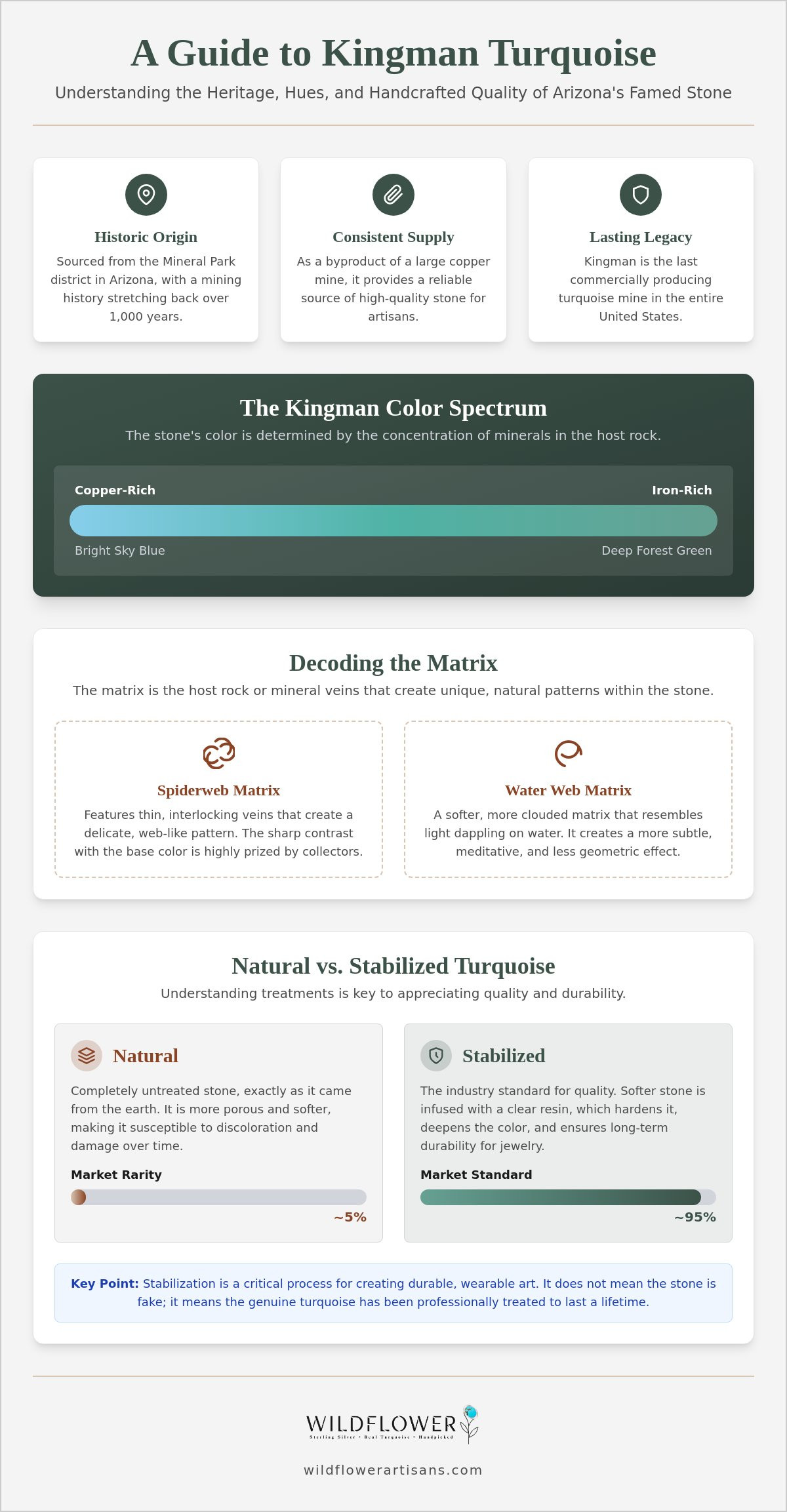
Kingman turquoise is a specific variety of the turquoise mineral found in the Mineral Park district of Arizona. It's celebrated for its immense color range and historical significance as one of the oldest and most productive mines in North America.
This stone represents a lineage of mining that stretches back over a thousand years. While many other famous American mines have closed their gates, the Kingman mine continues to produce high-grade material that defines the look of Southwestern style. Its versatility is its greatest strength. You'll find it in a staggering array of hues, from the classic bright blue often associated with Arizona to deep, mossy greens that feel rooted in the earth. Because it's a byproduct of a large copper mining operation, the supply remains steady enough for artisans to rely on it for consistent, high-quality work.
To better understand the scale and history of this location, watch this helpful video:
The legacy of the Mineral Park district
The Mineral Park district sits in the Cerbat Mountains, just outside Kingman, Arizona. This area is a massive copper mining hub. Copper is the specific element responsible for those bright blue tones we love. If there's more iron present in the ground, the stone leans toward green. For decades, the Colbaugh family has managed the mine, ensuring that this resource remains available to the jewelry world. Their stewardship has helped define what we consider quality American turquoise today. You can learn more about the specific history of this site on our Kingman stone origins page.
A tradition of handcrafted jewelry
For generations, these stones have been the centerpiece of Southwestern style. Early pieces were often hand-hewn and simple, focusing on the raw beauty of the cabochon. Today, we see a shift toward more refined, artisan-made silverwork that uses modern techniques while respecting the stone's heritage. At Wildflower, we focus on a small batch approach. This means we don't mass-produce designs. Instead, we create limited runs where the sterling silver bezel is carefully fitted to the unique shape and matrix of each hand-cut stone. This method ensures that the character of the turquoise remains the focus of every ring or pendant.
Understanding the diverse colors and matrix patterns of Kingman stones
Kingman stones are famous for a color spectrum that ranges from a vivid sky blue to a deep, earthy forest green. These variations occur naturally based on the local mineral concentration during the Kingman turquoise formation. While many mines produce a single, recognizable shade, the Mineral Park district is known for its immense diversity. This makes kingman turquoise a versatile choice for anyone building a jewelry collection.
Beyond the base color, the character of a cabochon is defined by its matrix. The matrix is the host rock or mineral veins that ramble through the turquoise, creating patterns that can't be replicated by a machine. Some stones are "clean," meaning they have very little matrix, while others are prized specifically for their intricate webbing. These patterns act as a visual history of the stone's growth over millions of years.
Collectors often look for two specific types of patterns to define the value of a piece:
- Spiderweb: This pattern features thin, interlocking veins that look like a delicate web across the stone. It's often dark or metallic, providing a sharp contrast to the blue or green background.
- Water web: This is a softer, more clouded matrix. It looks like light hitting the bottom of a clear pool, creating a dappled, meditative effect that's less geometric than spiderweb.
Blue vs Green Kingman varieties
The "high blue" stones are what many people first picture when they think of Arizona. These vibrant shades pop against a sterling silver setting, making them a favorite for everyday essentials. However, the green and teal varieties are just as authentic. These earthy tones often feel more organic and subtle. They're an excellent choice if you prefer jewelry that feels connected to the desert landscape. Whether you choose a bright sky blue or a muted sage green, you're getting a genuine piece of the Southwest.
The storytelling within the matrix
We often call the matrix a stone's fingerprint. It's the primary way to tell that your jewelry is truly one of a kind. Common matrix colors include deep black, light sandy brown, and even metallic silver flecks known as pyrite. A skilled lapidary artist will cut a cabochon to highlight these features, ensuring the most interesting part of the stone is front and center. A simple bezel setting acts like a frame for this natural art. If you're curious to see how these patterns look in finished jewelry, you can browse our shop to find a stone that speaks to you.
Is Kingman turquoise natural or stabilized?
Kingman turquoise comes in two primary forms: natural and stabilized. Natural turquoise is stone that is hard enough to be cut and polished without any chemical intervention, while stabilized turquoise is natural stone infused with a clear resin to increase its hardness and color stability. While natural stones are the rarest and most expensive, stabilized stones are the standard for high-quality, everyday jewelry.
Most material pulled from the Mineral Park district is naturally too soft to be used in silverwork. If we tried to shape a "chalky" raw stone on a lapidary wheel, it would simply crumble. Stabilization preserves the natural beauty of the stone while making it durable enough for a sterling silver bezel. At Wildflower, we believe in complete honesty about our materials. We clearly label each piece in our studio so you can choose the treatment state that fits your lifestyle and budget.
The artisan process of stabilization
The stabilization process is a permanent infusion that happens before the stone is ever shaped into a cabochon. Clear epoxy resin is forced into the pores of the turquoise under high pressure. This doesn't just make the stone harder; it also prevents it from reacting to external elements. Unlike dyed stones, which use pigments to fake a higher grade, stabilization uses only clear resin to protect the stone's original color. Most kingman turquoise you see in artisan-made jewelry has undergone this process to ensure it can survive the heat and pressure of the handcrafted jewelry-making process. It's a practical choice that makes Southwestern style accessible and wearable for years to come.
Caring for your turquoise jewelry
To clean your turquoise, use a soft, damp cloth and avoid chemical cleaners or ultrasonic machines. These stones are sensitive to harsh environments, even after stabilization. If you've chosen a natural, untreated stone, it's particularly important to keep it away from perfumes, hairsprays, and skin oils. Natural turquoise is porous. It will slowly absorb these substances, which can cause the color to deepen or shift toward green over time. Many people love this change because it reflects the history of the wearer, but if you prefer a consistent look, stabilized stones are your best bet. You can find more long-term maintenance tips on our care and repair page.
How to choose and style Kingman turquoise jewelry
Styling kingman turquoise is about finding a balance between the stone's natural character and your personal aesthetic. Since the mine produces such a wide variety of colors, you can build a collection that feels curated rather than repetitive. Start by identifying your color story. If you love the high-contrast look of bright blue against dark clothing, look for stones with a high blue profile. If your wardrobe is more neutral or earthy, the sage and forest green varieties provide a grounded feel that complements linen and wool textures.
Scale is another critical factor in your selection. A small cabochon set in a simple bezel is perfect for a minimal, understated look, while a heavy matrix stone demands a larger setting to show off its intricate details. Mixing patterns is an effective way to add depth to your style. You don't have to match your ring to your necklace perfectly. In fact, pairing a clean blue stone with a heavily webbed green piece creates a layered, organic aesthetic that feels intentional and personal. When evaluating a piece, look for clean silverwork and a bezel that sits tight against the stone, as these are marks of quality artisan-made jewelry.
Building a foundation with everyday essentials
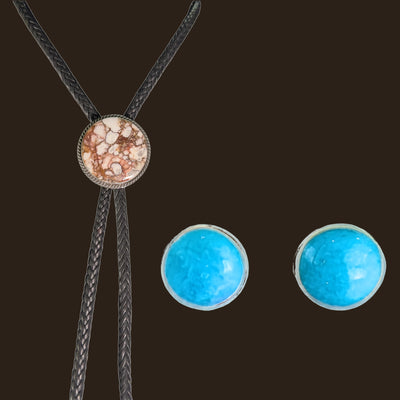
Building a foundation for your collection starts with everyday essentials. A pair of simple studs or a dainty ring works well with denim and white linens. These pieces are meant to be lived in, becoming a part of your daily rhythm rather than sitting in a jewelry box for special occasions. Because Kingman stones are durable, they're excellent candidates for jewelry you wear frequently. Choosing a smaller, hand-cut stone for daily wear ensures comfort without sacrificing that recognizable Southwestern style.
Making a statement with one-of-a-kind pieces
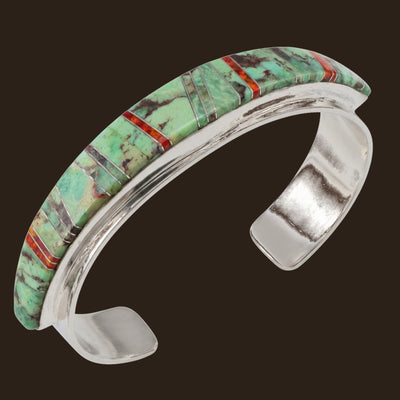
For those moments when you want the jewelry to be the focal point, look toward one-of-a-kind artisan jewelry. A wide cuff bracelet or a large pendant featuring a complex spiderweb matrix acts as a natural conversation starter. These pieces celebrate the unique, fleeting beauty of a single stone that can never be duplicated. A bold matrix serves as a visual anchor for your entire outfit, especially when paired with simple, solid-colored clothing. Investing in these larger pieces allows you to showcase the specific character of the Mineral Park district stones in their most raw and impressive form.
You can browse our shop to find the specific color and matrix pattern that fits your personal style.
Finding handcrafted Kingman turquoise pieces at Wildflower
At Wildflower, we treat every piece of kingman turquoise as a vessel for a story. Our studio isn't interested in the high-volume, mass-produced world of commercial jewelry. We focus on the marriage of intentional silverwork and genuine Arizona stones. It's a slow, deliberate process where we let the stone dictate the final form. This small batch approach ensures that every ring, pendant, and pair of earrings receives the attention it deserves. We exclude mystery metals and fake stones from our workshop, opting only for sterling silver and authentic materials that stand the test of time.
Choosing a piece from a working studio means you're investing in a tradition of quality. We don't rely on stock settings or generic designs. Instead, we look for the unique character in every hand-cut cabochon. This commitment to authenticity ensures that the jewelry you wear is a true celebration of Southwestern style. By keeping our production small and focused, we can guarantee the integrity of every stone and every solder joint.
The importance of expert lapidary work
A lapidary artist is the bridge between the raw earth and a finished piece of jewelry. They're responsible for transforming a piece of rough stone into a polished cabochon. We work closely with experts like Greg Cordova to ensure every stone is cut with care and precision. Greg has a refined eye for selecting specific matrix patterns to highlight. Whether it's a tight spiderweb or a clouded water web, he cuts the stone to reveal its most compelling narrative. You can visit Cutting Edge Turquoise for a deeper look at the lapidary process and the skill required to bring these stones to life. This partnership allows us to offer stones that are not only genuine but also artistically superior in their presentation.
A stone-first philosophy
Our design process begins with the stone itself. Instead of forcing a cabochon into a pre-made setting, we build the sterling silver bezel around the unique shape and character of the turquoise. This stone-first philosophy ensures that the natural asymmetries and organic details of the kingman turquoise are celebrated rather than hidden. Working with a small, independent jewelry studio offers a warmth and directness you won't find in larger retail environments. When you reach out to us, you're talking to the people who curate the stones and design the settings. It's a thoughtful conversation about craft and quality. We invite you to explore our Kingman turquoise collection to find a piece that resonates with your own story. Every selection is an opportunity to own a fragment of the Arizona desert, framed in silver and made to last.
Bringing the spirit of the Mineral Park district into your world
Choosing a piece of kingman turquoise is more than a simple purchase; it's an invitation to carry a fragment of the high desert with you. We've seen how the Mineral Park district offers a staggering diversity of matrix patterns and hues, from electric blues to quiet, mossy greens. Every hand-cut cabochon we set in our studio is a testament to the earth's slow, beautiful artistry. By prioritizing intentional silverwork and genuine materials, we ensure that your jewelry remains a vessel for your own personal narrative. Our small-batch studio production guarantees that you're receiving genuine Arizona stones set in quality sterling silver.
Explore our latest collection of handcrafted Kingman turquoise jewelry at Wildflower and find a piece that speaks to your story. For those who prefer the added comfort of marketplace protections, you can also browse our curated selection on Etsy. We hope you find a stone that resonates with your spirit and brings a sense of grounded beauty to your daily life.
Frequently Asked Questions
Is Kingman turquoise real turquoise?
Yes, Kingman turquoise is an authentic mineral turquoise pulled directly from the earth in Arizona. It is a genuine hydrous phosphate of copper and aluminum, not a synthetic imitation or a dyed substitute like howlite. While much of the material is stabilized to make it durable enough for artisan-made jewelry, the base material is a natural stone with a deep history in Southwestern style and jewelry making.
Why does some Kingman turquoise look green?
Green tones in kingman turquoise are caused by the presence of iron in the stone's chemical structure. While copper creates the classic high blue shades many people associate with Arizona, iron introduces earthy greens and teals. This variation is entirely natural and depends on the specific mineral concentration in the area of the mine where the stone was found. Many collectors prefer these organic, mossy hues for their unique character.
Can I wear my Kingman turquoise ring every day?
You can wear your Kingman turquoise ring daily, provided you take a few simple precautions to protect the stone. Most turquoise used in rings is stabilized, which makes the cabochon less porous and more resistant to scratching or color changes. However, you should still remove your jewelry before using household chemicals, swimming, or applying lotion. These substances can eventually dull the polish or affect the stone's appearance over time.
What is the difference between Kingman and Sleeping Beauty turquoise?
The primary difference lies in the matrix and color consistency. Sleeping Beauty turquoise is known for its uniform, clean sky blue color with little to no host rock visible in the stone. In contrast, kingman turquoise is celebrated for its wide color spectrum and intricate matrix patterns, such as spiderweb or water web. While Sleeping Beauty is now rare due to the mine's closure, Kingman remains a prolific source for diverse stones.
Does Kingman turquoise have silver in it?
Kingman turquoise does not contain silver, but it often features flecks of pyrite, which is frequently mistaken for silver or gold. Pyrite is a metallic mineral that creates a shimmering effect within the matrix of the stone. These pyrite inclusions are highly prized by many artisans because they add a layer of visual interest and confirm the stone's authenticity as a natural mineral rather than a mass-produced imitation.
How can I tell if my Kingman turquoise is fake?
You can identify fake turquoise by looking for unnaturally uniform color or a plastic texture. Imitations like dyed howlite often have dye that pools in the cracks, making the matrix look painted on rather than part of the stone's growth. If a stone feels unusually light or warm to the touch, it might be a composite or plastic block. Genuine Kingman stones will have a cool temperature and a unique, irregular matrix.
Is stabilized Kingman turquoise less valuable than natural?
Natural, untreated turquoise is rarer and commands a higher price because very little stone is hard enough to be used without chemical help. However, stabilized turquoise is not low quality. It is a necessary artisan process that makes beautiful, softer stones durable enough for everyday wear. For most jewelry lovers, a stabilized stone offers the best balance of authentic beauty and long-term durability for a sterling silver setting.
Where is the Kingman turquoise mine located?
The Kingman turquoise mine is located in the Cerbat Mountains, just outside of Kingman, Arizona. It sits within the Mineral Park district, an area famous for its massive copper deposits. This geographic location is significant because it is the last commercially producing turquoise mine in the United States. Its continued operation ensures that high-quality, artisan-made Southwestern jewelry remains accessible to collectors who value genuine American stones.
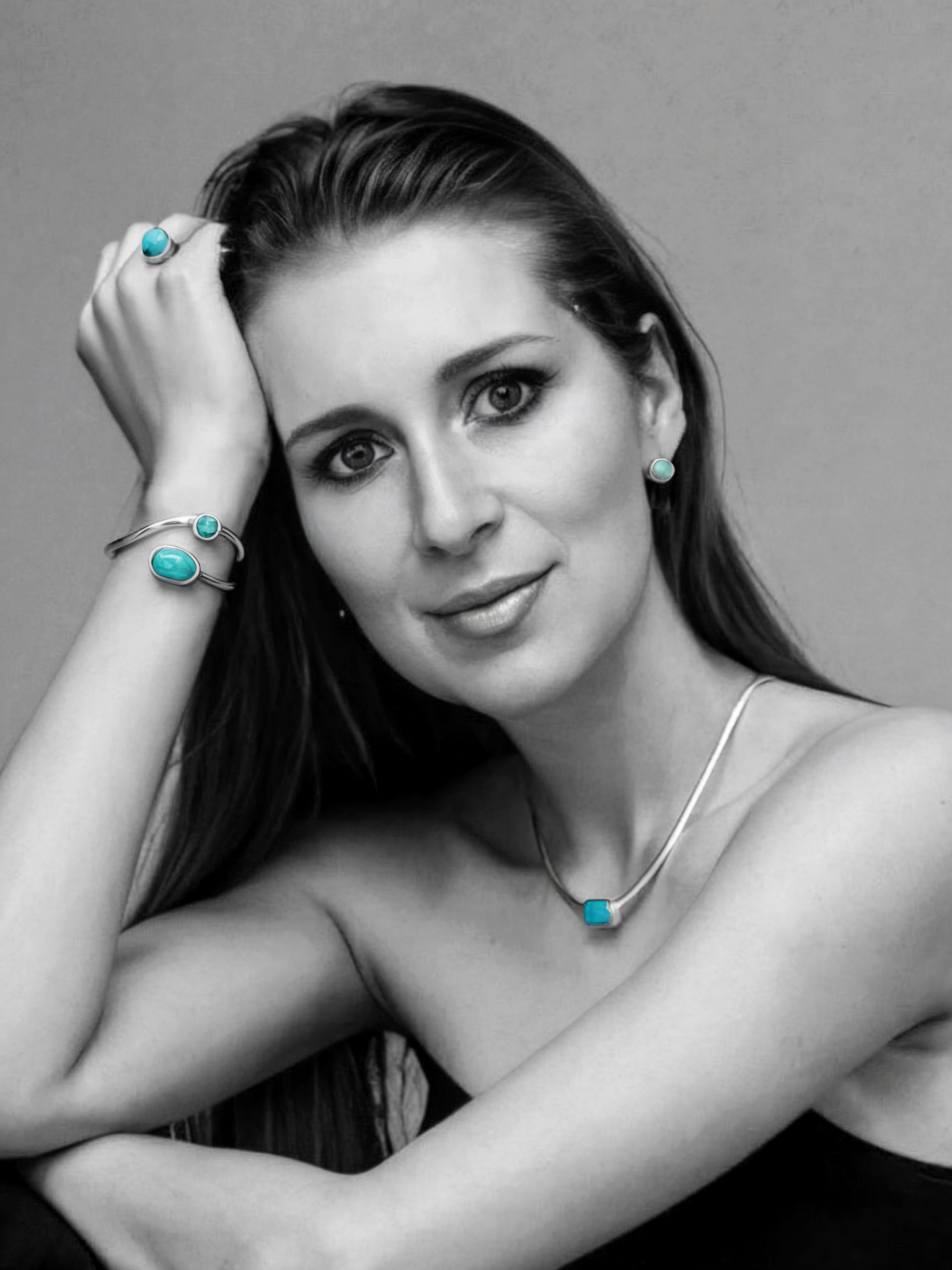
Article by
Kimberly Cordova
Kimberly Cordova is the founder and creative director of Wildflower Artisans, a handmade jewelry brand rooted in Santa Fe. Real turquoise, solid sterling silver, and a small line set in solid 14K gold. She built Wildflower around a simple belief: the best jewelry is the kind you actually reach for, not the kind you save for someday.
The collection is built three ways. Some pieces are made in-house, cut by her husband Greg from stones he sources himself, including rough from the family's King's Manassa Mine in Colorado and White Buffalo Mine in Nevada. Some are designed by Kimberly and fabricated by a trusted circle of Santa Fe silversmiths. And some are finished work she curates from artisan makers whose craft meets the same standard, because building a real collection means knowing when to make and when to look.
Turquoise leads, joined by White Buffalo, Wild Horse, Lapis Lazuli, Spiny Oyster, Black Onyx, Opal, and other genuine semi-precious stones. No shortcuts on the stone, the silver, or the story behind either.
Her writing covers everything she has learned along the way: how turquoise forms, how to tell natural from stabilized, what makes one mine different from another, how to read a bezel, and how to shop with confidence in a market that is not always straightforward. It is the kind of plainspoken information she wished someone had laid out for her when she was starting out.
Browse the collection at wildflowerartisans.com. Questions about a stone, a setting, or a specific piece are welcome any time.
0 comments