

You sit at your kitchen table, turning a cool, blue cabochon over in your palm, wondering if the weight you feel is the history of a Sleeping Beauty mine or just a clever piece of dyed plastic. It is a common anxiety for collectors, especially when the difference between a $10 per carat natural stone and a $0.10 treated imitation is often hidden beneath a polished surface. Performing a real vs fake turquoise test at home does not require a laboratory. It only requires a keen eye and a bit of studio-tested patience.
We understand the fear of accidentally damaging a cherished heirloom or being misled by confusing industry jargon like reconstituted or stabilized. This guide provides practical, non-destructive methods to help you identify genuine stones with the same confidence Greg Cordova uses when evaluating rough material for our Santa Fe studio. You will learn to spot the subtle matrix patterns that prove a stone's origin and understand how the new 2026 Turquoise Standard is finally bringing peer-reviewed grading to the industry. Trust is the foundation of any collection. By the time you finish, you will have the knowledge to curate your Southwestern style pieces with certainty.
Key Takeaways
- Recognize common imitations like dyed howlite and plastic resins by understanding the specific physical makeup of authentic stones.
- Examine matrix patterns for the subtle recessions and natural host rock textures that painted or molded fakes cannot replicate.
- Perform a safe real vs fake turquoise test at home by comparing the surface temperature and the relative density of your jewelry.
- Protect your collection from damage by avoiding the hot needle test, which often scorches genuine stones and melts resin imitations.
- Gain confidence in your collection by learning why mine-specific origins are the hallmark of authentic, artisan-made jewelry.
Understanding the Landscape of Imitation Stones
Turquoise is a hydrous phosphate of copper and aluminum. This specific chemical signature gives the stone its unique weight and specific gravity. To learn more about turquoise and its mineral properties, you can look at its crystalline structure, which is rarely visible to the naked eye but dictates how the stone feels in your hand. Most imitations found in the market today are not minerals at all. They are usually dyed howlite, magnesite, or various plastic resins designed to mimic the high-grade material we use in our studio.
When you prepare for a real vs fake turquoise test at home, you are looking for geological inconsistencies. A factory-made block of resin will be perfectly uniform, while a stone cut by Greg Cordova will show the character of its host rock. Knowing the stone origins is often the best defense against a bad purchase. Even with the introduction of the 2026 Turquoise Standard, which provides the first peer-reviewed grading system, the market remains flooded with clever fakes.
Before we dive into the specific materials, watch this video to see how these imitations appear in the wild:
The Rise of Dyed Howlite and Magnesite
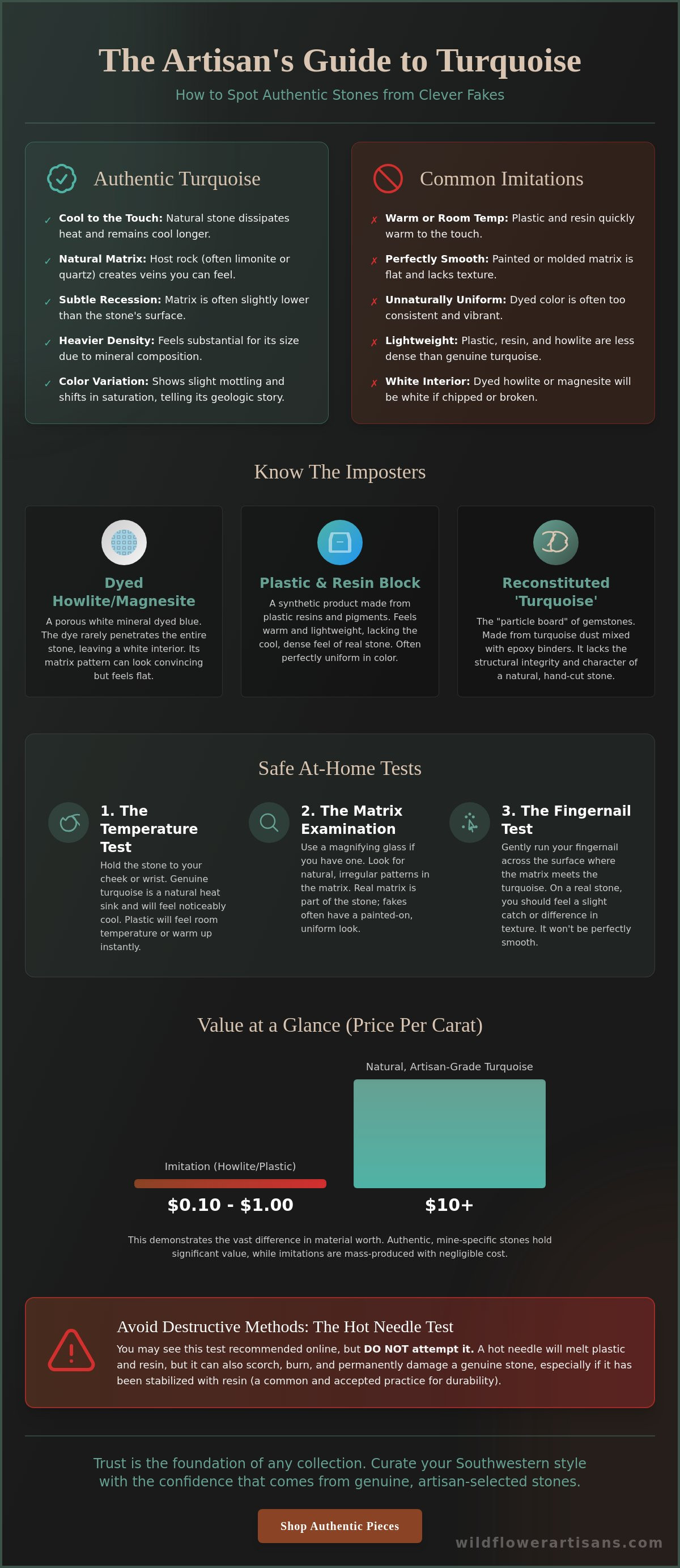
Howlite is a white, porous sedimentary rock. It naturally features a dark matrix that looks remarkably like the spiderweb patterns found in authentic stones. Because it is so porous, it takes on blue dye with ease. However, the dye rarely penetrates the entire stone. If you were to look at a cross-section, the interior would be stark white. Magnesite is a similar culprit. It often presents with a cracked or brain-like surface that lacks the smooth luster of a well-polished cabochon. While these materials are minerals, they are not turquoise. Their value is a fraction of the real thing, often priced between $0.10 and $1 per carat for treated specimens.
Plastic and Resin Block Turquoise
Block turquoise is the most common material in mass-produced fashion jewelry. It is a purely synthetic product made from plastic resins and pigments poured into large molds. It is easy to identify because it lacks the natural temperature variation of a stone. Plastic feels warm to the touch almost immediately; a real stone stays cool. It also lacks the density required for a quality piece of jewelry. Another common fake is reconstituted turquoise. This is made by mixing stone dust with epoxy binders. It is the particle board of the lapidary world. It might contain some turquoise molecules, but it lacks the structural integrity of a hand-cut, natural stone. Kimberly Cordova curates each stone in our studio to avoid these synthetics, ensuring every piece reflects the true spirit of Southwestern style.
Examining the Surface and Matrix Patterns
The matrix is the skeletal remains of the host rock where the turquoise formed. It isn't just a pattern; it's a structural element that tells the story of the stone's birth. When performing a real vs fake turquoise test at home, look closely at these veins. In a genuine stone, the matrix is often made of limonite, quartz, or pyrite. These materials have different hardness levels than the turquoise itself, which creates a physical landscape you can actually feel. Nature rarely produces something perfectly flat.
This brings us to the fingernail test. If you run your nail across a vein of spiderweb matrix, you should feel a tiny catch or a slight recession. Natural matrix has topography. If the pattern feels exactly like the rest of the stone's surface, it might be a reconstituted stone or a painted imitation. According to GIA's guide to turquoise quality, the texture and distribution of this matrix are key identifiers of a stone's value and authenticity. If the color is too consistent across the entire cabochon, it's often a sign of a synthetic process. Authentic stones usually show slight mottling or shifts in saturation that reflect their organic growth.
The Spiderweb and Matrix Detail
Spiderweb matrix is a delicate network of thin veins that grew through the stone over millions of years. It has a three-dimensional quality that fakes can't replicate. If you use a simple magnifying glass, you can see how the veins sit within the stone rather than on top of it. Fake matrix often looks like dark ink applied with a rubber stamp. These imitations lack the "bleeding" effect where the host rock and turquoise meet. Greg Cordova often points out that real matrix has its own life and grit. It has a depth that factory dyes simply cannot mimic. You can see these authentic patterns in our one of a kind turquoise collection, where each stone is chosen for its specific character.
Surface Texture and the Cabochon Cut
A cabochon is a stone that has been shaped and polished into a smooth, rounded form rather than being faceted like a diamond. Hand-cut cabochons from our studio show subtle, intentional variations. Mass-produced fakes often have a perfectly glass-like finish that feels too light and too slick. If a stone looks too perfect, it probably is. Authentic stones have character. Kimberly Cordova curates these stones specifically for their unique matrix patterns, ensuring that the Southwestern style remains grounded in geological reality. When you hold a real cabochon, it should feel dense and cool, with a surface that invites a closer look at its tiny, natural imperfections.
Performing a Real vs Fake Turquoise Test at Home
Testing jewelry shouldn't mean you have to destroy it. Many online guides suggest using a hot needle to see if the stone melts, but that ruins the finish of a genuine stone and can scorch natural matrix. When you conduct a real vs fake turquoise test at home, you want to use methods that preserve the piece while giving you a clear answer. Start with the temperature. Real turquoise is a mineral with high thermal conductivity. It feels cool against your skin and takes a while to warm up. Plastic or resin imitations will feel room temperature or warm almost instantly. It's a simple, sensory observation that often tells the story before you even reach for tools.
The weight of a piece is another immediate giveaway. Authentic turquoise is surprisingly dense because of its copper and aluminum content. If a large cabochon feels as light as a plastic button, it's likely a resin block or a hollow imitation. We often see this with mass-produced pieces where the silver is thin and the stone is synthetic. For a scientific baseline, the GIA Turquoise Guide details how these physical properties differ from common substitutes. If you're worried about the longevity of your piece after testing, our care and repair guide offers tips on maintaining sterling silver and stones.
Step-by-Step Acetone Swab Method
Acetone is a solvent that dissolves artificial dyes. This test is vital for identifying dyed howlite or magnesite, which are the most common fakes in the market. To perform this test, dip a clean cotton swab in pure acetone. Find an inconspicuous spot on the stone, perhaps right where it meets the silver bezel or on the back if the setting allows. Rub the stone gently for about ten seconds. If the swab comes away with a blue or green tint, the stone has been chemically dyed. Natural stones will not lose their pigment. The color is locked within the mineral structure itself, not just sitting on the surface.
The Mohs Scale Scratch Test
Turquoise ranks between 5 and 6 on the Mohs scale of mineral hardness. This makes it harder than plastic but softer than glass or quartz. You can use this knowledge to verify a stone's identity by testing a small area on the back of the cabochon. A copper penny has a hardness of about 3 and shouldn't be able to scratch real turquoise. However, a steel knife or a masonry nail has a hardness of about 5.5 and will leave a faint mark. If a penny easily gouges the surface, you are dealing with a soft plastic or resin. If a steel file can't even leave a mark, you likely have a piece of colored glass. Greg Cordova uses these hardness principles in our studio to ensure every stone meets the 2026 Turquoise Standard for quality and authenticity.
Avoiding Common Pitfalls and Destructive Methods
Performing a real vs fake turquoise test at home often leads collectors toward "hacks" that promise quick results but carry high risks. One of the most significant pitfalls is the assumption that turquoise must always be a specific robin's egg blue to be authentic. In reality, the palette of genuine stone is vast. Good quality green turquoise typically ranges from $2 to $7 per carat, while high-quality blue material often costs between $7 and $10 per carat. If you see a vibrant, oversized stone being sold for the price of a cup of coffee, it's likely a synthetic imitation. Price reflects rarity. Rare specimens like Bisbee turquoise can reach $40 per carat, and Lander Blue can exceed $500 per carat. Understanding these market values is your first line of defense against being scammed.
Why the Hot Needle Test is Risky
We strongly advise against the hot needle test for finished jewelry. This method involves heating a needle to a glow and pressing it into the stone to see if it melts or smells like plastic. While this identifies resin, it also causes thermal shock to natural stones. High heat can lead to permanent discoloration or deep structural cracks. You might prove the stone is real only to find you've scorched a hole in a valuable heirloom. Visual inspection and the chemical tests mentioned in previous sections are far safer for the intentional collector. Character matters more than a destructive shortcut. If you're unsure about a piece, it's better to consult an expert than to ruin the finish of a hand-cut cabochon.
Understanding Stabilized vs. Natural Stones
Natural turquoise refers to untreated stone that is hard enough to withstand the lapidary process without help. It's the gold standard for many collectors. However, much of the turquoise on the market is stabilized. This isn't a "fake" stone. Stabilization involves pressure-injecting clear resin into softer, porous turquoise to make it durable enough for a bezel setting. It's still real stone, but its value is different than a rare, untreated specimen. Greg Cordova sources and cuts both varieties at CuttingEdgeTurquoise.com, maintaining full transparency about every stone's history. Kimberly Cordova then curates these stones based on their unique matrix and color depth. Knowing whether your stone is natural or stabilized helps you care for it properly over time. To find pieces with confirmed origins and professional curation, browse our latest one of a kind turquoise jewelry selections.
Sourcing Authenticity Through Studio Expertise
While a real vs fake turquoise test at home provides a sense of security, the most reliable path to authenticity is a direct connection to the source. In our Santa Fe studio, we view every stone as a narrative of the earth. Knowing the specific mine origin isn't just about marketing; it's about geological truth. Greg Cordova handles the lapidary work for our pieces, often sourcing rough material directly from mine owners he has known for decades. This direct oversight means we don't have to guess if a stone is dyed or synthetic. We've seen it in its raw, unpolished state. This level of transparency is what separates a small batch studio from a mass-market retailer.
Kimberly Cordova brings this same intentionality to her design and curation process. She selects stones not just for their color, but for the way their matrix tells a story of the Southwestern style. When you buy from a working studio, you aren't just getting jewelry. You're getting a factual record of a stone's journey from the mountain to the bezel. This provenance is the ultimate test that no home chemical or scratch can replicate. It's the difference between a mystery stone and a documented heirloom.
The Value of Provenance and Mine History
Distinctive stones like King's Manassa or White Buffalo have visual signatures that are nearly impossible to fake convincingly. King's Manassa is prized for its rich greens and golden-brown matrix, while White Buffalo offers a stark, beautiful contrast of white stone and black chert. You can explore the diversity of these materials in our guide to stone origins. A certificate of authenticity or the word of a trusted artisan who actually cut the stone is the most powerful tool in your collection. It provides peace of mind that goes beyond what a magnifying glass can reveal.
Caring for Your Authentic Collection
Authentic turquoise is a porous mineral that can change over time if it isn't treated with respect. To preserve the natural color of your stones, keep them away from harsh chemicals, perfumes, and oils. These substances can seep into the stone's pores and alter its hue permanently. We recommend a gentle approach to maintenance. For a deeper look at keeping your pieces in gallery condition, visit our care and repair guide. When you treat your jewelry as an artisan-made heirloom, you ensure its story continues for generations. Real stones have a life of their own. They deserve to be cared for with the same intention used to create them.
Building a Confident Collection
Identifying the difference between a geological treasure and a clever piece of plastic resin changes how you interact with jewelry. You now have the practical tools to perform a real vs fake turquoise test at home using weight, temperature, and matrix texture. These simple observations help you look past the bright dyes of howlite and see the true character of the stone. Real value isn't just about the color; it's about the matrix and the specific story of the mine where the stone formed.
In our studio, we eliminate the guesswork by overseeing every step of the process. Every stone is curated by Kimberly Cordova for its unique Southwestern style, while the lapidary work is handled by Greg Cordova. We guarantee genuine materials in every piece, so you never have to worry about mystery metals or dyed imitations. Browse our collection of authentic, artisan-made turquoise jewelry to find a quietly timeless piece for your collection. If you prefer the reviews and protections of a marketplace, you can also find our work at the Wildflower Etsy shop. Trust your eye and enjoy the process of finding stones that truly speak to you.
Frequently Asked Questions
Can I use vinegar to test if my turquoise is real?
Vinegar is not a recommended test because its acidity can etch the surface of a genuine stone. While some use it to see if a stone fizzes, which indicates calcium carbonate found in magnesite, the risk of permanent damage to a polished cabochon is too high. You are better off using the acetone swab method. This protects the stone's finish while still identifying artificial dyes.
What does real turquoise look like when it is broken?
Genuine turquoise displays a conchoidal or granular fracture with a waxy to sub-glassy luster. If you see a broken piece, the color should be uniform from the surface to the center. Imitations like dyed howlite or magnesite will reveal a stark white interior once the outer layer of dye is breached. This internal consistency is a hallmark of stones Greg Cordova cuts in our studio.
Is stabilized turquoise considered fake?
Stabilized turquoise is real stone that has been treated with clear resin to increase its hardness. It is not considered fake. This process is necessary for about 90 percent of the turquoise pulled from the ground to make it durable enough for jewelry. It differs from reconstituted turquoise, which is made from stone dust and plastic. Kimberly Cordova curates both natural and stabilized stones based on their unique visual character.
How can I tell the difference between turquoise and variscite at home?
Telling the difference between turquoise and variscite at home relies heavily on color and hardness. Variscite is typically a much more vibrant, apple-green color and is significantly softer, ranking at 3.5 to 4.5 on the Mohs scale. Since turquoise is harder, ranking 5 to 6, a copper penny might scratch variscite but will not mark real turquoise. Both stones are beautiful, but they have distinct mineral compositions.
Does real turquoise change color over time?
Natural, untreated turquoise can change color over time as it absorbs skin oils or environmental chemicals. This process often shifts the stone's palette from blue toward a deeper green. While some collectors value this aging as a sign of authenticity, stabilized stones are specifically designed to be color-fast. Using the care and repair techniques we've discussed will help slow this natural transition in untreated pieces.
What is the most reliable non-destructive test for turquoise?
The most reliable non-destructive real vs fake turquoise test at home is a combination of the temperature check and a matrix inspection under magnification. Real stone stays cool to the touch much longer than resin or plastic. When you pair this with the observation of a recessed, natural matrix, you can identify most fakes without any chemicals. It's the same observant approach we use when evaluating material for our Southwestern style collections.
Article by
Kimberly Cordova
Kimberly Cordova is the founder and creative director of Wildflower, a handmade Turquoise and sterling silver jewelry brand based in Santa Fe. She built Wildflower around a simple belief: the best jewelry is the kind you actually reach for, not the kind you save for someday.
Kimberly designs pieces made by hand with a trusted circle of Santa Fe silversmiths, works alongside her husband Greg on in-house lapidary pieces cut from stones including the family's King's Manassa Mine in Colorado and White Buffalo Mine in Nevada, and sources finished work from artisan makers whose craft meets the same standard. The result is a collection with real range and no shortcuts on the stone, the silver, or the story behind either.
Her writing covers everything she has learned along the way: how Turquoise forms, how to tell natural from stabilized, what makes one mine different from another, how to read a bezel, and how to shop with confidence in a market that is not always straightforward. It is the kind of plainspoken information she wished someone had laid out for her when she was starting out.
Shop the Wildflower collection at wildflowerartisans.com, or find us on Etsy at wildflowersantafe.etsy.com if you prefer shopping there. Questions about a stone, a setting, or a specific piece are welcome any time.
0 comments