

You might think that a velvet-lined jewelry box is the safest harbor for your collection, but these fabric-lined cases often trap the very sulfur compounds that turn your silver black. It is a disheartening moment to reach for a favorite artisan piece only to find it has lost its luster. We understand the hesitation that comes with cleaning delicate, hand-cut stones, especially when you want to spend your time wearing your jewelry rather than scrubbing it. Learning how to store sterling silver jewelry to prevent tarnish is less about fancy equipment and more about simple atmospheric control.
In our studio, we rely on the same standards set by the Federal Trade Commission, which requires sterling silver to be at least 92.5% pure silver. This purity makes it beautiful but also reactive to the world around it. This guide shares the professional habits we use to protect our work, including the use of specialized materials like Hagerty Silversmiths' Cloth or Intercept bags. You will learn how to create a studio-grade environment at home for as little as $3.99 for a pack of anti-tarnish tabs, ensuring your turquoise remains protected and your silver stays bright for years to come.
Key Takeaways
- Identify the chemical triggers for tarnish to understand why common air exposure can dull the finish of your sterling silver.
- Master how to store sterling silver jewelry to prevent tarnish by utilizing moisture-absorbing silica packets and specialized anti-tarnish tabs.
- Replace standard jewelry boxes with chemically treated silver cloth to neutralize sulfur gases that cause your metal to turn black.
- Shield the delicate matrix of natural turquoise from oils and chemicals that can damage the stone over time.
- Adopt the professional habit of wearing your jewelry frequently and wiping it down after each use to maintain a quietly timeless shine.
Understanding why sterling silver jewelry tarnishes
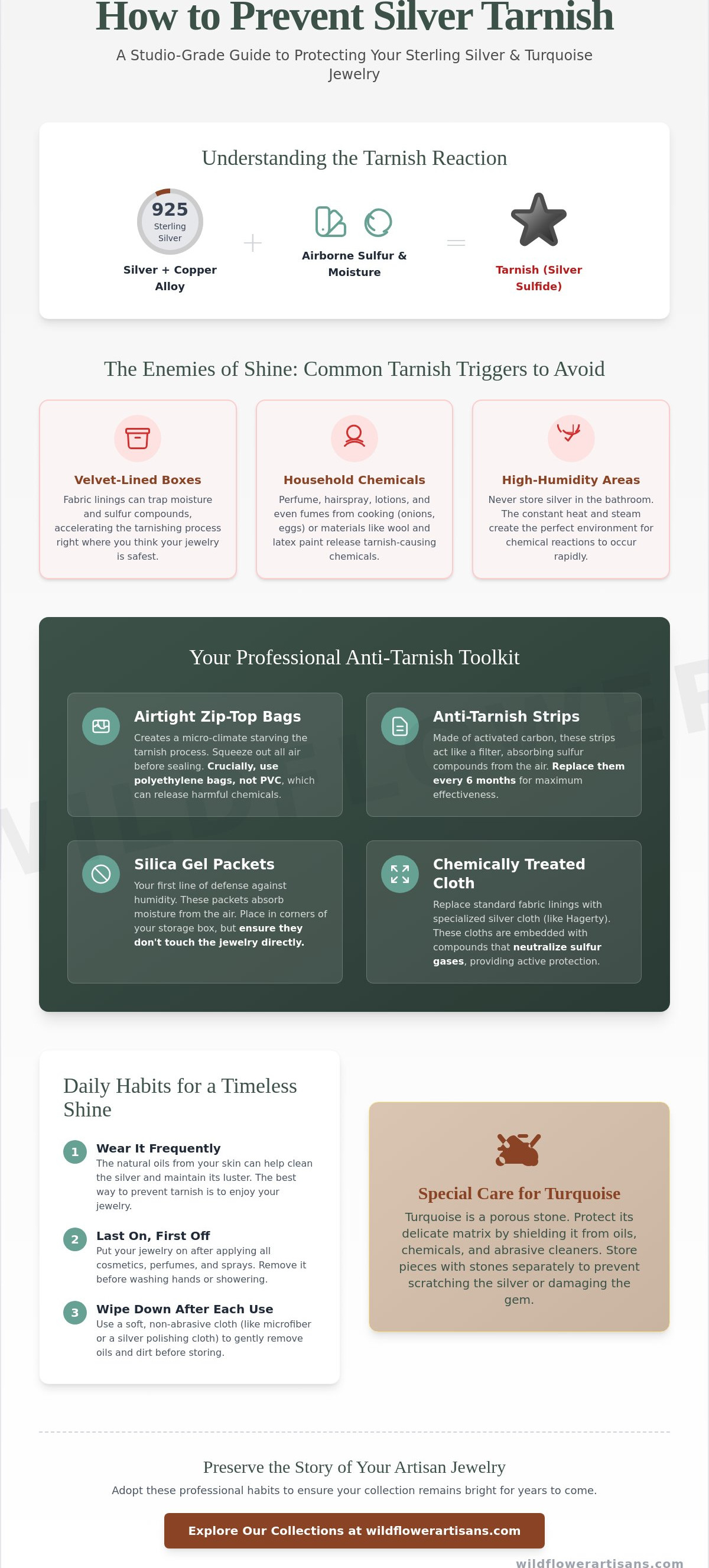
Sterling silver is a specific alloy, defined by the FTC as 92.5% pure silver and 7.5% other metals, usually copper. This copper provides the structural strength needed for artisan-made rings and cuffs, but it also invites a reaction with the atmosphere. Tarnish is a protective but unsightly layer of silver sulfide that forms on the surface of the metal. When you are learning how to store sterling silver jewelry to prevent tarnish, you are essentially learning how to manage a chemical boundary between your jewelry and the air. It is a natural process, but one that can be delayed with the right studio habits.
The chemical reaction between silver and your environment
The darkening you see isn't actually rust or dirt. It's the result of silver molecules meeting hydrogen sulfide. Understanding why sterling silver jewelry tarnishes involves looking at moisture as a primary catalyst. High humidity acts like a bridge. It makes it easier for sulfur gases to settle on the metal and begin the darkening process. In a city environment, the concentration of industrial pollutants and vehicle exhaust often contains higher levels of sulfur than rural areas. Your collection might darken faster in an urban apartment than in a desert studio. Daily rituals like applying hairspray or perfume also introduce chemicals that can pit the surface or accelerate this process, making it vital to understand how to store sterling silver jewelry to prevent tarnish after every wear.
Common household triggers to watch for
Your home is full of hidden sulfur sources that can bypass even a closed jewelry box. Wool carpets and silk scarves contain proteins that naturally release sulfur over time. Latex paints and even some types of treated wood in drawers can outgas chemicals that react with the copper in your sterling pieces. Kitchen fumes are another often overlooked risk. Cooking foods high in sulfur, like eggs or onions, releases gases that can settle on nearby jewelry. Tap water often contains chlorine or mineral salts that can be harsh on the metal finish. Storing your collection in a bathroom is perhaps the most common mistake. The constant cycle of heat and steam creates the perfect high-moisture environment for tarnish to thrive. Keeping your pieces in a dry, neutral space is the first step in a professional care and repair routine.
Creating a moisture-free environment for silver storage
Humidity is the silent engine behind the darkening of your favorite pieces. While the copper in the 925 alloy is necessary for strength, it reacts aggressively when moisture is present to facilitate the exchange of sulfur molecules. Understanding how to store sterling silver jewelry to prevent tarnish starts with creating a micro-climate that is both dry and chemically neutral. In our studio, we treat every piece of artisan-made jewelry as a living archive that requires a specific environmental shield. It's about slowing down the world around the metal.
Using silica gel and anti-tarnish strips
Silica gel packets are the first line of defense in a professional storage routine. These small sachets contain porous beads that pull water vapor out of the air before it can settle on your metal. You should place them in the corners of your storage box, but ensure they don't touch the silver or stones directly. Some packets can be abrasive or trap dust that might scratch a polished bezel. Along with silica, we use anti-tarnish strips made of activated carbon. These strips act like a filter, catching sulfur compounds before they reach the silver. The Canadian Conservation Institute provides extensive research on the science of silver tarnish, confirming that these passive chemical barriers are highly effective for long-term preservation. Most professional strips have a lifespan of about six months, so it's best to mark your calendar for a seasonal refresh.
The utility of airtight zip-top bags
For individual pieces, especially those with complex spiderweb matrix patterns, polyethylene zip-top bags are a studio staple. It's vital to avoid PVC-based plastics, as they can outgas chlorine and sulfur, which actually causes tarnish rather than preventing it. When you place a ring or pendant inside, press as much air out as possible before sealing the top. This creates a vacuum-like environment that starves the tarnish process of its oxygen and moisture. Learning how to store sterling silver jewelry to prevent tarnish using these bags also prevents delicate chains from tangling and protects hand-cut cabochons from rubbing against one another. Following a consistent care and repair routine ensures your collection stays ready for the next season. It's a simple, low-cost habit that keeps your jewelry bright and your turquoise protected.
Choosing the right containers for Southwestern style pieces
Many collectors invest in ornate wooden chests, believing they are the safest harbor for artisan-made pieces. However, the construction of these boxes often works against the metal. Kimberly Cordova, who leads our design and curation, recommends using open, soft-lined trays for organizing everyday essentials. This allows for better organization and prevents pieces from crowding one another. When considering how to store sterling silver jewelry to prevent tarnish, the chemical makeup of your container is just as vital as the room's humidity or the use of silica packets mentioned earlier.
Materials to avoid in jewelry boxes
Unfinished woods like oak or cherry are common in furniture but can be problematic for silver. These woods naturally release acidic vapors that accelerate the darkening process. Adhesives and glues used in mass-produced jewelry boxes are even more troublesome. Many of these chemicals contain sulfur compounds that outgas over time, creating a concentrated environment for tarnish to thrive. You should also avoid using rubber bands to bundle chains or foam inserts for padding. Rubber contains latex, which reacts aggressively with silver to cause deep, permanent black marks. These marks are often much harder to remove than standard surface tarnish. Safe alternatives include undyed cotton, linen, or specialized anti-tarnish velvet.
Selecting the best fabric liners for silver
The most effective studio-grade solution is a material known as silver-cloth, sometimes called Pacific Cloth. This fabric is treated with thousands of tiny silver particles that act as a decoy. They trap sulfur gases before the gases can reach your jewelry. You can buy this cloth by the yard to line your own drawers or find pouches made specifically from it. It is a quietly timeless method that works passively to protect your collection. Just ensure the cloth stays dry. If it traps moisture against a bezel or a hand-cut cabochon, it can cause spotting on the metal surface. These liners are particularly useful for protecting one of a kind pieces that you may not wear every day.
Heavy turquoise cuff bracelets and bolo ties require extra care to maintain their shape. Cuffs should never be stacked directly on top of each other. The weight of the silver can put pressure on the bezel setting, potentially loosening the stone or scratching the polished surface of a cabochon. For bolo ties, avoid hanging them by the cord for long periods. This can stretch the leather or cause kinking that is difficult to straighten. Instead, lay them flat in a lined tray or a polyethylene bag to protect the silver tips and the center stone. This approach preserves the structural integrity of the piece while keeping the metal bright and ready to wear.
Special storage considerations for silver with natural turquoise
While the goal is learning how to store sterling silver jewelry to prevent tarnish, adding a cabochon into the mix changes the rules. Natural turquoise is a porous stone. It breathes and reacts to its environment in ways that plain metal does not. Greg Cordova, who handles our lapidary work at CuttingEdgeTurquoise.com, often observes that years of careful stone-cutting can be undone by improper storage. If a stone is exposed to harsh chemicals or extreme heat, it can shift in color or even crack. Understanding your stone origins is the first step in knowing how much protection your specific piece requires.
Why porous stones require different care
Many people use anti-tarnish strips or treated cloths without realizing these items contain chemicals. While safe for the silver, these substances should never touch the stone directly. Natural turquoise can absorb oils, perfumes, and even the chemical treatments in storage fabrics. This absorption can turn a bright blue stone into a dull green over time. The matrix of the stone, that delicate spiderweb of host rock, is particularly vulnerable to these changes. When you consider how to store sterling silver jewelry to prevent tarnish, always ensure the stone is shielded from direct contact with any treated materials. A simple layer of acid-free tissue paper between the stone and the storage container can provide a safe barrier.
Balancing airflow and protection for cabochons
Creating a complete vacuum seal might be great for a silver chain, but it isn't always ideal for a large turquoise pendant. Organic stones benefit from a stable environment rather than an airtight one. Rapid temperature shifts are a major risk. Storing your collection near a heater or in a sunny window can cause the silver and the stone to expand at different rates. This often leads to the stone loosening in its bezel. We recommend keeping your pieces in a climate-controlled area where the temperature stays consistent. If you are worried about a specific piece, you can always check our care and repair guide for more tailored advice. Storing rings and pendants in individual compartments ensures that the hard silver edges of one piece don't chip the softer surface of a hand-cut cabochon.
Protecting the investment you've made in high-quality stones is just as important as keeping the metal bright. You can explore our latest one of a kind turquoise pieces to see how we set these stones for longevity.
Daily studio habits for maintaining a quietly timeless collection
It sounds counterintuitive, but one of the most effective ways to keep your silver bright is simply to wear it. The constant friction against your skin and clothing acts as a natural, gentle abrasive. It rubs off microscopic layers of silver sulfide before they can harden into a dark crust. When your pieces sit forgotten in a drawer, they are at the mercy of the still air and sulfur gases. However, even the most dedicated wearer needs to know how to store sterling silver jewelry to prevent tarnish during the hours when the jewelry is off. Professional maintenance isn't about expensive machinery. It's about the small, intentional actions you take at the end of the day.
Cleaning oils and salts after wearing
Your skin produces natural oils and salts that can become corrosive if left to sit. Sweat, makeup, and skin creams are the fastest ways to tarnish a silver chain or the underside of a ring. We follow a simple 'last on, first off' rule in the studio. Jewelry should be the final touch after your perfume and hairspray have dried. It should also be the first thing you remove when you return home. Before you tuck your piece away, use a simple lint-free cloth to give it a quick wipe-down. This removes the day's residue and prevents chemicals from reacting with the copper in the sterling alloy. Learning how to store sterling silver jewelry to prevent tarnish involves this crucial step of clearing the metal surface before sealing it in a protected environment. For more detailed instructions on long-term preservation, you can visit our care and repair page.
Professional polishing techniques for the home
There is a significant difference between a storage cloth and a polishing cloth. A storage cloth is designed to neutralize sulfur, while a dual-layered polishing cloth contains mild abrasives in the inner layer to lift oxidation. When you notice a slight yellowing, use the inner cloth first. Then use the outer cloth to buff the surface to a shine. We strongly advise against using liquid 'dip' cleaners for artisan-made pieces. These harsh chemicals can strip away the intentional oxidation in the deep crevices of a design and may permanently damage a hand-cut cabochon. When polishing around a bezel, work slowly. Use the edge of the cloth to avoid scratching the stone. This careful attention preserves the intricate spiderweb matrix of the turquoise while keeping the surrounding silver bright. These habits ensure your collection remains a quietly timeless reflection of your personal style.
To find your next favorite piece of artisan-made jewelry, visit wildflowerartisans.com. You can also explore sentimental collections and personalized gifts from VIP PRINTS 4U to find pieces that tell your unique story.
Keeping your collection bright for the next season
Preserving the luster of your silver and the intricate matrix of your turquoise doesn't require a professional lab. It just takes a few intentional habits. By choosing the right polyethylene bags and keeping your pieces away from household sulfur sources, you've already mastered the basics of how to store sterling silver jewelry to prevent tarnish. Your jewelry is meant to be lived in. Wearing your pieces often is the most natural way to keep the metal from darkening. Simple. Effective. Quietly timeless.
Every piece we create in our Santa Fe studio is built for longevity. Greg Cordova focuses on the lapidary work, using authentic stones from verified mines, while Kimberly Cordova handles the design and curation of our small batch collections. These hand-cut cabochons are designed to be vessels for your own stories. We take pride in the handmade nature of every bezel and band. Authenticity matters here.
Browse our shop for handcrafted silver and turquoise pieces to find a new addition to your collection. You can also see our latest arrivals and read customer reviews on our shop pages. Your jewelry should be ready to wear at a moment's notice, and with these studio methods, it will be.
Frequently Asked Questions
Can I use regular plastic sandwich bags to store my silver?
No, standard sandwich bags are often made with PVC, which releases sulfur gases that accelerate darkening. You should only use polyethylene bags, which are chemically inert and safe for long-term contact. When you are looking for how to store sterling silver jewelry to prevent tarnish, ensure the plastic is labeled as acid-free or food-grade. Press all the air out before sealing to minimize the amount of sulfur that reaches the metal surface.
Does putting a piece of chalk in my jewelry box really prevent tarnish?
Chalk acts as a natural desiccant by absorbing moisture, which is a primary catalyst for the oxidation process. While it's a common household tip, it isn't as effective as activated carbon or silica gel. It also creates a fine dust that can settle in the crevices of a bezel or around a cabochon. If you use it, wrap the chalk in a piece of cheesecloth to keep the dust away from your stones.
How often should I replace anti-tarnish strips in my storage container?
Most professional anti-tarnish strips have a functional lifespan of about six months. In humid climates or city environments with high pollution, you might need to swap them every four months. You can tell a strip is reaching its limit when it begins to change color or when you notice a slight yellowing on your silver. Marking the date on the back of the strip helps you stay on a consistent schedule.
Is it safe to store turquoise and sterling silver together in an airtight bag?
It is safe as long as the bag is polyethylene and the stone is protected from physical impact. How to store sterling silver jewelry to prevent tarnish when it features a hand-cut cabochon requires extra care. Ensure the stone doesn't touch the anti-tarnish strip directly, as the chemicals can be absorbed by the porous matrix. Wrapping the piece in acid-free tissue paper before bagging provides a safe, neutral buffer.
Why does my silver jewelry tarnish even when I am wearing it?
Tarnish occurs during wear because of the sulfur in the air and the acidity of your skin. If you use heavy lotions or perfumes, the chemicals react with the copper in the 925 alloy. Greg Cordova often notes that even the chlorine in a swimming pool or the minerals in tap water can cause a sudden darkening. Wiping your jewelry with a soft cloth after every wear helps remove these reactive residues.
Should I store my silver jewelry in the original gift box?
Most original gift boxes are designed for presentation rather than long-term storage. The adhesives used to secure the fabric lining often contain sulfur, and the cardboard itself can outgas acidic vapors. It is much better to move your piece to a soft-lined tray or a polyethylene bag. Kimberly Cordova suggests using these boxes only for gifting and choosing a neutral, dry environment for your daily collection.
Can I use silica gel packets from my shoe boxes for my jewelry?
It is better to purchase fresh silica packets specifically for your jewelry collection. The packets found in shoe boxes or electronics have often been exposed to high levels of humidity and may already be saturated. They can also trap dust and industrial odors that you don't want near a hand-cut stone. Fresh packets are inexpensive and ensure you are actually removing moisture from the air.
Does sunlight affect how fast sterling silver tarnishes?
Sunlight doesn't cause tarnish directly, but the heat from UV rays acts as a catalyst. When a jewelry box sits in a sunny window, the internal temperature rises, speeding up the chemical reaction between silver and sulfur. This heat can also cause natural stones like turquoise to expand or lose their moisture, potentially leading to cracks. Keep your storage containers in a cool, dark place to maintain a stable environment.

Article by
Kimberly Cordova
Kimberly Cordova is the founder and creative director of Wildflower, a handmade Turquoise and sterling silver jewelry brand based in Santa Fe. She built Wildflower around a simple belief: the best jewelry is the kind you actually reach for, not the kind you save for someday.
Kimberly designs pieces made by hand with a trusted circle of Santa Fe silversmiths, works alongside her husband Greg on in-house lapidary pieces cut from stones including the family's King's Manassa Mine in Colorado and White Buffalo Mine in Nevada, and sources finished work from artisan makers whose craft meets the same standard. The result is a collection with real range and no shortcuts on the stone, the silver, or the story behind either.
Her writing covers everything she has learned along the way: how Turquoise forms, how to tell natural from stabilized, what makes one mine different from another, how to read a bezel, and how to shop with confidence in a market that is not always straightforward. It is the kind of plainspoken information she wished someone had laid out for her when she was starting out.
Shop the Wildflower collection at wildflowerartisans.com, or find us on Etsy at wildflowersantafe.etsy.com if you prefer shopping there. Questions about a stone, a setting, or a specific piece are welcome any time.
0 comments