

While most silverwork celebrates the weight of the metal, Zuni-style jewelry is a quiet rebellion where the stone acts as the primary architect of the design. This focus on lapidary mastery makes zuni sterling silver jewelry a unique intersection of geological patience and human precision, resulting in pieces that feel more like wearable mosaics than simple ornaments. You likely appreciate the rhythmic quality of these intricate settings but feel a natural hesitation when faced with a market often cluttered by mass-produced imitations and mystery metals.
We understand the desire for genuine craft and the confusion that arises when trying to distinguish between specialized techniques like needlepoint and petit point. We'll show you how to identify the technical markers of true artisan-made work and evaluate the stability of delicate stone settings. This guide explores the specific styles of Southwestern lapidary craft, offering the clarity you need to choose a piece that holds its value and remains a cherished part of your collection through the seasons.
Key Takeaways
- Learn to distinguish between needlepoint and petit point styles by observing the specific shapes and points of the hand-cut stones.
- Discover why the lapidary artist is the primary architect in zuni sterling silver jewelry, where the silver is secondary to the intricate stone patterns.
- Gain confidence in identifying high-quality artisan work by inspecting the precision of flush stone inlays and the absence of gaps in the bezels.
- Understand how to verify authenticity by locating the proper sterling hallmarks and recognizing the characteristics of natural materials like shell and coral.
- Explore how a curated collection of Southwestern style pieces can bridge the gap between traditional craft and modern, everyday wear.
Hallmarks of Zuni sterling silver jewelry and lapidary art
Historically, Southwestern silverwork often emphasized the metal's weight and volume. Zuni-style craft changed that narrative by making the stone the protagonist. In zuni sterling silver jewelry, the silver serves as a quiet, structural foundation. It's a technical shift where the lapidary artist dictates the design. The metal is often reduced to thin, serrated bezels that grip tiny, hand-cut stones with extreme precision. You'll see this most clearly in motifs like the sunface or dragonflies, where geometric patterns are built from dozens of individual slivers of turquoise, coral, and shell.
This style requires a deep understanding of material limits. Sterling silver is the preferred medium because it offers the necessary strength to hold these delicate stone clusters without being bulky. Because art is a vital part of the local economy (as many as 85% of households in Zuni Pueblo include a working artist), the level of specialization is incredibly high. You can learn more about the history behind these Zuni silversmithing techniques which have evolved from early copper and brass work into the refined silver and stone mosaics we see today.
The role of the lapidary artist
There is a distinct line between the silversmith who builds the frame and the lapidary who shapes the soul of the piece. Selecting raw turquoise for this work is a rigorous process. The stones must be hard enough to withstand being shaped into needle-like points or tiny rounds without fracturing. When Greg Cordova cuts turquoise for our studio, he looks for specific density and color consistency that allows for this level of precision. Matching the hardness of different materials (like turquoise and mother of pearl) is essential to ensure the finished surface wears evenly over time.
Defining the Southwestern aesthetic
Authentic artisan pieces find beauty in the balance of clean stone color and natural matrix. Unlike mass-produced items that use uniform, synthetic blocks, handcrafted jewelry embraces the subtle shifts found in small batch production. We focus on identifying stone origins to ensure every cabochon tells a story of the earth. This precision is what makes zuni sterling silver jewelry stand out from other regional styles. These aren't just fashion accessories. They're wearable art. Each piece reflects a specific moment in time and the steady hand of an artist who values authenticity over a flawless, factory-made finish.
Technical mastery: Needlepoint and petit point styles
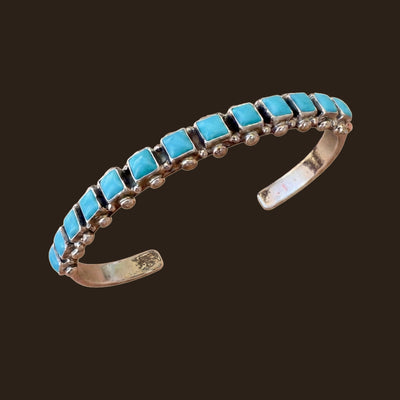
The steady hum of the lapidary wheel is the heartbeat of a studio specializing in zuni sterling silver jewelry. It's a sound of patience. While other styles might feature a single large cabochon, this tradition asks for dozens, sometimes hundreds, of tiny, uniform stones. This is where we see the distinction between needlepoint and petit point, two styles that demand a level of focus that borders on the meditative. Needlepoint involves stones cut into incredibly thin, needle-like shapes that are pointed at both ends. In contrast, petit point refers to small round, oval, or teardrop cabochons. Both require the artist to hand-grind every single piece to match its neighbor perfectly. Every stone must be calibrated by eye and touch, a process that can take days for a single elaborate piece.
Achieving this level of uniformity by hand is a rare skill. We rely on Greg Cordova's lapidary expertise to prepare these precision cuts, ensuring each stone is structurally sound before it ever meets a silver bezel. This meticulous preparation is a foundational part of The art of stone inlay and cluster work, where the physical integrity of the stone is just as vital as its color. When the stones are this small, even a minor flaw in the matrix can cause a fracture during the setting process.
The needlepoint setting process
Needlepoint is arguably the most labor-intensive style found in the Southwest. Every sliver of stone needs its own hand-formed silver bezel. The silversmith must shape these tiny walls of metal to grip stones that are often no wider than a matchstick. It's a delicate dance. If the bezel is too tight, the stone fractures. If it's too loose, the stone eventually falls out. Because of this high risk and the sheer volume of stones required for a single cuff or necklace, needlepoint pieces are highly valued by collectors who understand the hours of quiet labor involved.
Petit point variations and design
Petit point offers a different visual rhythm. By using small round or teardrop shapes, artists can create intricate floral or sunburst effects that feel organic yet disciplined. You'll often notice small silver raindrops or beads nestled between the stones. These aren't just decorative; they provide structural support and help transition the eye between the vibrant turquoise and the cool sterling silver. If you're looking for a piece that balances this delicate stone work with daily durability, you can browse our latest artisan-made arrivals to see how these styles translate into modern wear.

The art of stone inlay in Southwestern design
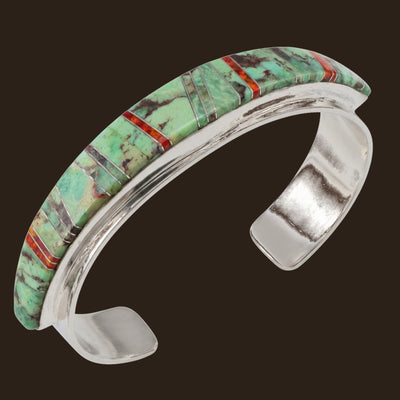
While cluster work celebrates the texture of raised stones, inlay is a study in smooth, uninterrupted surfaces. It's a process where the lapidary artist becomes a painter, using slivers of the earth as their palette. In zuni sterling silver jewelry, this technique involves fitting stones so tightly against one another that the finished piece feels like a single, polished plane. This style emerged as a significant evolution in the history of Southwest silverwork, shifting the focus from the silver frame to the complex narrative of the stones themselves. Precision fitting is the ultimate test of an artisan's skill. If a single stone is cut even a fraction of a millimeter too small, the entire geometric structure can lose its integrity.
The materials used in these designs extend far beyond turquoise. Artisans frequently incorporate a rich variety of natural elements to create contrast and depth. Common materials include:
- Deep Red Coral: Used for warmth and bold accents.
- Mother of Pearl: Provides an iridescent, ethereal glow.
- Jet: A fossilized coal that offers a dense, matte black.
- Spiny Oyster Shell: Adds vibrant oranges and purples.
These materials are often separated by thin silver striations, which act as dividers to keep the design organized and structurally sound. It's a meticulous puzzle where every piece must be shaped to fit its specific home.
Channel inlay vs. mosaic inlay
There are two primary ways these stones are arranged. Channel inlay uses silver strips (striations) to create individual cells for each stone. This provides a clear geometric structure and makes the piece slightly more durable, as the silver protects the edges of the stones. Mosaic inlay is more challenging. In this style, stones are set directly against each other without silver dividers. It creates a seamless, painterly look that is beautiful but difficult to repair if a stone cracks. We often recommend channel inlay for everyday wear because the silver framework offers extra security for the delicate settings.
Stone selection for multicolored inlay
When creating multicolored designs, the artist must consider more than just color. They have to account for the Mohs hardness of each material. If you grind a very hard stone next to a soft shell, the shell will wear away much faster, leaving an uneven surface. Artisans select stones with compatible hardness levels to ensure the piece polishes to a uniform shine. This careful curation allows for the creation of intricate color narratives that reflect the natural world. You can learn more about how we identify and source these materials on our stone origins page. Every matrix and color variation is a reminder of the small batch, handcrafted nature of this Southwestern style.
Identifying quality in handcrafted silver and stone
Finding a piece that speaks to you is only the first step. To ensure your zuni sterling silver jewelry is a true artisan creation, you need to look closer at the structural details. Start with the interior surface. A genuine piece will typically feature a stamped hallmark like 925 or Sterling to verify the metal's purity. Beyond the stamp, look at the bezels. These are the thin silver walls that hold the stones. In high-quality work, the bezel should be snug against the stone with no visible gaps. If you see uneven stone heights or jagged metal edges, it's often a sign of rushed production rather than the deliberate pace of a studio.
The stones themselves offer the clearest narrative of authenticity. When you examine a cluster or inlay piece, look for a consistent matrix across the stones. A shared pattern of host rock suggests the stones came from a single-mine source, which is a hallmark of intentional, small batch work. Be wary of stones that look too perfect or lack any variation in color. Dyed howlite and mystery metals are common in the mass-produced market, but they lack the density and cold, stony feel of authentic turquoise and sterling silver.
Evaluating the lapidary work
Symmetry is the ultimate test for styles like needlepoint and petit point. Each stone should mirror its neighbor in shape and orientation, creating a rhythmic, balanced pattern. In mosaic inlay, the finish should be smooth to the touch, feeling like a single piece of polished glass. Look for signs of hand-tooling. Small, nearly invisible marks on the silver are often evidence of an artisan's files and saws. Mass-produced casting usually looks too uniform, lacking the character found in handmade settings. If you want to see these details in person, you can shop our curated collection of artisan-made jewelry.
Understanding stone stability
There is a practical reality to precision lapidary work. Because needlepoint and inlay require such thin, delicate cuts, many artists use stabilized turquoise. This process involves pressurized resin that makes the stone durable enough for the lapidary wheel without changing its natural color. Truly natural, untreated stones are rare in these specific styles because they are often too brittle to survive the grinding process. If you do find a piece with natural stones, it requires extra care to prevent fracturing or discoloration from oils and soaps. We've put together a care and repair guide to help you maintain the integrity of these delicate settings over time.
The Wildflower collection: Curated artisan jewelry
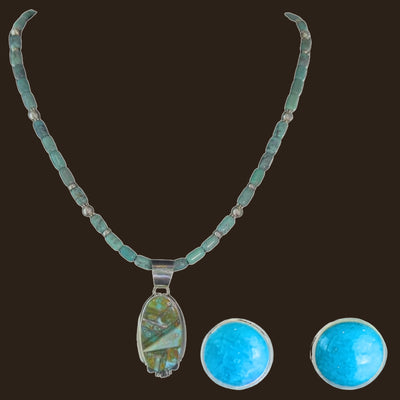
Our studio in Santa Fe functions as a bridge between the quiet labor of the lapidary wheel and the modern collector. We approach the selection of zuni sterling silver jewelry with an eye for both technical precision and emotional resonance. Every piece we offer is a vessel for the landscape it comes from. We distinguish between our in-house designs, where Greg Cordova cuts the stones and Kimberly provides the creative vision, and our sourced collection. Sourced pieces are carefully curated from other independent artisans who share our commitment to small batch production. This ensures that the jewelry you find here is never mass-produced. We have a strict policy against mystery metals and fake stones. We want you to feel the weight and history of a piece the moment it touches your skin.
This curation process is deeply personal. We look for pieces where the lapidary work and silversmithing coexist harmoniously, reflecting the rhythms of the high desert. By focusing on zuni sterling silver jewelry that emphasizes stone over metal, we highlight the mastery required to shape raw turquoise into delicate patterns. Our collection is a celebration of the handmade, finding beauty in the slight asymmetries that prove a human hand was involved in every step.
One-of-a-kind and everyday essentials
We believe that fine lapidary work shouldn't be reserved for special occasions. Our curation balances elaborate statement pieces with wearable items that fit into your daily rhythms. You might find a heavy cuff with intricate needlepoint clusters alongside a simple, polished ring. Our one-of-a-kind collection features the most complex artisan work, while our everyday essentials offer a grounded way to carry the spirit of the Southwest with you. Each piece is selected because it honors the organic beauty of the stone and the steady hand of the maker. We look for the way a cabochon is seated in its bezel and the smoothness of the silver work. These details matter. They are the difference between a temporary accessory and a lifelong companion.
The Wildflower promise of authenticity
Authenticity is the foundation of our studio. We work directly with trusted artists and lapidaries to ensure every stone and sterling silver setting meets our standards. We provide transparent descriptions of stone origins and any necessary treatments, such as stabilization for delicate inlay work. By choosing small batch jewelry, you're supporting independent creators and preserving a tradition of craft that values quality over volume. We never sell dyed howlite or plated base metals. Our focus remains on the authentic, the handmade, and the enduring beauty of natural materials. This intentionality allows us to offer pieces that aren't just beautiful, but are also honest representations of the earth. We invite you to discover a piece that resonates with your own story.
Explore our full range of artist-made sterling and turquoise at wildflowerartisans.com. For those who prefer the Etsy platform, you can also find our curated selection at the Wildflower Etsy shop.
Choosing your next artisan piece
Understanding the difference between a hand-cut needlepoint cluster and a machine-cast imitation gives you the confidence to invest in work that lasts. We've explored how the lapidary artist acts as the architect of every design, ensuring the sterling silver serves the stone. When you look for zuni sterling silver jewelry, remember to check for snug bezels and consistent matrix patterns that signal a single-mine source. These small details are the fingerprints of a maker who values precision over speed. It's about the quiet labor that happens at the grinding wheel long before a piece reaches the display case.
Our independent Santa Fe studio is dedicated to preserving these traditions by offering hand-selected artisan pieces that honor the high desert landscape. We provide guaranteed authentic stones and transparent sourcing so you can build a collection with peace of mind. Discover our curated collection of artisan-made jewelry at Wildflower. If you prefer to shop on a different platform, you can also browse our latest finds at the Wildflower Etsy shop. We hope you find a piece that resonates with your own sense of wonder.
Frequently Asked Questions
What is the difference between Zuni and Navajo jewelry styles?
Zuni-style work is primarily stone-centric, whereas Navajo-style jewelry historically focuses on the weight and texture of the silver itself. While a Navajo piece might feature a single large cabochon surrounded by heavy stampwork or sandcast details, zuni sterling silver jewelry emphasizes the precision of the cut stones. You'll see this in the intricate mosaics of inlay or the repetitive, delicate patterns of needlepoint where the silver is almost entirely hidden by the lapidary work.
How do I clean my needlepoint turquoise jewelry without damaging the stones?
You should never submerge needlepoint jewelry in water or liquid cleaners because moisture can dissolve the jeweler's sawdust or glue holding the tiny stones in place. Use a dry silver polishing cloth to gently buff the metal while avoiding the stones entirely. If dust accumulates in the tiny crevices of the bezels, a soft, dry toothbrush can be used to lightly whisk it away without applying pressure. This keeps the settings dry and secure.
Why is some turquoise jewelry much more expensive than others?
The price of a piece is determined by the rarity of the stone and the hours of lapidary labor involved. High-grade turquoise from specific mines costs significantly more per carat than common varieties. Additionally, hand-grinding dozens of identical stones for a single zuni sterling silver jewelry cuff takes days of focused work. We rely on expert lapidaries like Greg Cordova to prepare these precision cuts, making the artisan's time a major factor in the final value.
Can Zuni inlay rings be resized?
Most inlay rings cannot be resized because the process of heating or bending the silver band will cause the flush-set stones to pop out or crack. The geometric precision required for inlay means the silver frame and the stones are a matched set. It's best to verify your exact size before purchasing. Even a minor adjustment can ruin the structural integrity of the mosaic and lead to stones falling out later.
Is all Zuni-style jewelry made with sterling silver?
Authentic artisan-made pieces are almost exclusively crafted from .925 sterling silver to provide the strength needed for delicate stone settings. While you might find mass-produced imitations made from nickel or mystery metals, these lack the durability and value of genuine sterling. Always look for the hallmark stamp on the interior to ensure you're getting a piece that won't irritate your skin or tarnish in an unusual way.
How can I tell if the turquoise in my jewelry is real?
You can often identify real turquoise by looking for natural variations in the matrix and color. Real stone feels cold to the touch and has a weight that dyed howlite or plastic imitations lack. If the color looks too uniform or the spiderweb patterns seem painted on the surface, it's likely a synthetic substitute. Checking for a consistent matrix across multiple stones in a cluster can also signal a genuine, single-mine source.

Article by
Kimberly Cordova
Kimberly Cordova is the founder and creative director of Wildflower, a handmade Turquoise and sterling silver jewelry brand based in Santa Fe. She built Wildflower around a simple belief: the best jewelry is the kind you actually reach for, not the kind you save for someday.
Kimberly designs pieces made by hand with a trusted circle of Santa Fe silversmiths, works alongside her husband Greg on in-house lapidary pieces cut from stones including the family's King's Manassa Mine in Colorado and White Buffalo Mine in Nevada, and sources finished work from artisan makers whose craft meets the same standard. The result is a collection with real range and no shortcuts on the stone, the silver, or the story behind either.
Her writing covers everything she has learned along the way: how Turquoise forms, how to tell natural from stabilized, what makes one mine different from another, how to read a bezel, and how to shop with confidence in a market that is not always straightforward. It is the kind of plainspoken information she wished someone had laid out for her when she was starting out.
Shop the Wildflower collection at wildflowerartisans.com, or find us on Etsy at wildflowersantafe.etsy.com. Questions about a stone, a setting, or a specific piece are welcome any time.

0 comments