

Holding a piece of high-contrast, monochrome stone in your palm feels different than holding a piece of traditional blue. While many collectors ask what is White Buffalo turquoise, the truth is that this striking material from the Dry Creek Mine isn't technically turquoise because it lacks the copper that creates desert blues. It is a geological anomaly of dolomite and aragonite that has earned its prestige through rarity and a stark, beautiful matrix. We know it's frustrating to navigate a market filled with dyed howlite or mystery stones when you're looking for something genuine and lasting.
You deserve to know exactly what sits in your jewelry box and why certain stones carry such value. In this article, we will uncover the geological secrets of the Nevada desert and the specific lapidary skills Greg Cordova uses to bring out the best in every hand-cut cabochon. We'll show you how to identify a genuine spiderweb pattern and explain how Kimberly Cordova curates these pieces into our small batch collections. By the end, you'll understand why this rare white stone is a quietly timeless staple of Southwestern style.
Key Takeaways
- Understand the geological makeup that defines what is White Buffalo turquoise and why it lacks the copper found in traditional blue varieties.
- Identify the Dry Creek Mine near Tonopah, Nevada, as the only authentic source for this rare white and black stone.
- Learn to distinguish genuine spiderweb matrix from common imitations like dyed howlite or generic magnesite.
- Appreciate the artisan effort involved in hand-cutting cabochons and curating one-of-a-kind Southwestern style jewelry.
Defining White Buffalo in the World of Southwestern Jewelry
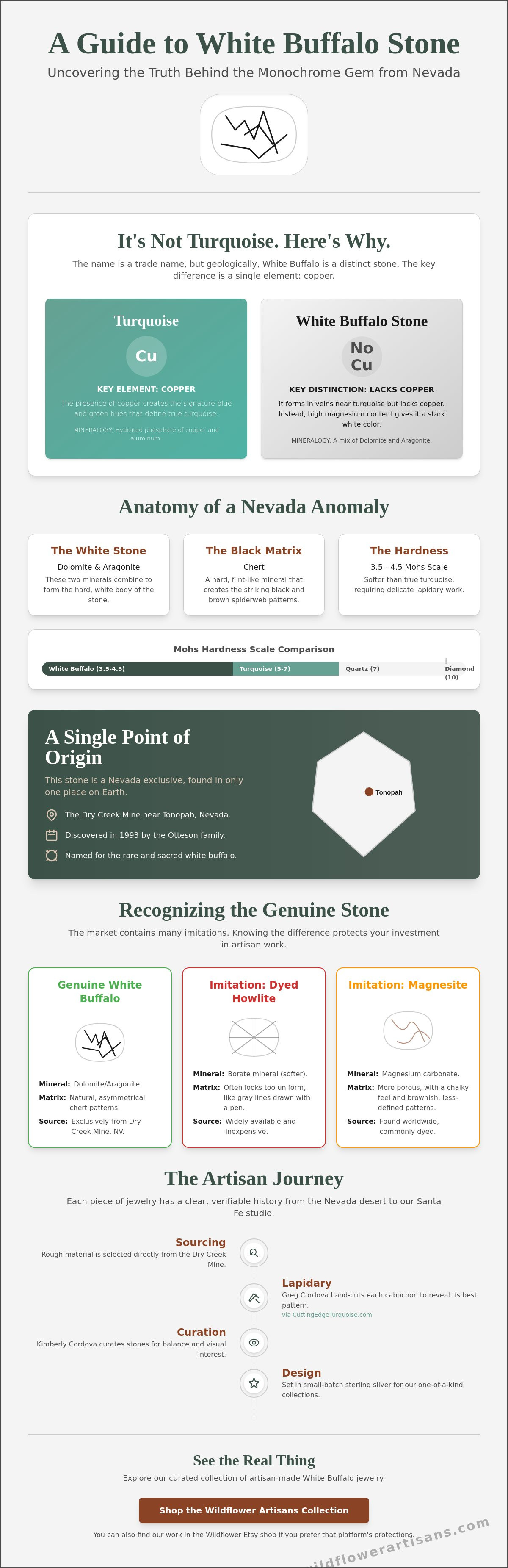
When you first see a high-contrast black and white stone set in sterling silver, it's natural to ask what is White Buffalo turquoise and how it fits into the broader story of Southwestern jewelry. This striking material is a bit of a geological rebel. It isn't actually turquoise in the mineralogical sense because it lacks the copper and aluminum that create those familiar desert blues and greens. Instead, it is a rare mixture of dolomite and aragonite. While it's often sold under the trade name "white turquoise," that label is more about where the stone is found and how it's used rather than its chemical makeup. It is a quietly timeless stone that has carved out its own prestige alongside traditional blues.
The visual appeal lies in the clean, stark white background paired with a deep black or brown matrix. This matrix is actually a flint-like mineral called chert. In our Santa Fe studio, we treat this stone as a vessel for a different kind of Southwestern aesthetic, one that favors monochrome elegance over the vibrant colors of the Sleeping Beauty or Kingman mines. It's a specific look that requires an eye for balance. Many buyers find themselves confused by trade names, often encountering Howlite as an imitation, which is a much more common and less valuable mineral used to mimic the genuine Nevada find.
To better understand this concept, watch this helpful video:
The Mineral Makeup of a Rare Find
The white pigment in this stone comes from a high concentration of magnesium, which essentially bleaches the mineral structure and leaves it without the typical turquoise hues. While it's found in the same geological veins as traditional turquoise, its structure is distinct. Based on mineralogical data, White Buffalo stone has a Mohs hardness of 3.5 to 4.5, making it softer than true turquoise, which usually rates between 5 and 7. This softness means the lapidary process is delicate. Greg Cordova handles the stone cutting and mine sourcing through Cutting Edge Turquoise, ensuring each cabochon is stable enough for daily wear while preserving the intricate spiderweb matrix that collectors look for.
Why the Name White Buffalo Matters
The name isn't just a clever bit of marketing; it's a reference to rarity. It was coined by the Otteson family after they discovered the deposit in 1993 at the Dry Creek Mine in Nevada. In Southwestern tradition, a white buffalo is an incredibly rare, sacred occurrence, and the Ottesons felt this unique white stone deserved a name that reflected that same "once-in-a-lifetime" quality. It was a single, anomalous find in a landscape known for blue. Kimberly Cordova focuses on this narrative of rarity when she curates stones for our one of a kind pieces. She looks for specific patterns that honor the original 1993 discovery, ensuring each setting highlights the natural, asymmetrical beauty of the stone.
Geology and Origins at the Dry Creek Mine
The high desert of Nevada is a quiet, expansive landscape where the earth holds its secrets tightly. The Dry Creek Mine, located near Tonopah, is the only place on earth where this specific mineral deposit is found. It's a localized geological event. When collectors ask what is White Buffalo turquoise, they are really inquiring about a singular vein of stone discovered in a region otherwise dominated by copper-rich blues. This isn't a mineral you'll find in Arizona or Colorado. It is a Nevada exclusive.
Mining at Dry Creek is a small batch endeavor. It isn't a massive industrial operation. It's a slow, patient process of uncovering thin ribbons of white stone tucked inside hard host rock. This scarcity is exactly why the stone is so prized in Southwestern style. Greg Cordova handles the sourcing and lapidary work through Cutting Edge Turquoise, selecting the best rough material and hand-cutting each piece. He looks for the right balance of white space and dark matrix before a stone ever reaches our workbench. This direct connection to the mine ensures that every piece we set has a clear, verifiable history.
The Otteson Family Legacy
The story of this stone began in 1993. The Otteson family was out in the Nevada sun, searching for traditional blue turquoise, when they hit a vein that looked entirely different. It was white. Initially, they weren't sure what they had found. After testing, it was identified as a unique blend of dolomite and magnesite. Unlike many white minerals that are too soft for jewelry, the material from Dry Creek is surprisingly hard and stable. This natural durability is a result of the specific pressure and mineral concentration at that one site. It was a once-in-a-lifetime find that changed the landscape of Nevada mining.
Sourcing Natural Stones for the Studio
In our studio, "natural" is a word we use with great care. It means the stone is untreated and hasn't been stabilized with resins or altered with dyes. When you see the black and white contrast in our new arrivals, you're seeing the stone exactly as it came from the ground. Many stones on the market are "improved" in a lab, but we prefer the raw, honest character of the earth.
We believe in absolute transparency. Understanding stone origins is the only way to ensure you're getting a genuine piece of the Dry Creek find. The journey from the mine to the studio is long. It starts with a heavy piece of rough stone. Greg Cordova carefully slabs the rock to find the best matrix patterns. He then shapes it into a cabochon ready for a sterling silver setting. From there, Kimberly Cordova curates the stone, designing a bezel that highlights its specific, organic character.
Recognizing Authentic Matrix and Stone Quality
The character of this stone is found in its matrix. When people ask what is White Buffalo turquoise, they're often mesmerized by the deep black or chocolate brown lines that cut across the white surface. This matrix is actually a flint-like mineral called chert. It's much harder than the surrounding white stone. This contrast creates the visual drama that defines the style. We look for a balance between the stark white background and the dark chert. It's about the narrative written in the rock.
Not all patterns are created equal. Fine spiderweb matrix consists of thin, interconnected lines that resemble a web. It's rare and highly sought after. On the other hand, larger and more erratic patterns are known as 'blotch' matrix. While blotchy stones have their own organic charm, spiderwebbing is generally more valued for its complexity. High-quality pieces should also have a porcelain-like finish. Because of the mineral density, a well-polished stone will have a smooth, glassy luster without surface pits or dull spots. It should feel substantial and smooth to the touch.
When you're inspecting a stone, look for these markers of quality:
- Consistent depth in the black or brown matrix colors.
- A surface free of visible pits, cracks, or 'vugs'.
- A high-gloss polish that reflects light evenly across the dome.
- Clear, distinct lines rather than blurred or fuzzy edges.
The Lapidary Process: Cutting for Contrast
Cutting this material requires a steady hand and a deep understanding of stone anatomy. Greg Cordova handles the lapidary work through Cutting Edge Turquoise, where he carefully selects the best face for each cabochon. He slabs the rough rock to reveal the most intricate patterns. The goal is to maximize the contrast. A well-cut cabochon will showcase the spiderwebbing perfectly centered or balanced across the dome. The density of the Dry Creek material allows it to take a high polish, which Greg achieves through a multi-stage sanding and buffing process. This work happens long before Kimberly Cordova begins the design phase in our studio.
Caring for Your Artisan Jewelry
Owning a piece of handcrafted jewelry means taking responsibility for its longevity. White Buffalo stone is durable, but it isn't indestructible. You should avoid using harsh chemicals, jewelry dips, or ultrasonic cleaners. These can damage the stone's surface or weaken the bond in the setting. We recommend a simple wipe with a soft, damp cloth after wearing. Storing your pieces away from direct sunlight is also a good idea. This helps maintain the stark white contrast over time. For more detailed instructions on maintaining your silver and stones, visit our care and repair guide. It covers everything from tarnish removal to long-term storage tips.
Distinguishing White Buffalo from Common Imitations
Identifying genuine material is the hardest part for many collectors. When you ask what is White Buffalo turquoise, you're looking for that specific, crisp contrast that only comes from the Dry Creek Mine in Nevada. The market is unfortunately flooded with look-alikes. We see a lot of dyed howlite and mass-produced magnesite labeled as the real thing in big-box stores. At Wildflower, we have a strict policy against using dyed howlite or mystery metals. Every stone in our collection is vetted for its origin to ensure you're getting a piece of Southwestern history rather than a cheap substitute.
The Howlite Problem in Mass Markets
Howlite is the most common substitute you'll find in high-volume retail. It's a porous, white mineral that's often dyed blue to mimic turquoise, but in its natural state, it looks remarkably like White Buffalo stone. However, if you look closely at a howlite cabochon, the matrix is usually a fuzzy, blurred grey rather than the sharp, ink-black chert found in the Nevada material. Howlite is significantly cheaper because it's abundant and much softer on the Mohs scale. You should also be wary of stabilized white stones. These are often plastic-injected to make a low-grade, crumbly material look like a high-end find. It lacks the porcelain-like density we look for when selecting stones for our studio.
Magnesite vs. White Buffalo
The mineralogy can get a bit technical here. While White Buffalo stone contains magnesite, it doesn't mean all magnesite is White Buffalo. Many mass-produced items use a generic white magnesite that lacks the characteristic Tonopah look. Genuine pieces from the Dry Creek vein have a very specific, high-contrast matrix that doesn't look mottled or swirled. We also see Wild Horse magnesite often confused with this stone. Wild Horse is beautiful in its own right, but it features a reddish-brown hematite matrix instead of black chert. Always ask for the mine provenance. Greg Cordova sources our rough through Cutting Edge Turquoise to ensure every hand-cut stone meets our standards. Explore our current authentic turquoise jewelry and white stone collections to see the difference that genuine mine-direct stones make in a finished piece.
Kimberly Cordova curates each stone for our studio based on its visual clarity and matrix pattern. She avoids stones with bleed, where the black matrix turns the surrounding white stone a muddy grey. This level of curation is what separates a quietly timeless artisan piece from a mass-produced accessory. When you buy from a working studio, you're buying the expertise required to tell these minerals apart at a glance. It's a matter of looking for the story the stone tells through its matrix.
Handcrafted White Buffalo in the Modern Studio
After Greg Cordova finishes the lapidary work at Cutting Edge Turquoise, the stones arrive at our studio benches. This is where the transition from raw mineral to wearable art happens. Kimberly Cordova handles the curation process, spending hours sorting through cabochons to find stones that share a similar visual language. When collectors ask what is White Buffalo turquoise and why it remains a staple of Southwestern style, the answer lies in its versatility. The monochrome palette allows it to pair beautifully with high-grade sterling silver, creating a look that is both bold and sophisticated. We focus on framing the stone in a way that respects its organic origin.
Every stone we set is a unique geological fingerprint. No two matrix patterns are identical, which means every ring or pendant we create is a one-off piece. This individuality is the hallmark of the artisan-made experience. Understanding what is White Buffalo turquoise helps you appreciate the specific design choices we make in the studio. We don't mass-produce these items. We work in small batches to ensure that the character of the Nevada desert is preserved in every bezel. The result is jewelry that feels personal and quietly timeless.
Designing for the Stone
Designing around a high-contrast stone requires a balance of weight and detail. We often choose heavy-gauge sterling silver for our White Buffalo settings to match the visual density of the black chert matrix. A simple, clean bezel might be enough for a stone with a complex spiderweb pattern, while a more minimalist stone might benefit from hand-stamped accents on the shank or frame. These details are added by hand in our Santa Fe studio, ensuring that the silver work complements rather than competes with the stone. This versatility makes White Buffalo jewelry an excellent choice for everyday wear. You can see how these elements come together in our latest one-of-a-kind collection, where we highlight the best of the Dry Creek find.
The Artisan Difference
There is a significant difference between a factory-made accessory and a handcrafted piece of jewelry. In our studio, we prioritize the intentionality of the process over the speed of production. Every solder joint is inspected, and every bezel is hand-fitted to the specific curves of the cabochon. This small batch approach allows for a level of quality control that is impossible in a mass-market setting. We embrace the asymmetrical and the organic. If a stone has an unusual shape, we build the silver around it rather than grinding the stone to fit a pre-made mold. This preserves the soul of the material. When you hold an artisan-made piece, you can feel the effort that went into the hand-cut stone and the hand-polished silver. It's an honest representation of the craft.
Bringing the White Stone into Your Collection
Understanding what is White Buffalo turquoise allows you to shop with confidence and appreciate the specific beauty of this Nevada find. You now know that while it lacks the copper of traditional blue stones, its rare mixture of dolomite and black chert matrix creates a high-contrast look that is unmatched in Southwestern style. Authentic stones from the Dry Creek Mine are finite. This rarity makes every genuine cabochon a small piece of geological history that holds its value through both quality and scarcity.
We take pride in our direct connection to the source. Greg Cordova hand-cuts every stone we use to ensure the matrix is balanced and the polish is smooth, while Kimberly Cordova curates these gems into our studio collections. We don't deal in dyed howlite or mass-produced imitations because we believe your jewelry should be as honest as the ground it came from. If you're ready to add a piece of this monochrome rarity to your own story, explore our latest collection of handcrafted White Buffalo jewelry at Wildflower. You can also find a curated selection of our work at the Wildflower Etsy shop if you prefer that platform's protections. We're here to help you find a piece that feels right for your daily wear.
Frequently Asked Questions
Is White Buffalo turquoise a real stone?
Yes, it is a genuine mineral found in the Nevada desert, though it isn't technically a turquoise because it lacks copper. When people ask what is White Buffalo turquoise, they are usually referring to the rare white and black stone found at the Dry Creek Mine. It's often called turquoise as a trade name because it forms in similar veins and is used the same way in jewelry. It is a geologically unique mixture of dolomite and magnesite.
Where is the White Buffalo mine located?
The only authentic source for this stone is the Dry Creek Mine located near Tonopah, Nevada. This specific high-desert location provides the unique geological conditions needed for the dolomite and black chert matrix to form together. While other white stones exist in the region, only the material from this specific mine carries the White Buffalo name. We source our rough material directly to ensure every piece has clear mine provenance.
How can you tell if White Buffalo is real or fake?
You can identify genuine stone by looking for a crisp, ink-black matrix made of chert rather than the fuzzy, greyish veins found in howlite. Authentic pieces also have a dense, porcelain-like luster when polished. Greg Cordova hand-cuts our stones to ensure the matrix is natural and untreated, so you won't see the artificial uniformity typical of mass-produced imitations. Genuine stones feel cool to the touch and have a distinct mineral weight.
Does White Buffalo turquoise change color over time?
This stone is generally more stable than traditional blue varieties and does not absorb oils or change color over time. Because it lacks the copper and aluminum found in blue turquoise, it won't take on a green hue from skin contact. It stays a stark, clean white as long as you keep it away from harsh chemicals that could dull the surface polish. It is a durable choice for those who want a consistent look.
Why is White Buffalo jewelry so expensive?
The cost reflects the extreme rarity of the Dry Creek find and the small batch nature of the mining process. Since there is only one known source, the supply is very limited compared to other stones. Additionally, understanding what is White Buffalo turquoise means appreciating the artisan effort involved in hand-cutting each cabochon and creating custom sterling silver settings. This labor-intensive process adds significant value to every finished piece we create.
What is the difference between White Buffalo and Wild Horse stone?
The primary difference lies in the color of the matrix and the mineral makeup. White Buffalo features a deep black or dark brown chert matrix, while Wild Horse magnesite is known for its reddish-brown hematite matrix. Both are beautiful white stones from Nevada, but they have distinct visual styles. Kimberly Cordova curates each stone for our studio to ensure the matrix patterns are clear and provide the best contrast for our Southwestern style designs.
Is White Buffalo harder than blue turquoise?
It is actually softer than traditional blue turquoise, ranking between 3.5 and 4.5 on the Mohs scale, while turquoise usually sits between 5 and 7. This means the stone requires a gentler touch during the lapidary process. Despite being softer, it is durable enough for daily wear once it is properly cut and set into a protective silver bezel. We use heavy-gauge silver to provide a secure frame for these delicate stones.
Can White Buffalo get wet?
Occasional contact with water won't harm the stone, but you should avoid soaking your jewelry or wearing it while swimming. Chemicals in soaps or chlorinated water can eventually break down the polish and dull the white surface. A quick wipe with a damp cloth is the best way to keep the stone clean without causing any long-term damage. Always dry your jewelry thoroughly before storing it to preserve the integrity of the sterling silver.

Article by
Kimberly Cordova
Kimberly Cordova is the founder and creative director of Wildflower, a handmade Turquoise and sterling silver jewelry brand based in Santa Fe. She built Wildflower around a simple belief: the best jewelry is the kind you actually reach for, not the kind you save for someday.
Kimberly designs pieces made by hand with a trusted circle of Santa Fe silversmiths, works alongside her husband Greg on in-house lapidary pieces cut from stones including the family's King's Manassa Mine in Colorado and White Buffalo Mine in Nevada, and sources finished work from artisan makers whose craft meets the same standard. The result is a collection with real range and no shortcuts on the stone, the silver, or the story behind either.
Her writing covers everything she has learned along the way: how Turquoise forms, how to tell natural from stabilized, what makes one mine different from another, how to read a bezel, and how to shop with confidence in a market that is not always straightforward. It is the kind of plainspoken information she wished someone had laid out for her when she was starting out.
Shop the Wildflower collection at wildflowerartisans.com, or find us on Etsy at wildflowersantafe.etsy.com if you prefer shopping there. Questions about a stone, a setting, or a specific piece are welcome any time.
0 comments