

What if the most famous blue gemstone in American history was never actually the primary goal of the mountain that produced it? You've likely felt the pull toward a clean, robin's egg cabochon, searching for a stone that captures the sky without the distraction of a heavy dark matrix. It's frustrating to browse for sleeping beauty turquoise only to find yourself questioning if a piece is genuine or merely dyed howlite from a mass-produced factory. We understand that hesitation because the market shifted dramatically after the mine in Globe, Arizona, ceased gemstone production in August 2012.
In our studio, we focus on the technical reality of these copper-rich stones and the history of the mine to help you make informed choices. You'll learn how to identify authentic, natural material and why the lack of iron in this specific deposit creates such a pure blue. We'll also look at how Greg Cordova selects and cuts these stones for our small batch sterling silver settings. This exploration provides the clarity you need to find a piece that is both artisan-made and quietly timeless.
Key Takeaways
- Understand how the copper-rich terrain of Globe, Arizona, created the distinct robin’s egg blue color that defines high-grade stones from this storied mine.
- Learn to identify the hallmark characteristics of sleeping beauty turquoise, specifically the uniform sky-blue hue and the preference for clean cabochons with minimal matrix.
- Discover why the 2012 shift toward copper production at the mine created a permanent ceiling on supply, making authentic stones a finite resource for collectors.
- Gain clarity on the differences between natural, stabilized, and reconstituted stones to ensure you are investing in authentic artisan-made jewelry.
- Explore how Kimberly Cordova curates these hand-cut stones into Southwestern style settings using heavy-gauge sterling silver from our working studio.
The Geological Legacy of the Sleeping Beauty Mine in Globe Arizona
Walking into the studio and seeing a tray of sleeping beauty turquoise for the first time is a specific kind of experience. The color is immediate and unmistakable, reflecting a clear, high-desert sky without the heavy webbing or dark matrix often found in other Southwestern varieties. This stone is a copper-hosted phosphate mineral found in the mountains near Globe, Arizona. The mine itself takes its name from the mountain range, which features a silhouette resembling a woman lying on her back in a quiet, permanent slumber.
While the site was originally developed for copper mining, the 1900s brought a shift in focus as miners began to recognize the value of the vibrant blue veins. Turquoise from this location became a staple for artisans who wanted a clean, uniform look. Greg Cordova, who handles the lapidary work for our studio through CuttingEdgeTurquoise.com, often points to the 2012 closure of the mine as a turning point that transformed this stone into a finite, collected resource.
To better understand the history and extraction of this stone, watch this helpful video:
Copper Deposits and the Chemistry of Sky Blue
The signature robin egg blue of this stone is a direct result of the specific mineral chemistry in Gila County. In the molecular structure of sleeping beauty turquoise, high concentrations of copper provide the primary pigment. While aluminum and phosphorus are essential building blocks, the lack of iron is what truly sets this material apart. Most mines in the region contain iron, which shifts the color toward green or yellow. Because this specific geological pocket is iron-poor, the stones maintain a crisp, pure blue that remains consistent across different veins.
The Physical Profile of the Mountain Range
The peaks of the mountain sit at an elevation of roughly 4,200 feet, where the environmental pressure and arid climate influenced the stone's development over millions of years. This environment produced a material that is relatively dense and hard, typically falling between 5 and 6 on the Mohs scale. This higher density means the stone has lower porosity than many other varieties. When we work with this material in the studio, the lower porosity allows us to cut a precise cabochon that retains its luster and deep color when set into a hand-cut silver bezel.
You can view our current collection of handcrafted jewelry featuring these stones at wildflowerartisans.com. We also maintain a selection of our studio work at the Wildflower Etsy shop for those who prefer that platform's community and reviews.
Identifying the Characteristics of High Grade Sleeping Beauty Cabochons
The hallmark of high grade sleeping beauty turquoise is its uniform, saturation-heavy sky blue. While many mines produce stones with heavy brown or black webbing, this Arizona deposit became famous for material that looks like a clear desert sky at noon. It is a color that feels both ancient and fresh. Collectors often look for the robin’s egg hue, a specific shade that has defined the market for decades. This consistency makes the stone a favorite for those who value purity in their palette. Expert evaluations from the GIA on Turquoise confirm that color remains the most significant factor in determining the value of these specimens, with even, medium-toned blues commanding the highest interest in the gem trade.
Matrix Variations and Collector Preferences
In the world of high fashion, particularly in European jewelry houses during the 1970s and 1980s, the matrix-free stone was the absolute standard. These clean cabochons allow the color to speak without interruption. Some grades feature soft white quartz or small flecks of pyrite that add a subtle, metallic shimmer to the surface. Dark or black matrix is exceptionally rare in the Sleeping Beauty vein. Occasionally, a rare spiderweb pattern emerges where thin, delicate lines of matrix create a lace-like effect across the blue field. These pieces are often held back for small batch collections because they offer a different narrative than the solid blue stones. Kimberly Cordova curates our selection of these stones, ensuring each one meets our studio standards for clarity and hue.
Lapidary Standards for Cutting and Polishing
The way a stone is handled in the studio changes everything. Greg Cordova hand-cuts each sleeping beauty turquoise cabochon to maximize its specific color depth and light return. A taller dome can sometimes deepen the perceived blue, while a lower profile might be chosen to preserve a particularly rare matrix pattern. Every stone is finished with a high-grade polish that brings out its natural luster. We place these stones in a secure bezel set to protect the edges from daily wear. This intentional approach ensures the jewelry remains a quietly timeless companion for years. You can see how these hand-cut stones catch the light in our one-of-a-kind collection.
View our latest handcrafted designs at wildflowerartisans.com. For those who enjoy reading through verified reviews and community feedback, our work is also available at the Wildflower Etsy shop.
Why the 2012 Mine Closure Defined the Modern Turquoise Market
The year 2012 marked a quiet but profound shift for the jewelry of the Southwest. When the Sleeping Beauty Mine in Globe, Arizona, ceased its turquoise operations, the gemstone world lost its most prolific source of solid sky blue material. This wasn't a case of the earth running dry. Instead, the owners shifted focus entirely to copper production. This decision turned every existing robin's egg blue cabochon into a finite piece of history. For those of us in the studio, the closure transformed sleeping beauty turquoise from a reliable staple into a cherished, non-renewable resource.
The Transition to Copper Mining Operations
The decision to close the turquoise side of the mine was driven by the rising global demand for copper and the complexities of modern mining regulations. In August 2012, the cost of extracting turquoise as a byproduct of copper mining became economically unsustainable for the operators. New environmental and safety standards in Arizona required more streamlined, industrial processes. These high-volume methods didn't allow for the delicate, hand-sorting methods turquoise requires. Today, the site operates strictly as a large-scale copper facility. The blue veins that once defined the mountain are now crushed and processed as ore. No new material has been legally extracted for over a decade.
Supply Scarcity and the Rise of Imitations
With no new material entering the market, a void was created that was quickly filled by imitations. You'll often see dyed howlite or magnesite sold under the name of this famous mine at lower price points. These synthetic or treated stones lack the density and the true, natural hue of the Arizona original. We rely on the expertise of Greg Cordova at CuttingEdgeTurquoise.com to source authentic material from old collections. His lapidary work ensures that the stones we use are genuine remnants of the pre-2012 era. Kimberly Cordova then curates these pieces for our one-of-a-kind collections, focusing on the stone's purity. Over the last ten years, the market value for high-grade, untreated sleeping beauty turquoise has climbed steadily. It's now viewed as a finite investment piece, much like a rare vintage textile or a heritage tool.
Buying from a studio with a verified stone lineage is the only way to ensure you're wearing a piece of the actual mountain. Authentic stones have a specific weight and a quietly timeless quality that imitations can't replicate. We treat every stone as a vessel for a story that ended at the source in 2012 but continues in the jewelry we create today. You can explore our current artisan-made pieces at wildflowerartisans.com, or visit the Wildflower Etsy shop to see our latest reviews and handcrafted designs.

Distinguishing Natural Stones from Treated and Synthetic Alternatives
A raw piece of turquoise sits on the workbench, dusty and unassuming before the wheel touches its surface. Holding this material reveals a secret about its geological nature. Much of the mineral pulled from the Globe, Arizona mine arrives as chalk grade. This term describes a stone so porous and soft that it would crumble if you tried to cut or polish it. Because of this structural reality, nearly 95 percent of all sleeping beauty turquoise used in jewelry undergoes a stabilization process. This is a necessary evolution from a fragile, earth-bound mineral to a durable gemstone capable of being worn. While natural, untreated stones exist, they are exceptionally rare and often too delicate for the friction of daily wear. Reconstituted stones are a different matter entirely. These are made from ground-up dust and plastic binders, lacking the soul and crystalline structure of a true cabochon.
Stabilization Processes in the Studio
In our studio, we prioritize the longevity of every piece. Stabilization involves using pressurized clear resins to fill the microscopic voids within the stone. This process hardens the material and locks in that specific sky-blue hue, preventing skin oils or perfumes from darkening the stone over time. Greg Cordova manages these technical lapidary details at Cutting Edge Turquoise, ensuring the integrity of the stone remains intact during the high-speed friction of the cutting process. There is a clear distinction between these high-grade stabilized pieces and low-quality treatments. We avoid stones that have been color-shot or dyed, as these artificial enhancements mask the true character of the mineral.
Practical Tests for Authenticity
Spotting a fake requires a keen eye and a bit of healthy skepticism. Many stones sold as turquoise are actually dyed howlite or magnesite. You can often identify these by looking closely at the matrix or small crevices in the surface. If you see concentrated pooling of dark blue color in the cracks, it is a sign of an artificial dye bath. Price is your most reliable compass. Genuine sleeping beauty turquoise carries a premium because the mine has been closed since 2012. If a large, flawless cabochon is priced like a trinket, it likely originated in a factory rather than a mine. We encourage our collectors to visit our stone origins page to understand the journey from the earth to the bezel. Understanding these nuances ensures you are investing in a piece of Southwestern history rather than a mass-produced imitation.
You can explore our current collection of hand-cut stones and silver work by visiting the Wildflower Artisans shop. For those who prefer the community environment of a marketplace, we also maintain a selection of pieces at the Wildflower Etsy shop.
Handcrafted Southwestern Style Jewelry from Our Studio
Kimberly Cordova approaches jewelry design as a form of intentional curation. She believes the setting should never compete with the stone, especially when working with high-grade sleeping beauty turquoise. Our studio focuses on heavy-gauge sterling silver, often starting with 14-gauge or 16-gauge sheet metal to ensure the piece feels substantial in your hand. This weight provides a physical connection to the craftsmanship. Mass-market jewelry often relies on thin, cast components that feel hollow and fragile. Our small batch process allows us to refine every edge and hand-polish the interior of a cuff or ring until it fits the body comfortably. It results in a quietly timeless aesthetic that avoids the noise of fast fashion. We choose to make fewer pieces so that each one receives the attention required to become a legacy item.
The Art of the Sterling Silver Bezel
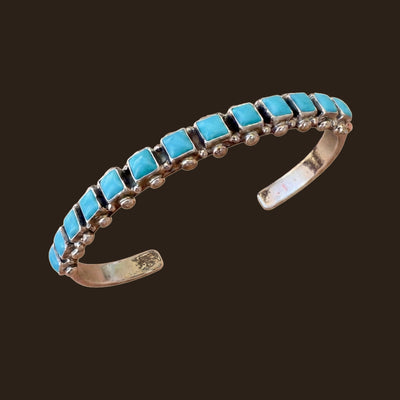
A hand-stamped bezel does more than just hold a stone in place. It frames the color and provides a textured transition between the metal and the gem. When we set a bright blue sleeping beauty turquoise cabochon, the silver reflects light back into the stone, deepening the sky-blue hue. We often pair these stones with others that offer a contrasting earthiness, such as the deep greens of King’s Manassa or the rich, golden browns found in Royston matrix. These combinations tell a story of the varied Southwestern landscape. You can explore our latest rings to see how these Arizona stones interact with hand-cut silver details.
Caring for Your Artisan Jewelry Pieces
Turquoise is a porous material that can change over time if not handled correctly. It absorbs oils and chemicals from its environment. We advise keeping your jewelry away from household cleaners, perfumes, and hairsprays. Never put these artisan pieces in an ultrasonic cleaner. The high-frequency vibrations and harsh chemical solutions can strip the silver of its natural patina or even fracture a delicate stone. For storage, keep your sterling silver and turquoise cuffs in a dry, cool place, ideally in a soft cloth pouch to prevent scratching from other jewelry. If your piece loses its luster, a simple polishing cloth is usually enough to restore the shine. You can find more detailed instructions in our care and repair guide to help your jewelry stay beautiful for years.
Browse our complete collection of handcrafted jewelry at wildflowerartisans.com to find a piece that speaks to you..
Honoring the Rarity of the Sleeping Beauty Mine
The 2012 closure of the Sleeping Beauty mine in Globe, Arizona, shifted the landscape for collectors and artisans alike. This event transformed a once-abundant supply into a finite resource, making genuine, untreated stones increasingly difficult to source. In our studio, we treat these stones with the respect their history deserves. Greg Cordova performs all lapidary work, hand-cutting each cabochon to reveal the clear, robin’s egg blue that defines high-grade sleeping beauty turquoise. These natural stones are never stabilized or color-treated, allowing their organic beauty to speak for itself. Kimberly Cordova curates the final designs, placing each hand-cut stone into small batch, Southwestern style settings made from solid precious metals. We never use mystery metals or plated finishes. Every piece is a legitimate reflection of the Arizona sky. Finding a piece that resonates with you is a personal process, and we are here to help you navigate the details of these rare stones.
Explore our collection of artisan-made Sleeping Beauty jewelry to see our latest studio work. You can also find our handcrafted pieces and read through customer reviews at the Wildflower Etsy shop.
Frequently Asked Questions About Sleeping Beauty Turquoise
Is the Sleeping Beauty turquoise mine still open?
The Sleeping Beauty mine in Globe, Arizona, officially ended its turquoise production in August 2012 to focus entirely on copper mining. Since that date, no new material has entered the market from the source. Every authentic stone we use in the studio is sourced from old-stock collections or private reserves. Greg Cordova carefully selects this legacy material to ensure our Southwestern style pieces remain genuine.
What color is Sleeping Beauty turquoise supposed to be?
This material is famous for its solid, vibrant sky-blue color that mimics a clear high-desert sky. It lacks the heavy green or teal undertones found in many Nevada or Colorado mines. The most sought-after pieces show a uniform robin's egg blue. This consistent palette allows the artisan-made silver work to stand out without competing with heavy patterns or distracting shifts in the stone.
How can I tell if my Sleeping Beauty turquoise is real or dyed howlite?
You can often spot a fake by looking for dye concentrations in the surface cracks of the stone. If you apply a small amount of acetone to a cotton swab and rub it on the back of the stone, no blue pigment should transfer. We rely on the expertise of Greg Cordova at Cutting Edge Turquoise to source and cut our genuine sleeping beauty turquoise for every bespoke project.
Does Sleeping Beauty turquoise have a matrix?
Most high-grade sleeping beauty turquoise is prized for having little to no matrix. When host rock is present, it usually appears as small white water web spots or thin black lines rather than the heavy brown webbing seen in other Southwestern styles. Kimberly Cordova curates these cleaner, nearly matrix-free cabochons to highlight their natural, ethereal blue and quiet sophistication within our jewelry designs.
Why is Sleeping Beauty turquoise so expensive compared to other types?
Prices have climbed steadily since the August 2012 closure because the global supply is strictly finite. It's a simple matter of scarcity meeting high demand. As the remaining rough material is cut into cabochons, the cost reflects the increasing difficulty of finding high-quality, authentic stones in a market often flooded with treated or synthetic alternatives.
Can I wear Sleeping Beauty turquoise jewelry every day?
You can wear your jewelry every day if you treat it with a bit of gentle respect. Turquoise is a relatively soft, porous stone with a Mohs hardness of 5 to 6, so it's best to remove rings before heavy labor, gardening, or swimming. This prevents the stone from absorbing oils or chemicals that might alter its delicate color over time.
What is the difference between stabilized and natural Sleeping Beauty turquoise?
Natural turquoise is untreated and remains exactly as it was pulled from the earth. Stabilized stones have been treated with a clear resin to make them harder and less porous for jewelry use. We only use the term natural for confirmed untreated stones. Stabilized material is often preferred for rings because it resists absorbing skin oils and maintains its bright blue color for decades.
How should I clean my sterling silver and turquoise jewelry?
Use a soft, dry polishing cloth for the sterling silver and a damp, lint-free cloth for the stone itself. Never use ultrasonic cleaners, steam, or harsh chemical dips. These can fracture the stone or strip the intentional patina from the silver work. A quick wipe after a day in the studio or out in the world keeps the handcrafted bezel and stone bright.
See our latest small-batch designs at wildflowerartisans.com. You can also find our handcrafted work and read customer reviews on our Wildflower Etsy shop.

Article by
Kimberly Cordova
Kimberly Cordova is the founder and creative director of Wildflower, a handmade Turquoise and sterling silver jewelry brand based in Santa Fe. She built Wildflower around a simple belief: the best jewelry is the kind you actually reach for, not the kind you save for someday.
Kimberly designs pieces made by hand with a trusted circle of Santa Fe silversmiths, works alongside her husband Greg on in-house lapidary pieces cut from stones including the family's King's Manassa Mine in Colorado and White Buffalo Mine in Nevada, and sources finished work from artisan makers whose craft meets the same standard. The result is a collection with real range and no shortcuts on the stone, the silver, or the story behind either.
Her writing covers everything she has learned along the way: how Turquoise forms, how to tell natural from stabilized, what makes one mine different from another, how to read a bezel, and how to shop with confidence in a market that is not always straightforward. It is the kind of plainspoken information she wished someone had laid out for her when she was starting out.
Shop the Wildflower collection at wildflowerartisans.com, or find us on Etsy at wildflowersantafe.etsy.com. Questions about a stone, a setting, or a specific piece are welcome any time.
0 comments