

Greg Cordova recently sorted through a new parcel of rough Royston turquoise in our studio, uncovering stones that range from mossy greens to vibrant, electric blues. It's easy to feel overwhelmed by the sheer variety of colors found in this Nevada district, especially when so many online marketplaces are crowded with dyed howlite or plastic imitations. You want to know that the stone in your jewelry grew in the earth, not a factory.
This article provides a detailed look at the history of the Royston district and explains why the unique mineral deposits in Nevada produce such a diverse palette of color and matrix. You'll learn how to identify authentic material and understand the value of natural stones compared to stabilized options. We'll also take you inside our studio process to show how Greg Cordova selects and hand-cuts each cabochon, while Kimberly Cordova curates these gems for our small batch jewelry. By the end, you'll have the confidence to choose a piece that resonates with your personal style while supporting genuine, artisan-made craftsmanship.
Key Takeaways
- Discover how the high desert of Nevada produces stones that shift from deep emerald to robin egg blue within a single piece.
- Learn why the golden brown and chocolate matrix patterns of royston turquoise make it one of the most recognizable varieties found in the American West.
- Follow the journey of a raw slab through the studio where Greg Cordova evaluates each face to create a hand-cut cabochon.
- Understand how Kimberly Cordova balances weight and silver detail to ensure the metalwork highlights the character of the stone.
- Gain practical tips for preserving the color of porous stones and maintaining the natural patina of handcrafted silver pieces.
Royston Turquoise Mines and the Nevada High Desert
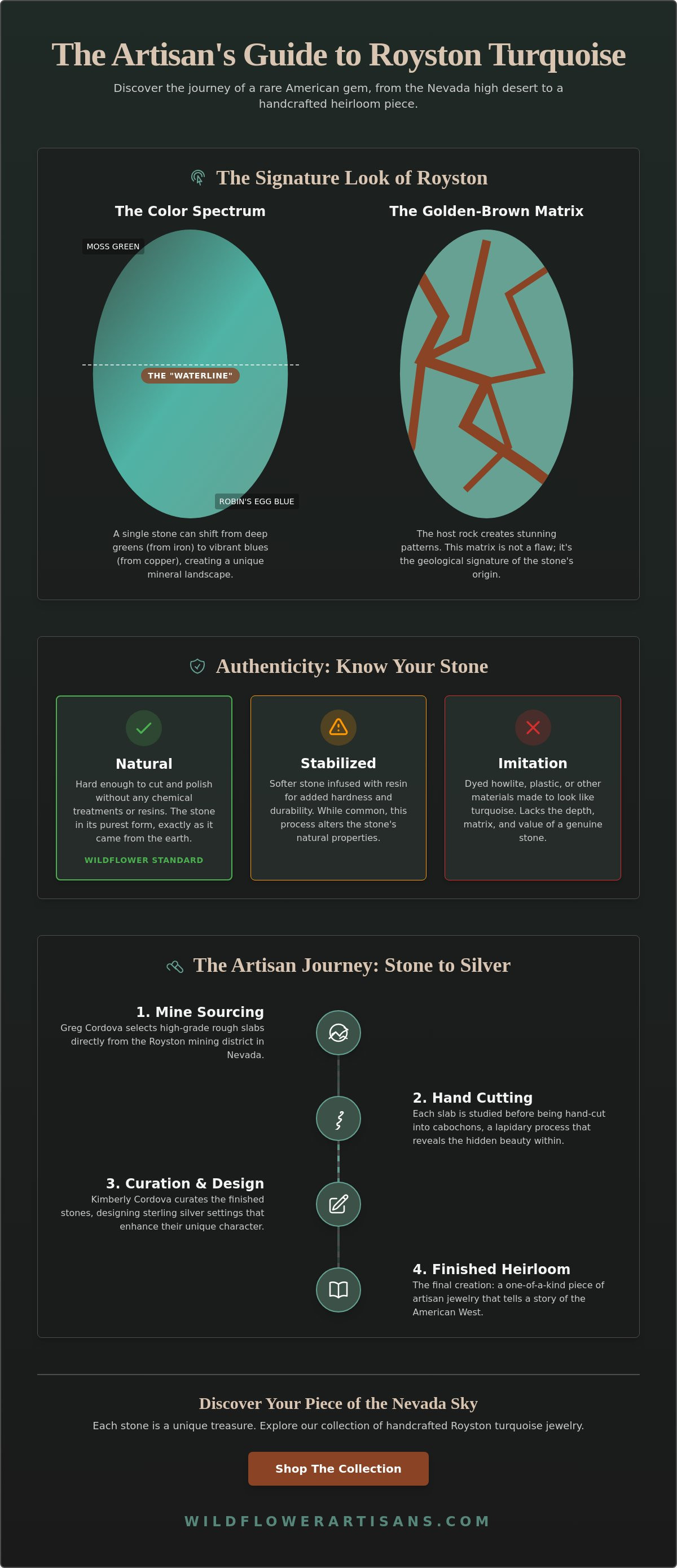
A single piece of royston turquoise can hold the entire gradient of a Nevada horizon, shifting from a deep, mossy emerald to a bright robin egg blue within a few millimeters of stone. This specific palette comes from the Royston district located just outside Tonopah, Nevada. Since the early 1900s, these high desert hills have yielded some of the most sought after high grade material in the American West. It is a place where the earth seems to have captured the rugged, shifting beauty of the landscape. Unlike other regions that produce a uniform color, the stones from this area are celebrated for their variety and character.
Royston is not a single mine but a collection of famous claims that have defined the region for over a century. These include the Bunker Hill, Oscar Wehrend, and the storied Royal Blue. The district is known for producing material that remains quietly timeless, appealing to collectors who value the organic variation of the stone over mass-produced consistency. The stones pulled from these claims often feature a heavy brown or gold matrix that provides a striking contrast to the vibrant blues and greens of the mineral.
The Legacy of the Tonopah District
The geography of the Nevada desert provides a specific crucible for turquoise formation. In this arid environment, copper rich water trickles through host rock over millions of years to create the unique ribbons of color found in a hand-cut cabochon. The Royal Blue mine stands as the primary producer of the area. It was discovered around 1902 and quickly became famous for its fine spiderweb patterns and deep hues. Because these mines are remote and often worked by small crews, the material remains small batch. Greg Cordova, who oversees mine ownership and lapidary work at CuttingEdgeTurquoise.com, notes that the history of turquoise mining in Nevada is written in the tunnels of the Tonopah district. This isolation ensures that each stone feels like a discovered treasure rather than a commodity.
Understanding Stone Origins and Authenticity
In our studio, we prioritize the integrity of the raw material. This requires a clear distinction between natural and stabilized stones. Natural royston turquoise is material that is hard enough to be cut and polished without any chemical intervention or plastic resins. It is the stone exactly as it came from the ground. We avoid mystery metals and dyed stones because they mask the true character of the mineral and degrade the quality of the work. Kimberly Cordova focuses on curation and design, selecting stones that tell a clear story of their origin and geological movement. For a deeper look at how we categorize these materials, you can visit our stone origins page. We believe the beauty of a handcrafted piece lies in its authenticity and the skill of the artisan who shaped it.
To see our current collection of hand-cut stones and jewelry, you can browse our shop at wildflowerartisans.com. If you prefer the familiar protections of a larger marketplace, you can also find our work at the Wildflower Etsy shop.
Evaluating the Color Spectrum and Matrix Patterns
Holding a Royston cabochon feels like looking at a topographical map of the high desert. One side might be a deep mossy green while the other fades into a pale, clear blue. This transition is the most striking feature of the stone. Collectors often seek out a waterline, which is a distinct boundary where these two colors meet within a single piece. It's a natural phenomenon that makes every stone a landscape of its own. Unlike the flat, uniform blue of the Sleeping Beauty mine, royston turquoise is valued for its organic and asymmetrical beauty. These stones don't try to be perfect. They try to be honest.
The Range from Emerald to Cerulean
The shift from emerald to cerulean happens because of the specific mineral makeup in the Nevada soil. Copper creates those bright blues we recognize, while aluminum and iron introduce the greens. Green turquoise is often more silicated. This makes it harder and more durable for a ring or cuff you'll wear every day. While the Royston district has been producing stones since 1902, high-grade blue material remains quite rare. Experts evaluating Nevada turquoise quality look for the saturation and stability that defines the best of the district. We focus on sourcing natural, untreated stones that showcase this chemical dance without any artificial enhancement.
Reading the Golden Brown Matrix
The matrix isn't a flaw. It's the host rock that tells the story of how the turquoise formed over millions of years. In Royston, this matrix usually appears as a golden brown or dark chocolate webbing. It provides a grounded, earthy contrast to the vibrant turquoise. We look for stones where this spiderweb or mottled pattern enhances the overall look. Kimberly Cordova curates each stone for our studio, ensuring the matrix adds character without overwhelming the face of the cabochon. Greg Cordova cuts these stones at his shop, CuttingEdgeTurquoise.com, focusing on preserving these organic patterns through careful lapidary work. You can see how these patterns come to life in our one of a kind collection where each stone is chosen for its unique personality.
Finding the right balance in a stone takes a patient eye. A heavy matrix can sometimes distract, but a fine, dark chocolate web can make a pale blue stone pop. We prefer stones that feel balanced but not necessarily symmetrical. This approach celebrates the raw, unrefined state of the Nevada desert. It's about finding beauty in the way the stone grew in the earth. Every piece we make is a small batch production, ensuring that the character of the royston turquoise stays center stage.
View our full gallery of artisan-made jewelry at wildflowerartisans.com. If you prefer the convenience of a marketplace, our work is also available at the Wildflower Etsy shop.
Hand-Cut Quality and the Lapidary Process
The journey of a royston turquoise stone begins at the workbench, where a raw slab sits under the steady glow of a studio lamp. We evaluate every inch of the rough material to find its best face, looking for the specific intersection of color and matrix that tells a story. This isn't a process that can be rushed by a machine. It requires a human eye to see the potential within the crust of the host rock, identifying where the greens bleed into blues and where the brown limonite creates the most striking patterns.
Greg Cordova provides the expert lapidary work for our studio, often sourcing material directly from mine owners in the Tonopah area. This direct connection to the source is vital for maintaining the integrity of the stone. According to the Nevada Bureau of Mines and Geology, the Royston district is famous for its diverse color palette, which requires a master's touch to reveal. Hand-cutting a cabochon requires a steady hand and a deep, intuitive understanding of the stone’s internal fractures. We prioritize the hand-cut label to distinguish our pieces from mass-produced, calibrated stones that are often ground down to uniform sizes, losing their unique soul in the process.
The Artisan Approach to Lapidary
Before a stone is set in silver, it often undergoes a backing process to provide stability and durability for daily wear. Greg Cordova brings decades of experience to this craft, carefully deciding whether a stone should be shaped into a high-dome or a flat cabochon. A high-dome cut catches the light and adds a sculptural quality to a ring, while a flat cabochon allows the intricate matrix of the royston turquoise to sit closer to the skin in a low-profile design. While Greg masters the stone, Kimberly Cordova focuses on the curation and design, ensuring each finished piece feels balanced and grounded.
Why Small Batch Production Matters
Working in small batches allows for more intentional design choices. We don't treat these stones as commodities, but as individual pieces of the high desert. Sourcing material directly from mines reduces the environmental footprint and ensures ethical standards are met at the source. This slow pace allows us to spend hours matching stone pairs for earrings or multi-stone cuffs. We look for shared characteristics in the matrix or a complementary color palette to create a cohesive look that feels quietly timeless. You can learn more about our commitment to these processes on our stone origins page.
If you are looking for a specific piece of handcrafted jewelry, you can browse our latest collection at wildflowerartisans.com. We also maintain a selection of studio pieces in our Wildflower Etsy shop for those who prefer that platform's community reviews.
Designing Artisan Jewelry with Royston Cabochons
A finished Royston cabochon often dictates its own future. When we sit at the bench in our Santa Fe studio, the first step is weighing the visual density of the stone against the silver that will house it. Working with royston turquoise requires a specific understanding of how light interacts with its varied green and brown surfaces. Kimberly Cordova curates each stone with a specific vision, ensuring the silverwork highlights the natural matrix rather than overwhelming the delicate color transitions within the rock.
Southwestern style jewelry frequently relies on a heavy gauge silver for both aesthetic and structural reasons. Using a thick 14 or 16 gauge plate provides a solid foundation that protects the edges of the stone from the bumps and scrapes of daily life. While the silver provides necessary strength, the design must remain balanced to let the character of the Nevada high desert shine through. The goal is a piece that feels substantial on the wrist or finger without losing the organic grace of the original stone.
The Role of the Bezel and Shank
The bezel is the most critical element of any setting. It is the thin ribbon of silver that wraps around the stone, holding it securely for a lifetime of wear. A smooth bezel offers a clean, modern look that lets a complex spiderweb matrix take center stage. In contrast, a serrated bezel adds a rhythmic, textured border that evokes a more traditional artisan feel. For our turquoise rings, we often pair these settings with a hand-stamped shank. These bands are designed for comfort, featuring internal curves that feel soft against the skin. We use high grade sterling silver because its bright, reflective surface provides a sharp contrast to the deep, earthy tones of royston turquoise.
Curation and Design Philosophy
We lean into the asymmetrical. Because Greg Cordova cuts each stone to follow its natural formation, every piece we create is inherently one-of-a-kind. When designing cuffs and bangles, the process starts with the central statement stone. The organic, often erratic shapes found in Royston inspire silver designs that flow naturally around the host rock. This approach celebrates the raw, unforced beauty of the earth. We do not try to force a stone into a standard oval. Instead, we let the silver follow the lead of the turquoise. This creates a quietly timeless piece that feels like it was grown rather than manufactured.
Explore our latest one-of-a-kind Royston designs and see how these stones come to life in silver.
Shop our full collection of handcrafted jewelry at wildflowerartisans.com, or visit our Wildflower Etsy shop for more artisan-made pieces.
Preservation and Care for Handcrafted Silver Pieces
Handcrafted jewelry is built to last, but the materials have their own specific needs. Genuine royston turquoise is a porous stone. It can absorb oils, soaps, and chemicals from your skin or the environment, which might shift its color over time. This isn't necessarily a bad thing. Many collectors appreciate the deepening hues and character that come with years of wear. However, keeping the stone away from harsh liquids helps maintain the original character Greg Cordova preserved during the lapidary process at CuttingEdgeTurquoise.com.
Silver behaves differently. It reacts with sulfur in the air to create a dark patina. In Southwestern style jewelry, this oxidation often settles into the deep crevices of a stamped design or around a bezel. It adds a sense of history and highlights the hand-cut details of the metalwork. If you prefer a brighter look, a quick buffing is usually all it takes. Proper care turns a piece of jewelry into a durable heirloom that survives for generations. Avoid exposing your stone to harsh chemicals, perfumes, or excessive water to keep the matrix crisp and the colors true.
Cleaning Your Sterling Silver and Stones
Cleaning at home should be simple and manual. Use a soft, non-abrasive polishing cloth to rub the silver parts of your jewelry. This removes surface tarnish without scratching the metal. Never put your royston turquoise jewelry into an ultrasonic cleaner. The high-frequency vibrations and chemical solutions can fracture the stone or cause it to discolor permanently. For more detailed instructions on professional maintenance, we have a comprehensive care and repair guide available for our collectors.
Long-Term Storage and Wear
Keep your silver and stones in a dry, cool place when you aren't wearing them. Moisture and heat accelerate tarnishing. A small zip-top bag or a lined jewelry box works well. We always suggest that turquoise should be the last thing you put on in the morning and the first thing you take off at night. This prevents contact with perfumes, hairsprays, and lotions that can seep into the stone. Every few months, take a close look at the bezel and prongs. If you notice any movement in the stone, it's time for a professional checkup to keep the cabochon secure and protected.
Visit wildflowerartisans.com to see our latest small batch designs and artisan-made jewelry. You can also browse our selection and read customer reviews at the Wildflower Etsy shop.
Bringing Nevada Stone into Your Collection
The allure of royston turquoise lies in its honest connection to the Nevada high desert and the surprising range of mossy greens and sky blues found within a single mine. In our Santa Fe studio, we prioritize the integrity of the stone through a careful lapidary process. Greg Cordova, who handles our lapidary work and can be reached at CuttingEdgeTurquoise.com, hand-selects and artisan-cuts every cabochon to highlight its raw character and matrix. Kimberly Cordova then curates these stones for her silver designs, focusing on small batch production and structural durability.
Choosing a handcrafted piece means investing in a story that began in the Tonopah hills. Our work relies on authentic sterling silver and genuine turquoise, built to be worn and appreciated daily. By following basic care steps, like keeping your jewelry away from moisture, you ensure these artisan pieces remain a staple in your collection. We invite you to explore our collection of handcrafted Royston jewelry on our main site. You can also find our latest studio work at the Wildflower Artisans Etsy shop if you prefer that platform's reviews and protections. We look forward to helping you find a piece that feels right and remains quietly timeless.
Frequently Asked Questions
Where is Royston turquoise mined?
Royston turquoise comes from the Royston district in Nye County, Nevada, located roughly 24 miles outside of Tonopah. This mining area consists of four primary claims: Bunker Hill, Easter Blue, Oscar Wehrend, and Royal Blue. Greg Cordova sources material from these historic sites, which have produced a wide variety of blue and green stones since the first claims were recorded in 1902.
Is Royston turquoise always green?
This stone variety is not always green, although it's celebrated for its deep forest and soft mint shades. The district also yields vibrant sky blues. It's common to find a single cabochon that transitions from emerald green to a bright blue within the same stone. This color range occurs because of varying levels of copper and aluminum present during the stone's formation, making each small batch unique.
How can you tell if Royston turquoise is real?
You can identify authentic stones by their heavy, stone-like feel and the presence of a signature golden or chocolate brown matrix. Real stones lack the uniform, flat appearance seen in dyed howlite or plastic imitations. We guarantee every piece in our studio is genuine. Kimberly Cordova curates each stone to ensure it meets our standards for handcrafted jewelry, avoiding the "perfect" look of mass-produced synthetics.
What is the matrix in Royston turquoise?
The matrix is the host rock that remains embedded in the turquoise after it's cut into a cabochon. In the Royston district, this host rock is typically a brown or golden-hued rhyolite. This material creates intricate patterns, ranging from fine spiderweb lines to bold, mottled patches. These patterns provide a grounded contrast to the smooth surface of the stone and serve as a visual fingerprint for the Nevada mine.
Does Royston turquoise need to be stabilized?
Some Royston material is hard enough to remain natural, but roughly 80 percent of turquoise on the market is stabilized to ensure it doesn't fracture. This process uses clear resins to harden the stone without altering its organic color. For stones that are untreated, we use the term natural. Stabilization is a standard practice that allows us to use beautiful, softer cuts of royston turquoise in durable jewelry.
How should I clean my Royston jewelry?
Clean your Royston jewelry by using a dry, soft cloth to polish the sterling silver settings. You should never submerge the stone in water or use harsh chemical dips, as turquoise is a porous mineral that can absorb liquids. If the stone gets dusty, wipe it with a very slightly damp cloth and dry it immediately with a clean towel. This protects the integrity of the bezel and the stone's surface.
Explore our latest collection of handcrafted jewelry at wildflowerartisans.com to find a piece that speaks to you. You can also view our artisan designs and read customer stories on the Wildflower Etsy shop.
Article by
Kimberly Cordova
Kimberly Cordova is the founder and creative director of Wildflower, a handmade Turquoise and sterling silver jewelry brand based in Santa Fe. She built Wildflower around a simple belief: the best jewelry is the kind you actually reach for, not the kind you save for someday.
Kimberly designs pieces made by hand with a trusted circle of Santa Fe silversmiths, works alongside her husband Greg on in-house lapidary pieces cut from stones including the family's King's Manassa Mine in Colorado and White Buffalo Mine in Nevada, and sources finished work from artisan makers whose craft meets the same standard. The result is a collection with real range and no shortcuts on the stone, the silver, or the story behind either.
Her writing covers everything she has learned along the way: how Turquoise forms, how to tell natural from stabilized, what makes one mine different from another, how to read a bezel, and how to shop with confidence in a market that is not always straightforward. It is the kind of plainspoken information she wished someone had laid out for her when she was starting out.
Shop the Wildflower collection at wildflowerartisans.com, or find us on Etsy at wildflowersantafe.etsy.com if you prefer shopping there. Questions about a stone, a setting, or a specific piece are welcome any time.
0 comments