

When you shop Southwestern turquoise jewelry long enough, you start to notice that the work looks different depending on who made it. Heavy single-stone cuffs read one way. Mosaic channel-inlay pieces read another. Both are real Southwestern silversmithing. Both use sterling silver and turquoise. But they come from different traditions and the visual vocabulary is distinct.
This post is a practical guide to telling Navajo and Zuni work apart, what each tradition is known for, and why both belong in a serious turquoise collection.
A brief history of how the two traditions developed
Navajo silversmithing traces to the late 1800s, when Navajo artists learned silverwork from Mexican plateros and began applying it to their own aesthetic vocabulary. The first generation of Navajo silversmiths worked with whatever silver they could melt down (Mexican pesos, US coins) and developed techniques around heavy single-piece silver work that emphasized the metal as much as the stones.
Zuni silversmithing developed slightly later as Zuni Pueblo silversmiths learned techniques from Navajo neighbors and adapted them to a different aesthetic instinct. Zuni work emphasized smaller, more numerous stones arranged in mosaic compositions where the silver became the framework for the stone arrangement rather than the centerpiece itself.
By the early 20th century both traditions had developed distinct vocabularies that continue to define how we recognize the work today.
What Navajo silver looks like
Navajo silver tends toward presence. The pieces are substantial. The silver carries weight. A Navajo cuff bracelet is the kind of piece you feel on your wrist throughout the day.
Characteristic features:
Single dominant stones. The classic Navajo composition is one large turquoise cabochon as the focal point. Sometimes flanked by smaller stones but always with one stone clearly the centerpiece.
Heavy silver. Thick gauge silver, substantial bezel construction, broad bands. The silver weight is itself part of the aesthetic.
Hand-stamped textures. Geometric patterns, symbolic motifs, and decorative stamping around the bezel and along the band edges. The stamping is hand-done, not machine-applied, which means each stamp impression is slightly unique.
Bezel-set cabochons. The stones are held in raised silver collars (bezels) that lift the stone above the surface of the piece. The bezel itself is often part of the visual design, sometimes scalloped or stamped.
Repousse and stamp work on the band. The band of a Navajo cuff often has decorative texture worked into the silver itself, raised or impressed patterns that add visual interest beyond the stone.
Examples of Navajo work in our shop include the Snowfield White Buffalo Cuff (substantial single-stone cuff in classic Navajo style), the Winter Star Pendant, and the Sonoran Sky Ring.
What Zuni silver looks like
Zuni silver tends toward precision. The pieces are stone-forward in a different way than Navajo work: where Navajo emphasizes one substantial stone, Zuni often arranges many smaller stones in compositions where the stones are the picture and the silver is the canvas.
Characteristic features:
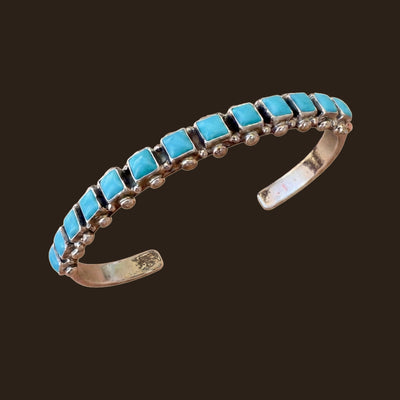
Multiple smaller stones. A Zuni piece often features dozens of small stones arranged together. The composition is mosaic rather than singular.
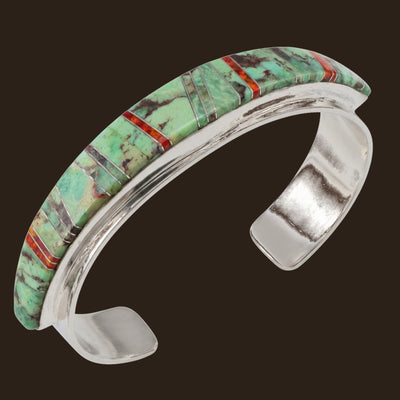
Channel inlay. One of the signature Zuni techniques. The silversmith builds silver channels (tiny silver compartments) into the face of the piece, then cuts each stone to fit its channel exactly. The stones are set flush with the silver. The whole face reads as a single tight mosaic.
Needlepoint and petit point. Tiny pointed cabochons (needlepoint) or small round cabochons (petit point) set in clusters or rows. Each stone is individually cut and bezel-set in fine silver work that requires exceptional precision.
Lighter silver framework. The silver in Zuni work tends to be lighter weight than Navajo because it functions as scaffolding for the stones rather than as the centerpiece itself.
Mosaic and figurative compositions. Some Zuni work uses inlay to create figurative imagery (animals, traditional symbols, geometric patterns). The stones become pixels in a larger picture.
Examples of Zuni work in our shop include the Strata Ribbon Channel Inlay Cuff by Johnny Coonsis (read the origin story) and the Twin Drop Bypass Ring by Kenny Lonjose.
How to tell them apart at a glance
The fastest visual test: count the stones. One or two stones, substantial silver, hand-stamped textures around the bezel? Probably Navajo. Many small stones arranged in mosaic or channel inlay, lighter silver framework? Probably Zuni.
The second test: look at the silver. Is the silver itself part of the design (Navajo) or a framework for the stones (Zuni)? Heavy stamped band suggests Navajo. Lighter silver channels around stones suggests Zuni.
The third test: read the signature if there is one. Both traditions have well-known silversmiths whose work carries provenance. A signed piece tells you who made it and which tradition they work in.
What about other Southwestern traditions?
Navajo and Zuni are the two largest and most visible Southwestern silversmithing traditions but they are not the only ones. A complete picture includes:
Hopi. Hopi silver typically features overlay work — silver layered over silver with patterns cut through the top layer to reveal a darker oxidized layer beneath. Stone work is less prominent in Hopi silver than in Navajo or Zuni.
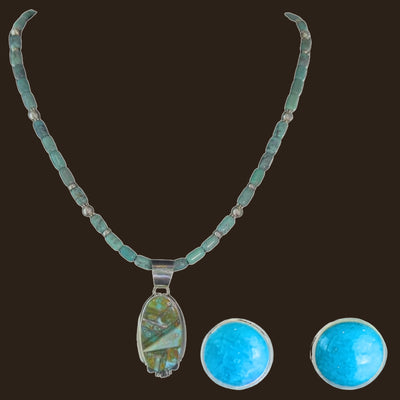
Santo Domingo (Kewa Pueblo). Traditional Kewa work emphasizes shell and stone bead jewelry rather than silver-and-stone settings. The heritage shell and turquoise mosaic earrings are a recognizable Santo Domingo style.
Hispano New Mexican. The Hispano communities of northern New Mexico have a long tradition of silversmithing that predates Anglo settlement, often incorporating religious imagery alongside Southwestern motifs.
Contemporary American. Many silversmiths working today blend traditional techniques with contemporary design instincts. A piece might use Navajo stamping techniques on a modern silhouette, or apply Zuni inlay methods to a piece that does not look traditionally Southwestern at all.
Why both Navajo and Zuni belong in a serious collection
If you are building a collection of Southwestern turquoise jewelry, having work from both traditions gives you visual range and tradition depth. A Navajo statement cuff and a Zuni inlay piece read very differently on the body and complement rather than compete.
The two traditions also represent different points on the price spectrum at different times. Top-tier work in either tradition can run into thousands of dollars for collector-grade pieces by well-known silversmiths. Mid-tier work is accessible and there is excellent pieces available for hundreds of dollars from working silversmiths in both traditions.
If you want to see the named silversmiths we work with directly in each tradition, see our Silversmiths We Work With page.
What to read next
For broader buying guidance, see our Turquoise Buying Guide. For identifying real turquoise from substitutes, see How to Tell if Turquoise Is Real. For deeper context on the lapidary side of the supply chain, see About Our Mines.

0 comments