

If you have shopped Southwestern jewelry long enough, you start to recognize regional styles before you see the signature. Channel inlay almost always means Zuni. This piece is a perfect example.
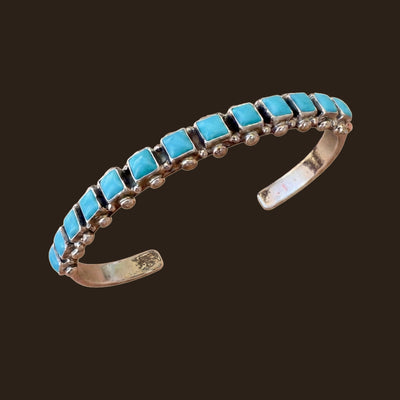
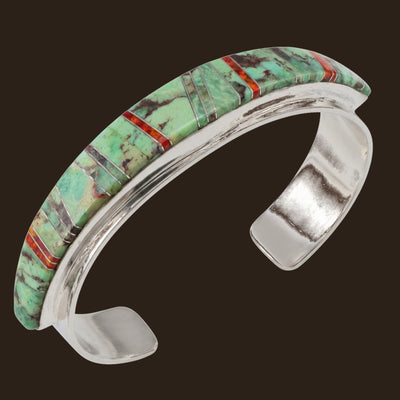
The Strata Ribbon Cuff by Johnny Coonsis is a Zuni-tradition channel inlay turquoise cuff in sterling silver. Multiple turquoise pieces set in precise silver channels, each stone shaped and polished to fit its slot exactly, the whole face of the cuff reading like a ribbon of stone running across the wrist.
What channel inlay actually is
Channel inlay is one of the signature techniques of Zuni silversmithing. The maker builds silver channels (think tiny silver compartments) into the face of the piece, then cuts and shapes stones individually to fit each channel exactly. The stones are set flush, polished to the same level as the silver, and the entire face reads as a single mosaic.
The technique is harder than it looks. Every stone has to be shaped to fit a specific channel. The stones cannot be off by more than a fraction of a millimeter or the fit fails. The polish has to be uniform across stone and silver, which means the lapidary work and the silver work have to happen in sync. A single cracked stone or misfit edge ruins the whole face.
Zuni silversmiths have been doing this work for generations. The level of precision in Strata Ribbon is the result of practiced hands, not luck.
Zuni versus Navajo tradition
Navajo silver and Zuni silver are both Southwestern silversmithing traditions, and a casual viewer often groups them together. They are distinct.
Navajo silverwork tends toward heavy single stones in substantial silver settings. The aesthetic emphasizes the stone, the silver weight, and the hand-stamped textures around the bezel. The Snowfield Cuff in our shop is a classic Navajo example.
Zuni silverwork emphasizes the stones in a different way. The stones are usually smaller and more numerous. The composition is mosaic-like. Channel inlay, needlepoint, and petit point are all Zuni signatures. The silver is the framework rather than the centerpiece.
Neither tradition is better. They are different vocabularies for working with the same materials. Strata Ribbon shows the Zuni vocabulary at its most refined.
The turquoise in this piece
The cuff uses natural turquoise across the inlay. The color story is consistent across the stones, which is itself a sign of careful sourcing and selection. Channel inlay only works visually if the stones harmonize. Mismatched colors or jarring variations break the mosaic effect.
If you want to understand more about how turquoise material varies by mine and how to identify genuine stone, see our Turquoise Buying Guide and our post on how to tell if turquoise is real.
Who this cuff is for
This is a piece for someone who appreciates technique. The Snowfield Cuff says "presence." Strata Ribbon says "craft." Both have their place.
It works as a centerpiece for a Southwest-influenced wardrobe, layered with simpler sterling bangles, or worn solo with denim and a white tee. The channel inlay reads as art at close range. The overall shape and weight make it wearable in any setting that allows a serious cuff.
If you are building a collection that spans Southwestern traditions, having both a Navajo-tradition piece and a Zuni-tradition piece is the start of a serious foundation.
About this piece. Each Strata Ribbon Cuff is a one-of-a-kind. The stones in the listing photo are the stones you receive. Sizing notes are on the product page. Questions about fit or wear, reach out.
View Strata Ribbon in the shop or browse all current cuffs.

0 comments