

A single slip of a jeweler's saw can ruin hours of delicate work, yet the artisans of the Three Mesas have mastered this precision for over 80 years. You likely appreciate the depth found in handcrafted Southwestern style jewelry but find it difficult to distinguish between traditional stamping and the intricate layers of Hopi silver overlay. It's a common frustration to worry about the authenticity of a piece when mass-produced imitations often hide the true hand of the creator. We believe that understanding the process is the first step toward finding a piece that resonates with your own story.
This article invites you to discover the deep history of the Hopi people and the specialized silver overlay techniques that define their quietly timeless artistic legacy. We'll explore the significance of the Three Mesas in Arizona and share the specific hallmarks that help you identify genuine artisan-made silver work with confidence. From the blackened textured backgrounds to the high-polish surfaces, you'll learn to see the narratives etched into every small batch design. By the end, you'll possess the knowledge to recognize the intentional movement and precision that makes this style a cornerstone of regional craft.
Key Takeaways
- Explore the history of the Hopi people and the philosophy of balance that guides their life on the high mesas of Arizona.
- Learn the specific steps of the silver overlay process, where a jeweler uses a saw and steady hands to join two distinct layers of sterling silver.
- Interpret the stories told through Southwestern style symbols, from the migration paths of different clans to the importance of rain and corn.
- Gain the skills to spot authentic artisan-made jewelry by examining the precision of the cutouts and the unique markers of hand-cut work.
- Find a starting point for your own quietly timeless collection by prioritizing quality studio work and versatile everyday essentials.
The Hopi people and the legacy of the Three Mesas
Dust rises off the high mesas of northeastern Arizona, where the Hopi people have lived in a sovereign relationship with the land for centuries. Their name translates to "the peaceful ones," which is less a simple label and more a complex philosophy of stewardship and balance. For over 1,000 years, these communities have thrived through dry-farming techniques, growing corn and beans in a landscape that receives less than 10 inches of rain annually. It is a culture built on endurance and a deep, quiet respect for the natural world. This survival in an arid climate required a precise understanding of seasonal cycles and a communal commitment to the land.
To better understand the artistry of this region, watch this helpful video:
Life on First, Second, and Third Mesa
The villages are clustered atop three distinct landforms known as First, Second, and Third Mesa. Old Oraibi, located on Third Mesa, was established around 1100 AD and remains one of the oldest continuously inhabited settlements in the United States. This elevation provided a natural defense against intruders and a clear, unobstructed view of the sky. Over time, each mesa developed specific artistic specialties. First Mesa is known for its distinct pottery styles, while Second Mesa artisans often focus on coiled basketry. Third Mesa is frequently associated with wicker baskets and the foundational development of the Hopi silver overlay technique, which uses two layers of silver to create depth and shadow. The geography influences the work, as the expansive horizon line often appears in the geometric patterns of their handcrafted jewelry.
A matrilineal foundation for art
Social organization centers on the clan system, which is matrilineal. This means that family names, land rights, and ceremonial duties pass through the mother's line. Clans often take names from the natural world, such as the Bear, Water, or Badger clans, reflecting their origin stories. This structure ensures that artistic knowledge and technical standards flow through specific family lines, preserving a high level of craftsmanship. Kimberly Cordova focuses on curating one-of-a-kind pieces that honor these Southwestern style traditions. These works are not just objects. They are a continuation of family histories and a commitment to a standard of excellence that has been maintained for generations. In the studio, we see how these lineage-based skills result in a precision that is difficult to replicate without that deep historical grounding. The focus remains on small batch production that respects the original intent of the maker.
Explore our current collection of handcrafted jewelry at wildflowerartisans.com or visit the Wildflower Etsy shop to see our latest reviews.
Mastering the technical process of silver overlay
The jeweler sits at a worn wooden bench, leaning into the light with a fine-frame saw in hand. Silver overlay is a hallmark of the Southwestern style, a technique requiring two distinct layers of heavy sterling silver to create a single piece. It is not a process for the hurried or the careless. Each piece begins as two flat sheets, eventually becoming a singular, heavy object that carries the weight of tradition. Understanding the spiritual significance of Hopi jewelry helps one appreciate why these artisans commit so many hours to a single design. The method produces a look that is both deeply traditional and strikingly modern, relying on the play of light against dark shadow.
Cutting the design from the top plate
An artisan hand-cuts a design into the top sheet of silver using a fine-toothed jeweler’s saw. This is the most demanding stage of the process. The saw blade is often no thicker than a human hair, and a single slip can ruin hours of careful work. In this method, the negative space in the top sheet becomes the primary image of the piece. A master jeweler is identified by the fluid nature of their curves and the sharp precision of their corners. There is no room for jagged edges or hesitant lines. Every cut must be intentional and steady.
Soldering and texturing the base
Once the top plate is perfected, it is soldered to a solid bottom sheet of the same shape. Before the two layers are permanently joined, the artisan uses a small chisel or a specialized stamp to add texture to the visible bottom layer. This step is often called matting. It creates a rough surface that allows the dark oxidation to adhere later, providing a deep, high-contrast visual effect. A dark oxidation is applied to the bottom layer to create a high-contrast visual effect that makes the top design pop. The result is a textured, three-dimensional design that feels substantial yet refined.
The role of the lapidary
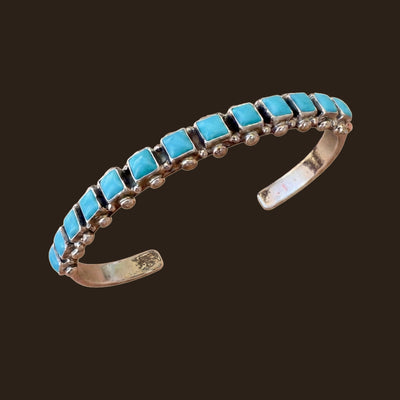
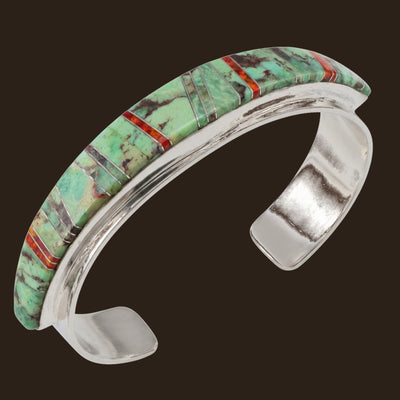
While many overlay pieces are all silver, some include high-quality cabochons to add a focal point of color. Greg Cordova often selects stones with a specific matrix or pattern to complement the geometric precision of the overlay. Whether it is a piece of natural turquoise or a deep red coral, the lapidary work must match the technical skill of the metalwork. You can check our stone origins page to see how these materials are sourced and cut in our studio. Integrating a stone requires a carefully constructed bezel that sits flush against the silver layers, maintaining the clean lines of the hopi style. If you appreciate the weight and texture of these handcrafted pieces, browse our latest work at wildflowerartisans.com.
To see our full collection of Southwestern style jewelry, visit wildflowerartisans.com or find our curated selections on the Wildflower Etsy shop.
Symbolism in Southwestern style designs
Southwestern style jewelry functions as a living archive. When you hold a piece of silver overlay, you aren't looking at a simple decorative pattern. You're engaging with a visual language. Elements from the natural world, such as corn stalks or rain clouds, aren't chosen because they look nice. They are chosen because they represent the foundations of life. The hopi artisans who pioneered this style used these figures to document clan histories and cultural narratives that have been shared for generations. Animal figures like the badger or the flute player carry specific stories. The badger often signifies persistence and a deep connection to the earth, while the flute player marks the transition of seasons and the promise of a harvest. These designs aren't just shapes. They are stories etched into metal with deliberate care.
Water and weather motifs
In the arid environment of the Southwest, water is the ultimate currency. Symbols for rain and clouds are prevalent because they are highly valued in a region that often receives less than 10 inches of annual rainfall. Lightning bolts and waves represent the raw power and necessity of moisture. These designs are often rendered with a precision that highlights the artisan-made quality of the work. When we look at the Hopi silver overlay technique, we see how the negative space is used to create depth. The darkened, textured background makes the silver clouds look as though they are heavy with rain. It’s a technical achievement that requires a steady hand and a sharp saw. Every line is a prayer for the next monsoon.
Migration and the path of life
The concept of the journey is central to many Southwestern style designs. Spiral motifs often signify the migration paths of different clans as they moved across the vast landscape to find their permanent homes. These aren't just abstract circles. They are maps of movement and history. Similarly, the maze or labyrinth represents the path of life. It depicts the various choices and challenges a person faces from birth to the end of their journey. These pieces offer a quietly timeless look at universal human experiences. The artisan captures the complexity of a lifetime within the small circumference of a ring or the flat surface of a pendant. It’s a way of grounding the wearer in a larger story that connects the past to the present.
If you're looking for a specific piece that tells your own story, you can browse our current collection at wildflowerartisans.com. We also maintain a selection of handcrafted work on our Wildflower Etsy shop for those who prefer that platform's reviews and protections.

How to identify authentic handcrafted silver work
You can often tell a piece's quality just by holding it in your palm and feeling the cool, solid weight of the metal. Genuine silver overlay involves two distinct sheets of sterling silver, usually 20 to 24 gauge, soldered together to create depth. This physical presence is the first sign that you are holding something made with intention rather than a hollow, mass-produced imitation.
Look closely at the cutouts. In authentic hopi style overlay, the top layer is hand-cut with a jeweler's saw. This process leaves clean, sharp edges that a mold simply cannot replicate. If you see rounded, soft corners inside the design, it is likely a cast piece made in a factory. Hand-cut work shows tiny, human variations under a magnifying loupe. These are not flaws. They are the fingerprints of the artisan's process. The background layer is also textured, typically with a small chisel or stamp, to create a dark, oxidized contrast that makes the silver design pop.
The weight provides another clue. Because an artisan uses two layers of heavy gauge silver, the finished work feels substantial. Mass-produced pieces often use thin plating or a single sheet stamped to look like two. Flip the piece over to examine the back. A reputable maker will stamp their hallmark or signature on the reverse side. This is their promise of quality and a connection to the studio where the piece was born. These hallmarks are often unique to the individual artist, serving as a record of their specific lineage in Southwestern style jewelry.
Avoiding mass-produced imitations
Cast jewelry often lacks the crisp detail of a hand-cut saw line, resulting in "mushy" textures where the silver meets the blackened background. Fake pieces might use mystery metals or thin plating that wears off after a few months of wear, revealing a copper or brass base underneath. We specialize in one-of-a-kind jewelry created with solid materials that stand up to daily life and maintain their integrity for decades.
Understanding the bezel and stone setting
A hand-cut bezel should wrap tightly around the stone with no visible gaps. In our studio, Kimberly Cordova curates stones with character, while Greg Cordova handles the precision lapidary work at Cutting Edge Turquoise for many of our featured settings. The stone should be a genuine cabochon rather than plastic or dyed howlite. A high-quality matrix in the stone, such as the intricate spiderweb patterns found in certain regional mines, indicates a more thoughtful selection process. The setting should feel like a protective cradle, built specifically for the unique dimensions of that exact stone.
Explore our latest handcrafted silver collections to see these details in person.
Browse our full collection of quietly timeless pieces at wildflowerartisans.com or visit our Wildflower Etsy shop for additional reviews and protections.
Building a collection of quietly timeless artisan pieces
Building a collection of jewelry is a slow, deliberate process that reflects your own growth and aesthetic shifts. You don't need to start with a heavy cuff or an elaborate necklace to appreciate the craft. Instead, begin with everyday essentials like a simple overlay band or a pair of small stud earrings. These pieces allow you to appreciate the weight of high grade silver and the fine detail of the saw work without a major commitment. When you hold a piece of hopi silver overlay, look closely at the depth of the chisel marks in the recessed areas. The quality of the silver work and the reputation of the studio are the most important factors to consider when you first start your journey.
Collecting is a long-term journey that celebrates the immense skill of the artisan. Each piece represents hours of physical labor, from the initial sketching of the design to the final polishing of the raised surfaces. This isn't about fast fashion or fleeting trends. It's about finding work that feels substantial and honest. Because these items are crafted from heavy-gauge metals, they are built to last. Proper care ensures that these pieces can be passed down for generations, carrying their stories and the history of the Southwestern style forward to those who come next.
Caring for oxidized silver overlay
The dark, textured background found in hopi jewelry is achieved through a deliberate oxidation process. This contrast is what gives the geometric patterns their depth and character. It's essential to avoid using liquid silver cleaners or chemical dips, as these solutions will strip away the dark oxidation and leave the metal looking flat and lifeless. Use a soft polishing cloth only on the raised, high-shine surfaces to keep them bright. If you have questions about maintaining the luster of your silver, consult our care and repair guide for detailed maintenance tips.
Curating your personal style
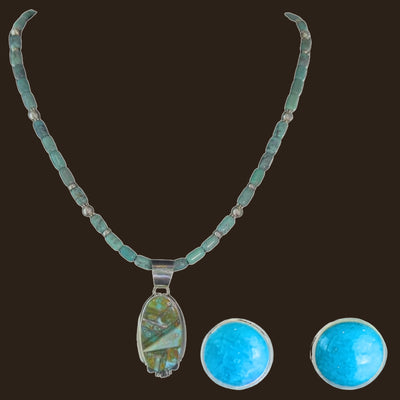
A balanced Southwestern style look often benefits from a mix of textures and techniques. You can pair the clean, geometric lines of overlay with stone-heavy pieces that feature a high-grade cabochon or a complex spiderweb matrix. Greg Cordova performs the lapidary work for our most intricate stones, ensuring the cut highlights the unique character of the material. Kimberly Cordova curates our selection to ensure each piece resonates with a sense of place and a connection to the natural world. Choose items that feel personal to your own narrative rather than following a specific rulebook. For more inspiration on styling handcrafted silver and seeing how different pieces work together, visit our journal.
Explore our full selection of handcrafted silver and stone work at wildflowerartisans.com. You can also find a curated range of our latest studio pieces and read buyer reviews on the Wildflower Etsy shop.
Building a Collection of Southwestern Style Silver
The precision required for silver overlay is a testament to the enduring skill of the Hopi people and their commitment to storytelling through metal. When you hold a piece of Southwestern style jewelry, you feel the weight of history and the steady hand of an artisan who spent decades perfecting the saw-cut technique. It's about the technical mastery of layering silver to create depth and shadow without losing the fine detail of the symbolism. Identifying authentic work means looking for these clean lines and the subtle textures that define a well-made piece.
At our Santa Fe studio, we focus on maintaining this standard of quality in every small batch collection. Every piece is guaranteed authentic silver and stone. Kimberly Cordova carefully curates each design to reflect this heritage, while Greg Cordova handles the lapidary work with precision. You can feel the difference in a hand-cut cabochon or a perfectly set bezel. We invite you to browse our collection of handcrafted silver and turquoise at Wildflower Artisans to find your next piece. If you prefer the familiarity of a marketplace, you can also find our work at the Wildflower Etsy shop. We hope these pieces bring a sense of grounded beauty to your daily life.
Frequently Asked Questions
What is the difference between Hopi silver overlay and other silver styles?
Hopi silver overlay uses two separate sheets of sterling silver to create a three-dimensional effect. While other Southwestern styles often feature heavy stamping or sand-casting, this specific technique relies on a jeweler manually cutting a design into the top sheet with a fine saw. The bottom sheet is then soldered to the top, creating a recessed area that we darken to provide contrast. It's a meticulous process that requires a steady hand and hours of focused bench work.
Is the dark background in silver overlay paint?
The dark background is not paint, it's a controlled chemical reaction called oxidation. We use a solution like liver of sulfur to darken the recessed silver of the bottom layer. This creates a matte black finish that makes the polished top layer pop. Over years of wear, this patina remains protected in the grooves, though the high points of the silver will stay bright through natural contact with your skin.
How can I tell if a piece of silver jewelry is truly handcrafted?
Truly handcrafted silver jewelry reveals itself through subtle variations and the presence of an artist's hallmark. If you look closely at the recessed areas of a piece, you might see tiny vertical lines from the jeweler's saw blade. Cast pieces made in factories look too perfect and often lack these human markers. Every piece curated by Kimberly Cordova features a distinct hallmark, which is a stamped signature that identifies the specific artisan who spent 10 to 20 hours at the bench creating it.
Do the symbols on Southwestern style jewelry have specific meanings?
Symbols in Southwestern style jewelry often represent elements of the natural world like rain, clouds, or migration patterns. For instance, a wavy line might signify water or life, while a parrot often represents the cardinal direction of the south. These designs are not merely decorative, they are visual stories rooted in 800 years of tradition. We view these pieces as quiet narrators of the high desert landscape, captured in sterling silver.
Why is silver overlay jewelry more expensive than other types?
This jewelry costs more because it requires double the amount of sterling silver and significantly more labor than standard stamped pieces. An artisan must hand-cut the top layer with a saw that has a blade thinner than a human hair. A single 2-inch pendant can take an experienced jeweler 12 hours to complete from the first cut to the final polish. You're paying for the technical skill and the time required to achieve that level of precision.
Can I wear my silver overlay jewelry every day?
You can absolutely wear silver overlay jewelry every day because it's constructed from two layers of heavy-gauge silver. This makes the pieces exceptionally durable and resistant to bending. While the silver is sturdy, we recommend removing it before swimming in chlorinated pools or using harsh cleaning chemicals. The silver will develop a soft, lived-in glow over time that reflects your personal history with the piece.
How do I clean my jewelry without ruining the oxidation?
Clean your jewelry using a soft polishing cloth rather than liquid silver dips. Liquid cleaners will strip away the intentional oxidation in the recessed areas, ruining the contrast that defines the hopi style. Rub the cloth gently over the raised surfaces to restore the shine while leaving the dark background untouched. If the piece gets dusty, a quick rinse with mild soap and water is safe, provided you dry it immediately with a soft cotton rag.

Article by
Kimberly Cordova
Kimberly Cordova is the founder and creative director of Wildflower, a handmade Turquoise and sterling silver jewelry brand based in Santa Fe. She built Wildflower around a simple belief: the best jewelry is the kind you actually reach for, not the kind you save for someday.
Kimberly designs pieces made by hand with a trusted circle of Santa Fe silversmiths, works alongside her husband Greg on in-house lapidary pieces cut from stones including the family's King's Manassa Mine in Colorado and White Buffalo Mine in Nevada, and sources finished work from artisan makers whose craft meets the same standard. The result is a collection with real range and no shortcuts on the stone, the silver, or the story behind either.
Her writing covers everything she has learned along the way: how Turquoise forms, how to tell natural from stabilized, what makes one mine different from another, how to read a bezel, and how to shop with confidence in a market that is not always straightforward. It is the kind of plainspoken information she wished someone had laid out for her when she was starting out.
Shop the Wildflower collection at wildflowerartisans.com, or find us on Etsy at wildflowersantafe.etsy.com. Questions about a stone, a setting, or a specific piece are welcome any time.

0 comments