

Only 15% of all turquoise pulled from the earth is natural and hard enough to be cut into a cabochon without stabilization. We know the frustration of staring at a tray of vibrant blue stones and feeling overwhelmed by conflicting labels or the difficulty of identifying a mine without a proper tag. This guide to different turquoise mines serves as your map through the beautiful, varied landscape of Southwestern stones, identifying the distinct colors and matrix patterns of famous locations like the deep chocolate webbing of Bisbee or the high blue of Kingman. Drawing on the lapidary expertise of Greg Cordova and the curation of Kimberly Cordova, you will gain the confidence to recognize five major mines by sight and understand exactly how the relationship between matrix and value defines a truly exceptional, handcrafted stone that is quietly timeless.
Key Takeaways
- Learn to identify the visual signatures of major Southwestern mines, from the clear sky-blue tones of Arizona to the rare apple-green hues found in Nevada.
- This guide to different turquoise mines explains how the host rock creates unique matrix patterns, serving as a mineral fingerprint for a stone's origin.
- Understand why specific mineral compositions, such as the high zinc content in Carico Lake, produce colors that deviate from the traditional blue palette.
- Gain insight into the lapidary process and how untreated, natural turquoise is identified and preserved through the expert hand-cutting techniques used in our studio.
Guide to different turquoise mines across the American Southwest
Turquoise is a chemical conversation between water and metal. At its core, it's a hydrated phosphate of copper and aluminum that forms in arid climates. This mineral grows within the cracks and voids of a host rock, absorbing the personality of the ground around it. This guide to different turquoise mines explores how geography dictates the color and hardness of every stone we curate. While massive commercial operations once dominated the market, the modern era belongs to small batch mining where individual claims are worked for their unique aesthetic qualities.
The history of these deposits stretches back centuries. Prehistoric sites like the Cerrillos Hills in New Mexico were active long before the first commercial shafts were sunk in the late 1800s. Today, we focus on stones that represent the best of these historic and modern locales, ensuring every piece tells a specific geological story. To see how these historic locations look on the ground, watch this overview of a classic site:
The role of copper and iron in stone color
The specific metals present during a stone's birth determine its final palette. High concentrations of copper produce the classic, vibrant blue hues that many associate with the Arizona desert. When iron or zinc replaces aluminum in the crystal structure, the stone shifts toward the organic greens and yellows found in Nevada and Colorado mines. Because we work with natural, untreated material, color consistency is never guaranteed. A single vein might yield a deep sky blue on one end and a mossy green on the other. You can find detailed Turquoise gemstone information regarding these chemical variations to better understand the science behind the beauty.
Understanding the matrix and host rock
The matrix is the skeletal remains of the mother rock that held the turquoise for millions of years. It appears as the delicate spiderweb lines or bold blotches that break up the field of color. Some collectors prefer a clean stone with no visible matrix, but many of the pieces curated by Kimberly Cordova celebrate these inclusions for the character they provide. Common host rocks like rhyolite, limonite, and quartz each leave a different signature. A heavy matrix doesn't just add visual depth; it serves as a map of the stone's origin, making it easier to identify which mine the turquoise called home.
Arizona’s legendary deposits from Kingman to Sleeping Beauty
Arizona's landscape is defined by its massive copper deposits, which historically produced the bulk of the world's turquoise. This guide to different turquoise mines wouldn't be complete without acknowledging how these industrial sites birthed some of the most sought-after collector stones. Most Arizona turquoise is a byproduct of copper mining, where the mineral forms in the oxidized zones of large ore bodies. The stones from this region are typically known for their hard, durable nature and their classic high-blue color palettes. One unmistakable Arizona signature is the presence of iron pyrite, specifically in stones from the Morenci mine. This "fool’s gold" creates a metallic shimmer within the matrix that provides a heavy, industrial contrast to the vibrant blue of the stone.
The Kingman mine signature
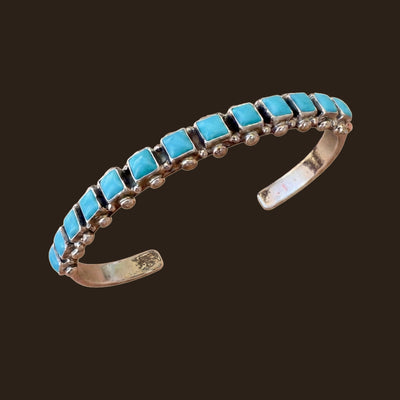
The Kingman mine remains the most prolific source of turquoise in the United States. Its stones are easily identified by a white or "water-web" matrix that drifts through various shades of blue. While large quantities of stabilized Kingman are available for around $150 per pound, the high-grade natural cabochons we use in our studio are much harder to find. These top-tier stones often feature a dark, intricate spiderweb matrix that increases their value significantly. Kingman is the backbone of Southwestern style jewelry. Because of its steady production, it allows us to create consistent everyday wearable jewelry that still maintains a high level of artisanal character.
The rarity of Sleeping Beauty and Bisbee
Scarcity is the primary driver for collectors looking at Sleeping Beauty and Bisbee stones. The Sleeping Beauty mine ceased operations in 2012, a move that reduced the global turquoise supply by an estimated 20% by the end of 2025. It is the gold standard for "robin’s egg" blue, prized for its uniform color and lack of matrix. When evaluating these stones, many collectors refer to GIA's guide to turquoise quality factors to understand how color saturation and texture impact the stone's market price, which is projected to exceed $17.00 per carat for high-quality specimens in 2026.
Bisbee turquoise is considered a high-grade investment stone for different reasons. The mine has been closed since the mid-1970s, making any "new" Bisbee jewelry the result of old-stock collections. It is famous for a "smoky" lavender-brown matrix that pairs with deep, electric blue hues. The visual depth of the "Bisbee Blue" color is unique among Southwestern stones, often appearing as if the blue is glowing from beneath the dark host rock. If you are starting a collection, looking for these specific Arizona signatures in our one-of-a-kind artisan pieces is a reliable way to ensure you are investing in genuine mineral history.
Nevada’s high-desert gems and the Royston district
Nevada produces over 10% of the world’s turquoise, offering a landscape of color that feels more organic and varied than the bright blues of Arizona. While the previous section focused on the copper-heavy deposits of the south, this guide to different turquoise mines looks at the high-desert mineralogy that creates deep greens and golden matrix patterns. Nevada is a collector's playground because the mines are often smaller, family-run operations that produce small batch runs of high-character stones. These deposits are frequently found in pockets rather than massive veins, leading to the legend of "hat mines" like Lander Blue, where the entire deposit was reportedly small enough to be covered by a Stetson.
The Royston color palette
The Royston district is unique because it produces stones with incredible color gradients within a single piece of host rock. A single cabochon can transition from a deep forest green into a pale sky blue, separated by a heavy brown limonite matrix. Greg Cordova carefully selects Royston rough for these specific banding patterns, using a thoughtful hand-cut process to ensure the final stone showcases the natural movement of the mineral. These stones are the centerpiece of many one-of-a-kind artisan pieces curated by Kimberly Cordova, as the color transitions make every setting completely unique.
Carico Lake and the green turquoise appeal
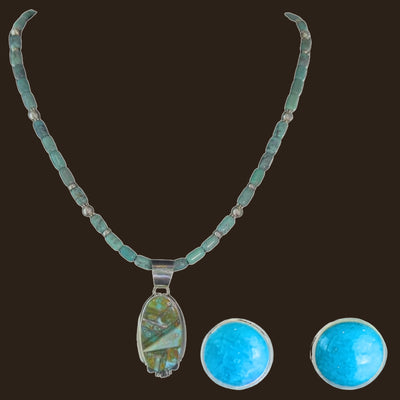
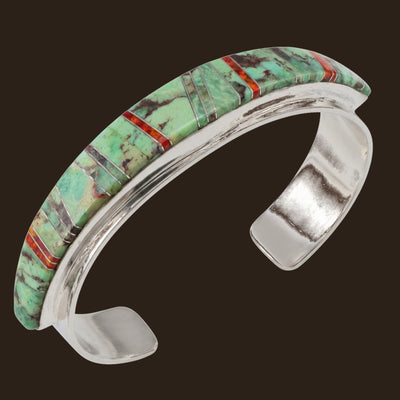
Carico Lake turquoise comes from a dry lake bed in Lander County and is famous for its high zinc content. This specific chemistry shifts the palette away from blue toward a vibrant, "spring green" or apple-green shade that is highly collectible. Because these stones are found in a dry lake bed environment, they are often harder than stones from other regions, which allows them to take a high, glass-like polish. This hardness makes them ideal for pieces that see daily wear, like a turquoise cuff bracelet or a heavy ring.
Beyond Royston and Carico Lake, Nevada is home to historic legends like the Number 8 mine. This mine hasn't produced turquoise since 1961, making the existing supply finite and valuable. It is best known for its golden-brown spiderweb matrix, with top specimens sometimes selling for over $2,000 per carat. Then there is Lander Blue, the rarest turquoise in the world. With prices ranging from $300 to $1000 per carat, it represents the ultimate investment for a collector. We focus on these Nevada stones because they offer a level of visual storytelling that simpler, uniform stones can't match. Every matrix line and color shift is a record of the high-desert floor.
Colorado and New Mexico specialties like King’s Manassa
New Mexico and Colorado offer stones that feel distinct from the high-blue Arizona staples or the high-desert greens of Nevada. While Arizona is the industrial heart of the trade, these northern regions provide stones with a historic weight that collectors value for their rarity and unique mineral signatures. This guide to different turquoise mines highlights the local favorites that define our Santa Fe studio's aesthetic. These mines often produce smaller yields, making the stones more exclusive and harder to find in mass-produced settings.
The historic weight of Cerrillos turquoise
Cerrillos is located just south of Santa Fe and stands as one of the oldest mining districts in North America. Prehistoric mining at this site dates back centuries, long before modern commercial interests arrived in the late 1800s. The stone is famous for its unique waxy luster and a color range that spans over 75 documented shades of green and blue. Within the district, the Tiffany mine is a standout, known for producing some of the hardest and most vibrant specimens in the region. Because the Cerrillos hills are so close to our studio, these stones carry a specific sense of place that Kimberly Cordova prioritizes when curating our one-of-a-kind artisan pieces.
King’s Manassa and the gold matrix
Across the border in Colorado, the King’s Manassa mine produces a stone that is impossible to mistake for anything else. The King family has worked this claim for generations, pulling out material that leans into brilliant, deep greens. What sets it apart is the gold-toned matrix that webs through the stone. This warm, metallic host rock complements sterling silver settings by adding a layer of visual warmth that cooler stones lack. The King's Manassa mine is no longer in operation, which means the existing supply is finite and increasingly difficult to source for our studio. A 12-carat stabilized and backed King's Manassa cabochon is often priced around $50.00, though the natural, high-grade stones we prefer are significantly rarer and more valuable.
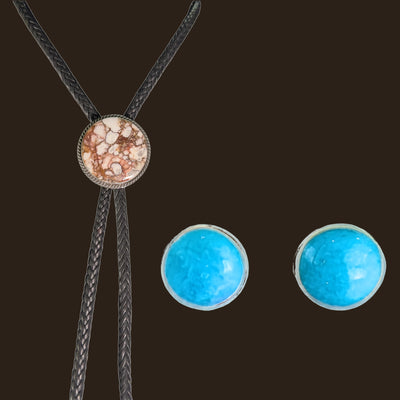
We also look to Colorado for Villa Grove turquoise, a lesser-known source that yields a high-grade blue stone often compared to the best Nevada material for its clarity and hardness. Then there is White Buffalo. While it's technically a white dolomite with black chert matrix rather than a phosphate of copper, it's categorized alongside turquoise in the Southwest due to its beauty and the way it's cut into cabochons. We treat it with the same respect as any mine-specific stone, ensuring the handcrafted necklaces we create showcase the stark contrast of the stone. Finding these specific regional stones requires a deep connection to the land and the people who work it. Greg Cordova often sources this rough directly, ensuring the lapidary work preserves the character of the Colorado and New Mexico soil. If you're looking to add a piece of local history to your collection, browse our authentic turquoise jewelry to see these stones in their finished form.

Why lapidary expertise and provenance define a stone’s value
A raw stone is a silent record of geological time. To find the story within the rock, an artisan must understand how to navigate the specific hardness and fractures of each deposit. This guide to different turquoise mines has shown that every location produces a different mineral signature, but the value of that signature is often determined by the hands that touch the stone after it leaves the ground. In our studio, we prioritize untreated material, knowing that only 10% to 15% of all turquoise is naturally hard enough to be cut without stabilization. We believe that preserving this natural state is the only way to honor the true character of the Southwestern landscape.
Provenance is the thread that connects a finished piece of jewelry back to the earth. When you buy from makers who maintain direct relationships with mine owners, you aren't just buying a stone; you're acquiring a verified piece of history. Greg Cordova handles the lapidary work with this philosophy in mind, ensuring that the hand-cutting process respects the stone's integrity. This expertise ensures that the "natural" label on our jewelry is a factual claim based on decades of experience in the trade.
The art of the cabochon
Cutting a cabochon is an exercise in observation. Greg Cordova studies the rough material to determine how to orient the stone to highlight its most compelling matrix patterns, whether that is a tight spiderweb or a bold, earthy blotch. A well-cut stone requires a precise bezel fit, which enhances the visual impact and protects the mineral for generations. This intentional approach to lapidary work transforms raw earth into an artisanal centerpiece. For those who want to dive deeper into the specific mineralogy of these sites, you can find more detail on our Wildflower stone origins page.
Building a collection based on provenance
For a serious collector, documentation is just as important as the stone itself. Provenance often gets lost when stones pass through multiple hands, which is why we maintain clear records of every stone's journey. Spotting the difference between a genuine matrix and a dyed substitute requires a trained eye, but a good rule of thumb is to look for the asymmetrical, organic variations that only nature can produce. Kimberly Cordova’s curation focuses on these verified details, ensuring each piece is quietly timeless and geographically accurate. We invite you to explore our one-of-a-kind collection to see these verified stones in settings that celebrate their unique Southwestern origins.
Start your journey into Southwestern stone history
Identifying the mineral signature of a specific hill or desert floor is the first step toward building a collection with real depth. Whether you're drawn to the clear blue of a Sleeping Beauty stone or the golden matrix of King’s Manassa, understanding the geology behind the gem changes how you see your jewelry. This guide to different turquoise mines has shown that true value lies in the details of the matrix and the integrity of the lapidary work. We handle every step of the process in our studio, using stones hand-cut by Greg Cordova and designs curated and crafted by Kimberly Cordova. You won't find mystery metals or dyed howlite in our work, only guaranteed authentic stones that honor their origins. Explore our collection of hand-cut turquoise jewelry at Wildflower Artisans for pieces that tell a specific story of the land. If you prefer the reviews and protections of a marketplace, you can also find our studio's work at the Wildflower Etsy shop. We look forward to helping you find a stone that resonates with your personal history.
Frequently Asked Questions
How can I tell which mine my turquoise came from?
Identification is primarily done through visual signatures like matrix color and host rock composition, but absolute certainty requires provenance from the source. Experts look for markers like the water-web of Kingman or the lavender-brown matrix of Bisbee. Because many mines produce overlapping colors, buying from a studio with a direct link to the lapidary work of Greg Cordova is the most reliable way to verify origin.
Is Nevada turquoise always green and Arizona turquoise always blue?
Color is determined by mineral concentration rather than state lines, though regional trends do exist. Arizona's copper-heavy soil often produces high-blue stones, but mines like Morenci can yield deep greens. Nevada is famous for the apple-green hues of Carico Lake, yet it also produced the legendary Blue Gem mine stones. This guide to different turquoise mines emphasizes that mineralogy, not just geography, dictates the final palette.
What is the rarest turquoise mine in the United States?
Lander Blue is widely considered the rarest turquoise mine in the world. Located in Nevada, this hat mine produced a very small amount of high-grade spiderweb turquoise before it was exhausted in the 1970s. With only about 100 pounds of total production ever recorded, its extreme scarcity drives prices between $300 and $500 per carat for authentic specimens today.
Why does some turquoise have a spiderweb pattern while others are clear?
The spiderweb pattern occurs when the turquoise forms in small nuggets within a host rock that is later cut and polished to reveal the thin veins of the mother rock. Clear stones, like those from Sleeping Beauty, formed in larger, solid veins without these mineral intrusions. Collectors often choose between the two based on whether they prefer a uniform color or the organic storytelling found in a complex matrix.
What is the difference between Kingman and Sleeping Beauty turquoise?
The primary difference lies in the matrix and the current availability of the stones. Kingman turquoise typically features a white or dark water-web matrix and is still actively mined in Arizona. Sleeping Beauty is famous for its solid, robin's egg blue with almost no matrix, but the mine closed in 2012. This closure reduced the global supply by 20% as of late 2025, making genuine Sleeping Beauty stones significantly harder to source.
Does the mine origin significantly affect the price of a turquoise ring?
Origin is a primary factor in valuation, especially for stones from closed or dead mines. A ring featuring a stone from a historic location like Bisbee or Number 8 will command a higher price than a more common stone because the supply is finite. When Kimberly Cordova curates our collections, she focuses on these provenance details to ensure the jewelry reflects the true mineral rarity of the stone.
How do I care for jewelry made with stones from different mines?
Treat all natural turquoise with care by avoiding harsh chemicals, oils, and prolonged water exposure. Because natural stones are porous, they can absorb perfumes or lotions, which might change their color over time. Clean your jewelry with a soft, dry cloth after wearing it to preserve the original luster of the cabochon and the integrity of the sterling silver setting.
Is White Buffalo turquoise actually turquoise?
White Buffalo is technically a white dolomite with black chert inclusions rather than a phosphate of copper. It lacks the copper or iron required to be classified as turquoise, but it is found in the same geological regions of Nevada. We include it in our collections because it takes a beautiful polish and offers a striking, monochromatic contrast that collectors of Southwestern style jewelry appreciate.

Article by
Kimberly Cordova
Kimberly Cordova is the founder and creative director of Wildflower Artisans, a handmade jewelry brand rooted in Santa Fe. Real turquoise, solid sterling silver, and a small line set in solid 14K gold. She built Wildflower around a simple belief: the best jewelry is the kind you actually reach for, not the kind you save for someday.
The collection is built three ways. Some pieces are made in-house, cut by her husband Greg from stones he sources himself, including rough from the family's King's Manassa Mine in Colorado and White Buffalo Mine in Nevada. Some are designed by Kimberly and fabricated by a trusted circle of Santa Fe silversmiths. And some are finished work she curates from artisan makers whose craft meets the same standard, because building a real collection means knowing when to make and when to look.
Turquoise leads, joined by White Buffalo, Wild Horse, Lapis Lazuli, Spiny Oyster, Black Onyx, Opal, and other genuine semi-precious stones. No shortcuts on the stone, the silver, or the story behind either.
Her writing covers everything she has learned along the way: how turquoise forms, how to tell natural from stabilized, what makes one mine different from another, how to read a bezel, and how to shop with confidence in a market that is not always straightforward. It is the kind of plainspoken information she wished someone had laid out for her when she was starting out.
Browse the collection at wildflowerartisans.com. Questions about a stone, a setting, or a specific piece are welcome any time.
0 comments