

A single stone can hold the dusty blues of a Nevada morning or the deep, mossy greens of a Colorado creek bed. When you look at the famous turquoise mines of the American Southwest, you aren't just seeing a color, you're seeing a geological fingerprint that took millions of years to form. It's understandable if the sheer variety of names and matrix patterns feels overwhelming. Between the bright sky blues of the now-closed Sleeping Beauty mine and the intricate spiderweb patterns found in Royston, the landscape of authentic stones is vast and often confusing.
You likely want to feel certain that the piece you bring home is exactly what the seller claims it to be. At Wildflower Artisans, we believe that understanding the specific character of each mine is the best way to move past the fear of buying dyed or mass-produced imitations. This guide will help you learn to identify the distinct colors and matrix patterns of the most legendary turquoise mines in the region. We'll explore how to spot the difference between a natural cabochon and a stabilized stone. This knowledge builds confidence. It allows you to appreciate the hand-cut, small batch pieces we create at Wildflower while ensuring your jewelry truly resonates with your style.
Key Takeaways
- Learn to recognize the clear robin's egg blue of Arizona stones, particularly the solid color often found in the Sleeping Beauty mine.
- Discover why Nevada and Colorado mines are celebrated for their diverse green tones and the intricate host rock patterns known as matrix.
- Gain confidence in identifying the famous turquoise mines of the american southwest by studying the unique geological fingerprints of each location.
- Understand how the artisan lapidary process and hand-cutting techniques reveal the best features of a raw stone.
- Learn to distinguish between natural turquoise and treated materials to ensure your collection remains authentic and high-quality.
What defines the famous turquoise mines of the American Southwest?
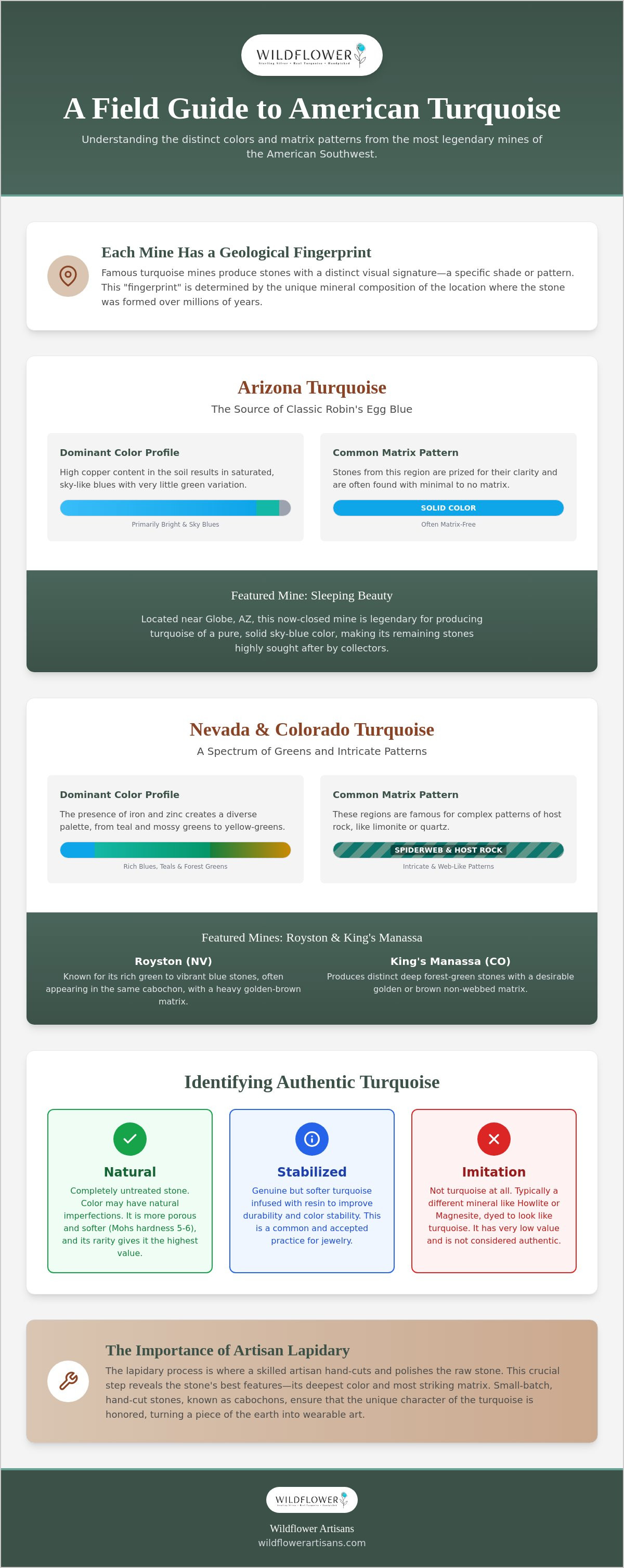
Famous turquoise mines are specific geographical locations recognized for producing stones with a distinct visual signature, such as a particular shade of blue or a unique matrix pattern. These sites became legendary because their output is consistent and high-quality, allowing collectors to trace a stone back to its source just by looking at a finished cabochon. In the arid regions of Arizona, Nevada, Colorado, and New Mexico, the earth provides a very specific set of conditions that make the famous turquoise mines of the american southwest possible. For a site to earn its reputation, it must produce stones with a reliable "fingerprint" that artisans and buyers recognize immediately, whether it is the clear sky blue of a specific Arizona peak or the deep mossy green found in a high-altitude Colorado vein.
Understanding Turquoise mineralogy and history helps us appreciate why these specific patches of desert are so rare. The dry climate is essential because it allows mineral-rich water to seep through the earth without being washed away. Over millions of years, this water reacts with copper, aluminum, and phosphorus to form the stone. At Wildflower, we focus on these specific origins because the story of the stone begins in the ground, long before it ever reaches a jeweler's bench. We prioritize educating our customers so they can feel the same connection to the landscape that we do when we are working in the studio.
To better understand how these landscapes look and function, watch this helpful video:
The role of geography and geology
The color of a stone is a map of the minerals present during its formation. When copper is the dominant mineral, you get those bright, punchy blues. If iron or zinc is more prevalent, the stone shifts toward green or yellow. The matrix is the remains of the host rock, like limonite or quartz, that stayed trapped within the stone as it hardened. Most famous turquoise mines of the american southwest are located near large copper deposits, which is why the region remains the heart of the world's turquoise trade. These geological conditions are rare, which is why authentic, untreated stones are so highly valued.
Why mine names matter to collectors
A mine name provides provenance, establishing the origin and potential value of a piece. For collectors, this origin is a mark of authenticity. For example, the Sleeping Beauty mine in Arizona closed in 2012, making its remaining natural stones much harder to find. When a mine closes, the supply stops, but the demand usually grows. Knowing the mine also helps you find the specific look you prefer. If you love deep forest greens with golden host rock, you might look for King's Manassa turquoise, a mine owned by our lapidary artist, Greg Cordova. We maintain a detailed guide to stone origins to help you understand the history behind every handcrafted piece.
Which Arizona mines produced the most recognizable blue stones?
Arizona acts as the primary source for the clear, robin's egg blue turquoise that defines Southwestern style for many people. While other states offer a kaleidoscope of greens and teals, the famous turquoise mines of the american southwest found here are celebrated for their saturated, sky-like hues. These stones are often the foundation for a jewelry collection. They provide a bright, reliable pop of color in simple sterling silver settings, which is why we often feature them in our everyday essentials. The chemistry here is straightforward. High copper content in the soil leads to these punchy blues, while a lack of iron prevents the stone from shifting toward green.
This iconic style isn't limited to jewelry; it also influences architecture and interior design across the state.
The clear blue of Sleeping Beauty
Located near Globe, the Sleeping Beauty mine earned its fame by producing stones with almost no matrix. Matrix is the host rock material that appears as dark lines or blotches. When a stone is "clean" like this, it's highly sought after for intricate work. This solid color is a staple in petite point and inlay designs where the artist needs consistent, uniform pieces across a single piece of jewelry. It's important to recognize that this mine closed for turquoise production in 2012. Today, it operates primarily as a copper mine. Because the supply is finite, natural stones from this location are increasingly rare. Collectors look for the signature hue that remains consistent even in very small cabochons.
The diversity of Kingman turquoise
When discussing the famous turquoise mines of the american southwest, the Kingman mine always stands out for its longevity and scale. Its output is incredibly diverse, reflecting the massive scale of the deposit. You'll find everything from pale, chalky blues to deep, forest greens with heavy matrix. High-grade Kingman stones are often recognized by a "water web" matrix. This pattern looks like shimmering ripples of light across the surface of the stone, often in a darker blue or black. The Ithaca Peak area of the mine is particularly famous. It produces stones with a deep blue color and silver-colored pyrite inclusions that look like flecks of metal frozen in the stone. You can learn more about these variations on our Kingman turquoise stone origins page.
Because these Arizona stones are so recognizable, they are also the most frequently imitated. Many mass-produced items use dyed howlite or plastic to mimic the Sleeping Beauty look. At Wildflower, we prioritize stones that are cut by hand to preserve their natural character. Whether it's a smooth, high-dome cabochon or a flat inlay piece, the goal is to let the Arizona blue speak for itself. If you're ready to add a piece of this history to your wardrobe, you might explore our current studio collection to see the genuine stones we have currently available.
How do Nevada and Colorado mines compare in color and matrix?
While Arizona is often defined by its sky-blue clarity, Nevada and Colorado offer a more complex, earthy palette. These regions are the heart of the famous turquoise mines of the american southwest for collectors who crave variety. Nevada is particularly famous for its intricate matrix and a spectrum of colors that ranges from soft teal to deep, mossy green. In contrast, Colorado stones often lean into rich, forest hues. These variations are a direct result of different mineral compositions in the host rock, such as iron and zinc, which push the stone's color away from pure blue toward the greener end of the spectrum. It's this diversity that makes the region so fascinating for those of us who work with these materials every day.
Nevada's Royston and Number 8 mines
The Royston mine is a favorite in our studio because of its incredible color gradients. It's common to find a single cabochon that moves from a vibrant blue to a deep emerald green within the same stone. Sometimes, these stones are cut to show boulder turquoise or ribbon patterns, where a thin vein of turquoise is left nestled within its natural host rock. This creates a striking, organic look that highlights the stone's journey from the earth. You can see these varied patterns in our Royston turquoise collection. It's a perfect choice if you prefer jewelry that feels like a small, wearable landscape.
The Number 8 mine, though no longer in commercial operation, remains a collector's prize for its spiderweb matrix. A spiderweb matrix consists of very fine, thin lines of host rock that crisscross the stone like a delicate web. In Number 8 stones, this web is often a high-contrast golden brown or black against a light blue base. It's a look that feels both sophisticated and raw, representing some of the most sought-after material among the famous turquoise mines of the american southwest. Because the mine is closed, finding these stones in small batch artisan pieces is a special experience for any collector.
Colorado's King's Manassa legacy
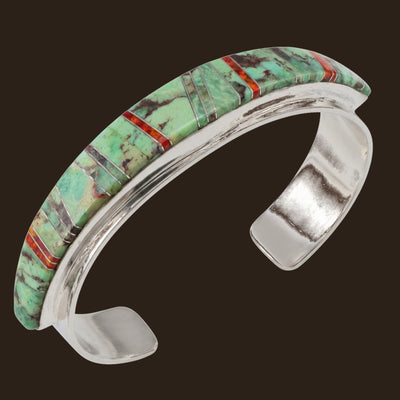
Colorado brings a different energy to Southwestern style, specifically through the King's Manassa mine. This site holds a special place in our hearts because it's owned and operated by the Cordova family. Greg Cordova, a master lapidary artist, handles the extraction and cutting of these stones personally. You can find more about his specific work at CuttingEdgeTurquoise.com. King's Manassa is celebrated for its deep, saturated greens and its distinct golden-colored host rock. When these forest-green stones are set in polished sterling silver, the contrast is grounding and elegant. The greens are not a sign of lesser quality; rather, they are a celebration of the specific iron-rich geology of the Manassa region. These stones offer a warmth that feels deeply connected to the high-altitude landscapes where they are found.
How can you tell the difference between these famous turquoise varieties?
Identifying a stone feels like reading a landscape, and it begins with observing the base color and the specific character of the host rock. The famous turquoise mines of the american southwest each leave a unique geological signature that acts as a fingerprint for the stone. You might see a base color that ranges from a pale, chalky white to a deep, saturated sky blue. Matrix is the non-turquoise mineral material that weaves through the stone. This material is actually the remains of the host rock, such as quartz, rhyolite, or limonite, that stayed trapped within the turquoise as it formed over millions of years. By looking at the color and pattern of this matrix, you can often trace a stone back to its specific origin in the high deserts of the West.
Visual cues for Arizona vs. Nevada stones
Arizona stones are generally celebrated for their "cleaner" appearance. When matrix is present in stones from mines like Kingman, it often appears as a light tan or golden brown. The patterns tend to be more open, leaving large fields of bright blue visible. Nevada stones, however, are known for being much more "active." You'll frequently see dark brown or even black matrix that creates a heavy contrast against teal or green-blue backgrounds. There's also a distinction in the texture of the pattern. A "tight" spiderweb matrix features a fine, delicate network of lines that looks almost like a lace overlay. A "patchy" matrix appears as larger, irregular islands of host rock that break up the color in a more rugged, organic way. Nevada mines are famous for producing these complex, multi-toned patterns that tell a story of geological pressure and change.
Identifying rare varieties like White Buffalo
White Buffalo is a striking white stone characterized by its high-contrast black chert matrix. While it is technically not turquoise due to its lack of copper, it is often grouped with the famous turquoise mines of the american southwest because it is found in the same regions and cut using the same lapidary techniques. It has become a favorite for statement pieces because of its bold, monochromatic look. When you see a high-quality White Buffalo cabochon, the white should be crisp and the black matrix should be sharp and well-defined. Because this stone is quite rare and only found in one specific location in Nevada, it carries a high value for collectors who want something beyond the traditional blue. You can see how we use these high-contrast stones in our White Buffalo jewelry collection.
Learning these visual cues takes time, but it's the best way to ensure you're investing in a genuine piece of Southwestern history. We believe that every stone has a narrative, and being able to recognize that narrative is part of the joy of collecting. If you want to see these patterns for yourself, you can browse our latest artisan-made jewelry to find a stone that resonates with your personal style.
Why is the artisan lapidary process essential for these rare stones?
The lapidary process is the critical bridge between a raw mineral and a finished piece of jewelry. For stones sourced from the famous turquoise mines of the american southwest, this step requires an expert eye to determine where to cut to reveal the most vibrant color or the most balanced matrix. A lapidary artist is a professional who cuts and polishes stones to prepare them for jewelry settings. Without this artisan touch, a rare stone might remain hidden within its host rock or be cut in a way that misses its best features. At Wildflower, we treat every stone as a separate story, ensuring that the final cabochon represents the very best of what the mine produced.
From rough stone to bezel-set jewelry
Our approach is rooted in a "stone-first" philosophy. This means the setting is designed to accommodate the stone's natural shape rather than forcing the stone into a pre-made mold. A cabochon is a stone that has been shaped and polished into a smooth, domed surface rather than faceted like a diamond. Greg Cordova brings a lifetime of experience to this process, particularly with stones from the mines he owns. When you see a piece featuring expertly cut stones from King's Manassa or White Buffalo, you are seeing Greg's specific lapidary work. He hand-cuts each cabochon to reveal the intricate spiderweb matrix or deep forest greens we've discussed. Kimberly then curates these stones, selecting only those that meet our studio's high standards for authenticity and visual balance. This collaboration ensures that the final sterling silver bezel perfectly frames the stone's unique character.
The value of small batch production
In a market filled with mass-produced items, small batch production offers a level of quality and soul that machines cannot replicate. Large retailers often use mystery metals or stabilized "block" turquoise that has been dyed to look like the real thing. When you choose handcrafted Southwestern style jewelry, you are investing in a piece that was made by a human hand using genuine materials. This is especially important for gift buyers who want to give something meaningful and lasting. Because we work in small batches, we can focus on the fine details of the silverwork and the specific needs of each stone. You can see the result of this intentional process in our Wildflower one-of-a-kind collection, where no two pieces are ever exactly alike. It's about honoring the rarity of the famous turquoise mines of the american southwest by creating jewelry that is just as unique as the stones themselves.
Finding a stone that tells your story
Every stone we work with at Wildflower carries the quiet history of the high desert. By learning to recognize the visual fingerprints of the famous turquoise mines of the american southwest, you can move past the confusion of mass-produced materials and find a piece that truly resonates with you. Whether you're drawn to the clear skies of an Arizona blue or the mossy, iron-rich greens of Colorado, the beauty lies in the authenticity of the earth. We take pride in our stone-first philosophy. This ensures that every cabochon is handcrafted in our small batch studio to highlight its natural character and unique geological narrative.
Every stone in our collection is guaranteed authentic. We feature many pieces with stones personally cut by master lapidary Greg Cordova, whose expertise ensures that the best color and matrix are revealed in every setting. We invite you to browse our curated collection of authentic turquoise jewelry to find a piece that speaks to your personal style. For those who prefer the added layers of buyer protection, you can also explore our artisan designs at wildflowersantafe.etsy.com. We hope you find a treasure that feels like it was meant just for you.
Frequently Asked Questions
Which turquoise mine is the most famous in the Southwest?
The Kingman mine in Arizona is widely considered the most well-known due to its massive scale and continuous operation over several decades. It's one of the famous turquoise mines of the american southwest that produces a huge variety of stones, ranging from high-grade water web patterns to pale blue nuggets. Many collectors also point to the Sleeping Beauty mine as a top contender because of its unique, matrix-free blue color that became a staple of Southwestern style jewelry.
Is Sleeping Beauty turquoise still being mined?
The Sleeping Beauty mine ceased all turquoise mining operations in 2012 to focus exclusively on copper production. While the site remains active as a copper mine, no new turquoise has been pulled from the ground for over a decade. This closure has significantly reduced the global supply of natural, untreated Sleeping Beauty stones, making existing pieces more collectible and harder to find in small batch artisan studios.
What is the rarest type of turquoise from the American Southwest?
Lander Blue is the rarest variety of turquoise found in the region, with the entire deposit in Nevada yielding only about 100 pounds of high-grade material. Other rare stones include Bisbee turquoise, which is prized for its deep blue color and smoky chocolate matrix. Because these deposits are so small or have been closed for decades, finding genuine, hand-cut cabochons from these locations is a rare occurrence for most jewelry buyers.
How can I tell if my turquoise is natural or stabilized?
Natural turquoise is untreated stone that has been cut and polished exactly as it came from the earth, whereas stabilized turquoise has been infused with resin to make it harder. Stabilization is the process of infusing a porous stone with clear resin to improve its durability and color. Identifying natural turquoise often requires looking for subtle variations in color that haven't been smoothed over by this process. We always recommend asking for a guarantee of authenticity, as approximately 75% of the turquoise currently on the market has undergone some form of stabilization.
Why is some turquoise green while others are blue?
The presence of specific minerals during the stone's formation determines its final color. High copper content creates the bright blues associated with Arizona mines, while the presence of iron or zinc shifts the color toward the green and yellow spectrum. This is why Nevada and Colorado mines, which often have iron-rich host rock, are so celebrated for their deep forest greens and teal hues.
What does 'spiderweb matrix' mean in turquoise jewelry?
Spiderweb matrix refers to a pattern of thin, delicate lines of host rock that crisscross the stone, resembling a web. Matrix is the non-turquoise mineral material, often remnants of the host rock, that weaves through the stone. This pattern is highly valued by collectors because it only occurs in high-grade stones where the host rock and turquoise have grown together in a very specific, delicate way. You'll often see this prized feature in stones from the Number 8 or Kingman mines.
Are stones from closed mines more valuable?
Stones from closed mines generally carry a higher value because the supply is finite and cannot be replaced. Closed mines are often the most famous turquoise mines of the american southwest because their rarity drives up demand among collectors. When a famous mine stops producing, the remaining stones become part of a fixed inventory that circulates among artisans, leading to a steady increase in the price per carat for natural material.
What is the difference between Kingman and Royston turquoise?
The primary difference lies in their color profiles and geographical origins, with Kingman producing clear Arizona blues and Royston offering Nevada greens and teals. Royston stones are particularly known for their color gradients, often showing both blue and green in a single cabochon. If you're looking for stones cut by a specialist, Greg Cordova often works with these varieties, and you can find more about his process at CuttingEdgeTurquoise.com.

Article by
Kimberly Cordova
Kimberly Cordova is the founder and creative director of Wildflower Artisans, a handmade jewelry brand rooted in Santa Fe. Real turquoise, solid sterling silver, and a small line set in solid 14K gold. She built Wildflower around a simple belief: the best jewelry is the kind you actually reach for, not the kind you save for someday.
The collection is built three ways. Some pieces are made in-house, cut by her husband Greg from stones he sources himself, including rough from the family's King's Manassa Mine in Colorado and White Buffalo Mine in Nevada. Some are designed by Kimberly and fabricated by a trusted circle of Santa Fe silversmiths. And some are finished work she curates from artisan makers whose craft meets the same standard, because building a real collection means knowing when to make and when to look.
Turquoise leads, joined by White Buffalo, Wild Horse, Lapis Lazuli, Spiny Oyster, Black Onyx, Opal, and other genuine semi-precious stones. No shortcuts on the stone, the silver, or the story behind either.
Her writing covers everything she has learned along the way: how turquoise forms, how to tell natural from stabilized, what makes one mine different from another, how to read a bezel, and how to shop with confidence in a market that is not always straightforward. It is the kind of plainspoken information she wished someone had laid out for her when she was starting out.
Browse the collection at wildflowerartisans.com. Questions about a stone, a setting, or a specific piece are welcome any time.
0 comments