

Only 2% of the turquoise pulled from the earth is high enough quality to be cut and polished without chemical intervention. This rarity makes finding genuine stones a challenge in a market often filled with dyed howlite or plastic-infused imports. It is easy to feel a sense of hesitation when looking at a tray of stones, wondering if that vibrant blue is a gift from the high desert or a product of a lab.
We see this uncertainty often at our Santa Fe studio benches. Understanding the different types of turquoise starts with looking past the surface and into the unique geological fingerprint of each mine. Greg Cordova, who handles our lapidary work and sources through CuttingEdgeTurquoise.com, emphasizes that every stone tells the story of its origin. This guide will help you identify stones from locations like Bisbee or Royston and explain why a natural cabochon commands a higher price than a stabilized one. You will learn to see the matrix and color through the eyes of a working studio, giving you the confidence to choose pieces that are quietly timeless and authentically sourced.
Key Takeaways
- Learn how the presence of copper and iron creates the distinct blue and green palettes found in different types of turquoise across the Southwest.
- Identify the specific physical traits and origins of stones from legendary locations like the Sleeping Beauty and Royston mines.
- Understand the technical difference between natural untreated stones and those hardened with resin through the stabilization process.
- Discover why the hand-cut cabochon process used in our studio adds value and character to every piece of handcrafted jewelry.
- Gain insight into how Kimberly Cordova curates specific stones for our collections based on their unique matrix and history.
Types of turquoise and the geology of the Southwest
Turquoise is not just a stone; it is a specific geological event that requires a rare combination of minerals and climate. Technically, it is a hydrous phosphate of copper and aluminum that forms when water moves through copper-rich host rocks in arid regions. While many people think of it as a single uniform material, there are actually dozens of distinct types of turquoise defined by the unique chemistry of the ground where they grew. In our Santa Fe studio, we view these stones as a geological record of the high desert. Greg Cordova, who handles our lapidary work and sources through CuttingEdgeTurquoise.com, often begins with raw, dusty nuggets that look like ordinary river rocks until the first pass of the saw reveals the color inside.
The chemistry of color in Southwestern stones
The specific hue of a stone is a direct result of its mineral environment. Copper is the element responsible for the bright sky-blue shades that many collectors prioritize. When iron or aluminum is present in the surrounding soil, the stone shifts toward a sage, lime, or deep forest green. These Turquoise mineral facts illustrate how sensitive the material is to its surroundings. Beyond color, the desert environment influences the density of the stone. Arid conditions with low water levels typically produce harder, more durable material that can be shaped into a cabochon without breaking. This natural hardness is a primary marker of quality in the different types of turquoise we select for our collections.
How the matrix defines a stone's character
Most turquoise forms within a host rock, and the remnants of that rock are what we call the matrix. This might appear as dark brown limonite, golden rhyolite, or even metallic iron pyrite. Rather than viewing the matrix as an imperfection, we see it as the stone's signature. A fine spiderweb pattern, where delicate veins of the host rock lace through the color, is particularly prized for its visual depth. Kimberly Cordova intentionally curates these patterns when designing our one-of-a-kind designs. She matches the movement of the matrix to the silver bezel, ensuring the metalwork highlights the natural geometry of the stone. Whether the matrix is a bold block of chocolate brown or a faint web of gold, it provides the contrast that makes the primary color pop.
Choosing between a clear stone and one with heavy matrix is often a matter of personal preference, but the geological history remains the same. The host rock tells us which mine the stone likely came from and how it was formed over millions of years. By focusing on these lapidary details, we can ensure that every piece of handcrafted jewelry we produce is both authentic and quietly timeless. If you're inspired to bring this same level of quality into your home, you can discover X Cabinet & Stone for expert kitchen and bathroom remodeling.
Classic blue turquoise mines of Arizona and Nevada
Arizona and Nevada provide the vibrant, high-desert palette that most people associate with Southwestern style. These states are home to some of the most famous mines in history, each producing a specific signature of color and matrix. Greg Cordova often looks for stones that represent the peak output of these locations, sourcing through CuttingEdgeTurquoise.com to find material that meets our studio's standards. While there are many types of turquoise, the classic blues from these regions remain the focal point for many of our handcrafted pendants.
Bisbee turquoise, or Bisbee Blue, is another Arizona treasure that is increasingly rare to find in its natural state. It was originally a byproduct of the Lavender Pit copper mine, which ceased operations in 1975. These stones are famous for their deep, smoky blue color and a distinct chocolate brown matrix that looks almost like a wash of watercolor. It's a heavy, dense stone that takes a high polish, making it a favorite for our small-batch jewelry designs. Because no new material is being pulled from the ground, every Bisbee cabochon we cut is a piece of history.
The sky blue clarity of Sleeping Beauty and Kingman
The Sleeping Beauty mine in Globe, Arizona, earned its reputation by producing a remarkably consistent robin's egg blue. This stone is often found without any matrix, creating a clean, sky-like surface that became a global standard for jewelry design. Since the mine closed in 2012, these clear blue stones have become increasingly collectible. In contrast, the Kingman mine serves as the backbone of the industry. It offers a vast spectrum of blues, often characterized by intricate matrix colors ranging from stark white to deep black. When we evaluate these stones, we look at several turquoise quality factors including the saturation of the blue and the stability of the host rock. A bright Kingman cabochon set in polished sterling silver creates a sharp, high-contrast look that feels both modern and grounded.
Nevada blue varieties and the Lander Blue legend
Nevada turquoise is known for its character and small-batch rarity. The Number 8 mine, located in the Lynn District, is famous for its unique golden-brown spiderweb patterns that lace through a light blue base. These stones are instantly recognizable and highly prized for their intricate geometry. However, the Lander Blue mine holds the title of the most valuable of all types of turquoise in the world. Discovered in 1973, this pocket mine yielded only about 100 pounds of high-grade material before it was exhausted. Its tight, black spiderweb matrix against a deep blue background is the ultimate find for serious collectors. Because these Nevada claims are often small and short-lived, the stones they produce carry a sense of fleeting beauty. Kimberly Cordova carefully selects these rare specimens to ensure each piece of jewelry tells a specific story of the earth.
Green turquoise varieties and the allure of the matrix
Many collectors believe a stone must be robin's egg blue to be high quality. This is a narrow view that ignores some of the most durable and visually complex types of turquoise found in the American West. Green stones are often harder than their blue counterparts. The iron or zinc providing the color also contributes to the stone's density. This makes them ideal for daily wear in hand-cut rings or cuffs. We often get asked about White Buffalo in our Santa Fe studio. It is important to clarify that while it is beautiful, White Buffalo is not turquoise. It lacks the copper and aluminum phosphate chemistry found in the stones we discuss here. It is actually a mixture of dolomite and aragonite. Actual green turquoise, like those from the Carico Lake or Royston mines, retains that classic mineral structure while offering a completely different aesthetic.
The earthy depths of Royston and Carico Lake
The Royston district in Nevada is famous for ribbon or landscape stones. A single cabochon might transition from a deep forest green to a vibrant sky blue. These colors are often separated by a rich brown limonite matrix. This creates a tiny, natural portrait of the high desert. Carico Lake turquoise is another standout. It is known for a high zinc content that produces a bright, neon lime green. These stones are incredibly hard. They take a glass-like polish that lasts. Greg Cordova, our lapidary expert at CuttingEdgeTurquoise.com, often selects these for their durability. He looks for stones where the colors stay vibrant over decades of wear. There is a specific honesty in these green hues that blue stones sometimes lack.
Kings Manassa and the legacy of Greg Cordova
The Kings Manassa mine in Colorado has a history dating back over a century. These stones are characterized by a warm, golden-to-brown matrix. This provides a soft contrast to the mossy green of the stone. Greg Cordova has a deep connection to these historic mines. He performs the delicate lapidary work needed to bring out the depth of the color. Kimberly Cordova then curates these stones for our one-of-a-kind collections. She often pairs them with oxidized silver. The darkened metal highlights the earthy tones of the matrix. This makes the green hues feel grounded and quietly timeless. A simple bezel setting is often all a Manassa stone needs to shine. It doesn't need to shout to be noticed.
Identifying natural turquoise versus stabilized treatments
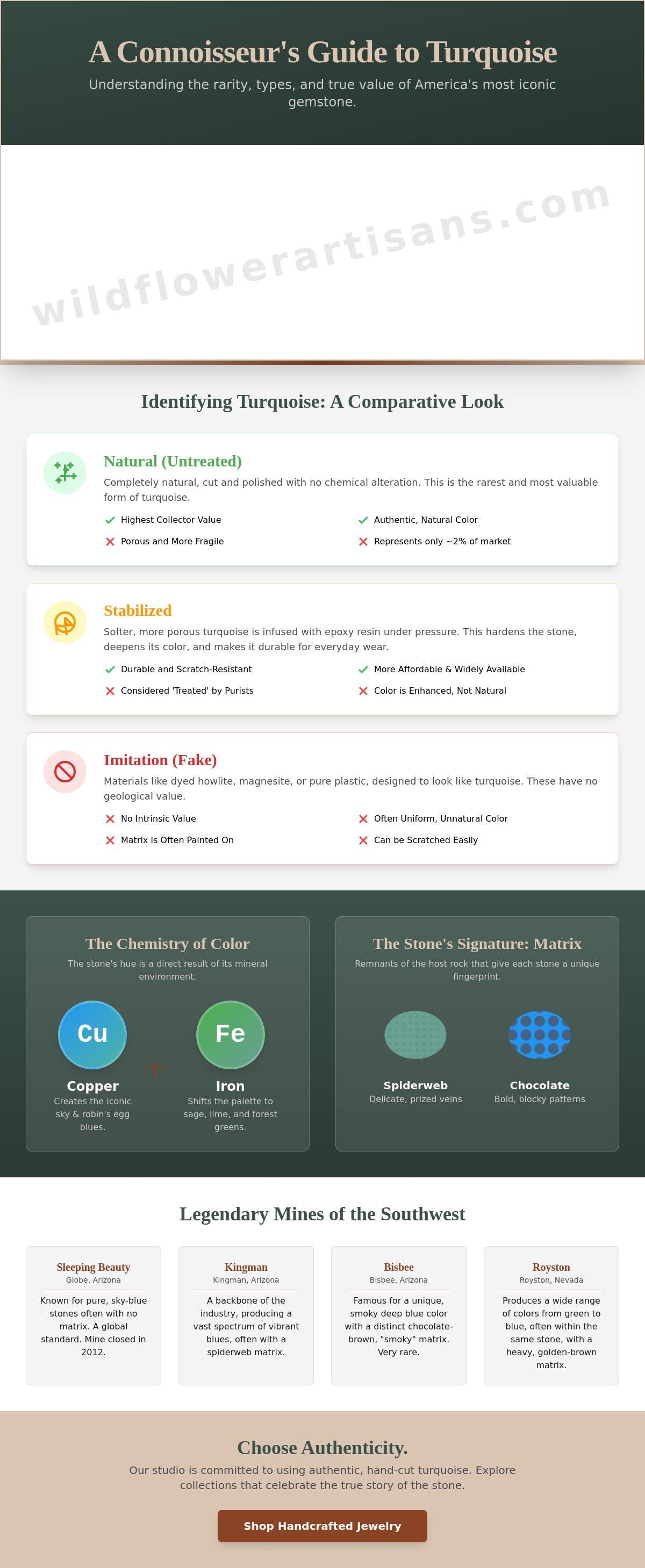
Natural turquoise refers to a stone that is completely untreated and chemically unaltered from the moment it leaves the earth. It is a rare find. In fact, some estimates suggest that only 2% of all turquoise mined worldwide is hard enough to be cut into a cabochon without some form of chemical intervention. When we talk about natural stones in our studio, we are referring to this tiny fraction of high-grade material. These stones are prized by collectors because they retain their original color and structural integrity for generations without the help of resins or dyes.
The reality of stabilized and treated stones
Most commercial types of turquoise are actually "chalk" grade when first pulled from the ground. This means the material is porous and soft; it would literally crumble under the heat and pressure of a lapidary saw. To make this stone usable for jewelry, it undergoes stabilization. This process involves pressurized clear resins that fill the microscopic pores of the stone to harden it. While stabilization is a standard industry practice, it should always be disclosed. Over many years, treated stones can experience a subtle color shift as the resins age or react to skin oils. Greg Cordova, who handles our lapidary work and sources material through CuttingEdgeTurquoise.com, prioritizes transparency about these treatments so you know exactly what is sitting in your silver bezel.
The mass market is also flooded with dyed howlite and magnesite. These are inexpensive white minerals that take dye easily. You can often spot these fakes by looking for color pooling where the dye has collected in the deeper cracks of the matrix. Our studio checklist for spotting fakes is straightforward. We check the weight, as plastic-infused stones feel lighter and warmer than cold mineral. We also look for the specific matrix fingerprint of the mine. Authentic types of turquoise have distinct patterns that are nearly impossible to replicate in a factory setting. Before you invest in your next piece, take a moment to explore our stone origins guide to see how we verify the authenticity of every cabochon we set.
White Buffalo and Wild Horse: Not actually turquoise
There is a common misconception that White Buffalo is a form of white turquoise. In reality, White Buffalo is a combination of calcite and aragonite. It lacks the copper and phosphate minerals that define the turquoise family. Similarly, Wild Horse is a mixture of magnesite and hematite. Despite the technical difference, these stones are highly valued in Southwestern style jewelry for their striking black and white contrast. Kimberly Cordova often curates these stones for our one-of-a-kind collections because they offer a bold, graphic look that pairs beautifully with heavy, oxidized silver work. They are authentic minerals from the earth, but they are simply a different branch of the geological family tree.
Choosing handcrafted jewelry with authentic stones
Selecting a piece of jewelry is often an emotional response to a specific stone. However, the quality of that piece depends heavily on the technical skill used to bring the material to life. In our Santa Fe studio, we believe the final beauty of various types of turquoise is inseparable from the lapidary work. Most mass-produced jewelry uses factory-calibrated stones that are cut to uniform sizes. This often ignores the natural flow of the matrix or the most vibrant pockets of color. Small batch production allows us to treat each stone as an individual, ensuring the silver work honors the specific character of the cabochon.
The value of hand-cut cabochons by Greg Cordova
A master lapidary doesn't just cut a shape; they follow the stone's narrative. Greg Cordova, who sources our material through CuttingEdgeTurquoise.com, spends hours studying a raw nugget before the first cut. He looks for the best face of the stone, often navigating around host rock to highlight a perfect spiderweb pattern or a clear blue window. This hand-cut process creates unique, organic shapes that factory machines simply can't replicate. You can learn more about the specific histories of these locations in our stone origins guide. When a stone is cut by hand, the bezel must be built specifically for it. This creates a more secure and aesthetically balanced piece of handcrafted jewelry.
Building a curated collection of Southwestern style
Starting a collection doesn't require a massive investment all at once. Many of our clients begin with everyday essentials like simple studs or a narrow cuff. These pieces allow you to appreciate the subtle differences in types of turquoise through daily wear. As your eye for quality develops, you might find yourself drawn to one of a kind statement pieces where the stone is the undisputed star. Kimberly Cordova curates these larger stones for their rarity and visual movement, often matching them with heavy silverwork that feels quietly timeless. Because natural, untreated stones are sensitive to chemicals, understanding care and repair is vital for protecting your investment. A well-cared-for stone will maintain its desert-born luster for a lifetime.
Finding a stone that tells your story
Understanding the geological narrative of the Southwest changes how you look at a jewelry box. It moves a stone from being a simple accessory to a piece of history. Every mine we've discussed offers a specific fingerprint of color and matrix that cannot be replicated in a factory. Whether you're drawn to the clear blues of Arizona or the mossy, iron-rich greens of Nevada, your choice reflects a connection to the high desert. We focus on these different types of turquoise because we value the honesty of the earth and the skill of the human hand. Greg Cordova verifies each stone for authenticity before performing the delicate lapidary work that brings its best face to the surface.
Kimberly Cordova then curates these hand-cut cabochons into designs that are quietly timeless and built for daily wear. Finding a piece that feels right is a personal discovery. Explore our latest collection of artisan-made turquoise jewelry and find a piece that speaks to you. You can also find our verified stones and designs at the Wildflower Etsy shop if you prefer that platform's community reviews. We hope this guide helps you choose your next stone with confidence and a deeper appreciation for the ground beneath our feet.
Frequently Asked Questions
How many types of turquoise are there in the world?
There are dozens of documented types of turquoise across the globe, with the American Southwest alone hosting over 50 historically significant mine locations. Each mine produces a stone with a specific chemical signature based on the local mineral content. This variety means that a stone from Arizona can look entirely different from one found in Nevada or Colorado.
What is the rarest type of turquoise stone?
Lander Blue is widely considered the rarest variety, originating from a single small pocket discovered in Nevada in 1973. This specific claim yielded only about 100 pounds of high-grade spiderweb material before the source was completely exhausted. Because of this extremely limited supply, authentic Lander Blue is more difficult to source than almost any other stone in the world.
Is green turquoise less valuable than blue turquoise?
Green turquoise is not inherently less valuable; value is determined by rarity, density, and the quality of the matrix. While sky blue is a traditional standard, high-grade green stones from mines like Carico Lake or Damele are often harder and more durable than common blue varieties. Many collectors now prioritize these earthy tones for their unique character and limited availability.
What does stabilized turquoise mean in jewelry?
Stabilization is a process where soft, porous turquoise is infused with clear resin under pressure to harden the stone for cutting. About 98% of the turquoise pulled from the ground is too soft to be used in jewelry without this treatment. We always prioritize transparency regarding these processes, ensuring you know if a stone is natural or has been stabilized for durability.
Is White Buffalo a type of turquoise?
White Buffalo is not a member of the turquoise family. It is a combination of dolomite and aragonite that lacks the copper and aluminum phosphate chemistry required to be classified as turquoise. While it is a beautiful mineral frequently used in Southwestern style jewelry, it belongs to a completely different geological class and is valued for its distinct black and white contrast.
What is the matrix in a turquoise stone?
The matrix is the remnant of the host rock that remains in the stone after it is cut and polished. This can appear as delicate spiderwebbing or bold blocks of color made from minerals like limonite, quartz, or pyrite. Kimberly Cordova curates specific matrix patterns for our collections because these natural inclusions provide the visual depth that makes each piece unique.
How can I tell if my turquoise jewelry is real or fake?
Authentic turquoise is a mineral that feels cold to the touch and has a distinct weight compared to plastic or resin imitations. You can often spot fakes by looking for color pooling, where dye has collected in the deeper cracks of a stone like howlite. Greg Cordova verifies the authenticity of every stone we use, sourcing only genuine material through CuttingEdgeTurquoise.com to protect the integrity of our handcrafted work.
Article by
Kimberly Cordova
Kimberly Cordova is the founder and creative director of Wildflower, a handmade Turquoise and sterling silver jewelry brand based in Santa Fe. She built Wildflower around a simple belief: the best jewelry is the kind you actually reach for, not the kind you save for someday.
Kimberly designs pieces made by hand with a trusted circle of Santa Fe silversmiths, works alongside her husband Greg on in-house lapidary pieces cut from stones including the family's King's Manassa Mine in Colorado and White Buffalo Mine in Nevada, and sources finished work from artisan makers whose craft meets the same standard. The result is a collection with real range and no shortcuts on the stone, the silver, or the story behind either.
Her writing covers everything she has learned along the way: how Turquoise forms, how to tell natural from stabilized, what makes one mine different from another, how to read a bezel, and how to shop with confidence in a market that is not always straightforward. It is the kind of plainspoken information she wished someone had laid out for her when she was starting out.
Shop the Wildflower collection at wildflowerartisans.com, or find us on Etsy at wildflowersantafe.etsy.com if you prefer shopping there. Questions about a stone, a setting, or a specific piece are welcome any time.
0 comments