

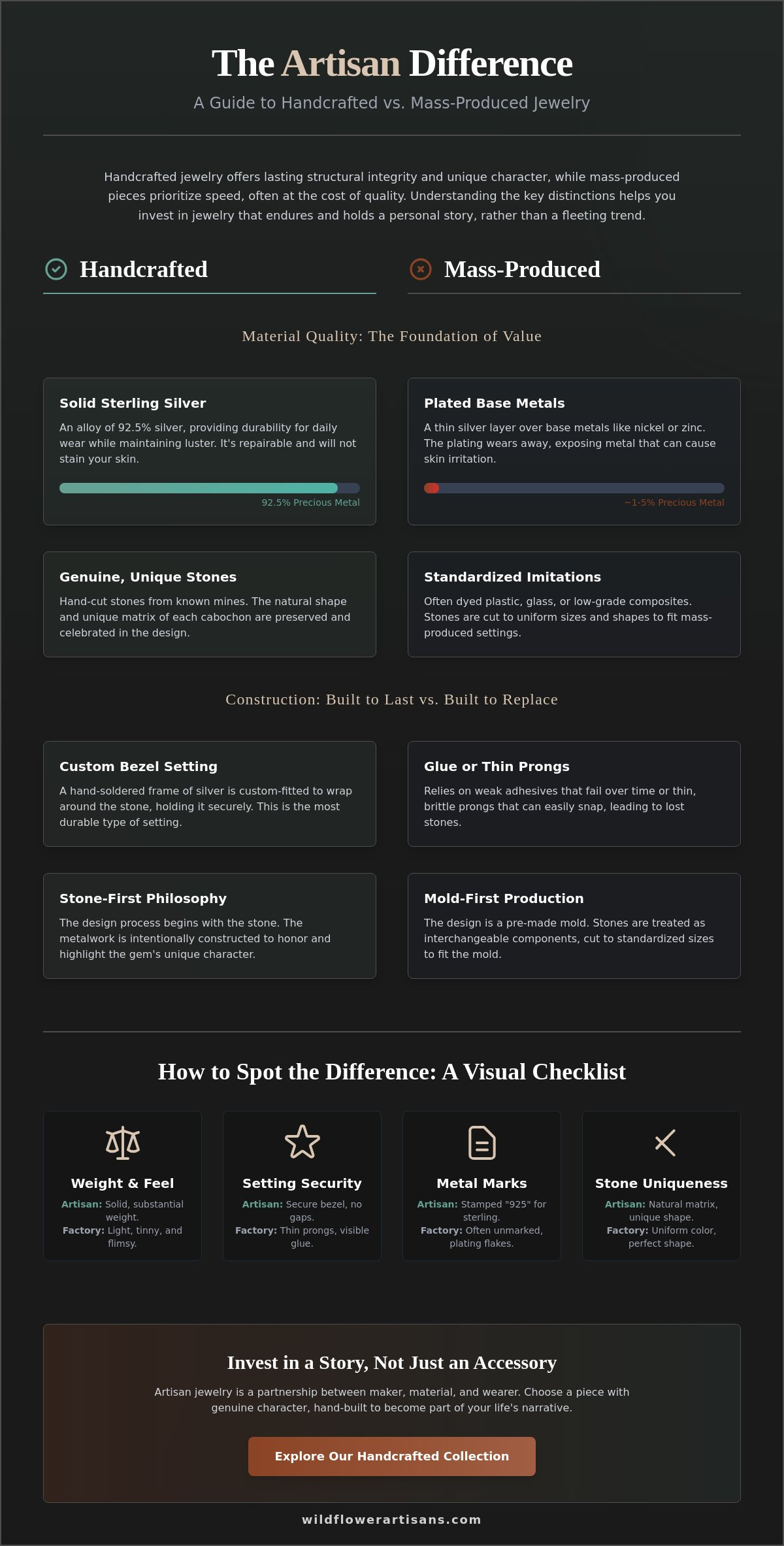
A solid sterling silver ring has a weight that anchors it to your hand, unlike the light, tinny feel of a factory-stamped band. When you look closely at the details of Handcrafted vs. Mass-Produced Jewelry, the differences move well beyond the surface aesthetics. You may have felt the frustration of a flimsy chain snapping or a turquoise cabochon revealing itself as dyed plastic. These common disappointments happen when a production line prioritizes speed over the structural integrity of the metal and the authenticity of the stone.
It's natural to want a jewelry collection that feels authentic and stands up to daily wear without turning your skin green. At Wildflower Artisans, we believe your jewelry should be a vessel for personal stories and a celebration of high-quality materials. This guide explores the technical and emotional differences between artisan-made pieces and mass-market accessories to help you choose items with lasting value. You'll discover how a hand-cut stone and a secure bezel setting create a piece that transitions from a simple accessory to a lifelong companion. A bezel is a custom-fitted frame of silver that wraps around the edge of a stone to hold it securely in place.
Key Takeaways
- Learn why structural integrity and the weight of solid sterling silver ensure jewelry lasts for years without the flimsiness of factory-stamped metal.
- Understand how to verify genuine materials like hand-cut turquoise to avoid skin irritation and the disappointment of dyed plastic stones.
- Discover the stone-first design philosophy where the unique shape and matrix of a cabochon dictate the artisan's custom bezel setting.
- Understand the differences between Handcrafted vs. Mass-Produced Jewelry to ensure you are investing in pieces with lasting structural value.
- Recognize how an artisan-made piece serves as a vessel for personal storytelling and a grounded connection to Southwestern style.
Why should you choose handcrafted vs. mass-produced jewelry?
Handcrafted jewelry offers a level of structural integrity and unique character that automated factory processes cannot replicate. While a machine can stamp out thousands of identical shapes in an hour, an artisan works at a slower, more intentional pace. This difference is felt in the weight of the silver and seen in the way a setting is tailored to the specific curves of a stone. Choosing artisan pieces means prioritizing the narrative of the material over the high-volume output of a global assembly line. It's a choice for permanence, much like the botanical art from Taraxacum Orbis - Dandelion Sphere that preserves the fleeting beauty of real flowers in resin.
Mass production relies heavily on molds and casting. This process often results in thinner, more brittle metal settings that are prone to cracking over time. To fit these pre-made molds, stones must be cut to standardized sizes, which often requires using lower-quality stabilized materials that can withstand the pressure of industrial cutting. In contrast, an artisan-made piece begins with the stone itself. The metal is then built around the gem, honoring its natural shape and matrix. To better understand this concept, watch this helpful video:
The human touch in every solder point
Every joint and connection in an artisan piece is an intentional act of construction. When we work at the bench, we inspect every bezel for durability to ensure the stone is held fast for years to come. A bezel is the thin metal rim that wraps around the edge of a cabochon to hold it in place. It's the most critical component for the security of your jewelry. Unlike factory pieces that may rely on glue or thin prongs, hand-soldered elements are far less likely to snap or fail. This careful Jewellery design process respects the physical limits of the silver, resulting in a piece that feels grounded and secure against the skin.
The decline of quality in fast-fashion jewelry
The rise of fast-fashion has led to a market flooded with disposable accessories. These mass-produced items often use mystery metals or base alloys plated in a thin layer of silver. These materials frequently cause allergic reactions or turn the skin green after only a few wears. They are designed for a single season, meant to be discarded when the next trend arrives. Shifting toward an intentional jewelry collection is about seeking authenticity. It's about moving away from the frantic energy of retail and toward a stone-first philosophy. When you choose Handcrafted vs. Mass-Produced Jewelry, you're investing in a small batch creation that was made to be a lifelong companion rather than a fleeting accessory.
Does material quality differ in artisan jewelry?
Material quality is one of the most significant points of departure in the comparison of Handcrafted vs. Mass-Produced Jewelry. Artisan studios prioritize long-term wearability by choosing documented metals and genuine stones that retain their value over time. While mass production often hides lower-grade materials under a shiny surface, handcrafted work is transparent about its origins. This commitment to quality ensures that your jewelry remains a lasting part of your collection without causing the skin irritation often associated with cheaper alternatives.
The reality of sterling silver vs. plated metals
Sterling silver is an alloy of 92.5 percent silver and 7.5 percent other metals, which is almost always copper. This specific blend provides the necessary hardness for a durable setting while maintaining the luster of the precious metal. Mass-produced accessories frequently rely on mystery metals or base alloys like nickel and zinc. These are often hidden under a thin layer of silver plating that wears away with minimal friction. Once the plating is gone, the base metal can react with your skin, often leaving behind a green or grey stain. At Wildflower, we use solid sterling silver so that every piece can be polished, cleaned, and even professionally repaired if a joint ever needs attention.
Sourcing genuine stones from known mines
Authenticity in jewelry starts with the stone. In the broader market of Handcrafted vs. Mass-Produced Jewelry, the stones found in factory pieces are frequently dyed howlite or plastic-based composites designed to mimic the appearance of real turquoise. Natural turquoise refers specifically to stones that are untreated and retain their original color and hardness from the earth. We believe in transparency regarding every cabochon we set. A cabochon is a stone that has been shaped and polished into a smooth, rounded surface rather than faceted like a diamond.
Knowing the mine of origin is the most reliable way to guarantee stone authenticity. For instance, stones from King's Manassa are known for their distinct green hues and golden-brown matrix. Matrix is the host rock that appears as a web-like pattern within the stone. We also work with White Buffalo, a striking white stone with black chert matrix. While often mistaken for turquoise, it is technically a different mineral found in the same region. Greg Cordova's lapidary work ensures these stones are hand-cut to professional standards, preserving the natural character of the material. By processing stones in a small batch environment, we can highlight specific features like a fine spiderweb matrix. A spiderweb matrix is a tight, intricate pattern of host rock that resembles a web across the surface of the stone. Factory machines often ignore these details. If you are ready to move away from disposable accessories, you can browse our collection of authentic Southwestern jewelry to find a piece that truly resonates with you.
How does the artisan process affect the design?
The artisan process allows for a stone-first design where the unique characteristics of a gem dictate the final silver setting. In the debate of Handcrafted vs. Mass-Produced Jewelry, this approach ensures that the metal serves the stone rather than forcing the stone to fit a pre-made factory mold.
Mass-produced jewelry relies on standardization to maintain high-volume output. In these settings, stones are often cut to exact millimeters to fit into cast molds, a process that frequently requires stabilizing the stones with resins so they don't shatter under industrial pressure. When we work in a small batch environment, we have the freedom to embrace asymmetrical and organic shapes. This flexibility allows us to adjust the weight and balance of a piece, ensuring it sits comfortably against the skin during daily wear. Every curve in the silver is a response to the material itself.
The stone-first philosophy explained
A stone-first philosophy means the creative journey begins with the natural cabochon. A cabochon is a stone that has been shaped and polished into a smooth surface rather than being faceted like a diamond. By starting here, the artisan can respect the natural fractures and matrix of the stone. Instead of a rigid, identical setting, the silver is hand-formed to follow the unique perimeter of the gem. This method preserves the inherent narrative of the earth, resulting in a piece that feels more like a discovery than a product.
Lapidary work as an art form
Design is inseparable from lapidary work, which is the technical art of cutting and polishing stones. Hand-cut stones retain a depth and character that factory-tumbled stones often lose in the pursuit of mechanical perfection. Greg Cordova specializes in the art of lapidary cutting, focusing on techniques that highlight the natural beauty of the material before it ever reaches the silver bench. By carefully orienting the stone before the first cut is made, he can bring forward a spiderweb matrix. A spiderweb matrix is an intricate, web-like pattern of host rock that winds through the turquoise, creating a visual texture that is entirely unique to that specific piece of earth. This level of detail is a hallmark of artisan work that automated machines simply cannot replicate. It requires a human eye to see the potential hidden within the rough stone and the patience to bring it to the surface.
Can you spot the difference between handmade and factory-made pieces?
You can identify the difference by looking for intentional variations in the silver work and the physical weight of the solid sterling silver. Mass-produced items appear perfectly identical because they are cast from the same mold, whereas artisan pieces show subtle signs of hand-finishing and feature a more robust construction. When comparing Handcrafted vs. Mass-Produced Jewelry, the evidence of quality is often found in the details that a machine simply cannot replicate.
Checking the back of a piece is one of the quickest ways to verify its origin. Mass-produced jewelry is frequently hollowed out or finished with a generic, machine-stamped pattern to reduce the amount of metal used and lower production costs. In contrast, an artisan-made cuff or pendant will have a solid, smooth back that feels substantial against the skin. You might also look for artisan marks or slight variations in the silver stamping. While some shoppers look for a 925 stamp as a guarantee of quality, these marks are easily faked on factory-made items. The true test lies in the weight of the metal and the complexity of the stone setting. Handcrafted pieces are built with a heavier bezel to ensure the stone remains secure for a lifetime of wear.
Evaluating the matrix and color
Matrix is the web-like pattern of host rock found within a turquoise stone. In natural, high-quality turquoise, this matrix should appear varied and deep. It is a physical record of the stone's history within the earth. If you see a pattern that looks perfectly symmetrical or appears to be sitting on the surface like paint, it's likely a sign of a mass-produced imitation made from dyed howlite or plastic. Natural stones often show a range of color within a single cabochon, moving from deep sky blue to soft seafoam. Avoid pieces that feature a uniform, neon-blue color with no internal variation. These are frequently stabilized with heavy resins or dyed to hide the fact that the material is not genuine turquoise.
Testing the metal and weight
The physical weight of a piece tells a story of its materials. Handmade sterling silver jewelry has a grounded, substantial feel in the hand. If a piece feels surprisingly light or hollow, it's usually a sign of mass production where thin, plated metals were used to cut costs. This flimsiness is why factory jewelry often snaps or bends after only a few months of daily use. Learning about the care and repair of solid sterling silver will give you confidence in identifying pieces that are built to last. Solid metal can be polished and restored, whereas plated fashion jewelry will eventually lose its surface layer. When you are ready to add a piece of lasting value to your collection, you can browse our shop for authentic Southwestern jewelry and experience the difference of artisan-made work.
Why is the artisan perspective vital for Southwestern style?
An artisan's perspective ensures every piece is built with a specific aesthetic eye that balances rugged natural materials with refined metalwork. This grounded connection transforms jewelry from a simple accessory into a vessel for storytelling. Southwestern style is defined by the balance between the raw earth and the human hand, a harmony that automated factory processes often overlook. In the comparison of Handcrafted vs. Mass-Produced Jewelry, the artisan's role is to honor the stone while providing the structural integrity needed for daily wear. While factory production chases seasonal trends, our one-of-a-kind pieces are designed to be permanent fixtures in your life.
The narrative of the stone
Every cabochon we set has a history tied to the mine it left and the person who cut it. Learning about stone origins adds a layer of depth to your collection that mass-market pieces can't offer. When you know where your turquoise was pulled from the earth, the jewelry becomes more than a decoration. It becomes a tangible link to the natural world. This storytelling is the heartbeat of true Southwestern style. Handcrafted jewelry allows you to carry a specific piece of geography with you, whether it is the deep green of a King's Manassa stone or the stark contrast of White Buffalo.
Building a curated jewelry collection
A thoughtful wardrobe is built on the principle of quality over quantity. Instead of a drawer full of tarnished fashion accessories, we encourage focusing on everyday essentials that can withstand years of daily use. These are pieces that resonate with your personal observations of beauty, whether it's a specific spiderweb matrix or the warm glow of polished sterling silver. By choosing artisan-led work, you're committing to a collection that feels authentic and personal. It's about finding those few pieces that speak to you and trusting they were made with the skill to last a lifetime. This shift in perspective ensures your jewelry remains relevant long after factory trends have faded.
Find a piece that speaks to your story
Choosing between Handcrafted vs. Mass-Produced Jewelry is a decision about how you want to interact with the objects you wear. It's the difference between a disposable accessory and a piece with structural integrity that can be passed down. By prioritizing solid sterling silver and genuine stones from known mines, you ensure your collection remains as authentic as the landscapes that inspired it. Each stone in our studio is hand-selected and verified for authenticity. This commitment to quality is rooted in the artisanal traditions of Santa Fe, much like how businesses prioritize lasting value when selecting premium corporate gifts from SwagStore.NET. It ensures every joint and bezel is built for a lifetime of wear.
You now have the tools to identify the weight of the metal and the complexity of a natural matrix. A stone-first philosophy ensures that the silver setting protects the gem while celebrating its unique character. We invite you to explore our studio collection of artist-made turquoise and sterling silver jewelry or find our curated pieces on Etsy as an alternative for those who prefer Etsy's buyer protections. Investing in quality is a quiet way to respect the craft and the earth. We hope you find a piece that truly resonates with your personal journey.
Frequently Asked Questions
Is handcrafted jewelry more expensive than mass-produced jewelry?
Handcrafted pieces often have a higher initial cost because they reflect the labor of a skilled artist and the use of solid, high-value materials. In the comparison of Handcrafted vs. Mass-Produced Jewelry, factory items are cheaper because they use automated casting and thinner, plated metals. Over time, artisan work provides better value because it doesn't need to be replaced as often as disposable fashion pieces.
How can I tell if my turquoise is real or fake?
You can identify genuine turquoise by looking for a varied matrix and feeling the physical temperature of the stone. Fake turquoise, often made of dyed howlite or plastic, feels warm to the touch and usually has a perfectly uniform color. Real stones have a depth of character and a matrix that is physically part of the stone rather than painted on the surface.
What does the term "small batch" mean in jewelry making?
Small batch refers to a production method where only a few pieces are made at a time, often in a studio setting. This allows the artisan to focus on the unique details of every hand-cut stone and ensure the structural integrity of the silver work. It is the opposite of a factory line that produces thousands of identical, generic items that lack individual character.
Will sterling silver jewelry turn my skin green?
Solid sterling silver rarely turns skin green because it doesn't contain the high levels of nickel or base metals found in mass-produced jewelry. The green stain is usually a reaction to copper or nickel in plated items. Because Wildflower uses solid 925 silver, you can wear our pieces daily without the irritation or discoloration common with cheaper, factory-made accessories.
What is the difference between natural and stabilized turquoise?
Natural turquoise is untreated stone that remains in the exact state it was found in the earth. Stabilized turquoise has been treated with a clear resin to make the stone harder and more durable for cutting. While stabilized stones are still genuine turquoise, we prioritize labeling our natural stones clearly so you know exactly what you are wearing and how to care for it.
Can handcrafted jewelry be repaired if it breaks?
Yes, handcrafted jewelry made from solid sterling silver can almost always be repaired by a skilled jeweler. Because the metal is solid and not plated, it can be soldered and polished back to its original state. Mass-produced pieces are often made from mystery metals that melt or crumble under a jeweler's torch, making them impossible to fix once they break.
Why do artisans use bezels instead of prong settings for turquoise?
Artisans use a bezel setting because it provides a secure, protective frame around the entire perimeter of a stone. A bezel is a thin strip of silver that is folded over the edge of the cabochon. Prong settings, while common in factory work, leave the edges of softer stones like turquoise exposed to chips and can easily snag on your clothing.
What is a maker mark and why does it matter?
A maker mark is a unique stamp used by an artisan to sign their work and verify its origin. It matters because it establishes accountability and connects the piece to a specific creator's studio. In the world of Handcrafted vs. Mass-Produced Jewelry, a maker mark is a symbol of pride and a guarantee that the piece wasn't made on a faceless assembly line.
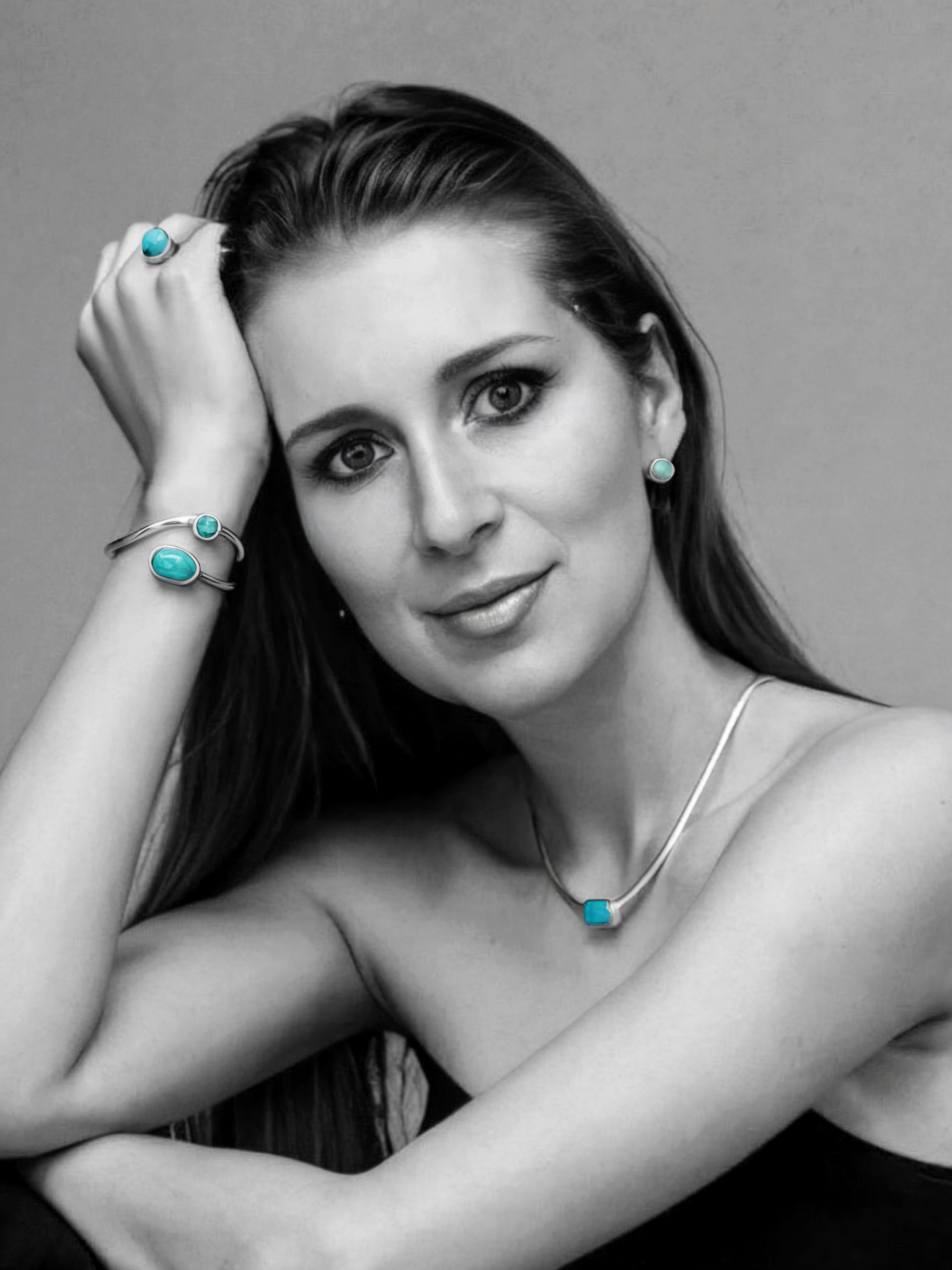
Article by
Kimberly Cordova
Kimberly Cordova is the founder and creative director of Wildflower Artisans, a handmade Turquoise and sterling silver jewelry brand rooted in Santa Fe. She built Wildflower around a simple belief: the best jewelry is the kind you actually reach for, not the kind you save for someday.
Kimberly designs pieces made by hand with a trusted circle of Santa Fe silversmiths, works alongside her husband Greg on in-house pieces with stones he cuts, both from the family's King's Manassa Mine in Colorado and White Buffalo Mine in Nevada and from rough he sources from other mines, and curates finished work from artisan makers whose craft meets the same standard. Turquoise leads the collection, joined by White Buffalo, Wild Horse, Lapis Lazuli, Spiny Oyster, and other genuine semi-precious stones. The result is a collection with real range and no shortcuts on the stone, the silver, or the story behind either.
Her writing covers everything she has learned along the way: how Turquoise forms, how to tell natural from stabilized, what makes one mine different from another, how to read a bezel, and how to shop with confidence in a market that is not always straightforward. It is the kind of plainspoken information she wished someone had laid out for her when she was starting out.
Browse the collection at wildflowerartisans.com. Questions about a stone, a setting, or a specific piece are welcome any time.
0 comments