

Finding authentic High-Grade Turquoise Jewelry among a sea of mass-produced imitations requires more than just an eye for color. A single vein of sky-blue stone running through a host of dark, weathered rock tells a story that began millions of years ago, yet much of what is sold today is little more than plastic and dye. You've likely felt that hesitation when looking at a jewelry display, wondering if the vibrant blue is a gift from the earth or a product of a chemical lab. It's frustrating to seek a genuine connection to the Southwest only to find plastic-backed stones and thin, machine-stamped silver.
At Wildflower Artisans, we believe in sharing the knowledge needed to find small batch pieces that feel personal rather than manufactured. This guide from Wildflower provides a grounded way to identify quality work by looking at the stone's geological integrity and the intentional hand of the artisan. You will learn to identify untreated natural stones, appreciate the nuances of a spiderweb matrix, and recognize the precision of a hand-cut cabochon set in a sterling silver bezel. By the end, you'll have the confidence to choose jewelry that serves as a lasting vessel for your own stories.
Key Takeaways
- Learn the physical characteristics of High-Grade Turquoise Jewelry, including how naturally dense stones achieve a high polish without the need for artificial stabilizers or resins.
- Discover the markers of authentic Southwestern style, such as hand-stamped silver and bezels that are meticulously wrapped around a stone.
- Understand the value of mine-specific stones from storied locations like King's Manassa and Royston, which allow you to trace the unique geological history of your piece.
- Explore the role of the lapidary artist in revealing a stone's inner matrix and how intentional, small-batch cutting preserves the character of the raw material.
- Master the simple care routines that protect the natural color of your artisan jewelry from common household chemicals and heat.
What defines high-grade turquoise jewelry?
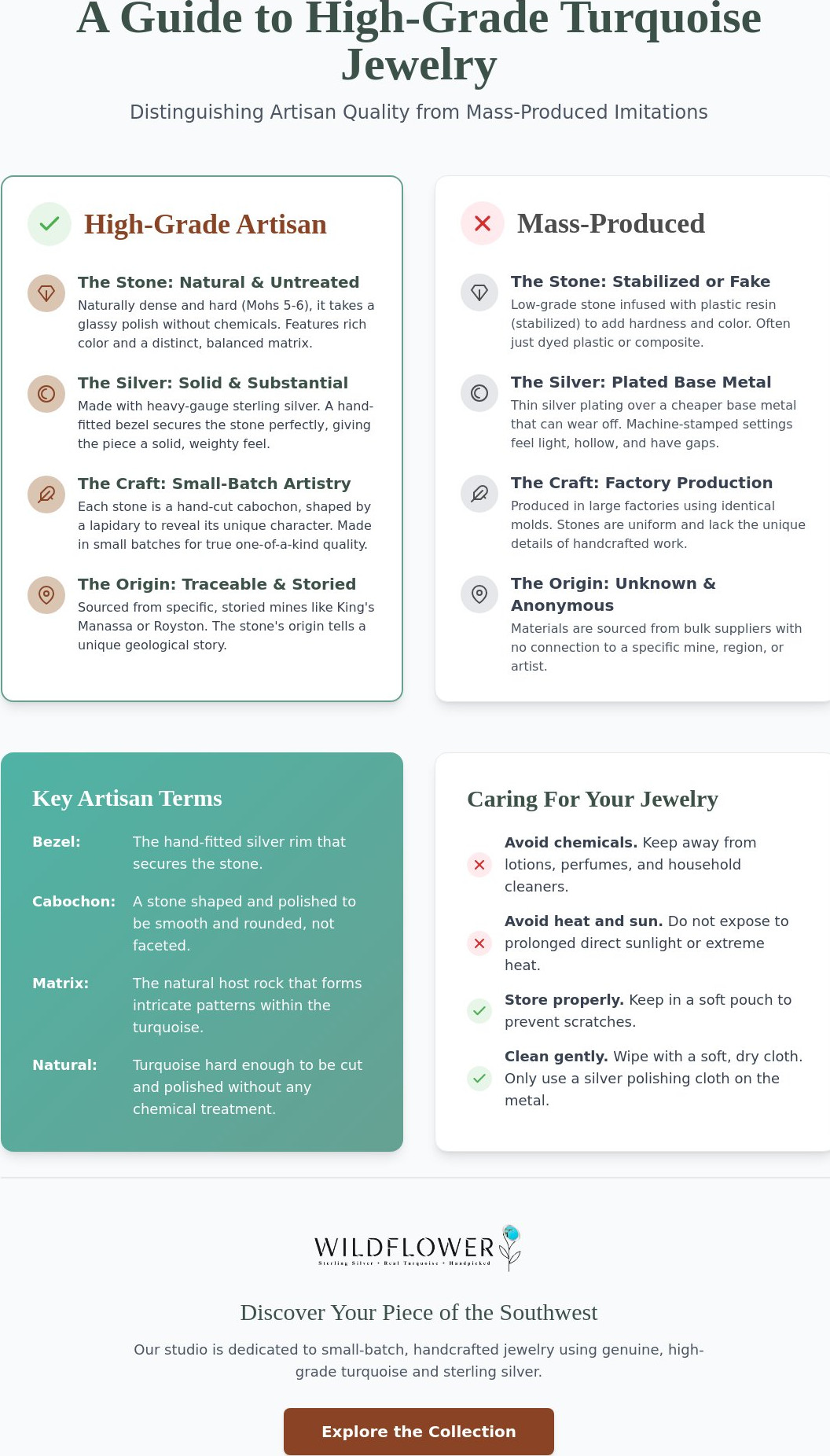
High-Grade Turquoise Jewelry represents the small percentage of stone that comes out of the ground with enough structural integrity to stand on its own. In a market filled with mass-produced pieces, high-grade refers to the top tier of natural stone quality, characterized by exceptional color density and a stable matrix structure. While most turquoise found in large retail stores has been stabilized (infused with plastic resins to make it hard enough to cut) high-grade stones are naturally dense. They take a high, glassy polish without any chemical intervention. These premium stones are almost always set in heavy-gauge sterling silver by artisans who understand that a rare stone deserves a substantial, hand-fitted frame.
These stones are the rare prizes of the lapidary world. Because they are untreated, they maintain their original color for decades, resisting the darkening that often happens when skin oils penetrate softer, porous stones. When you hold a piece of jewelry featuring these stones, you are holding a piece of the earth exactly as it was formed. For more details on these distinctions, you can consult our turquoise buying guide to see how we select our materials. Understanding What defines high-grade turquoise helps collectors appreciate why these pieces are typically set in small batch settings rather than being cast in thousands of identical molds.
To better understand this concept, watch this helpful video:
The importance of natural hardness
On the Mohs scale of mineral hardness, turquoise generally falls between a 5 and 6. High-grade specimens sit at the top of this range. This natural hardness is what allows a lapidary to shape a cabochon (a stone that has been shaped and polished rather than faceted) without it crumbling under the pressure of the grinding wheel. As many historic mines in the Southwest have closed, these hard, natural stones have become increasingly rare. They are a finite resource. This rarity is why High-Grade Turquoise Jewelry is considered an investment in both artistry and geology.
Visual markers of premium quality
Beyond hardness, the value of high-grade turquoise is found in its visual narrative. Color depth can range from a piercing sky blue to a rich, mossy forest green, often depending on the copper or iron content in the soil where it formed. Then there is the matrix, which is the host rock that remains entwined with the turquoise. Whether it appears as a delicate spiderweb of dark lines or a bold calico pattern, a distinct and balanced matrix adds significant character to the finished jewelry. A well-cut stone will have the matrix positioned to complement the overall shape of the bezel, showing the intentional hand of the maker.
How can you identify authentic Southwestern style jewelry?
Identifying authentic Southwestern style jewelry is a sensory experience that begins with the weight of the piece in your hand. Mass-produced imitations often rely on thin plating over mystery base metals, resulting in a hollow, light feel that lacks the permanence of solid silver. Genuine artisan work uses substantial sterling silver to support the stone. When you examine a piece of High-Grade Turquoise Jewelry, look closely at the bezel. This is the silver rim that secures the stone to the base. In quality work, the bezel is hand-fitted and pushed tightly against the stone's edges, leaving no gaps where dust or moisture could enter. This level of precision is a hallmark of a piece made with care rather than on a factory line.
Beyond the metal, you should look for the story told by the stone itself. Authentic pieces often feature mine-specific turquoise, where the color and matrix patterns can be traced back to a specific location in the Southwest. These stones are not the uniform, plastic-looking rounds found in department stores. Instead, they show the natural variations of the earth. You can learn more about the specific history of these locations by visiting our guide to stone origins to see the diversity of the landscape. Understanding these geological markers is a foundational part of identifying high-grade turquoise as defined by gemological standards.
Recognizing hand-cut cabochons
A cabochon is a stone that has been shaped and polished into a smooth, domed form rather than being cut with the flat facets used for diamonds. In a small batch studio, each stone is treated as an individual. A lapidary artist observes the raw material to decide how to best reveal the matrix, which is the host rock that creates those distinctive spiderweb or calico patterns. This intentional process means the stone's shape might be slightly asymmetrical to preserve its most beautiful features. Factory stones are usually uniform in size and shape, designed to fit into thousands of identical, pre-cast settings. Hand-cut stones carry the soul of the maker.
The role of sterling silver in quality
High-grade jewelry is built to last, which requires the use of .925 sterling silver. This alloy provides the necessary strength to hold a heavy cabochon securely over years of daily wear. You can identify the hand of the maker through techniques like hand-stamping and saw-work. Hand-stamping involves using hardened steel tools to strike patterns into the metal, while saw-work refers to the intricate shapes cut into the silver with a jeweler's saw. These details should feel intentional and crisp. Even with these decorative elements, the finished piece should feel smooth against your skin. High-quality silver work is always polished to remove sharp burrs or rough edges. If you are ready to find a piece that reflects this level of craftsmanship, you can browse our current artisan-made jewelry.
- Solid weight that suggests high-gauge sterling silver rather than thin plating.
- A bezel that is meticulously burnished down to meet the stone's surface.
- Unique stone shapes that follow the natural flow of the matrix.
- Hand-applied textures and stamps that show slight, human variations.
Why does the lapidary process impact jewelry value?
The lapidary process determines the final beauty of turquoise by revealing the hidden patterns and colors within the raw stone. A skilled cutter acts as a storyteller, deciding how to shape the material to best showcase its natural character. Raw turquoise often looks like an ordinary, dusty rock when it first leaves the earth. It takes the eye of an artist to see the potential hidden beneath that weathered surface. This act of discovery is what defines High-Grade Turquoise Jewelry, as the cutting process must be handled with extreme care to preserve the stone's geological integrity. Greg Cordova, a lapidary expert we work with closely, specializes in this delicate translation. Through his work at Cutting Edge Turquoise, Greg handles stones from specific mines like King's Manassa and White Buffalo. He knows exactly how to orient a stone to highlight a rare spiderweb matrix or a specific shade of sky blue. This level of skill is why the lapidary process impact jewelry value so deeply.
From raw stone to finished cabochon
The journey from a rough specimen to a finished cabochon involves slabbing, cabbing, and polishing. Slabbing is the process of slicing the raw stone into workable sheets using a diamond saw. Cabbing involves the careful grinding and shaping of those slices into smooth, domed forms. Finally, polishing reveals the stone's inner glow. Working with natural turquoise is a high-stakes task. Unlike stabilized material, natural stone is prone to cracking or shattering if the cutter applies too much pressure or heat. This risk requires a steady hand and decades of experience. We embrace a stone-first philosophy in our studio. We don't use factory-made settings. Instead, the sterling silver work is hand-built to follow the unique, organic contours of each hand-cut stone.
Small batch vs. mass production
Small batch production allows us to maintain a level of quality control that is impossible in a factory setting. Mass-produced jewelry often relies on block turquoise, which is a composite of dyed plastic and resin designed to imitate the look of real stone. It lacks the weight, texture, and geological history of the real thing. Because we prioritize one-of-a-kind pieces, your jewelry is as unique as the day it was cut. No two stones from the King's Manassa mine will ever have the exact same matrix. This means your piece cannot be replicated. It is a singular expression of a moment in time, captured in silver and stone.
What are the most sought-after turquoise mines?
The birthplace of a stone defines its character as much as the hand that cuts it. In the world of High-Grade Turquoise Jewelry, knowing the mine of origin is the primary way collectors trace the geological history of their pieces. Each mine in the Southwestern landscape offers a distinct thumbprint of color and matrix that cannot be found anywhere else. Some of these locations are now considered heritage mines. This means they are no longer actively producing new material, making the stones already in circulation finite treasures. You can explore the about our mines page to understand why certain stones are more sought after than others.
King's Manassa and White Buffalo
The rich greens and golds of King's Manassa turquoise have become a signature of the Wildflower studio. This Colorado mine is famous for producing stones with a deep, mossy hue that feels earthy and grounded. Alongside these vibrant greens, many collectors seek out White Buffalo. While it is technically a white stone with a sharp black chert matrix rather than a turquoise, it is formed in the same mineral-rich environments and is often collected for its striking contrast. We treat both of these stones with the same reverence in our collection, ensuring each cabochon is set to highlight its natural, un-dyed beauty.
Classic blue mines like Kingman and Sleeping Beauty
If you are drawn to the traditional sky-blue shades, the Sleeping Beauty mine is the global standard. Though it closed for turquoise production in 2012, its clean, high-blue color remains one of the most recognizable markers of quality in the industry. For those who prefer more complexity, Kingman turquoise offers a broad spectrum. It ranges from bright blue to deep teals, often featuring a heavy matrix of silver-colored pyrite that glints in the light. In contrast, the Royston mine is celebrated for its earthy greens and browns, often showing multiple colors within a single stone. These variations are what make High-Grade Turquoise Jewelry a personal discovery.
If you are ready to find a piece from one of these storied locations, you can shop our current collection of mine-specific jewelry.
How do you care for high-grade turquoise jewelry?
Caring for High-Grade Turquoise Jewelry requires a gentle touch to ensure its natural beauty remains unchanged for generations. Because these stones are untreated, they are far more sensitive to their environment than the stabilized or composite materials found in mass-market retail. You should avoid harsh chemicals, extreme heat, and ultrasonic cleaners, as these can strip the stone's natural oils or lead to structural stress. A good rule of thumb is to put your jewelry on last, after you've already applied perfumes, lotions, or hairsprays. These everyday products contain alcohol and oils that can seep into the stone over time, potentially altering its color. Storing your pieces in a cool, dry place away from direct sunlight will prevent the silver from tarnishing too quickly and keep the turquoise from becoming brittle. For a full maintenance guide, you can visit our care and repair page.
Cleaning sterling silver and stones
Natural turquoise is a porous mineral, which means it acts like a sponge for whatever it touches. It can absorb soaps, skin oils, and even water if left submerged for too long. To keep your jewelry looking its best, we recommend using a simple polishing cloth for the sterling silver parts only. Avoid using liquid silver dips or chemical pastes, as these can permanently damage the stone's surface. If the cabochon (a stone that has been shaped and polished into a smooth, domed form) itself needs a light cleaning, a soft, damp cloth is usually enough to remove surface dust or skin oils. Don't use abrasive brushes or dish soaps, as these can dull the high polish that is a primary marker of High-Grade Turquoise Jewelry.
Long-term preservation for collectors
Collecting Southwestern style jewelry is a long-term commitment to preserving a piece of the earth. We suggest checking the bezel and settings at least once a year to ensure the stone remains tight and secure within its silver frame. Over time, sterling silver will naturally develop a patina, which is a darkening of the metal that occurs through oxidation. Many collectors prefer this look because it adds depth and highlights the intricate hand-stamped details of the artisan's work. If you prefer a brighter look, a quick buff with a polishing cloth will restore the silver's original shine. At Wildflower, we offer ongoing support for the pieces we create, ensuring that your one-of-a-kind jewelry continues to be a vessel for your stories.
- Keep stones away from household cleaners and bleach.
- Remove jewelry before swimming or bathing.
- Store pieces individually to prevent scratching.
If you are looking to add a genuine piece of the Southwest to your collection, we invite you to explore our latest small batch creations at wildflowerartisans.com. Each piece is crafted in our studio with a focus on stone-first design and traditional techniques. For those who feel more comfortable using a platform they already know, you can also find a selection of our work at wildflowersantafe.etsy.com, where you can take advantage of Etsy’s buyer protections.
Embracing Authentic Southwestern Artistry
High-Grade Turquoise Jewelry is more than just a decorative object. It is a tangible connection to the geological history of the Southwest and the intentional hand of the maker. By looking for the natural hardness of untreated stones and the unique character of a hand-cut cabochon, you can avoid the disappointment of mass-produced imitations. We prioritize this authenticity in every piece we create, featuring direct-from-studio lapidary work by Greg Cordova and small-batch artisan craftsmanship that respects the raw material. When a stone is allowed to speak for itself through a clean silver bezel and thoughtful design, it becomes a vessel for your own story. Each piece reflects a commitment to quality that ensures your jewelry remains as vibrant decades from now as the day it was first polished. We invite you to explore our latest collection of handcrafted turquoise rings and pendants at Wildflower or visit our Etsy shop at wildflowersantafe.etsy.com for additional artisan-made pieces. Finding a piece that resonates with you is the beginning of a lifelong appreciation for these fleeting natural wonders.
Frequently Asked Questions
Is high-grade turquoise the same as natural turquoise?
High-grade turquoise is always natural, but not all natural turquoise qualifies as high-grade. The term high-grade refers to the top tier of stone quality, specifically those specimens with the natural hardness and color density to be polished without resins. Most turquoise pulled from the earth is too soft to be used in jewelry without chemical treatment. These rare, untreated stones are the ones we prioritize for our artisan-made pieces at Wildflower Artisans.
How can I tell if my turquoise is dyed howlite?
You can often identify dyed howlite by looking for unnatural color pooling in the stone's cracks or white patches where the dye failed to penetrate. Howlite is a naturally white, porous mineral frequently used to mimic High-Grade Turquoise Jewelry. If the color looks too uniform or sits only on the surface, it is likely an imitation. Real turquoise has a structural weight and depth of color that dyed stones cannot replicate.
Why is some turquoise green and some blue?
The color of a stone is determined by the specific minerals present in the soil during its formation millions of years ago. Copper creates the vivid sky-blue shades many people associate with the Southwest, while iron or aluminum results in greener or yellowish hues. Mines like Royston are famous for producing a wide range of these colors within a single stone. This natural chemistry is what gives each mine its own recognizable signature and personality.
What does 'stabilized' mean in turquoise jewelry?
Stabilized turquoise is stone that has been pressure-infused with clear resins or epoxies to increase its structural hardness. This process makes softer stone durable enough to be cut into a cabochon and prevents it from absorbing skin oils over time. While stabilized stones are common in mass-produced jewelry, they lack the rarity and value of natural material. At Wildflower, we always distinguish between these treatments to ensure you know exactly what you are buying.
Can I wear my turquoise ring every day?
You can wear a turquoise ring daily if you treat it with a little bit of care to protect the stone's surface. Because natural turquoise is porous, it can absorb chemicals from soaps, lotions, or perfumes, which might eventually change the stone's color. We recommend putting your jewelry on last and removing it before swimming or using household cleaners. With these simple habits, a well-made sterling silver setting will protect your stone for many years.
What is the matrix in a turquoise stone?
The matrix is the host rock, such as limonite or quartz, that remains entwined with the turquoise as it forms. It creates the beautiful patterns you see on the surface of a cabochon, ranging from delicate spiderweb lines to bold, chunky patches of color. Some collectors prefer a clean, clear blue stone, while others seek out the intricate stories told by a heavy matrix. It is a matter of personal preference and artistic composition.
Is White Buffalo a type of turquoise?
White Buffalo is not technically a type of turquoise, though it is often found in the same mineral-rich areas of Nevada. It is a white stone with a sharp black chert matrix, lacking the copper content that gives turquoise its blue color. Because it is mined and cut using the same lapidary techniques, it has become a staple of Southwestern style jewelry. We often include it in our studio collections for its striking, high-contrast look.
Why are some mine names more expensive than others?
The price of a specific mine name is driven by rarity, demand, and whether the mine is still actively producing stone. Heritage mines that have been closed for decades, like Sleeping Beauty or Bisbee, have a finite supply that makes them highly collectible. When a lapidary artist like Greg Cordova cuts stones from his own holdings, the value reflects both the rarity of the material and his specialized skill. You can see his work at Cutting Edge Turquoise.
Article by
Kimberly Cordova
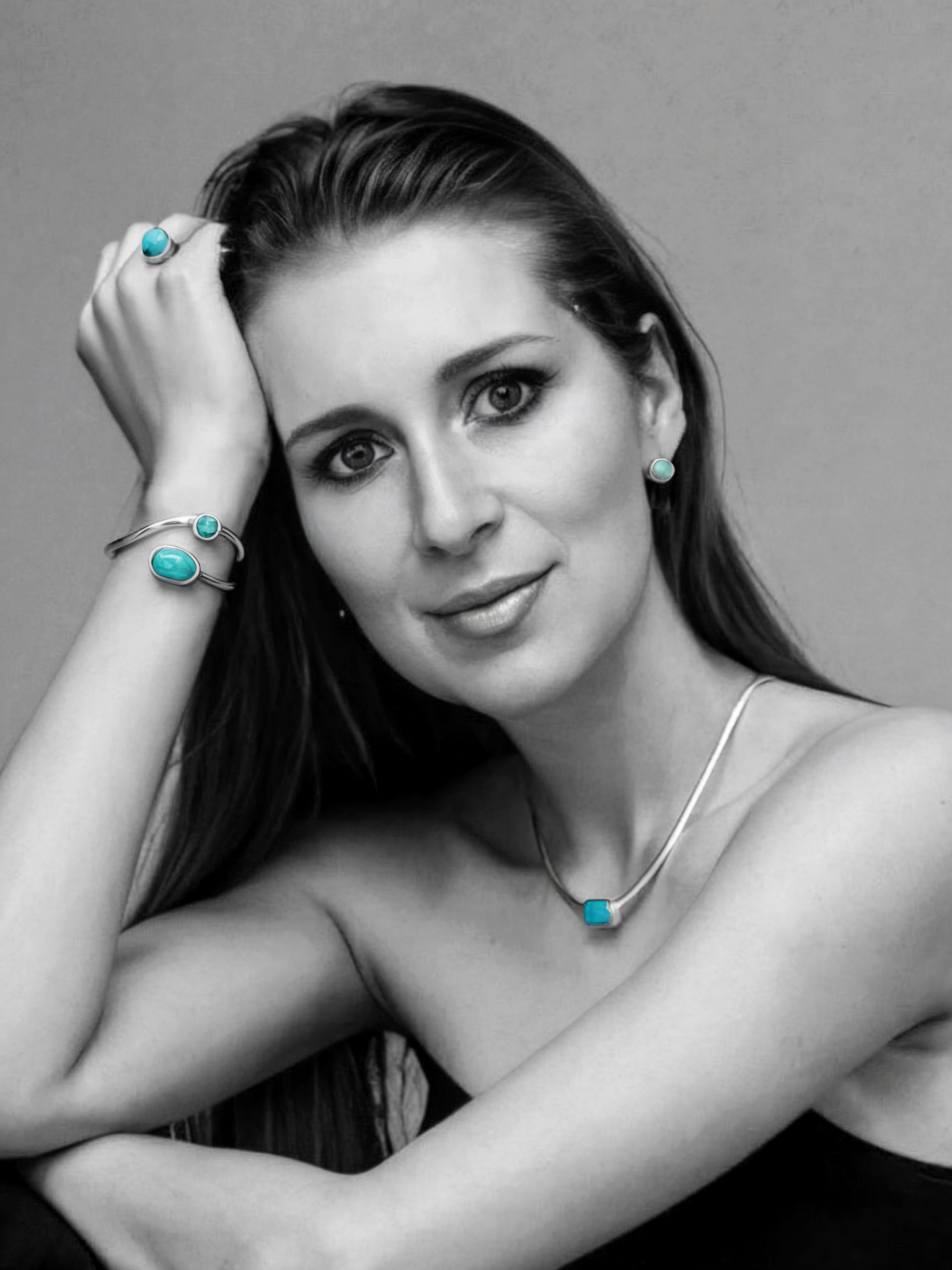
Kimberly Cordova is the founder and creative director of Wildflower Artisans, a handmade Turquoise and sterling silver jewelry brand rooted in Santa Fe. She built Wildflower around a simple belief: the best jewelry is the kind you actually reach for, not the kind you save for someday.
Kimberly designs pieces made by hand with a trusted circle of Santa Fe silversmiths, works alongside her husband Greg on in-house pieces with stones he cuts, both from the family's King's Manassa Mine in Colorado and White Buffalo Mine in Nevada and from rough he sources from other mines, and curates finished work from artisan makers whose craft meets the same standard. Turquoise leads the collection, joined by White Buffalo, Wild Horse, Lapis Lazuli, Spiny Oyster, and other genuine semi-precious stones. The result is a collection with real range and no shortcuts on the stone, the silver, or the story behind either.
Her writing covers everything she has learned along the way: how Turquoise forms, how to tell natural from stabilized, what makes one mine different from another, how to read a bezel, and how to shop with confidence in a market that is not always straightforward. It is the kind of plainspoken information she wished someone had laid out for her when she was starting out.
Browse the collection at wildflowerartisans.com. Questions about a stone, a setting, or a specific piece are welcome any time.
0 comments