One of a Kind Turquoise: A Guide to Rare Artisan Jewelry
Last Tuesday, Greg Cordova pulled a rough slab of Royston from the saw, revealing a deep emerald ribbon that no one had seen in millions of years. It was a quiet, heavy moment in the studio. Most collectors understand the sinking feeling of realizing a "rare" find is actually a mass-produced, dyed imitation. You want a piece that carries the weight of the high desert, not something that looks like every other retail item. Finding genuine one of a kind turquoise requires moving past the confusion of mine names and stone grades to see the hand of the maker.
We believe your jewelry should tell a story as specific as the landscape it came from. This guide will show you the reality of unique stones and the lapidary work involved in creating them. You will learn how Greg Cordova selects and cuts each cabochon at CuttingEdgeTurquoise.com to preserve its natural character. We also explore how Kimberly Cordova designs each bezel to frame these small batch treasures. By the end, you will have the knowledge to find a reliable source for authentic, Southwestern style jewelry that is quietly timeless.
Key Takeaways
- See how the distinct matrix of a stone ensures your jewelry is a singular piece that cannot be replicated.
- Follow the lapidary process where Greg Cordova hand-cuts raw material into individual cabochons to highlight their natural character.
- Learn how Kimberly Cordova curates designs built from the stone up to highlight the character of one of a kind turquoise.
- Identify the markers of natural, untreated turquoise and why slight surface variations are a sign of genuine quality.
- Understand how to select a piece that relies on your gut feeling, whether you want a statement ring or a quietly timeless pendant.
Defining One of a Kind Turquoise Jewelry
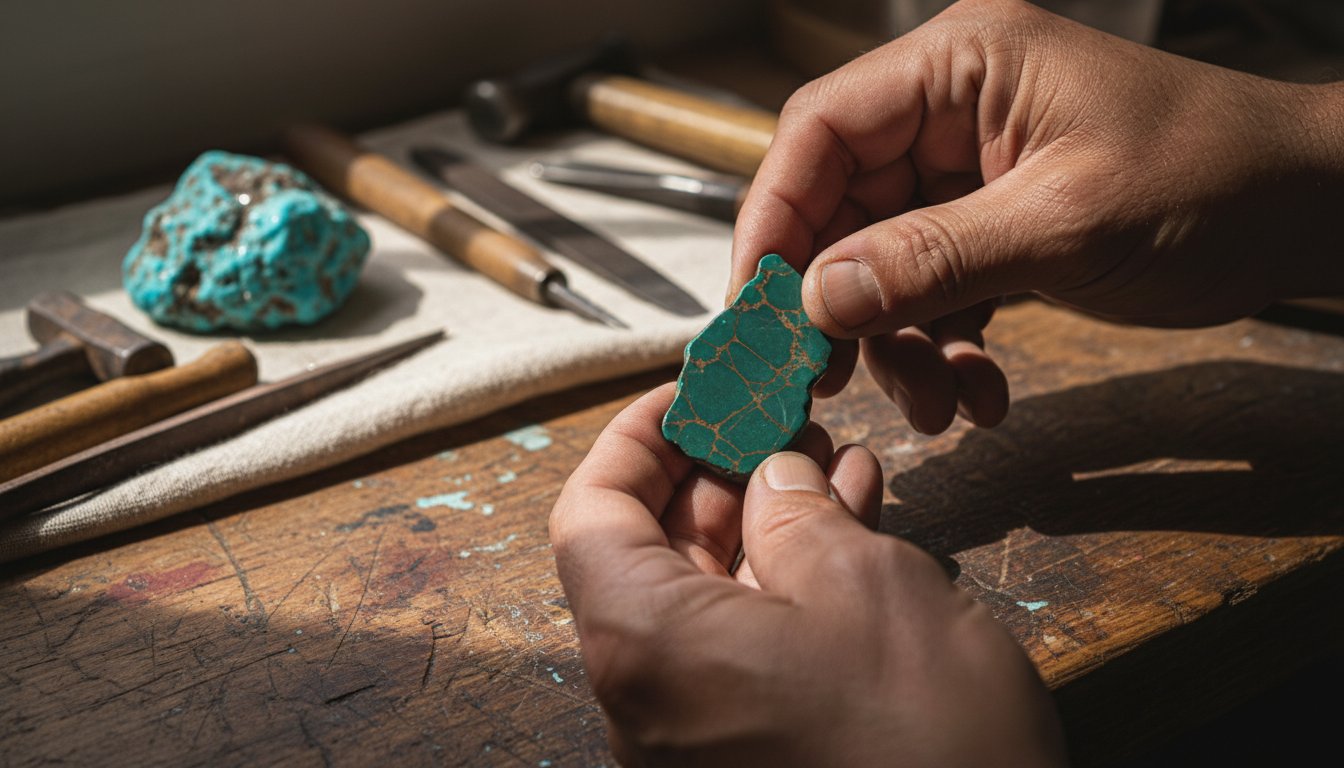
A rough piece of stone rests on a scarred wooden bench, its surface revealing a map of minerals that took millions of years to settle. This is the starting point for one of a kind turquoise jewelry. In a world of mass-produced accessories, these pieces stand apart because they cannot be replicated. The stone and the silver setting are joined in a way that respects the natural geometry of the earth. When we talk about unique jewelry, we mean that the specific pattern in the stone and the hand-fabricated metalwork will never exist in the exact same way again.
To better understand the level of detail required to create these singular pieces, watch this demonstration of the artisan process:
The Role of the Matrix and Color
The visual character of turquoise is a direct result of its environment. When you look at a high-grade stone, you are seeing a complex chemical reaction. Copper creates the vivid blues, while iron introduces earthy greens and yellows. These turquoise mineral properties define the palette of each specific mine. Greg Cordova, who manages our stone sourcing and lapidary work at CuttingEdgeTurquoise.com, emphasizes the importance of the matrix. This host rock creates the dark webbing or spiderweb patterns that act as a geological fingerprint. Even stones pulled from the same foot of earth will have different patterns. This ensures that every hand-cut cabochon possesses its own distinct personality.
Why Small Batch Production Matters
We choose to work in small batches to maintain the integrity of the materials. Large retailers often use factory molds and calibrated stones, which can strip the jewelry of its character. In our Santa Fe studio, Kimberly Cordova designs each setting to highlight the unique silhouette of the stone. If a cabochon is slightly teardrop-shaped or has a soft, organic curve, the silver bezel is hand-formed to match it exactly. This artisan-made approach avoids the generic look of mass-produced components. The result is a collection of one of a kind turquoise jewelry that feels grounded and intentional. These pieces are made to be quietly timeless, focusing on the enduring beauty of the stone rather than the fleeting noise of modern trends.
The Journey from Mine to Finished Cabochon
The studio floor often holds the fine dust of stones that were once buried deep in the Colorado earth. Every piece of one of a kind turquoise begins as a rough, unpromising chunk of rock. Greg Cordova, who owns and operates the mines, sifts through this raw material to find stones with the right hardness and color density. He looks for the story hidden inside the matrix. Cutting turquoise isn't a job for a machine. It takes a steady hand to guide the rock against the diamond blade, following the natural veins to ensure the most interesting patterns end up on the surface. This careful selection process ensures that no two stones are ever identical, preserving the soul of the raw material. Each stone is hand-cut and polished to reveal its natural character before it ever reaches a silversmith's bench.
Kings Manassa and White Buffalo Stones
The King Manassa Mine in Colorado is a historic site, known for producing stones since the late 19th century. These gems are famous for a specific palette of greens and deep blues, often marked by a distinct golden brown matrix. Greg Cordova manages these sites, providing a direct link to the source at CuttingEdgeTurquoise.com. While King Manassa is a true turquoise, White Buffalo is technically a chert. It's prized for its stark white background and sharp black contrast, making it a favorite for one of a kind turquoise jewelry that leans toward a modern, monochromatic look.
The Lapidary Art of Greg Cordova
The process of turning rough stone into a finished cabochon involves backing, shaping, and polishing. First, the stone is backed with a thin layer of durable material to provide stability during the grind. Greg then shapes the stone on a series of grinding wheels, moving from coarse to fine grits. This hand-cutting process allows for organic shapes that follow the stone's natural growth rather than forcing it into a sterile, machine-made circle. When evaluating turquoise quality, the finish is just as important as the color. A hand-polished stone retains a depth and luster that machine-cut stones lose. This precision is vital for a perfect bezel fit. If the cabochon isn't cut with a slight taper, the silver won't sit flush against the stone. If you want to see how these stones look once they're set, you can explore our latest handcrafted arrivals.
Find your next piece at wildflowerartisans.com, or browse our collection and read customer reviews on the Wildflower Etsy shop.
How Artisan-Made Jewelry Earns Its Place
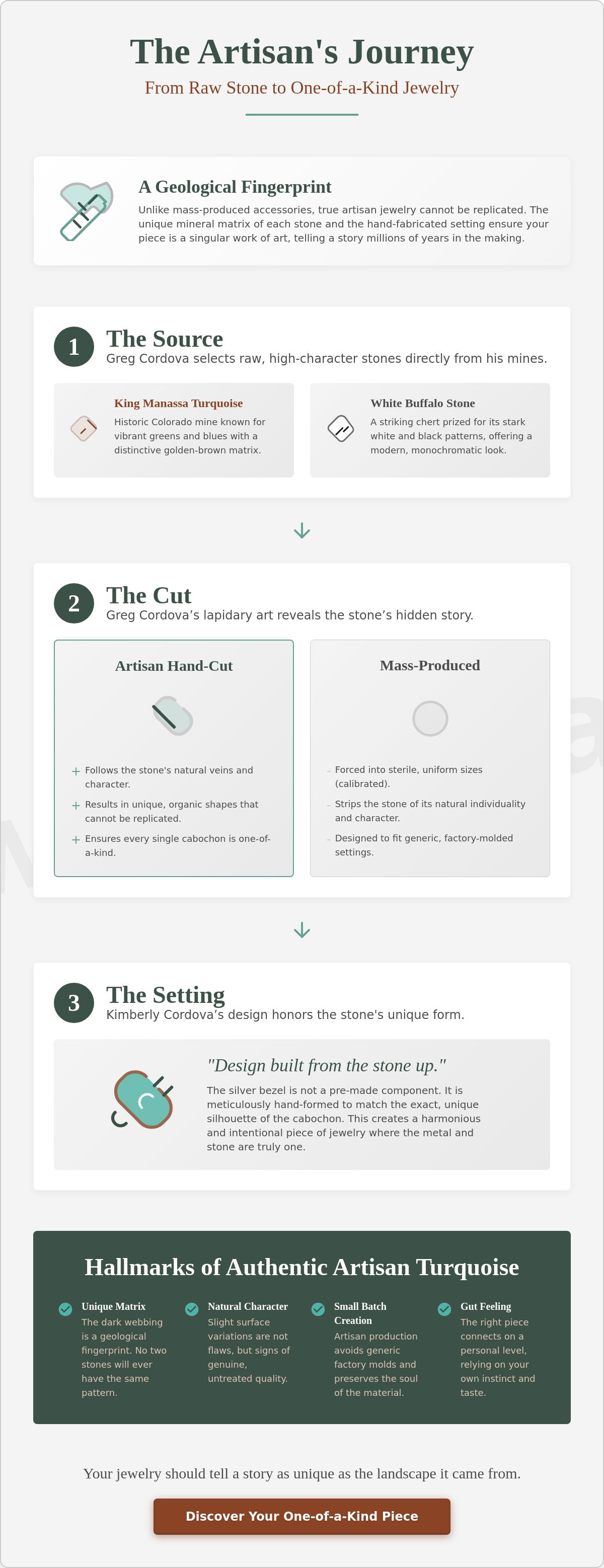
A raw cabochon rests on a charcoal block, its edges irregular and its surface alive with a dark spiderweb matrix. In a commercial factory, a stone is ground down to fit a standard, pre-cast oval setting. In our Santa Fe studio, the process is reversed. A piece of one of a kind turquoise dictates the entire structure of the jewelry. The silversmith begins by wrapping a sterling silver bezel wire around the specific perimeter of that single stone. This ensures a precise fit that protects the turquoise while honoring its organic, hand-cut shape.
Kimberly Cordova provides the creative direction for every design, focusing on the visual weight and physical balance of the piece. She evaluates how the light hits the stone and decides whether a simple, polished bezel or a heavy, stamped border best serves the material. Because every item is fabricated by hand, the silver work contains subtle variations. These are not flaws. They are the fingerprints of the maker and proof that the piece did not emerge from a mass-production mold. These details ensure the jewelry remains quietly timeless rather than following fleeting trends.
Custom Fabrication Techniques
The studio utilizes traditional methods including hand-soldering, decorative stamping, and multi-stage polishing. We distinguish between two levels of production to maintain transparency. Type 1 production involves a single artisan creating a unique piece from start to finish, often focusing on high-grade stones. Type 2 refers to our small batch studio work where several makers might contribute to a design. We never use mystery metals or plated alloys. Every ring and cuff is built from solid sterling silver, ensuring the piece can be maintained and repaired for decades. This commitment to genuine materials is a core pillar of our studio practice.
Southwestern Style and Santa Fe Roots
Santa Fe has served as a primary center for lapidary arts since the 1920s, and that history informs every hammer blow in our workshop. Our jewelry is made in Santa Fe by skilled silversmiths who understand the weight of regional tradition. We lean into the rugged, textured aesthetic that defines the high desert, avoiding the thin-gauge metal often found in imported goods. Each piece of one of a kind turquoise we set is a nod to this heritage, blending historical techniques with modern design sensibilities. You can explore our current artisan work on our shop page to see how these techniques translate into wearable art.
Evaluating Quality in Natural Turquoise
When you hold a piece of genuine turquoise, it should feel substantial and cool against your skin. In our studio, the term natural is a specific technical designation. It means the stone has come out of the earth and been cut without being infused with plastic resins or chemical hardeners. Most turquoise on the market today is stabilized, a process where soft, chalky stone is pressurized with epoxy to make it hard enough to cut. While stabilized stone is common, it lacks the investment value and raw soul of untreated material. Genuine natural stones often feature slight surface pits or subtle matrix variations. These aren't flaws. They're the fingerprint of the earth and a hallmark of one of a kind turquoise that hasn't been smoothed over by industrial fillers.
We advise collectors to stay away from anything labeled as composite or reconstituted. These materials are essentially turquoise dust and scraps held together by glue and dyed to look uniform. They lack the structural integrity and the unique story of a hand-cut cabochon. For a piece that will hold up over years of wear, look for a vivid color and a naturally hard surface. Greg Cordova sources and cuts stones that meet these rigorous standards, focusing on density and color stability that occurs naturally in the desert. This ensures the stone remains as vibrant decades from now as it was the day it left the bench.
Spotting Real vs Treated Stones
The market is unfortunately flooded with dyed howlite and magnesite masquerading as the real thing. At Wildflower, we strictly avoid these imitations because they lack the mineral complexity of genuine turquoise. Real stones show a matrix that is intricate and irregular, often appearing like a miniature landscape or a delicate spiderweb of host rock. If a stone looks too perfect or the color seems to pool in the cracks, it has likely been dyed. We prioritize transparency in our process and encourage our collectors to check our FAQ for more details on stone authenticity and how we verify every piece that enters our studio.
The Importance of Stone Origins
Knowing the specific mine where a stone was found adds a layer of history and value to one of a kind turquoise jewelry. Every mine produces a distinct palette and matrix style that acts as a geographic signature. For instance, stones from the Sleeping Beauty mine in Gila County are known for their clear, robin's egg blue. In contrast, the Royston mine in Nye County often produces stunning gradients of green and blue in a single stone, framed by a dark brown matrix. Greg Cordova prioritizes sourcing from these storied American mines, including the Kingman mine in Mohave County, to ensure our jewelry carries a documented legacy. You can explore the specific characteristics of these locations on our stone origins page to better understand what makes each mine unique.
Browse our latest one of a kind turquoise designs on our website. You can also find our handcrafted work and read customer reviews at the Wildflower Etsy shop.
Selecting Your Unique Statement Piece
Choosing a piece of jewelry is often a quiet act of recognition. You might find yourself drawn to the deep, silken blue of a specific stone or the way a heavy silver bezel anchors a design to the skin. When you look for one of a kind turquoise, let your intuition lead the way. It's a visceral process. The right piece usually feels like it already belongs to you, mirroring a part of your own story through its unique matrix and hand-cut shape. Kimberly Cordova curates this collection with an eye for these emotional connections, ensuring every design carries a sense of intentionality and warmth.
Consider the role the jewelry will play in your daily life. A large statement ring can serve as a bold anchor for your personal style, while a quietly timeless pendant might become a daily companion that rests near your heart. Because these are artisan-made pieces, sizing is a critical practical consideration. Many of our rings and cuffs are built with thick gauge sterling silver to protect the stones. This craftsmanship means they cannot always be resized without risking the integrity of the setting or the natural turquoise itself. Knowing your exact measurements ensures the piece sits comfortably and securely.
Finding Your Fit in the Collection
Our studio works in small batches to maintain the soul of the craft. We distinguish between our everyday essentials, which are designed for versatility, and our one of a kind statement designs that highlight rare, individual stones. You can explore our latest hand-cut discoveries by browsing the new arrivals section. Remember that each bespoke piece is a singular event in time. Once a specific stone and setting are sold, that exact combination is gone forever.
Caring for Your Investment
A genuine artisan piece is an investment intended to last a lifetime. Natural turquoise is a porous stone that requires gentle handling to maintain its original color and luster. Clean your jewelry using a soft, dry cloth to buff the sterling silver. Avoid submerging your pieces in water or using ultrasonic cleaners, as these can damage the stone's structure. Harsh chemicals, including perfumes and hairsprays, should never come into contact with the setting. For a detailed guide on preserving your jewelry, visit our care and repair page for full instructions. Greg Cordova, who handles our lapidary work and sources stones through Cutting Edge Turquoise, emphasizes that proper care respects the geological history of the stone.
View our current selection of handcrafted jewelry at wildflowerartisans.com to find your next heirloom. You can also visit the Wildflower Etsy shop to read reviews from our community of collectors.
Finding a Piece That Resonates
Selecting jewelry is a personal experience that starts with the integrity of the materials. In our Santa Fe studio, we treat every stone as a unique narrative of the high desert. Greg Cordova sources authentic material from the King Manassa and White Buffalo mines, hand-cutting each cabochon at Cutting Edge Turquoise to reveal its natural matrix. Kimberly Cordova then curates and designs settings that honor these organic forms, ensuring each piece is quietly timeless. We use only guaranteed natural stones and avoid mystery metals in our small batch work. This focus on the studio process ensures that every one of a kind turquoise ring or pendant is a genuine reflection of artisan skill. These pieces aren't meant for a display case. They're meant to be worn and enjoyed as they develop a character of their own over the years.
Explore our current one of a kind turquoise collection to find a piece that speaks to you. You can also browse our latest handmade designs in the Wildflower Etsy shop if you prefer their platform for your purchase. We're here to help you find a stone that feels like home.
Frequently Asked Questions
What makes turquoise jewelry one of a kind?
One of a kind turquoise jewelry is defined by the singular nature of the stone and the hand-forged setting that secures it. No two stones emerge from the earth with identical spiderweb patterns or color gradients. When Kimberly Cordova curates a specific cabochon, the silver bezel is built specifically for that stone's unique dimensions. This ensures the finished piece cannot be replicated exactly, making it a personal artifact of the earth.
How can I tell if a turquoise stone is natural or stabilized?
Natural turquoise remains exactly as it was pulled from the ground, only cut and polished without chemical intervention. You can often identify stabilized stones by their unnaturally uniform color or a plastic-like sheen on the surface. Natural stones are porous and will eventually change color as they absorb skin oils. In our studio, Greg Cordova provides natural stones that retain their original structural integrity and authentic character.
Why is some turquoise more expensive than others?
Pricing depends heavily on the rarity of the source mine and the stone's natural hardness. For instance, stones from the Lander Blue mine are significantly more expensive because the mine produced less than 110 pounds of total material. High-grade specimens with tight spiderweb matrix or deep, clear blues command higher prices. These factors reflect the scarcity of top-tier material in a market where 90 percent of turquoise is treated.
Is one of a kind turquoise jewelry a good investment?
One of a kind turquoise pieces often appreciate in value, particularly when they feature stones from "sleeping" or closed mines. As mines like Bisbee or Number 8 cease production, the existing supply of high-grade cabochons becomes a finite resource. Collectors value the combination of a rare, natural stone and the distinct handiwork of a skilled artisan. It is a tangible asset that carries both historical and geological weight.
Can a one of a kind ring be resized?
Resizing a one of a kind ring is possible but requires careful handling to protect the stone from heat. Most turquoise is sensitive to the high temperatures needed for soldering silver. A jeweler must either use a laser welder or pull the stone from its bezel before working on the band. Because each setting is bespoke, we recommend confirming your size before the final polish to maintain the piece's structural integrity.
What is the matrix in a turquoise stone?
The matrix is the remains of the host rock that held the turquoise as it formed over millions of years. This can appear as dark brown limonite, golden rhyolite, or black metallic lines running through the blue or green stone. A fine spiderweb matrix is highly sought after by collectors for its intricate, lace-like appearance. It provides a visual map of the stone's geological history and adds to its individual character.
How should I care for my one of a kind turquoise jewelry?
Proper care involves keeping your one of a kind turquoise away from harsh chemicals, perfumes, and prolonged water exposure. Turquoise is a porous phosphate mineral that can absorb substances, leading to permanent discoloration over time. Wipe your jewelry with a soft, dry cloth after wearing it. Avoid ultrasonic cleaners or steam, as these can damage both the stone and the hand-cut silver setting.
Where does the turquoise at Wildflower come from?
The turquoise used in our studio is sourced directly from reputable Southwestern mines, with much of the lapidary work handled by Greg Cordova. We focus on material from locations like the Royston district or the Kingman mine. By working closely with mine owners and cutting the stones ourselves, we ensure the authenticity of every cabochon. You can find more details about these specific sources and processes at CuttingEdgeTurquoise.com.
Article by
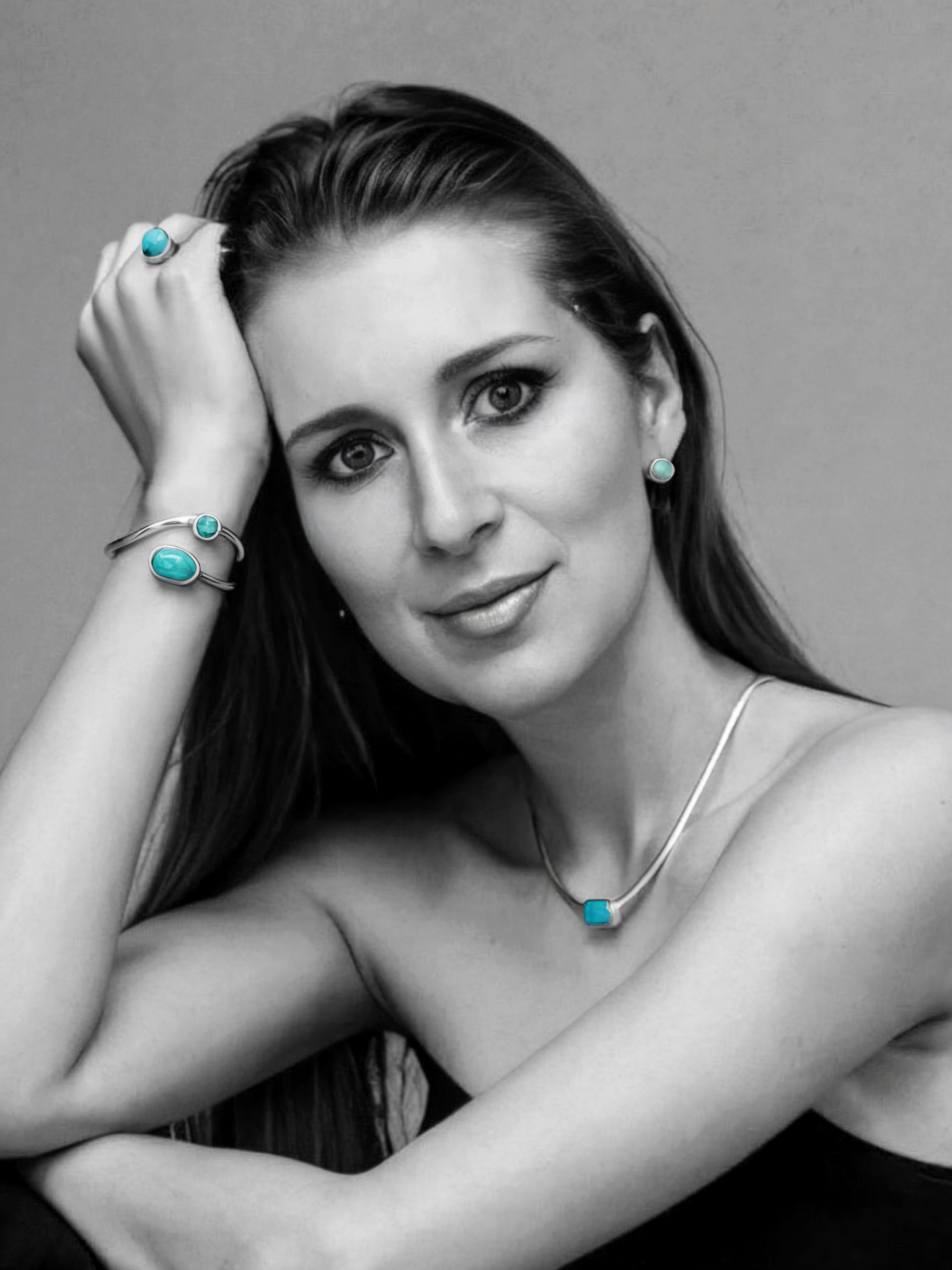
Kimberly Cordova
Kimberly Cordova is the founder and creative director of Wildflower, a handmade Turquoise and sterling silver jewelry brand based in Santa Fe. She built Wildflower around a simple belief: the best jewelry is the kind you actually reach for, not the kind you save for someday.
Kimberly designs pieces made by hand with a trusted circle of Santa Fe silversmiths, works alongside her husband Greg on in-house lapidary pieces cut from stones including the family's King's Manassa Mine in Colorado and White Buffalo Mine in Nevada, and sources finished work from artisan makers whose craft meets the same standard. The result is a collection with real range and no shortcuts on the stone, the silver, or the story behind either.
Her writing covers everything she has learned along the way: how Turquoise forms, how to tell natural from stabilized, what makes one mine different from another, how to read a bezel, and how to shop with confidence in a market that is not always straightforward. It is the kind of plainspoken information she wished someone had laid out for her when she was starting out.
Shop the Wildflower collection at wildflowerartisans.com, or find us on Etsy at wildflowersantafe.etsy.com if you prefer shopping there. Questions about a stone, a setting, or a specific piece are welcome any time.
