
Our Latest Articles
Notes from the bench side of Santa Fe—stone guides, styling ideas, and maker spotlights.
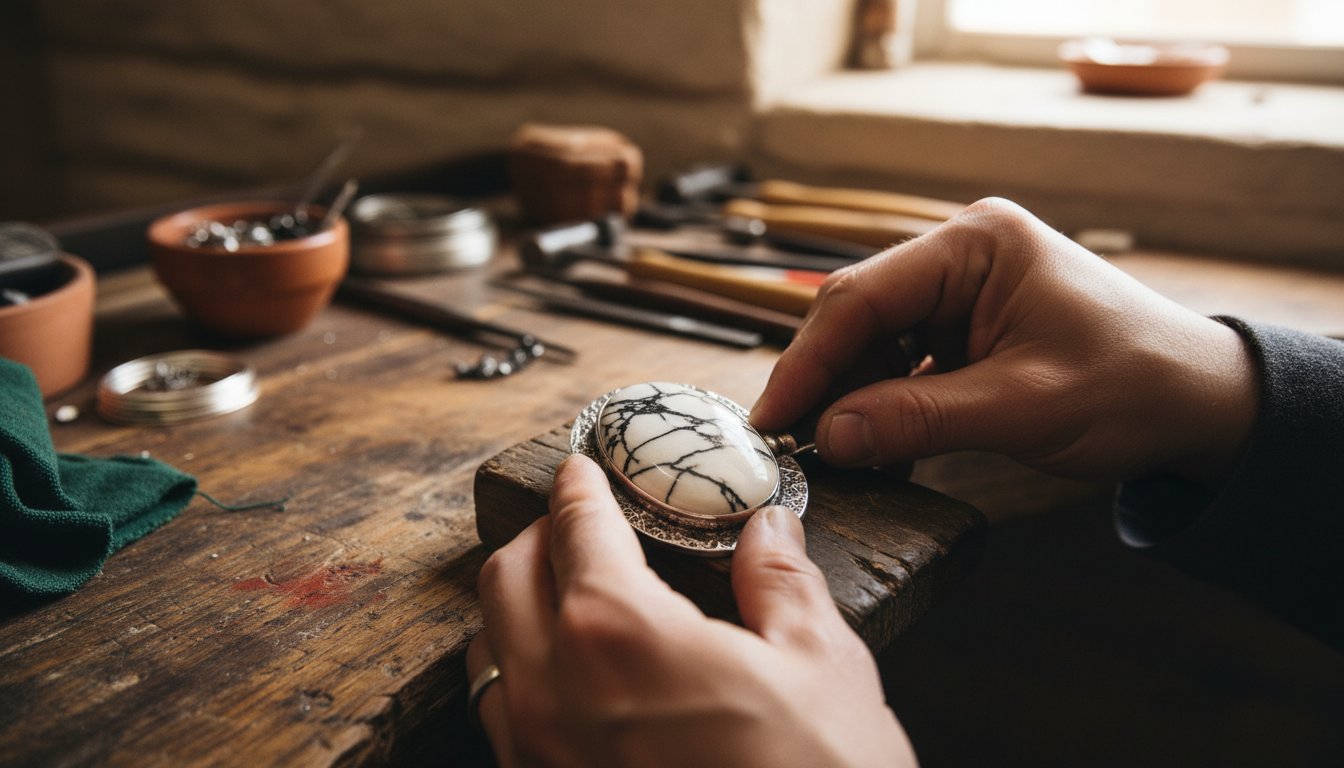
The Quiet Strength of White Buffalo Turquoise Jewelry
In our Santa Fe studio, some stones speak louder than others. The vibrant blues of Kingman turquoise or the deep greens of Carico Lake often catch the eye first. But then there is a quieter presence, a stone with a stark, monochromatic beauty that asks you to look closer. This is the unique character of White Buffalo, a stone whose story is as compelling as its appearance in artist-made white buffalo turquoise jewelry.
It carries a grounded strength, a confidence that does not need bright color to make a statement. For many collectors, its appeal lies in its black and white palette, a dramatic landscape of dark chert against a chalky white background. It is a stone for those who appreciate nuance and the quiet power of contrast.
What exactly is White Buffalo stone?
This is often the first question we hear, and the answer gets to the heart of what makes this stone so special. Mineralogically, White Buffalo is not turquoise. True turquoise gets its celebrated blue and green color from the presence of copper. White Buffalo, on the other hand, forms from a mix of magnesite and alumite, and contains no copper at all. It is its own distinct stone.
So why the common name? The stone was discovered in the Dry Creek Mine near Tonopah, Nevada, by the Otteson family. They were mining for turquoise and found these striking white veins running alongside the blue ones. Because it was found in a turquoise mine and cut and set in the same Southwestern style, the name "White Buffalo Turquoise" became a common trade name. It honors the stone’s origin story and its place in the world of handmade jewelry.
According to Howlite, often marketed as 'white buffalo turquoise', this is a well-documented area of ongoing research and practical application.
The story of the Otteson mine
The Otteson family has been central to the story of American turquoise for generations, and their discovery at the Dry Creek Mine is a perfect example of their expertise. The specific geological conditions in this part of Nevada created the perfect environment for this stone to form, with its dramatic black and grey matrix webbing through the white magnesite. Because it comes from this single, family-operated location, the supply is naturally limited. Each piece of authentic White Buffalo jewelry feels like a small batch find, a direct connection to a specific place in the high desert.
Navigating the "white turquoise" name
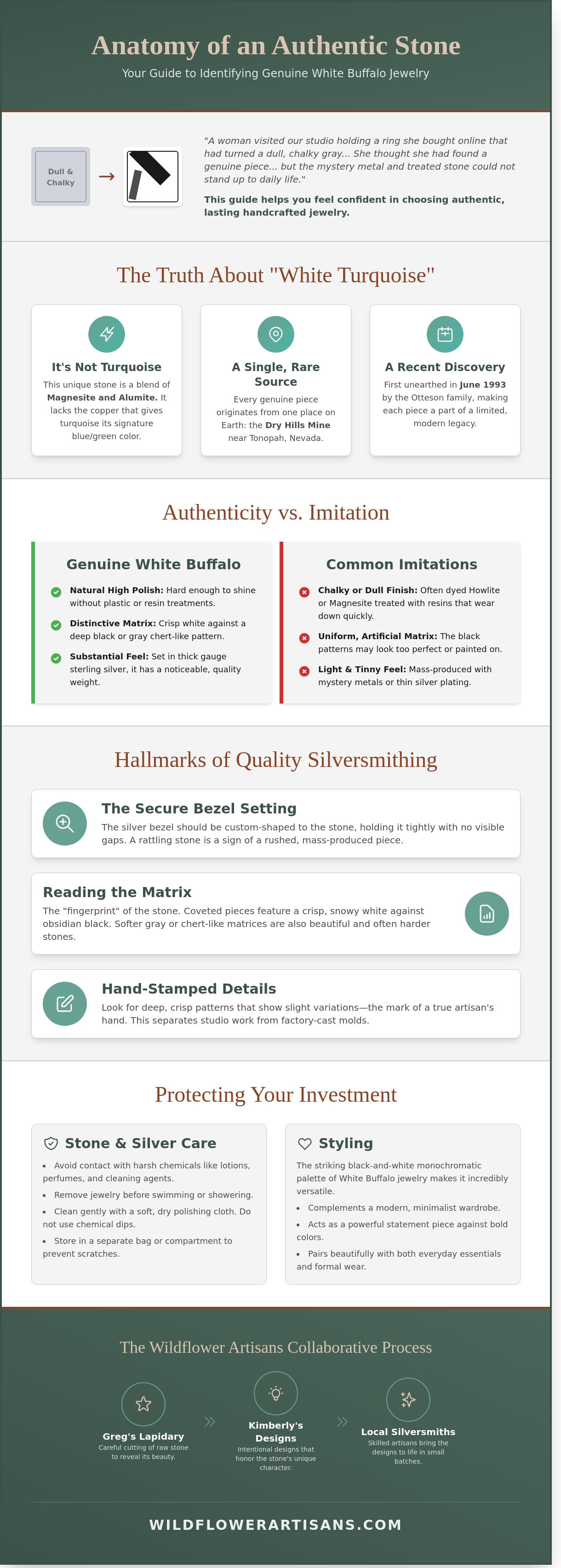
Knowing the stone’s true composition is the first step in building a thoughtful collection. It helps you distinguish genuine White Buffalo from dyed howlite, a more common and less valuable stone often treated to look similar. Howlite is very porous and soaks up dye easily, but it lacks the depth and unique matrix patterns of real White Buffalo. At Wildflower, we believe honesty about a stone’s origins is everything. We celebrate White Buffalo for what it is: a rare and beautiful American stone, not a turquoise substitute. The name also carries a certain reverence, tying it to the cultural meaning of the white buffalo, a symbol of abundance and hope.
How to identify quality in White Buffalo jewelry
When you hold a piece of well-made white buffalo turquoise jewelry, you can feel the difference. The quality is not just in the stone itself but in the thoughtful craftsmanship that surrounds it. It is a partnership between the lapidary artist who shapes the stone and the silversmith who gives it a home.
Start by looking at the stone's matrix, the pattern of black or brown chert running through the white. Some stones have a delicate, fine spiderweb pattern, while others feature bold splotches of black. Neither is better than the other; it is about which landscape speaks to you. A quality piece will also be securely set in a clean, well-formed bezel. The silver should feel substantial, not flimsy, and show signs of being worked by hand rather than cast from a mold.
Research published by Tips for buying authentic Native American jewelry shows that this is a well-documented area of ongoing research and practical application.
Reading the matrix and color
The stark black and white contrast is what makes White Buffalo so visually striking. This contrast is created by the dark chert matrix against the creamy white magnesite. Some stones may have a softer, greyish appearance or include hints of light brown, reflecting the specific part of the vein they were cut from. A great piece of jewelry is one where the silversmith has clearly designed the silverwork to complement the unique pattern of the stone, honoring its individual character.
Silversmithing details that matter
The details tell the story of a handmade piece. Look for the subtle textures of hand-stamped designs, the clean lines of a saw-cut bezel, or the soft glow of hand-polished sterling silver. These are the marks of a local Santa Fe silversmith who understands the material. For a stone as rare and distinct as White Buffalo, sterling silver is the only metal that feels right. It provides the strength and beauty to properly frame the stone’s quiet strength.
Choosing between statement pieces and everyday essentials
The monochromatic nature of White Buffalo makes it incredibly versatile. It can be the centerpiece of a bold look or a subtle, everyday companion. A large ring or a dramatic cuff bracelet can anchor an entire outfit, drawing the eye with its graphic beauty. At the same time, a simple pair of stud earrings or a delicate pendant offers a touch of organic elegance that fits into any modern wardrobe.
Understanding the labor behind each piece helps you appreciate its value. The journey from a rough stone to a finished piece of jewelry involves careful cutting, shaping, and polishing, followed by hours of meticulous silversmithing. This intentional, small batch artistry is what makes each piece feel so personal.
The allure of the statement cuff
There is something powerful about a bold cuff. A large, high-grade White Buffalo stone set in a heavy sterling silver cuff becomes a piece of wearable art. These one-of-a-kind cuffs and bangles often feature intricate silverwork designed to highlight the stone’s unique matrix. They pair beautifully with traditional blue turquoise, creating a stunning contrast of color and form.
Everyday wear with white stones
White Buffalo is not just for special occasions. Its neutral palette makes it a perfect choice for daily wear. A simple ring can add a touch of Southwestern style to your workday, while a pair of small earrings complements any look without overwhelming it. Even in a smaller size, the stone’s distinctive pattern gives it a quietly timeless presence that you will reach for again and again.
Caring for your sterling silver and white stones
Proper care will ensure your White Buffalo jewelry remains a favorite for years to come. The stone itself is relatively soft, rating between a 3.5 and 4 on the Mohs hardness scale. This means it is more susceptible to scratches and chemicals than harder gemstones, so it requires gentle handling.
You should always avoid exposing your jewelry to harsh chemicals, including chlorine, hairspray, and lotions. We also strongly advise against using ultrasonic cleaners, as the vibrations can damage the stone or loosen its setting. When you are not wearing your piece, store it in a soft cloth or a separate compartment in your jewelry box to prevent tarnish and scratches.
Cleaning tips for the home collector
For occasional cleaning, simply use a soft, dry polishing cloth on the sterling silver. If the stone itself needs cleaning, you can use a soft cloth dampened with a bit of mild soap and water. Be sure to dry it immediately and thoroughly, as the stone is porous and should not be left wet. For more detailed instructions, you can always refer to our comprehensive care and repair guide.
The beauty of natural patina
Over time, sterling silver naturally develops a patina, a soft darkening in the recessed areas of the design. Many collectors prefer this aged look, as it adds depth and character to the piece, highlighting the silversmith’s work. This natural process is part of the jewelry’s story. However, if a stone ever becomes loose in its bezel, it is best to seek professional repair to ensure its security.
Why we curate White Buffalo at Wildflower
Every stone in our collection is selected by hand. For White Buffalo, we look for stones with a compelling story in their matrix and a clean, solid structure. We work with both our in-house lapidary artist and a small group of trusted local silversmiths to create pieces that honor the stone’s natural beauty.
Our commitment is to authentic materials and transparent storytelling. You will never find dyed howlite or mystery metals in our studio, only genuine stones and sterling silver. We believe that connection is what makes jewelry meaningful.
Handmade with intention
In a world of mass production, there is immense value in knowing who made your jewelry. Supporting small batch artistry means you are investing in a person’s skill, creativity, and time. Each piece we offer tells a story of the high desert, from the Nevada mine where the stone was found to the Santa Fe hands that crafted it into its final form.
Finding your next favorite piece
The quiet strength of White Buffalo has an enduring appeal. It is a stone that feels both ancient and modern, dramatic and serene. We invite you to explore our latest collection of artist-made White Buffalo jewelry and see which piece speaks to you. If you have a question about a specific stone or design, please feel free to get in touch with us. We would love to help you find it.
Frequently Asked Questions
Is White Buffalo turquoise a real thing?
While it is a real, authentic stone from a specific mine in Nevada, it is not mineralogically turquoise. It is a unique combination of magnesite and alumite that lacks the copper required to be classified as turquoise. The name "White Buffalo Turquoise" is a trade name used because it was discovered in a turquoise mine and is used in Southwestern style jewelry.
Does White Buffalo stone change color over time?
No, the stone itself is color-stable. However, because it is porous, it can absorb oils, lotions, or chemicals, which may cause discoloration. Proper care, such as removing your jewelry before applying lotions or swimming, will keep it looking its best.
How can I tell the difference between White Buffalo and howlite?
Authentic White Buffalo has a distinct, often intricate black or brown chert matrix. Dyed howlite's "matrix" is often a uniform, spiderweb-like pattern of grey dye. Genuine White Buffalo, set in sterling silver, will also feel heavier and more substantial. The most important factor is buying from a reputable seller who guarantees their materials.
Is White Buffalo stone rare?
Yes, it is considered rare because it comes from a single source: the Dry Creek Mine in Tonopah, Nevada. This limited availability makes each piece a special find.
Can I wear White Buffalo jewelry every day?
You can, but with care. Because the stone is relatively soft, rings and bracelets are more susceptible to bumps and scratches. Earrings and pendants are excellent choices for daily wear. Always be mindful of your activities to protect the stone.
Where is White Buffalo stone mined?
It is exclusively mined by the Otteson family at the Dry Creek Mine, which is located near Tonopah, Nevada.
What is the best way to clean my White Buffalo ring?
The best way is the gentlest way. Use a soft, dry cloth to polish the sterling silver. If the stone is dirty, wipe it gently with a cloth slightly dampened with water and a touch of mild soap, then dry it immediately and thoroughly. Avoid submerging the ring in water.

Article by
Kimberly Cordova
Kimberly Cordova is the founder and creative director of Wildflower, a turquoise and sterling silver jewelry brand based in Santa Fe. She built Wildflower around a simple belief: that the best jewelry is the kind you actually reach for, not the kind you save for someday.
Kimberly designs pieces that are made by hand with local Santa Fe silversmiths, works alongside Greg on in-house lapidary pieces, and carefully sources finished work from artisan makers whose craft meets the same standard. The result is a collection that has range, without cutting corners on the stone, the silver, or the story behind either.
Her writing covers everything she has learned along the way: how turquoise forms, how to spot the real thing, what makes one mine different from another, and how to shop with confidence in a market that is not always straightforward. It is the kind of information she wished someone had laid out plainly when she was starting out.
Shop the Wildflower collection at wildflowerartisans.com, or send a message any time with questions about the stones or the craft.

Elegant Guidance
Our Promise, Your Peace of Mind
Every piece is chosen for quality, authenticity, and care—so you can shop with confidence.
Be First in Line
New drops go to VIP members first. If you've ever missed a piece you loved, this is how you don't do that again.
Always Sterling Silver
Authentic Turquoise Only
Makers Credited & Celebrated
Fast, Reliable Shipping
Easy, Hassle-Free Returns


